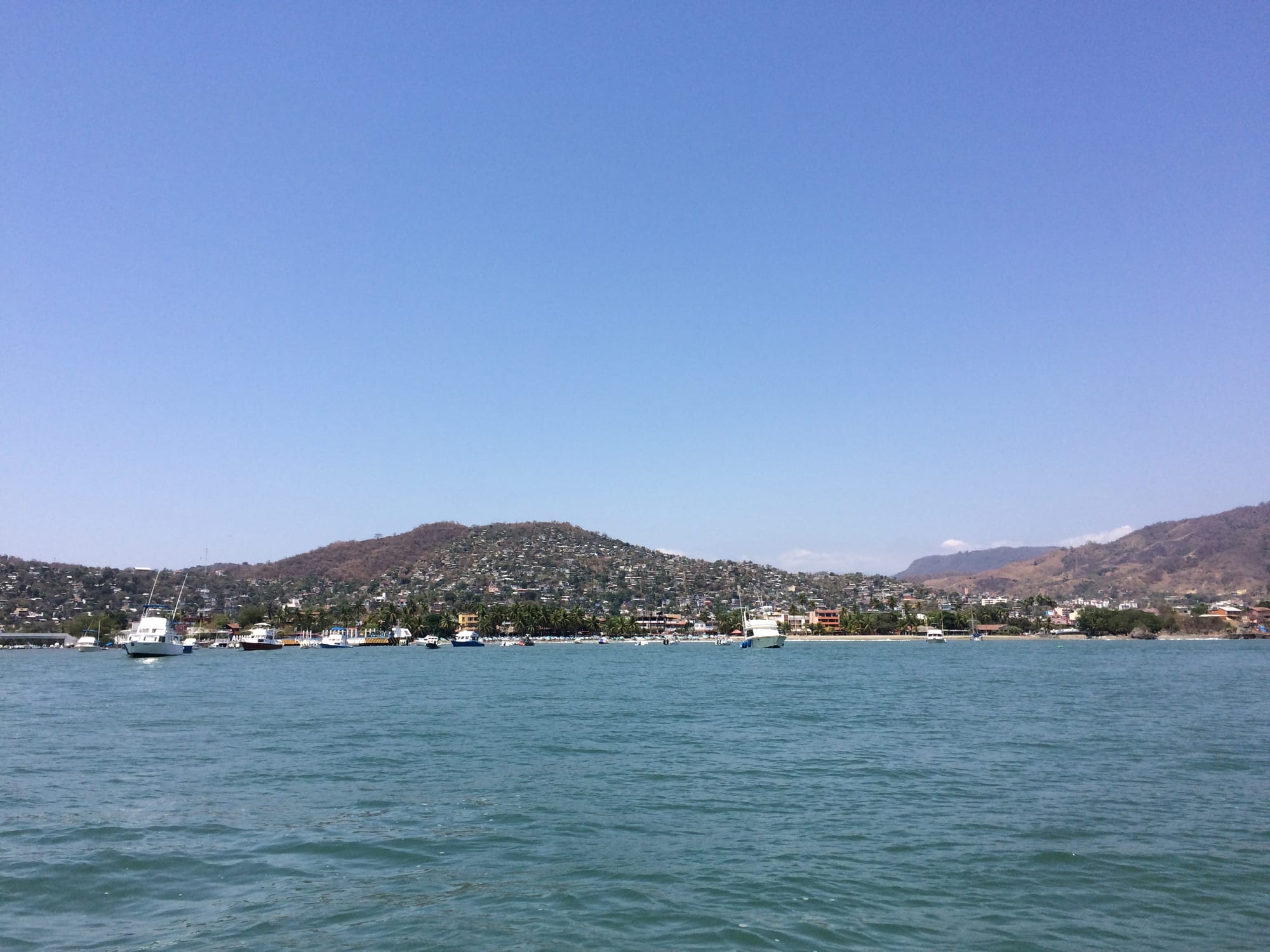
Boats moored in a calm green bay in front of a low town spread over dry, wooded hills under a clear blue sky

Oaxaca & the Pacific South, Mexico

Zihuatanejo

Zihuatanejo seen from its bay, with fishing and charter boats moored off the town. (Nick Navarro / Wikimedia Commons · CC BY-SA 4.0)

A fishing town on a sheltered bay on Guerrero's Costa Grande, about 240 km north-west of Acapulco. A port for some of the first Spanish ships to cross the Pacific, it stayed a village among coconut plantations until the government built the resort of Ixtapa next door in the 1970s; it has kept its narrow streets, fishing boats and calm beaches.

Neighbourhoods

  • El Centro
    • First-time visitors
    • Best for food
    • Local life

    The old town at the north end of the bay, with narrow streets paved in stone or brick, pedestrian sections and the waterfront Paseo del Pescador. Seafood restaurants, craft shops, the fishing pier and the basketball court that serves as the town's square are all here, and the area fills with people in the evening.

    Open in Maps
  • Playa Madera
    • Beaches
    • Views

    A short walk from the centre along a cement and sand walkway, a beach of light sand with gentle waves, backed by bay-view restaurants, bungalows, condominiums and hotels.

    Open in Maps
  • Playa La Ropa
    • Swimming
    • Quiet stays

    The bay's best swimming beach, with little wave action, about 1.2 km of sand below cliffs dotted with hotels, large houses and guesthouses. Sailboats moor off it in winter, and turtle eggs are protected here from August to December.

    Open in Maps
  • Ixtapa
    • Resort hotels
    • Nightlife
    • Families

    The planned resort 5 km north-west, built from the 1970s on a former coconut plantation and mangrove estuary, with large hotels along its beach, a marina and a livelier, more international feel than Zihuatanejo.

    Open in Maps

Things to do

The bay and its beaches

  • Paseo del Pescadortrail

    The tree-lined waterfront walkway, also called the malecón, running along the municipal beach between the archaeological museum and the fishing pier, the heart of the town.

    Open in Maps
  • Playa La Ropabeach

    Considered the best beach for swimming, with little wave action, and named after a colonial shipwreck whose cargo of silks and fabrics washed up on the sand; a small fenced estuary at one end is home to crocodiles.

    Open in Maps
  • Playa Las Gatasbeach

    The most popular snorkelling beach, across the bay from town and reached by open boat, sheltered by a coral reef and an old stone barrier that legend credits to the Purépecha ruler Calzontzin.

    Open in Maps
  • Playa Maderabeach

    A beach of light sand and gentle waves between the town beach and La Ropa, linked to the centre by a walkway.

    Open in Maps

Town sights

  • Archaeological Museum of the Costa Grandemuseum

    Six rooms at the end of the Paseo del Pescador covering the archaeology and history of this coast, from early villages and Aztec tribute to the Spanish search for a sea route west.

    Open in Maps
  • Mercado de Artesaníasmarket

    A crafts market of some 250 shops selling a wide variety of crafts, including silver from Taxco, lacquerware from Olinalá and Oaxacan ceramics.

    Open in Maps
  • The fishing pierattraction

    Where fishermen land their catch each morning and where open boats leave for Las Gatas, other beaches and sport-fishing trips offshore.

    Open in Maps

Short trips from the town

  • Ixtapaneighborhood

    Zihuatanejo's planned sister resort, 5 km north-west, with a long hotel-lined beach, a marina and its own bus link to town.

    Open in Maps
  • Isla Ixtapabeach

    A small island off the coast near Ixtapa with three main beaches — Varadero, Cuachalalate and Coral.

    Open in Maps
  • Xihuacanlandmark

    An archaeological site in the village of La Soledad de Maciel, in neighbouring Petatlán municipality, a ceremonial centre occupied for more than 3,000 years, with a site museum built alongside the excavations.

    Open in Maps
  • Playa Larga and Barra de Potosíbeach

    A long stretch of open-ocean white sand running from beyond the airport down to the village of Barra de Potosí and its lagoon.

    Open in Maps

Seasonal events

  • Zihua Sail FestFebruary

    A five-day event with more than 100 visiting sailboats, races, concerts, auctions and street fairs, raising money for the education of disadvantaged children in the town.

  • Zihuatanejo International Guitar FestivalMarch

    A week-long festival, begun in 2004, with nightly concerts at venues around town by guitarists from many countries and a free show on the main square.

  • International Sailfish Tournamentfirst weekend of May

    Hundreds of anglers and boats compete for prizes for the largest sailfish, marlin and dorado.

  • Virgin of Guadalupe vigil12 December

    A Mass and candlelit vigil at the plum tree near Playa La Ropa where an image of the Virgin was reported to have appeared in 2006.

Eat and drink

Long-standing places and food districts in Zihuatanejo. Hours, ratings and directions come from your maps app, always current.

Zihuatanejo classics

  • Seafood on the Paseo del Pescadorneighborhood

    The restaurants along the waterfront walkway serve the morning's catch and many other dishes, looking out over the fishing boats and the bay.

    Open in Maps
  • Thursday pozolerestaurant

    As across Guerrero, Thursday is pozole day, when restaurants serve the hominy stew in its white, red or green versions.

    Open in Maps

Food districts

  • Playa Madera and La Ropaneighborhood

    Bay-view restaurants on the hillside above Playa Madera and beach restaurants along La Ropa, the places to eat with the bay in front.

    Open in Maps
  • El Centro's streetsneighborhood

    The narrow streets and pedestrian lanes behind the waterfront, where small restaurants cater to residents as well as visitors.

    Open in Maps

Experience Zihuatanejo

History

The name may come from the Purépecha for "water of the yellow mountain" or from the Nahuatl Cihuatlan, "place of women", the western paradise of the goddess women who led the setting sun to the land of the dead. By the 15th century the area was home to the Chumbia, Panteca and Coixcas, who mined salt where Ixtapa now stands, and Purépecha kings are said to have used the bay for recreation. The Aztecs under Ahuizotl conquered the region in 1497 and made it a tributary province, and most of its people abandoned it.

The Spanish arrived in the 1520s, and on 31 October 1527 three ships ordered built by Cortés left the bay under Álvaro de Saavedra Cerón for Asia; only the Florida reached the islands, and no one returned. Colonial Zihuatanejo remained a fishing village among haciendas producing cacao, cotton, vanilla and tropical timber, and the Manila galleons brought the coconut palms that later carried the coastal economy. The bay drew pirates, and there are indications that between 1680 and 1740 it was used for smuggling Asian goods between New Spain and Peru. Morelos used it as a supply port in 1811.

The town became a municipality in 1953. In the 1970s the federal government chose to build a resort at Ixtapa, and the population grew from 6,887 to 37,328 by the early 1990s. The 1994 film The Shawshank Redemption made the name known worldwide as its hero's refuge. In 2008 bull sharks killed two surfers along the coast, and in 2009 the town's security headquarters was attacked with explosives. In 2023 Zihuatanejo was named a Pueblo Mágico.

Culture & Customs

Zihuatanejo has kept the feel of a traditional Mexican fishing town while its neighbour Ixtapa caters to the resort trade. Its centre has no conventional plaza: instead a basketball court in front of the beach, surrounded by benches and shade trees, serves as the meeting point, and beside it the gazebo and the Casa de la Cultura host concerts, cultural shows and art exhibitions. A long-standing community of Swiss and Italian immigrants has added to the town's character.

The calendar reflects both the sea and a sizeable foreign community. The Zihua Sail Fest in February brings more than 100 boats, some from as far as Alaska, for races, concerts and street fairs that raise money for local children's education, and the International Guitar Festival, begun in 2004, fills venues for a week each March. Sport fishing is part of the town's identity; Sport Fishing Magazine once rated the area second in the world for sailfish, and the International Sailfish Tournament is held each May.

Religious devotion has its own local form. Near Playa La Ropa, in a parking space, a plum tree where an image of the Virgin of Guadalupe was reported to have appeared in November 2006 has become a shrine, with steps, candles and flowers, and a Mass and candlelit vigil are held there each 12 December.

Daily Life

The 2020 census counted about 71,000 people in Zihuatanejo itself and about 126,000 in the municipality of Zihuatanejo de Azueta, which includes Ixtapa; it is the fourth-largest city in Guerrero. Tourism has been the economic base since the resort was developed, and the area is among Mexico's most popular for sport fishing.

The day starts at the pier, where fishermen come in every morning with their catch and open boats prepare to ferry visitors to Las Gatas and other beaches. Most sport fishing happens well offshore, where charter boats go for sailfish and marlin, caught and released year-round. The town centre's narrow streets, pedestrian lanes and waterfront are lined with restaurants and craft shops, and Juan Álvarez street, a block back from the water, carries the traffic.

In the evening the Paseo del Pescador fills with people socialising. Winter brings yachts that moor in the bay for months and cruise ship passengers; the summer is quieter, hotter and wetter. Residents live in neighbourhoods spreading inland from the bay into the foothills of the Sierra Madre del Sur, and buses tie the town to Ixtapa and the bus station, while the Autopista Siglo XXI has brought Mexico City within about six hours by road.

Food

Zihuatanejo eats from its bay. The fishermen's morning catch supplies the restaurants along the Paseo del Pescador, which serve seafood among many other dishes, and the bay-view restaurants above Playa Madera and the beach restaurants of La Ropa do the same with the water in front. Sailfish, marlin, dorado, tuna, snook and grouper are all caught off this coast.

Like the rest of Guerrero, the town keeps Thursday as pozole day, when restaurants serve the hominy stew white, red or green, with its traditional accompaniments. Coconut palms, brought by the Manila galleons and grown for centuries on the plantations around the bay, are part of the local landscape and economy, and the town's oldest building began as a storehouse for a coconut plantation.

The small restaurants on the streets of El Centro serve everyday Mexican food to residents as well as visitors. Ixtapa next door has the larger hotel restaurants and more international menus, while farmers on the coast to the south grow fruit trees, vegetables and coconuts for copra.

Planning tools

Budget

Zihuatanejo is cheaper than Ixtapa, whose large resort hotels set the upper end of prices. Guesthouses and small hotels in El Centro and on Playa Madera cost least; the hillside hotels above La Ropa cost far more. Seafood on the waterfront, local buses and open boats across the bay are inexpensive, and the airport taxi is a notable cost.

Daily Budget Midrange
USD 80–190 (hotel on Playa Madera or La Ropa, seafood restaurants, taxis, a boat to Las Gatas or a fishing trip)
Daily Budget Shoestring
USD 35–60 (guesthouse in El Centro, market and street food, local buses and colectivos)

Colectivos and city taxis are much cheaper than the airport shuttles and taxis, though town taxis can only drop off at the airport.

Best Time to Visit

The dry season, roughly November to April, is the main season, when sailboats winter in the bay, cruise ships call, the Sail Fest takes place in February and the guitar festival in March. Blue and black marlin fishing is best in February and March. The summer rains bring heat, humidity and the risk of Pacific hurricanes from about June to November.

Suggested Number of Days

Three or four days suit a first visit to the town and its bay. Five days to a week leave room for the neighbouring resort and the coast on either side, and anglers often add time at sea. Many visitors simply stay longer for the slow pace.

First Visit
3–4 days
With Surroundings
5–7 days

Transportation

El Centro is walkable, and taxis are plentiful for the beaches, the bus station and the airport. Local buses link the town with Ixtapa and with the main bus station, about 2 km north-east of the centre, and colectivos run towards the airport and Playa Larga. Open boats called lanchas leave from the pier for Las Gatas and other points on the coast.

Agree taxi fares before setting off; ride-hailing cars can drop off at the airport but not pick up.

Airport & Station Connections

Ixtapa-Zihuatanejo International Airport lies about 12.5 km south-east of town on Highway 200, with domestic flights and international services; shared shuttles and taxis run into town. Intercity buses take about four and a half hours from Acapulco and about five from Morelia, and the Autopista Siglo XXI toll road via Morelia has cut the journey from Mexico City to about six hours. Cruise ships also call.

Walkability

El Centro is compact, with pedestrian streets and the Paseo del Pescador along the water, and a walkway continues to Playa Madera. La Ropa is further along the bay, and taxis are plentiful; Las Gatas is best reached by boat, as only a rough rocky path leads there. Ixtapa needs a bus or taxi.

Safety

Safety varies enormously by state and even neighbourhood. Zihuatanejo lies in Guerrero, which has long been one of Mexico's most violent states, with rival organised-crime groups active across much of it, and several governments advise against travel there. The town has seen attacks on its police and kidnappings of Mexican citizens, though the centre and beaches are busy with visitors. On the coast, strong currents on open-ocean beaches are a danger to swimmers, and the hurricane season runs through the summer and autumn.

Swim in the bay rather than on open-ocean beaches, travel by day on main roads, and be cautious about Guerrero outside tightly organised trips. Check current official travel advice before travelling.

Climate

A tropical savanna climate, warm and mostly humid, with an average temperature of about 26°C. The dry season runs through winter and spring, and the rains come in summer and autumn, when Pacific hurricanes are a risk.

Summer
hot and humid, about 30–34°C along the Pacific coast, with storms
Winter
dry and sunny, around 30°C along the coast

Local Customs

Zihuatanejo keeps a relaxed, traditional Mexican feel quite unlike Ixtapa's resort style, and evenings are spent strolling and socialising along the waterfront. A long-standing community of Swiss and Italian immigrants is part of the town. Tipping is customary in restaurants.

Cover up away from the beach and in the Parish of Our Lady of Guadalupe; keep away from the crocodiles at La Ropa's estuary, which are wild animals however tame they seem.

Common Payment Methods

The currency is the Mexican peso. Hotels, larger restaurants and shops generally take cards, especially in Ixtapa, but buses, colectivos, taxis, lanchas, market stalls and small restaurants need cash.