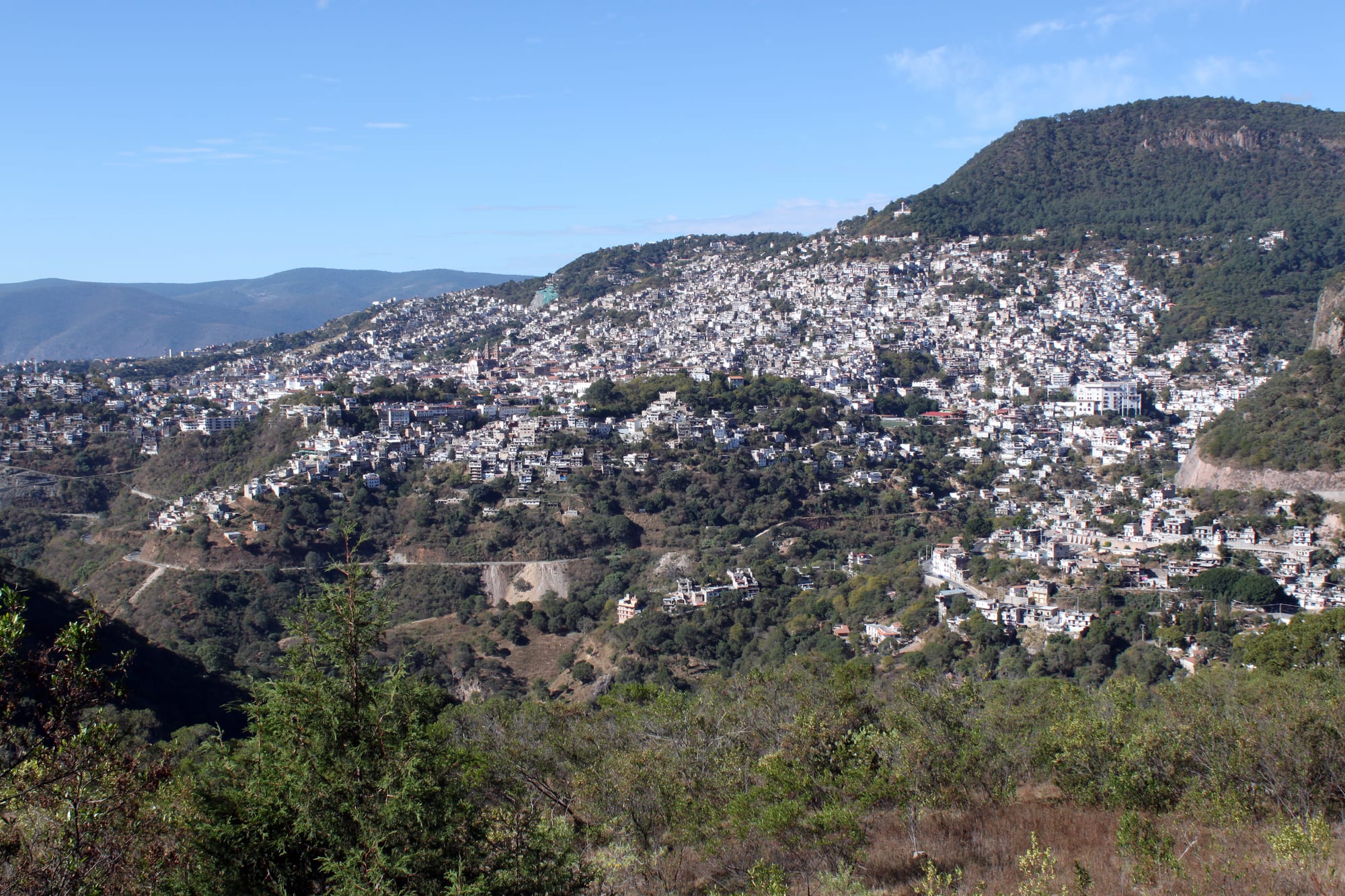
Thousands of white houses climbing a steep green mountainside under a clear blue sky, with scrub in the foreground

Oaxaca & the Pacific South, Mexico

Taxco

Taxco's white houses spread across the mountainside. (Anagoria / Wikimedia Commons · CC BY 3.0)

A hillside town in northern Guerrero, about 170 km south-west of Mexico City, founded by the Spanish for its silver. Colonial mine owners paid for the Churrigueresque church of Santa Prisca, and an American designer revived silversmithing in the 1930s; today steep cobbled lanes of white houses are lined with silver shops, and tourism is the main business.

Neighbourhoods

  • Plaza Borda and the centre
    • First-time visitors
    • Historic district
    • Silver shopping

    The small main square, officially Plaza Borda but known as the Zócalo, with Santa Prisca on one side and the Casa Borda on another. Silver shops, restaurants and bars ring it, and the museums and the covered silver market are a short, steep walk away.

    Open in Maps
  • Plazuela de la Veracruz and the old lanes
    • Quiet streets
    • Architecture

    The lanes around the little Church of Veracruz on Juan Ruiz de Alarcón street, near the house where the playwright was born. Dark cobbles inlaid with white stone patterns, red-tiled roofs and narrow streets without pavements give the feel of the colonial town.

    Open in Maps
  • The north side and El Chorrillo
    • History
    • Students

    The north side of town, where the Ex Hacienda del Chorrillo, one of the oldest silver haciendas in the region, now houses an arts and language campus run with the national university, UNAM, beside the remains of a 16th-century aqueduct.

    Open in Maps

Things to do

Churches and landmarks

  • Church of Santa Priscalandmark

    Built in the 1750s for the silver magnate José de la Borda, with towers of pink stone, a tiled dome and gilded floor-to-ceiling altarpieces; one of the finest examples of New Spanish Churrigueresque, and the tallest building in Mexico from 1758 to 1806.

    Open in Maps
  • Casa Bordalandmark

    José de la Borda's house on the main square, the most important civil building in Taxco: two storeys at the front and five at the back because of the slope, now a cultural centre.

    Open in Maps
  • Ex Hacienda del Chorrillolandmark

    A colonial silver hacienda built by men of Hernán Cortés, with part of its aqueduct of 1534 still standing, now an arts campus.

    Open in Maps
  • Cristo Monumentalviewpoint

    A statue of Christ on the Atachi hill above the town, put up in 2002 and restored in 2019 after damage from the 2017 earthquake and a lightning strike.

    Open in Maps
  • Cable carviewpoint

    A gondola up to a hilltop above the town, with wide views.

    Open in Maps

Museums and silver

  • William Spratling Museummuseum

    Behind Santa Prisca, the personal collection of the American who revived Taxco's silversmithing: pre-Hispanic pieces, among them a jade-covered skull and a stele, alongside reproductions.

    Open in Maps
  • Museum of Viceregal Artmuseum

    Colonial art and objects, some once owned by José de la Borda, in the Humboldt House, named after the German scientist who spent a night there in 1803.

    Open in Maps
  • The silver shops and marketmarket

    Streets full of silversmiths' shops and a small covered market selling jewellery and silverware, the work of a town with more than 3,000 silversmiths.

    Open in Maps

Short trips from the town

  • Grutas de Cacahuamilpa National Parkpark

    One of the largest cave systems in Mexico, with huge chambers of stalactites, a smaller cave system and two underground rivers, plus rappelling and climbing in a canyon.

    Open in Maps
  • Taxco el Viejoattraction

    Old Taxco, about 10 km south — the pre-Hispanic village that held the name first, once the seat of the Aztec governor who collected tribute across seven districts.

    Open in Maps

Seasonal events

  • Holy WeekMarch or April, Palm Sunday to Easter Sunday

    Ten major processions through the steep streets, six by night and four by day, centred on Santa Prisca; the tradition goes back at least to 1622.

  • Jornadas AlarconianasMay

    A theatre festival set up in 1987 to honour the Taxco-born playwright Juan Ruiz de Alarcón, with stagings of Spanish Golden Age drama.

  • Día del Jumilautumn

    Townspeople climb the Cerro del Jumil to gather jumiles, the edible insects prized since pre-Hispanic times, with dances to violins and guitars.

  • National Silver Fairlate November to early December

    The town's silver fair and design competition, the showcase of Taxco's silversmiths.

Eat and drink

Long-standing places and food districts in Taxco. Hours, ratings and directions come from your maps app, always current.

Taxco classics

  • Jumilesmarket

    Small edible insects gathered in the hills from November to February and sold in the town's markets, eaten in tacos or in mole.

    Open in Maps
  • Pozole and cecinarestaurant

    Pozole, the hominy stew eaten across Guerrero, and cecina, cured meat, are the everyday dishes of Taxco's small restaurants.

    Open in Maps

Food districts

  • Restaurants around Plaza Bordaneighborhood

    Restaurants and bars around the main square, several on upper floors and terraces facing Santa Prisca, the busiest place to eat in town.

    Open in Maps

Experience Taxco

History

The name comes from the Nahuatl Tlachco, "place of the ballgame", and the town's coat of arms still shows a ball court. Before the Spanish came, the community called Taxco stood about 10 km to the south, at what is now Taxco el Viejo, where an Aztec governor collected tribute from seven districts. Hernán Cortés founded the Spanish town on its present site because of the silver here; lodes were found in the 1530s, and haciendas such as El Chorrillo, built by men of Cortés, began commercial mining.

For most of the colonial period Taxco remained small and was governed as a dependency of Mexico City. In the mid 18th century José de la Borda arrived and opened new mines, made a fortune and spent it lavishly on the church of Santa Prisca in the 1750s; when his mines ran out he was practically bankrupt. As the only sizeable town in the area, Taxco was taken in several wars — by Hermenegildo Galeana in 1815, by Porfirio Díaz in 1865 and by revolutionary forces in 1911 — and became a municipal seat when Guerrero state was created. "De Alarcón" was added to its name in 1872 in honour of the playwright Juan Ruiz de Alarcón, born here.

The modern town was made by William Spratling, an American designer who arrived in 1929, set up silver workshops with master silversmiths from Iguala and exported their work, mostly to the United States. Tourism followed. The last large mine on the edge of town began closing in 2007, and in 2002 Taxco was named a Pueblo Mágico, the third place in Mexico to receive the title.

Culture & Customs

Silver defines Taxco's identity. Spratling's workshops trained generations of local silversmiths, and more than 3,000 now work in the town, which calls itself the silver capital of the world. Their work fills the shops around the main square, and the National Silver Fair, held in late November and early December, is the year's showcase. The William Spratling Museum keeps the designer's own collection of pre-Hispanic objects.

Religion runs deep. Holy Week is internationally famous: between Palm Sunday and Easter Sunday ten major processions wind through the steep streets, centred on Santa Prisca, a tradition dating back at least to 1622. On Palm Sunday vendors, mostly from the nearby village of Tlamacazapa, sell palm leaves woven into intricate designs. Smaller churches keep their own feasts, including the festival of San Antonio Abad in January.

Theatre honours Juan Ruiz de Alarcón, one of the great dramatists of Spain's Golden Age, born in Taxco: the Jornadas Alarconianas, established in 1987, stage plays in the town each May, and three of its small squares carry monuments to him. The Día del Jumil keeps an older custom, when townspeople climb the Cerro del Jumil to gather the insects, a practice traced to Aztec pilgrimages to a hilltop temple. Basketball is the most popular sport in the municipality.

Daily Life

The 2020 census counted about 50,000 people in the city of Taxco. The population grew fast in the second half of the 20th century, from about 10,000 in 1950 to around 50,000 by 2000, as silver and tourism drew people in. The town spreads over very rugged ground, with houses stacked up the hillsides, red-tiled roofs and streets paved in dark stone inlaid with white patterns; some of those patterns once marked trades, such as the sign of Taurus near Santa Prisca where butchers worked.

Silverwork and tourism are the mainstays of the economy. Mining, once the town's reason for being, ended as a major employer when the last big operation was phased out from 2007 after its reserves ran low. Silver is sold locally and exported abroad, and much of the town works in making, selling or serving visitors who come to buy it.

Daily movement depends on taxis and combis, converted Volkswagen vans that thread the narrow lanes, since the streets are too steep and tight for much else. Weekends bring visitors from Mexico City, and the square fills in the evenings. The Casa Borda serves as a cultural centre with classes in languages, art and sport, and the Ex Hacienda del Chorrillo houses a university campus for foreign students and fine arts.

Food

Maize is the staple in Taxco, and pozole and tacos are everyday food, as in the rest of Guerrero. The town's best-known speciality is the jumil, a small stink bug gathered on the surrounding hills, harvested from November to February and sold in the markets. Jumiles are eaten in tacos or ground into a mole sauce, and local people credit them with health-giving properties.

Other local dishes include cecina, a salted and cured meat, and tamales made with plums or beans. The town's own drink is the berta, a honey margarita. Corn appears at every meal, from tortillas and tamales to the antojitos sold in the markets, and the hominy for pozole is prepared from dried maize treated with lime, as across Mexico.

The restaurants around Plaza Borda, some on upper floors looking across at Santa Prisca, cater largely to weekend visitors from Mexico City, while the markets and small family restaurants on the lanes below serve the town's own residents.

Planning tools

Budget

Taxco is a modest-priced town where most visitors are Mexicans on a weekend from the capital. Food in the market and small restaurants is cheap; colonial-house hotels near the square cost more, and prices rise in Holy Week, when rooms fill well ahead. Silver is the big temptation, and prices vary widely between shops.

Daily Budget Midrange
USD 80–190 (colonial-house hotel, restaurants, taxis, a trip to the Cacahuamilpa caves)
Daily Budget Shoestring
USD 30–55 (simple guesthouse, market food and pozole, combis and buses)

Compare several silver shops before buying; quality and prices vary widely.

Best Time to Visit

The dry months outside the May-to-October rainy season are the most comfortable, and include the silver fair in late November and early December. Holy Week brings the famous processions but also the biggest crowds of the year.

Suggested Number of Days

Many visitors come for just a day or a single night from Mexico City or Cuernavaca. Allowing two or three days leaves time for the caves outside town as well. Holy Week deserves longer for anyone following the processions.

First Visit
1–2 days
With Surroundings
2–3 days

Transportation

The streets are steep, narrow and often without pavements. Taxis and combis, converted Volkswagen vans used as minibuses, are the way to get around; most combis pass through the Zócalo. Buses marked Zócalo also climb from the bus stations to the centre.

Driving in the centre is difficult on the narrow, steep lanes — leave a car outside the centre and use taxis.

Airport & Station Connections

Taxco has no airport. It lies on Federal Highway 95 and the 95D toll road, about 170 km south-west of Mexico City and 36 km from Iguala. Buses run from Mexico City's southern bus terminal and from Cuernavaca to two long-distance bus stations, Estrella de Oro in the south of town and Estrella Blanca in the north-east.

Walkability

The centre is compact and best seen on foot, but the town climbs a steep mountainside, so every walk involves stairs and slopes on uneven cobbles. Streets are narrow and many lack pavements, so walkers share them with taxis and combis. Comfortable shoes with good grip help.

Safety

Safety varies enormously by state and even neighbourhood. Taxco lies in Guerrero, which has long been one of Mexico's most violent states, with rival organised-crime groups active across much of it, and several governments advise against travel there. The narrow streets without pavements bring a more everyday danger from traffic.

Travel by day on the toll highway, use first-class buses or registered taxis, and be cautious about Guerrero outside tightly organised trips. Check current official travel advice before travelling.

Climate

Taxco has a warm, subhumid climate with summer rain and an average annual temperature of about 21°C. Spring is the warmest season, with highs of up to 32°C, and the rainy season runs from May to October.

Summer
rainy and mild, within the May-to-October rainy season, around an annual average of about 21°C
Winter
the dry season; the annual average temperature is about 21°C, and spring brings highs of up to 32°C

Local Customs

Taxco is a religious town as well as a tourist one: Santa Prisca is a working parish, and Holy Week is taken seriously, with penitents in the processions. Silver shops expect browsing, and some bargaining is common in the market. Tipping is customary in restaurants.

Dress modestly in the churches, keep quiet during services, and do not photograph penitents in the Holy Week processions without care and discretion.

Common Payment Methods

The currency is the Mexican peso. Larger silver shops and hotels take cards, but cash is needed for combis, taxis, the market and small restaurants. Withdraw cash inside banks rather than at street machines.