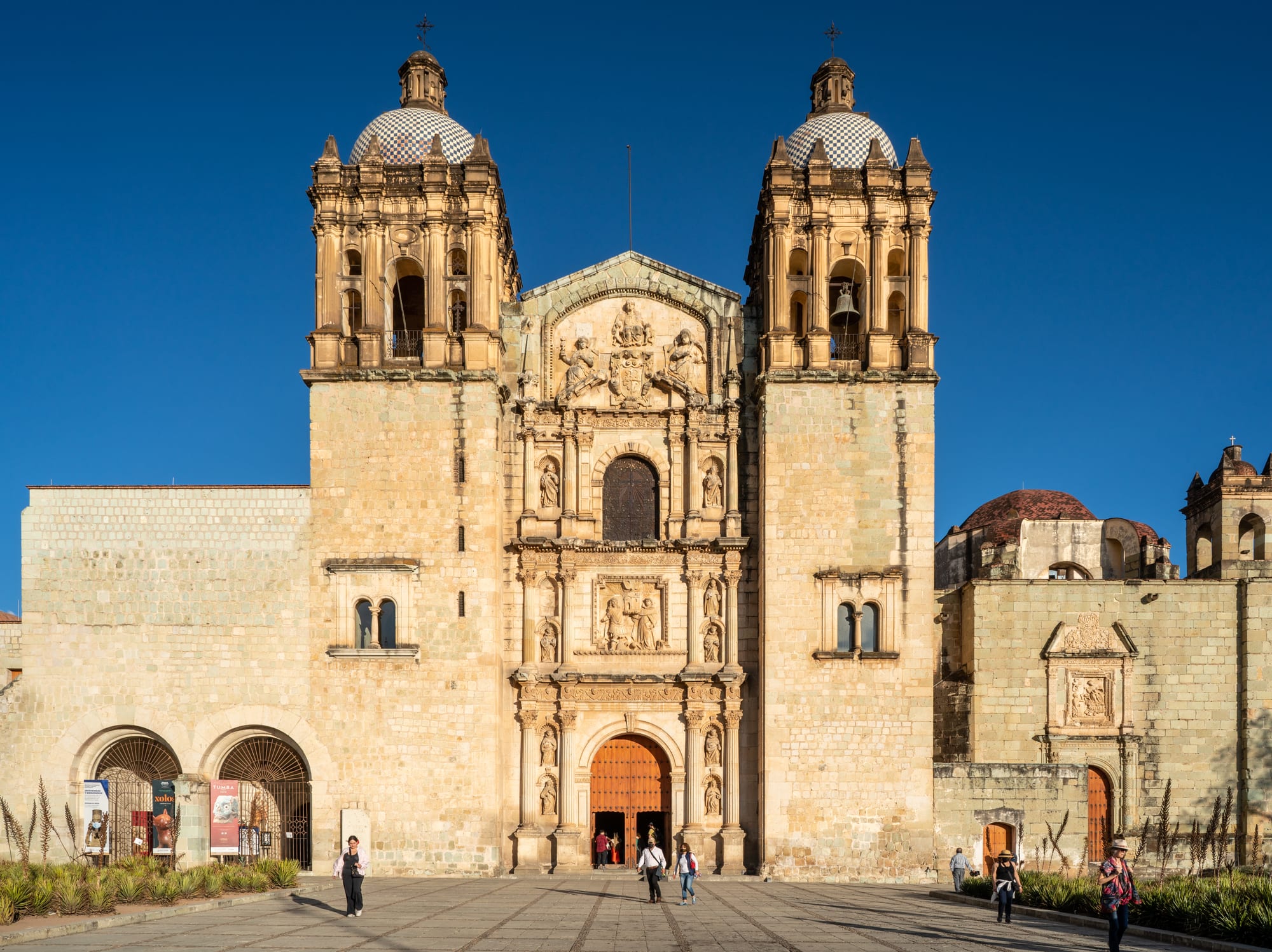
The pale stone baroque facade of Santo Domingo church with twin bell towers and tiled domes against a deep blue sky

Oaxaca & the Pacific South, Mexico

Oaxaca City

The church of Santo Domingo de Guzmán in the historic centre of Oaxaca City. (nan palmero / Wikimedia Commons · CC BY 2.0)

The capital of Oaxaca state, at about 1,555 metres in the Valley of Oaxaca, founded by the Spanish as Antequera in 1529 among Zapotec and Mixtec lands below the ancient city of Monte Albán. Known as the green Antequera for its buildings of local green stone, it is a UNESCO World Heritage Site with Monte Albán since 1987, and lives largely from tourism, its markets, kitchens and festivals.

Neighbourhoods

  • Centro Histórico
    • First-time visitors
    • Historic district
    • Museums

    The colonial grid of green-stone churches and low houses around the Zócalo and the Alameda de León. The pedestrian Macedonio Alcalá street, paved with green cantera, runs north to Santo Domingo, with the markets a block or two south of the main square.

    Open in Maps
  • Jalatlaco
    • Quiet and residential
    • Best for food

    San Matías Jalatlaco was one of the villages around the early Spanish town and kept its Nahuatl name; it is now a district of the city with a cooking school among its streets.

    Open in Maps
  • Xochimilco
    • Arts
    • Local life

    Across the highway on the north edge of the centre, about 20 minutes' walk from the Zócalo, the city's oldest residential neighbourhood has art studios and street murals.

    Open in Maps
  • Reforma
    • Quiet and residential
    • Best for food

    A wealthy neighbourhood north of the centre with cafés and restaurants away from the busiest tourist streets.

    Open in Maps

Things to do

Churches and landmarks

  • Church of Santo Domingo de Guzmánlandmark

    A New Spanish Baroque church and Dominican convent begun in the 16th century, used as a barracks and stable after the Reform and later returned to the Church; its convent now houses a museum.

    Open in Maps
  • Oaxaca Cathedrallandmark

    The cathedral of Our Lady of the Assumption on the Zócalo, begun around 1535 and consecrated in 1733, with a facade of green cantera stone.

    Open in Maps
  • Basilica of Our Lady of Solitudelandmark

    A Baroque sanctuary built between 1682 and 1690 for the city's patron, deliberately low to resist earthquakes, with a museum of offerings to the Virgin behind it.

    Open in Maps
  • Zócalolandmark

    The Plaza de la Constitución, laid out in 1529, the city's main square with its statue of Benito Juárez and green-stone fountains, the cathedral on one side and the Alameda de León beside it.

    Open in Maps
  • Macedonio Alcalá streetneighborhood

    The pedestrian street paved with green cantera that links the cathedral area with Santo Domingo, lined with historic buildings such as the original home of the state university.

    Open in Maps

Museums

  • Museum of the Cultures of Oaxacamuseum

    Ten halls in the restored convent buildings of Santo Domingo, devoted to Zapotec and Mixtec cultures, holding the Mixtec treasure found by Alfonso Caso in Tomb 7 at Monte Albán.

    Open in Maps
  • Museo Rufino Tamayomuseum

    The collection of pre-Hispanic art assembled by the Oaxacan painter Rufino Tamayo.

    Open in Maps
  • Casa de Juárezmuseum

    The house where Benito Juárez lived from 1818 to 1828 after arriving from Guelatao, now a museum of his life and of everyday objects of the time.

    Open in Maps

Gardens and viewpoints

  • Oaxaca Ethnobotanical Gardenpark

    A garden of native plants on the former monastery lands beside Santo Domingo, run by the state government.

    Open in Maps
  • Cerro del Fortínviewpoint

    The hill above the city where the Guelaguetza began, bearing Benito Juárez's slogan in stone letters and home to the Guelaguetza Auditorium.

    Open in Maps

Markets

  • Benito Juárez Marketmarket

    A market filling a whole block just south of the Zócalo.

    Open in Maps
  • Mercado 20 de Noviembremarket

    The block south of the Benito Juárez market, known as the food market for the cooked-food stands that dominate it.

    Open in Maps
  • Mercado de Abastosmarket

    A large market south-west of the historic centre, across the ring road, and a hub for colectivos to the valley villages.

    Open in Maps

Short trips from the city

  • Monte Albánlandmark

    The Zapotec capital on an artificially levelled ridge about 400 metres above the valley floor, founded around 500 BC and pre-eminent for nearly a thousand years; listed by UNESCO with the city in 1987.

    Open in Maps
  • Árbol del Tulelandmark

    A Montezuma cypress in the church grounds of Santa María del Tule, about 9 km east on the road to Mitla, with the stoutest tree trunk in the world.

    Open in Maps
  • Tlacolula de Matamorosmarket

    A town about 30 km east whose Sunday open-air market is one of the oldest, largest and busiest in Oaxaca.

    Open in Maps
  • Mitlalandmark

    The second most important archaeological site in Oaxaca state after Monte Albán, unique for the mosaic fretwork of small fitted stones that covers its walls.

    Open in Maps
  • Hierve el Aguaattraction

    Travertine rock formations that look like frozen waterfalls on cliffs rising 50 to 90 metres above the valley.

    Open in Maps

Seasonal events

  • GuelaguetzaJuly

    Also called the Mondays on the Hill, a festival of costumed dance from the regions of the state held on the two Mondays after 16 July, with concerts and other events through the month.

  • Day of the Deadlate October to early November

    Altars, cemetery vigils and events across the city and the valley villages.

  • Night of the Radishes23 December

    A competition of oversized carved radishes in the Zócalo, held formally since 1897; the carvings are shown for only a few hours and draw thousands of visitors.

Eat and drink

Long-standing places and food districts in Oaxaca City. Hours, ratings and directions come from your maps app, always current.

Food districts and markets

  • Mercado 20 de Noviembremarket

    Known for regional dishes — moles, tasajo, tlayudas and pan de yema — and for its smoke-filled grilling hall, the Pasillo de Humo, where vendors cook the meat bought on the spot.

    Open in Maps
  • Benito Juárez Marketmarket

    A block-wide market south of the Zócalo for chapulines, quesillo, chocolate, breads and everyday goods.

    Open in Maps
  • Mercado de Abastosmarket

    A large market west of the centre, with produce, cooked food and goods brought in from the valley.

    Open in Maps
  • Pochote Xochimilcomarket

    A market selling handmade tortillas, tlayudas, pastries, juices, mezcal, vegetables and woven goods.

    Open in Maps

Oaxaca classics

  • Mezcal bars of the centreneighborhood

    Bars serving mezcal, the agave spirit that is the drink of the region, made from many different species of agave.

    Open in Maps
  • Hot chocolateneighborhood

    Oaxaca's chocolate is flavoured with cinnamon, almonds and sugar and served in large cups made with water or milk, with a sweet roll.

    Open in Maps

Experience Oaxaca City

History

The Zapotec and Mixtec peoples lived in the Valley of Oaxaca for thousands of years, around great centres such as Monte Albán, founded around 500 BC on the ridge above today's city, and Mitla. A military post on the Cerro del Fortín watched over the Zapotec capital of Zaachila and the trade route between the Valley of Mexico, Tehuantepec and Central America. The city's name comes from the Nahuatl Huaxyacac, and its Zapotec name, Ndua, is still used.

When the Spanish arrived in 1521, the Zapotec and Mixtec were at war. Spanish settlers built a town at the foot of the Cerro del Fortín, and the first mass was said on the bank of the Atoyac under a huaje tree, but Hernán Cortés twice drove them out. They re-established it in 1529 as Antequera, named after Nuño de Guzmán's home town, laying out the main square that year, and the crown confirmed its status in 1532. The Dominicans received land for their convent of Santo Domingo in 1551, and the cathedral, begun around 1535, was rebuilt after earthquakes and consecrated in 1733. Built from local green stone, the town became known as the green Antequera.

After independence the city took the name Oaxaca, and in 1872 "de Juárez" was added for Benito Juárez, who had lived here from 1818 and became president of Mexico. During the Reform Santo Domingo was turned into a stable; its convent buildings now house a cultural centre. In 1987 the city and Monte Albán were declared a UNESCO World Heritage Site. In 2006 the teachers' union's annual occupation of the Zócalo grew into months of protest after police tried to clear it on 14 June; a broad movement, the APPO, formed, and in October federal forces were sent to retake the city.

Culture & Customs

The Guelaguetza is the city's great festival. Its name is Zapotec for an offering or act of cooperation, and its roots are pre-Hispanic: after the conquest, ceremonies on the Cerro del Fortín were rededicated to the Virgin. Since 1953 it has been organised as a festival of dance groups from across the state, and since 1969 it has been held on the two Mondays after 16 July, with concerts and plays through July. The Night of the Radishes on 23 December, a contest of carved radishes held formally since 1897, and the Day of the Dead are the other great occasions.

Oaxaca has a strong art scene. Rufino Tamayo, whose collection of pre-Hispanic art fills a city museum, and Francisco Toledo, who helped found cultural institutions here, are the best-known Oaxacan artists, and after the 2006 crisis political printmaking, muralism and street art collectives grew so fast that by 2017 the city was being called the capital of Mexican printmaking. These collectives continue to address issues such as gentrification and violence against women.

Spanish is the main language, but in the 2005 census 20,109 people in the municipality, between seven and eight per cent, spoke an Indigenous language, and Zapotec and Mixtec traditions are visible in markets, dress and festivals. The city's coat of arms bears Donají, a Zapotec noblewoman of legend killed during the wars with the Mixtec.

Daily Life

The municipality covers about 85 square kilometres, and the metropolitan area around the city had 744,912 people in 2020. The city is the state's capital and its main attraction, and its economy depends heavily on visitors: tourism became the dominant factor between 1984 and 2009, and about 77 per cent of jobs in the municipality are related to it in some way. Visitor numbers peak at Holy Week, in summer around the Guelaguetza and at New Year.

Politics is part of daily life. The Zócalo, the government buildings around it and the roads into the city are regular sites of demonstrations and blockades, and the teachers' union has occupied the square every summer since 1989. The 2006 conflict badly damaged tourism for a time, and the art and print collectives that grew out of it still comment on public life from the city's walls.

Markets set much of the rhythm. Residents shop at the Benito Juárez and 20 de Noviembre markets near the Zócalo and at the large Mercado de Abastos, and the villages of the valley hold their markets on fixed days of the week: Wednesday in Etla and Zimatlán for cheese and dairy products, Sunday in Tlacolula, when mezcal is sold. Colectivos link those villages with the city.

Food

Oaxaca has long been called Mexico's culinary capital, and its moles are the reason. These complex sauces of chillies, spices and seeds — to which ingredients such as tomatoes, peanuts, avocado leaves and chocolate were added after the conquest — come in more varieties here than anywhere else: negro, colorado, coloradito, chichilo, verde, amarillo and manchamanteles among them.

The markets serve the rest of the city's classics. The 20 de Noviembre market, the food market, is known for moles, tasajo, thin dried beef, and tlayudas, large crisp tortillas spread with toppings, and for its Pasillo de Humo, a narrow hall where vendors grill the meat customers have just bought. Pan de yema is a rich egg bread; chapulines are grasshoppers fried with chilli; and quesillo, the stringy cheese known elsewhere as Oaxaca cheese, is sold beside queso fresco.

Chocolate has been important here since long before the conquest. Oaxacan chocolate is ground with cinnamon, almonds and sugar, sold in bars in the markets and drunk hot, made with water or milk and served in large cups with a sweet roll. To drink, the region prefers mezcal: like tequila it is made from agave, but unlike tequila it can be made from many different species of the plant, and on Sundays it is sold at the Tlacolula market east of the city.

Planning tools

Budget

Oaxaca is one of the cheapest parts of Mexico to travel in: market meals, colectivo taxis and simple guesthouses cost little, and the city has good-value boutique hotels. Prices rise and rooms book out at the Guelaguetza in July, at Day of the Dead and over Christmas and Easter.

Daily Budget Midrange
USD 80–190 (boutique hotel, restaurants, first-class buses, a mezcal or ruins tour)
Daily Budget Shoestring
USD 30–55 (hostel, market meals, colectivos and second-class buses)

Carry cash for markets and village trips, and book early for the Guelaguetza, Day of the Dead and New Year.

Best Time to Visit

October to April is dry, though April is the hottest month. Day of the Dead in late October and early November and the Night of the Radishes on 23 December are highlights, and the Guelaguetza fills the city in July. Tourism peaks at Holy Week, in summer and at New Year.

Suggested Number of Days

Three or four days covers the centre, its museums and markets and the nearest ruins. Five to seven allow for the valley's market towns, mezcal villages and craft villages. Festival periods and the weekly market cycle in the valley can add to the number.

First Visit
3–4 days
With Surroundings
5–7 days

Transportation

The centre is best explored on foot. Taxis are cheap, and colectivos — shared taxis and buses — link the city with the villages of the Valley of Oaxaca, leaving from hubs near the Mercado de Abastos. Tours run to Monte Albán, Mitla, Hierve el Agua and the mezcal villages.

Allow extra time on the roads, where protest blockades can halt traffic for hours.

Airport & Station Connections

Oaxaca International Airport, officially Xoxocotlán International Airport, is in Santa Cruz Xoxocotlán, a southern suburb of the city, and handled about 1.9 million passengers in 2025, with domestic and some international flights. First-class buses take about six to seven hours from Mexico City.

Walkability

The historic centre is compact, flat and pleasant to walk, with the Zócalo, Santo Domingo, the markets and most museums within a few blocks of each other along the pedestrian Macedonio Alcalá. Xochimilco is about 20 minutes' walk from the Zócalo.

Safety

Safety varies enormously by state and even neighbourhood. Oaxaca city is among the far safer, heavily visited areas, where visitors mostly face petty crime, while protests and road blockades are frequent. The Zócalo has long been the site of political demonstrations, including the teachers' union's summer occupation.

Watch belongings in markets and crowds, avoid demonstrations, and check for road blockades before travelling. Check current official travel advice before travelling.

Climate

The city lies at about 1,555 metres and has a tropical savanna climate, cooler than the lowlands at the same latitude. Days are warm all year and nights cool; the rains fall roughly from June to September.

Summer
the rainy season, with warm days and afternoon rain; around 25–30°C across the region
Winter
dry and sunny, with an average high of 27.1°C in December and lows around 9°C in January; April averages 33.3°C

Local Customs

Oaxaca is the most Indigenous corner of Mexico, and Zapotec and Mixtec communities keep their own languages, dress and festivals. Modest dress is expected in churches. A tip is customary in restaurants. Markets are working places for local shoppers as well as visitors.

Ask before photographing people, especially in markets, villages and during festivals, and do not photograph altars or cemetery vigils at Day of the Dead without permission.

Common Payment Methods

The currency is the Mexican peso. Cards are accepted at hotels and many restaurants in the centre; markets, colectivos and villages need cash. Carry enough cash for trips to the villages.