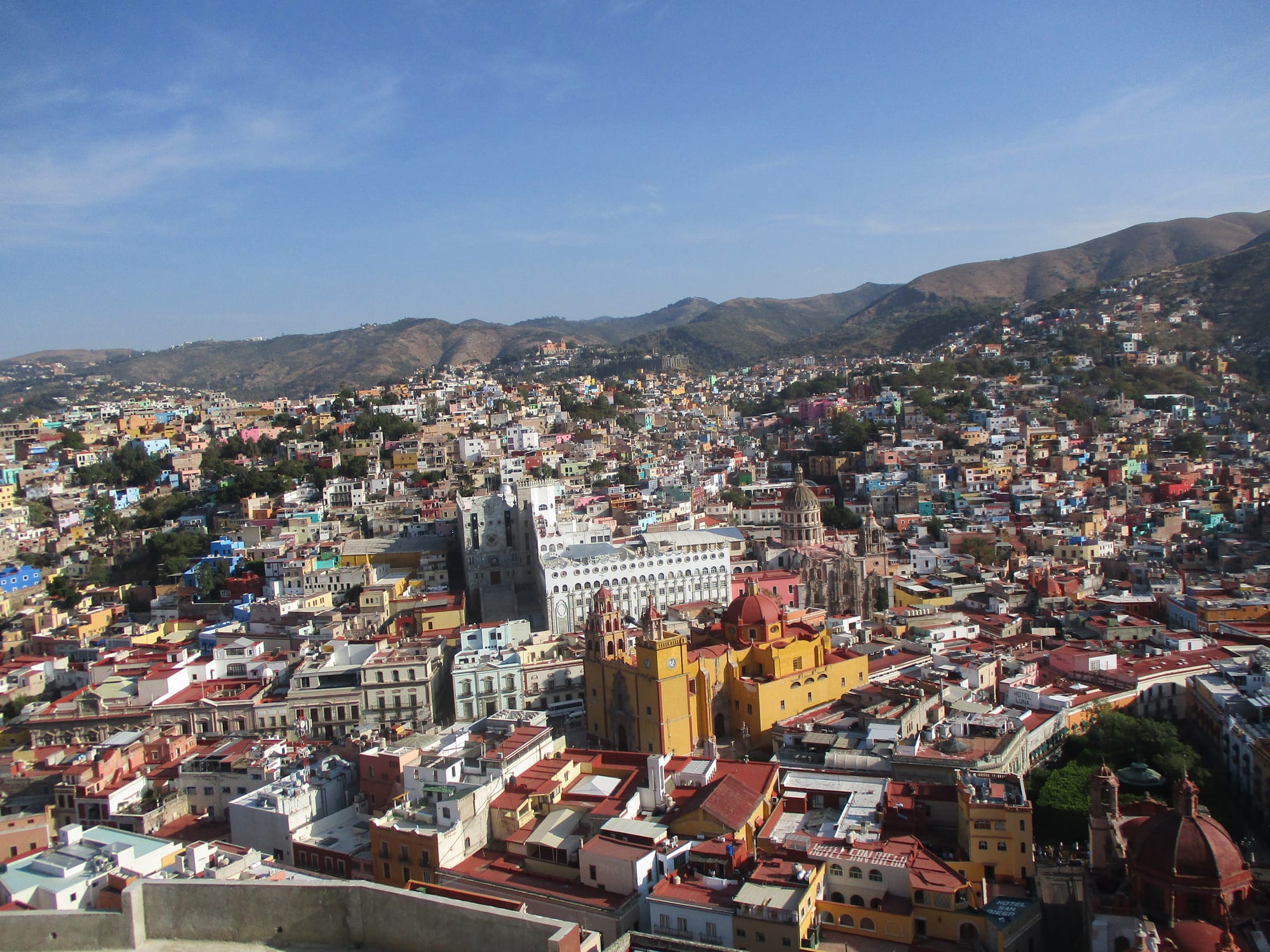
Brightly painted houses filling a valley below brown hills, with a yellow domed basilica and a white university building

Mexico

The Bajío & the Colonial Heartland

Guanajuato from the hillside, with the yellow Basilica of Our Lady of Guanajuato and the university at its centre. (August Dominus / Wikimedia Commons · CC BY-SA 4.0)

The high plateau north of Mexico City — Guanajuato, Querétaro, Aguascalientes, Zacatecas and San Luis Potosí — where colonial silver built some of the country's finest baroque cities, the independence war began in 1810, and a modern car and aerospace industry now spreads across the farmland, with the tropical Huasteca waterfalls on its eastern edge.

Explore The Bajío & the Colonial Heartland

History

Before the Spanish, the northern part of this plateau was the land of the Chichimeca, a Spanish name for the nomadic and semi-nomadic peoples of the arid north, while Otomí and Purépecha farmers lived on its southern edge. Older cultures left sites such as La Quemada in Zacatecas and Plazuelas in Guanajuato, and the Huastec people lived in the eastern lowlands.

Silver changed everything. Ore was found at Zacatecas in 1546 and at Guanajuato soon after, setting off the Chichimeca War, a long conflict that the Spanish ended in the 1590s through payments and settlement rather than conquest. Querétaro, San Miguel, San Luis Potosí and Aguascalientes grew as mining centres, supply towns and stops on the Camino Real de Tierra Adentro, and by the 18th century Guanajuato's La Valenciana mine was one of the richest in the world. The fertile Bajío plain fed the mines with wheat and meat.

The region was the cradle of independence. Conspirators met in Querétaro, and on 16 September 1810 the priest Miguel Hidalgo called for revolt at Dolores; his army, joined by Ignacio Allende of San Miguel, stormed the Alhóndiga de Granaditas granary in Guanajuato. Querétaro saw the execution of Emperor Maximilian in 1867 and the drafting of the 1917 constitution, and Pancho Villa's victory at Zacatecas in 1914 was one of the decisive battles of the Revolution. The Cristero War of the 1920s was fought hard in the Bajío. Since the 1990s, car, aerospace and appliance factories have transformed the plain.

Culture & Customs

The region is often seen as conservative and Catholic, and religious life is visible everywhere: Holy Week processions, pilgrimages to the sanctuary of Atotonilco near San Miguel, and patron saint fiestas with fireworks and dances. The Cristero heritage is still honoured in many towns. Real de Catorce, in the San Luis Potosí desert, is a place of pilgrimage for Catholics and also lies near Wirikuta, the sacred land of the Wixárika, or Huichol, who travel there to gather peyote.

Guanajuato's university gives the city a student character, with estudiantinas, groups of students in Renaissance costume, leading nightly callejoneadas, singing walks through the alleys. The Festival Internacional Cervantino, begun in 1972, fills the city with theatre and music each autumn. San Miguel de Allende has attracted foreign artists and retirees since the 1940s, and it is one of Mexico's largest communities of US and Canadian residents.

Crafts are regional: pottery in Dolores Hidalgo, leather and shoes in León, Otomí crafts around Querétaro, and masks in Zacatecas. Aguascalientes's San Marcos fair, held since the 19th century, is one of the largest in Mexico, with bullfights, cockfights and concerts.

Daily Life

About 14 million people live in the five states, nearly half of them in Guanajuato. León, with around 1.7 million, is the region's largest city and a centre of shoe and leather manufacturing; Querétaro, San Luis Potosí and Aguascalientes each have around a million people in their metropolitan areas, while Guanajuato city and Zacatecas are much smaller.

The Bajío is one of Mexico's main industrial corridors. Car plants and suppliers run from Aguascalientes and San Luis Potosí to Silao, Salamanca and Celaya, and Querétaro has become a centre for aerospace and data centres. Farming remains important, with strawberries, broccoli and other vegetables grown for export, and Zacatecas produces beans and chillies. Mining still matters in Zacatecas and San Luis Potosí.

Growth has brought pressure: traffic, new suburbs, rising rents and stress on groundwater, as well as violence in parts of Guanajuato and Zacatecas. Many families in rural Zacatecas and Guanajuato depend on money sent by relatives working in the United States.

Food

Guanajuato is known for enchiladas mineras, miners' enchiladas filled with cheese and served with potatoes and carrots, and León for guacamayas, bread rolls filled with pork crackling and a sharp salsa. Celaya is famous for cajeta, a thick caramel of goat's milk, and Irapuato for strawberries.

San Luis Potosí has enchiladas potosinas, small folded tortillas made with red chilli dough and filled with cheese. In its Huasteca the food changes to tropical: zacahuil, a very large tamal baked in a wood-fired oven, and bocoles, small corn cakes. Zacatecas celebrates with asado de boda, pork in a chilli sauce served at weddings, and is known for its gorditas.

Querétaro and Aguascalientes grow wine: the Querétaro wine and cheese route around Tequisquiapan and Ezequiel Montes produces sparkling and still wines and sheep's and cow's milk cheeses. Mezcal is made in Zacatecas and San Luis Potosí. Guavas from Aguascalientes are used in sweets and drinks.

Attractions & Natural Wonders

Guanajuato fills a ravine with coloured houses and plazas: the Teatro Juárez, the Alhóndiga de Granaditas museum, the Callejón del Beso, Diego Rivera's birthplace, the mummy museum and the La Valenciana church and mine above town. San Miguel de Allende, about 90 minutes away, has its cobbled centre and parish church, and the nearby sanctuary of Atotonilco; both towns are UNESCO World Heritage Sites. Dolores Hidalgo, where the revolt began, lies between them.

Querétaro's centre has its aqueduct, the Theatre of the Republic and many convents. The state also holds the monolith of the Peña de Bernal and the Sierra Gorda, where 18th-century Franciscan missions with carved facades are UNESCO-listed. Zacatecas has its cathedral, the cable car to the Cerro de la Bufa, the El Edén mine tour and museums of masks and art; La Quemada lies to the south. Aguascalientes has the San Marcos garden and fair and a museum of José Guadalupe Posada.

San Luis Potosí city has a baroque centre, and to the north lies Real de Catorce, reached through a long tunnel. The Huasteca Potosina, to the east, is the region's natural highlight: the Tamul waterfall, the Micos cascades, the Sótano de las Golondrinas pit where swifts spiral out each morning, and Las Pozas at Xilitla.

Cities in The Bajío & the Colonial Heartland

Planning basics

Budget

Most of the region is good value, with prices close to the national average. San Miguel de Allende is the exception: its boutique hotels, restaurants and property prices reflect its many foreign residents and weekend visitors from Mexico City. Guanajuato is busy and pricier during the Cervantino festival in October, as is Aguascalientes during the San Marcos fair. Zacatecas, San Luis Potosí and the Huasteca remain inexpensive.

Daily Budget Midrange
USD 80–180 (restored colonial hotels, restaurants, first-class buses, tours in the Huasteca; more in San Miguel)
Daily Budget Shoestring
USD 30–50 (hostels or simple hotels, markets and fondas, second-class buses)

Book well ahead for Guanajuato in October and for San Miguel around Easter, Day of the Dead and Christmas; weekday stays are cheaper in both.

Safety

Safety varies across the five states. Querétaro and Aguascalientes are among the safer states in Mexico. Guanajuato has had some of the highest homicide totals in the country, driven by fighting between criminal groups over fuel theft and drugs, concentrated in industrial cities such as Celaya, Salamanca and Irapuato. Zacatecas carries strict government advisories because of organised-crime violence, especially on rural highways, and parts of San Luis Potosí are also affected.

Stay on the main tourist routes, avoid rural highways at night in Zacatecas and San Luis Potosí, and take care with belongings during festival crowds. Check current official travel advice before travelling.

Climate

Most of the region is high plateau at around 1,800 to 2,500 metres, with warm dry days, cool nights and a rainy season from about June to September. Zacatecas is the highest and coolest of the capitals and can see frost in winter. The Huasteca Potosina, far lower on the Gulf slope, is hot, humid and green, with heavy summer rain.

Summer
warm, 24–30°C by day on the plateau with afternoon showers; hot and humid, often above 33°C, in the Huasteca
Winter
dry and sunny, 18–24°C by day; cold nights near or below freezing in Zacatecas and the higher towns

Transportation

The region is well connected. First-class buses link all the capitals with each other and with Mexico City, which is about three hours from Querétaro and four from Guanajuato. There are airports at León (Bajío), Querétaro, Aguascalientes, San Luis Potosí and Zacatecas, and a shuttle or bus runs from León or Querétaro to San Miguel. The Huasteca is a long drive east of San Luis Potosí, and a car or tour is the practical way to reach its waterfalls.

Walk or take taxis in Guanajuato and San Miguel, whose steep, narrow centres are hard to drive; use toll roads and daylight for longer trips.

Best Time to Visit

October to April is dry and clear on the plateau, with the Cervantino in Guanajuato in October and Day of the Dead in early November. March to May is warm, with Holy Week processions in San Miguel and Querétaro and the San Marcos fair in Aguascalientes from April into May. For the Huasteca, the waterfalls are at their bluest in the dry months, roughly November to May; heavy rain in summer turns them brown and can close river trips.