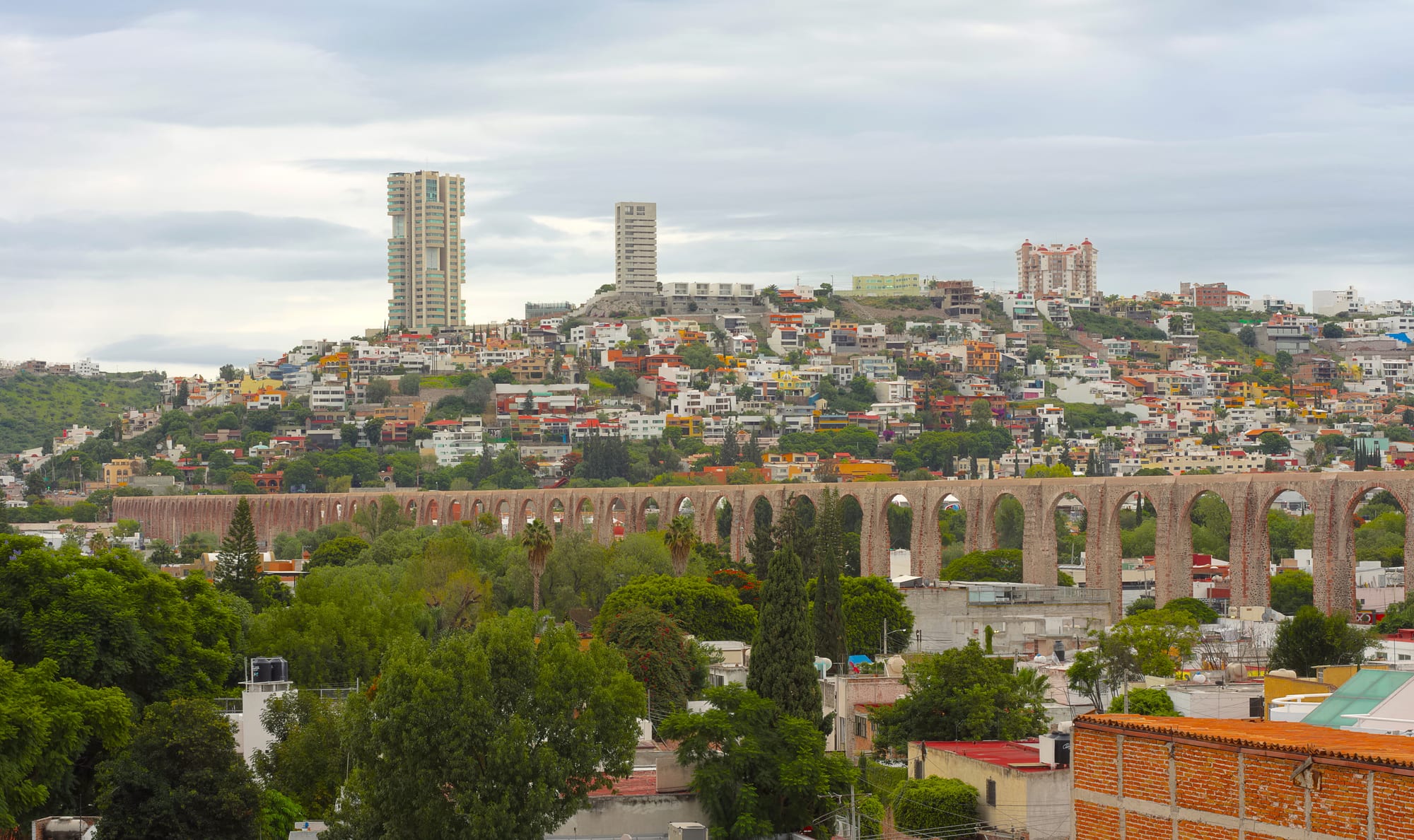
A long line of tall stone arches crossing a green valley in front of a hillside of colourful houses and tower blocks

The Bajío & the Colonial Heartland, Mexico

Querétaro

The aqueduct of Querétaro, seen from the old town. (Carlos Valenzuela / Wikimedia Commons · CC BY-SA 4.0)

The capital of Querétaro state, about 213 km north-west of Mexico City, founded in 1531 by Spaniards and their Otomi allies. Its UNESCO-listed centre of convents, arcaded plazas and a long stone aqueduct saw the independence conspiracy, the end of Emperor Maximilian and the 1917 constitution; today it is one of Mexico's fastest-growing industrial cities.

Neighbourhoods

  • Centro Histórico
    • First-time visitors
    • Historic district
    • Best for food

    The UNESCO-listed old town, where the grid of the Spanish city meets the winding lanes of the old Otomi quarters. Pedestrian streets link the Plaza de Armas, the Jardín Zenea, the Jardín Guerrero and the great churches and convents, and most hotels, restaurants and bars are within walking distance.

    Open in Maps
  • Barrio de la Cruz
    • Historic district
    • Quiet and residential

    The area around Sangremal Hill on the east side of the centre, crowned by the convent of Santa Cruz, where the aqueduct's water first arrived in 1735. Its streets are quieter than the main plazas, with food stalls on the square in front of the church.

    Open in Maps
  • Hércules
    • Local life
    • Quiet and residential

    A village-like area in the Cayetano Rubio borough, set between steep slopes along the Querétaro River.

    Open in Maps
  • Juriquilla
    • Quiet and residential
    • Golf

    An affluent suburb about 15 km north of the centre, founded as an 18th-century hacienda and developed from the 1970s as a golf course and residential area, with a small bullring.

    Open in Maps

Things to do

Famous landmarks

  • Aqueduct of Querétarolandmark

    A stone aqueduct of 74 arches running 1,280 m across the valley east of the centre, paid for largely by the Marquis of Urrutia; its water first reached the city in 1735.

    Open in Maps
  • Teatro de la Repúblicalandmark

    A theatre built between 1845 and 1852, where Maximilian and his generals were sentenced to death in 1867 and where the constitution of 1917 was promulgated.

    Open in Maps
  • Plaza de Armaslandmark

    The main square of the old town, where the annual re-enactment of the legend of La Carambada begins; the Casa de la Corregidora, now the state government palace, is nearby.

    Open in Maps
  • Church and monastery of San Franciscolandmark

    The first monastery in the city, built by the Franciscans, whose church served as the cathedral until the 20th century; the Jardín Zenea was part of its atrium.

    Open in Maps
  • Convent of Santa Cruzlandmark

    The convent on Sangremal Hill, where Saint James is said to have appeared at the city's founding; it housed a missionary college from 1683 and later held Maximilian as a prisoner.

    Open in Maps
  • Church of Santa Rosa de Viterbolandmark

    A baroque church finished in 1752 for a community of nuns devoted to teaching, whose house had become the Royal College of Santa Rosa by 1727.

    Open in Maps

History and parks

  • Cerro de las Campanaspark

    The Hill of the Bells, where Maximilian was executed in 1867, now a park with a memorial chapel erected by Maximilian's brother, Emperor Franz Joseph of Austria, a museum and a large statue of Benito Juárez.

    Open in Maps
  • Jardín Guerreropark

    A garden in front of the old city hall and one of the venues of the city's Holy Week arts festival.

    Open in Maps

Sport

  • Estadio Corregidoraattraction

    The football stadium of Querétaro FC, built for the 1986 World Cup.

    Open in Maps

Short trips from the city

  • Peña de Bernalviewpoint

    A 433-metre monolith, the exposed core of an ancient volcano, above the small town of San Sebastián Bernal; many people hike up to a chapel near the top.

    Open in Maps
  • Tequisquiapanattraction

    A cobbled colonial town on Querétaro's wine route, host of the annual National Cheese and Wine Fair.

    Open in Maps
  • San Miguel de Allendeattraction

    The colonial town with a pink neo-Gothic parish church and a large foreign community, about 63 km north-west in Guanajuato state.

    Open in Maps

Seasonal events

  • Festival of Santiago de QuerétaroHoly Week, March or April

    An eight-day arts festival that opens with a parade through the historic centre and fills the gardens, museums and theatres with performances.

  • Constitution DayFebruary

    The anniversary of the constitution enacted in the city on 5 February 1917, marked with particular meaning in the place where it was written.

Eat and drink

Long-standing places and food districts in Querétaro. Hours, ratings and directions come from your maps app, always current.

Querétaro classics

  • Gorditas queretanasrestaurant

    Round corn cakes bigger than the usual gordita, filled with cheese and migajas, and the typical food of the city.

    Open in Maps
  • Enchiladas queretanasrestaurant

    Red enchiladas, once simply called enchiladas rojas: fried tortillas in chilli sauce, filled with cheese and chopped onion.

    Open in Maps

Food districts and markets

  • Mercado de la Cruzmarket

    The neighbourhood market of the Barrio de la Cruz, close to the centre.

    Open in Maps
  • Food stalls at Santa Cruzmarket

    Stalls on the plaza in front of the Santa Cruz church serve snacks, with gorditas queretanas from Friday to Sunday afternoons and evenings.

    Open in Maps
  • Restaurants of the Centro Históriconeighborhood

    The pedestrian streets and plazas of the old town are lined with restaurants and cafés serving regional food and wines from the state's vineyards.

    Open in Maps

Experience Querétaro

History

Before the Spanish, the valley was a frontier between the Otomi and the Chichimeca peoples, and older centres such as Toluquilla and Las Ranas had flourished from the Classic period. The Spanish city of Santiago de Querétaro was founded on 25 July 1531, when Hernán Pérez Bocanegra arrived with the Otomi leader Conín, later baptised Hernando de Tapia. According to legend, Saint James appeared in the sky on Sangremal Hill during the struggle for the place. Franciscans, Jesuits, Augustinians, Dominicans and Carmelites followed, building monasteries and colleges, and in 1683 the College for the Propagation of the Faith at Santa Cruz began training missionaries for the north. In the 18th century the Marquis of Urrutia built the aqueduct, and its water reached the city in 1735.

The city was at the centre of the independence conspiracy: in 1810 the plotters met at gatherings hosted by Josefa Ortiz de Domínguez, wife of the city's corregidor, in what is now the Palace of the Corregidora. In 1867 Emperor Maximilian made his last stand in the Siege of Querétaro, and he was executed on the Cerro de las Campanas with Generals Miramón and Mejía.

In 1916 President Carranza made Querétaro the provisional capital, and on 5 February 1917 the Constituent Congress meeting in the Teatro de la República enacted the constitution that remains Mexico's law today. The historic centre became a UNESCO World Heritage Site in 1996, and from the mid-1990s industrial growth turned the city into one of the fastest-growing in Mexico.

Culture & Customs

UNESCO singled out the way the old town keeps the geometric street plan of the Spanish side by side with the twisting alleys of the Otomi quarters, and the Otomi heritage remains part of local identity. Querétaro takes pride in its history: the cradle of the independence plot, the place where the Second Empire ended and the birthplace of the modern constitution. La Corregidora, Josefa Ortiz de Domínguez, is the city's heroine, and her name appears on streets, a square, a stadium and a neighbouring municipality.

Religious life is visible in the many churches and convents and above all in Holy Week, when the eight-day Festival of Santiago de Querétaro fills gardens, museums and theatres with performances and opens with a parade through the centre. Folk legends such as that of La Carambada, re-enacted on the Plaza de Armas, are part of local storytelling.

Sport means football at the Estadio Corregidora, built for the 1986 World Cup, and, since 2024, professional baseball with the Conspiradores de Querétaro, who play in nearby Huimilpan. The city also has two bullrings, Santa María and the small ring at Juriquilla. In 2017 UNESCO named Querétaro a City of Design.

Daily Life

The municipality had about 1,049,800 people in 2020, and the metropolitan area, which takes in Corregidora, El Marqués, Huimilpan and Apaseo el Alto in Guanajuato, about 1.59 million. It is one of the fastest-growing urban areas in Mexico, and most of the growth comes from people moving from Mexico City, the State of Mexico, Guanajuato, Michoacán and Veracruz.

The economy is built on industry and services: aircraft manufacturing and maintenance, car parts and machinery, chemicals, food processing, logistics, call centres and, increasingly, data centres. Many large international companies have their Mexican headquarters here, and the city's output per person is above the Mexican average.

The old town is lived in as well as visited, with families walking in the plazas in the evenings and at weekends. Most residents, though, live outside the old town, in a city that now spreads into the neighbouring municipalities of Corregidora and El Marqués. Rapid growth has put pressure on water supplies, and a second aqueduct was begun in 2010 to relieve the overused aquifer.

Food

The everyday food of the city is the gordita queretana, a round corn cake larger than the usual gordita, filled with cheese and migajas, and enchiladas queretanas, red enchiladas that were once simply called enchiladas rojas. Pozole and both spicy and sweet tamales are also local favourites, along with pan de queso, a cheese bread.

Sweets include dulce de membrillo, a quince paste, jamoncillos, milk fudge, and mantecado ice cream, and atole, a warm corn drink, is widely sold. The Mercado de la Cruz is a market close to the centre, and stalls on the plaza in front of the Santa Cruz church sell gorditas at weekends.

Querétaro state is now Mexico's second wine region after Baja California, and the Spanish producer Freixenet makes wine here. Vineyards around Tequisquiapan make mostly sparkling wines along with reds, whites and rosés, and the area's cheeses come together each year at the National Cheese and Wine Fair in Tequisquiapan.

Planning tools

Budget

Querétaro is a prosperous business city, and hotel prices reflect weekday business travel, but food, buses and taxis are good value. The restored colonial houses of the centre are the pleasant places to stay; chain hotels cluster along the ring roads.

Daily Budget Midrange
USD 80–170 (hotel in the centre, restaurant meals, museums, taxis or a winery tour)
Daily Budget Shoestring
USD 30–50 (hostel or simple hotel, market food and street stalls, city buses)

Weekend rates in the centre can be lower than weekday business rates; prices rise around Holy Week and long holiday weekends.

Best Time to Visit

October to April is dry and sunny, with mild days and cool nights. Average highs reach about 31°C in May. The rainy season runs roughly from June to September. Holy Week brings the city's arts festival and processions.

Suggested Number of Days

The historic centre is compact, and one or two days cover it well. Three or four days allow time for the wine and cheese country, the small towns of the state and the monolith of Bernal; a car or tour makes those trips much easier.

First Visit
1–2 days
With Surroundings
3–4 days

Transportation

The historic centre is walkable, and taxis and ride-hailing apps are the easiest way to reach outer districts. City buses run on more than a hundred routes. Querétaro is a car city beyond the centre, with ring roads and freeways linking the new suburbs and industrial parks.

Use toll roads and daylight for trips into the countryside; traffic on the ring roads is heavy at rush hours.

Airport & Station Connections

Querétaro Intercontinental Airport, opened in 2004, lies in the countryside east of the city, with domestic and international flights. Many travellers still fly into Mexico City, about 213 km away, and continue by direct bus. First-class buses link the city with Mexico City in about three hours and with the rest of the Bajío.

Walkability

The historic centre is one of the most pleasant in Mexico to walk, with several pedestrian streets and plazas close together. The aqueduct and the Cerro de las Campanas are a longer walk or short taxi ride from the main squares. Beyond the centre the city is spread out and built around cars.

Safety

Safety varies enormously by state and even neighbourhood. Querétaro is among the safer states in Mexico, and the historic centre is busy and well used in the evening. Petty theft is the main risk for visitors.

Use registered taxis or apps at night, keep valuables out of sight in crowds, and travel by toll road in daylight. Check current official travel advice before travelling.

Climate

A semi-arid highland climate with mild temperatures all year. Most rain falls in summer, and the dry months are sunny.

Summer
May is the warmest month, with average highs of about 31°C; summer brings afternoon storms
Winter
dry and sunny; across the region, days are typically 18–24°C, with cool nights

Local Customs

Greet people with a 'buenos días' or 'buenas tardes' when entering shops and small restaurants. Tipping in restaurants is customary. Catholic festivals, above all Holy Week, are taken seriously.

Dress modestly in churches and keep quiet during services and processions. Drinking alcohol in the street is generally not allowed.

Common Payment Methods

The currency is the Mexican peso. Cards are widely accepted in hotels, restaurants and shops, and ATMs are common; cash is useful for markets, street stalls, small shops and tips.