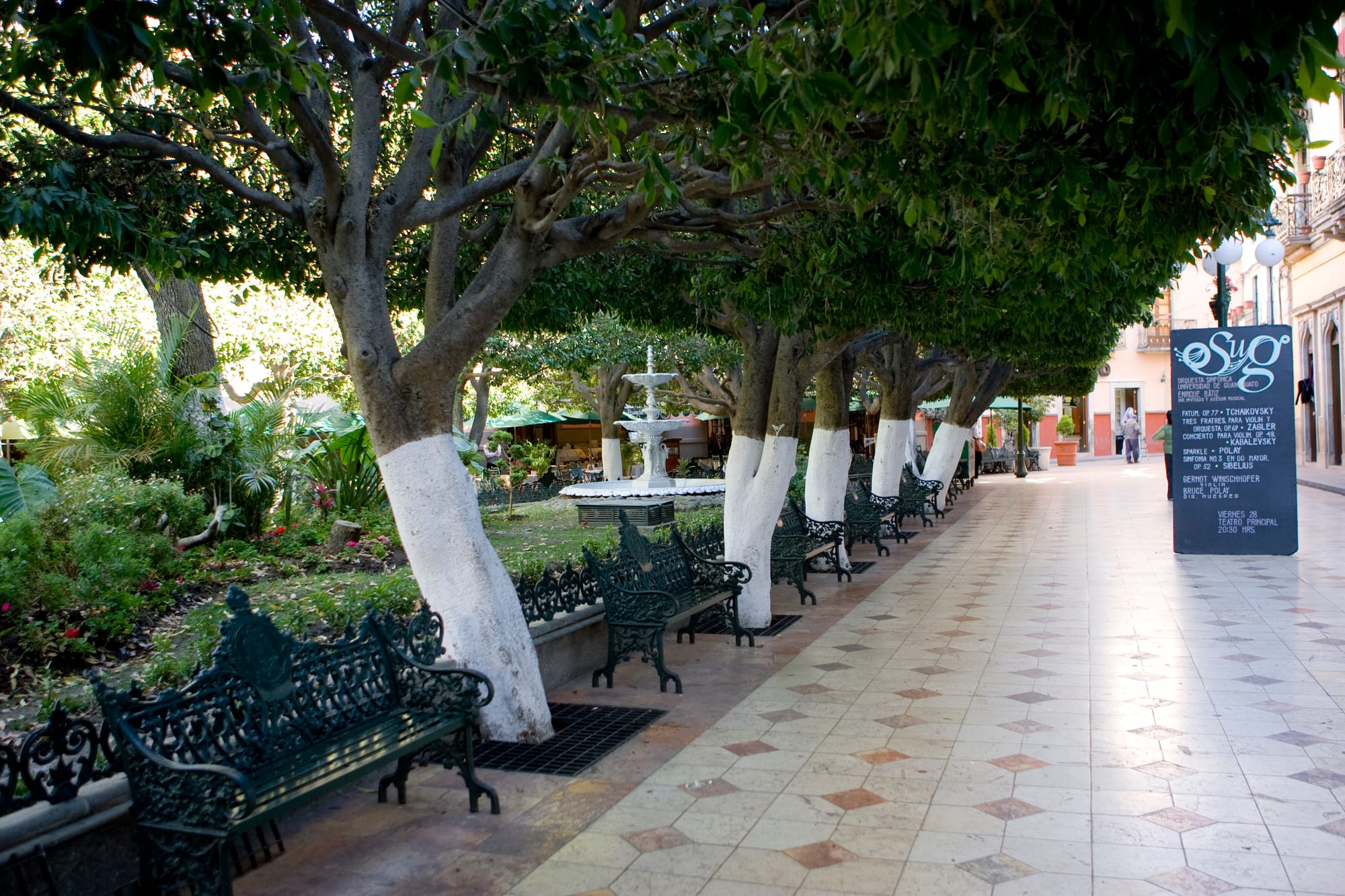
A tiled walkway under clipped laurel trees with white-painted trunks, green iron benches and a fountain

The Bajío & the Colonial Heartland, Mexico

Guanajuato

The shaded walks of the Jardín de la Unión in the centre of Guanajuato. (Lin Mei / Wikimedia Commons · CC BY 2.0)

The capital of Guanajuato state, built in a narrow valley in central Mexico, where colonial silver from mines such as La Valenciana paid for baroque churches and sandstone mansions. Its winding alleys, small plazas and roads running underground through old flood tunnels make it unlike any other Mexican city, and it is now a university town and home of the Cervantino arts festival.

Neighbourhoods

  • Centro
    • First-time visitors
    • Historic district
    • Nightlife

    The historic core along the valley floor, from the Jardín de la Unión and the Juárez Theatre to the Plaza de la Paz, the basilica and the university. Alleys and stairways climb the slopes on either side, student musicians lead singing walks in the evenings, and most cafés, bars and guesthouses are here.

    Open in Maps
  • Paseo de la Presa
    • Quiet and residential
    • Historic homes

    An avenue running east from the centre to the Presa de la Olla, the dam built in the mid-18th century to supply the city with drinking water. Restaurants and guesthouses stand along it, and it is calmer than the centre.

    Open in Maps
  • Valenciana
    • Mining history
    • Views

    One of the oldest districts, named after the mine on the northern edge of the city that made its owners, the Counts of Valenciana, among the richest families in New Spain. The gilded church of San Cayetano stands beside the mine entrance, high above the centre.

    Open in Maps
  • Marfil
    • Quiet and residential

    One of the city's four original barrios, once counted as a separate community and now joined to the city. The former Santa Ana hacienda here, home of the Canadian artist Gene Byron from 1962, is now a house museum.

    Open in Maps

Things to do

Famous landmarks

  • Teatro Juárezlandmark

    A theatre built between 1872 and 1903 beside the Jardín de la Unión, inaugurated with Verdi's Aida, and the main venue of the Festival Internacional Cervantino since 1972.

    Open in Maps
  • Jardín de la Uniónpark

    The small garden at the heart of the city, shaded by clipped Indian laurels and ringed by cafés, restaurants and the San Diego church.

    Open in Maps
  • Basilica of Our Lady of Guanajuatolandmark

    The basilica on the Plaza de la Paz, the Basílica Colegiata de Nuestra Señora de Guanajuato; on Good Friday the Passion is re-enacted in front of it.

    Open in Maps
  • University of Guanajuatolandmark

    The university's main building is reached by a long staircase of 113 steps, which serves as seating for events during the Cervantino.

    Open in Maps
  • Callejón del Besoattraction

    The Alley of the Kiss, the best known of the city's many narrow lanes and the subject of a local legend.

    Open in Maps
  • Underground streetsattraction

    Roads and footpaths running through old river channels and flood tunnels beneath the city, with underground bus stops; the main street into town, Belaunzarán, runs about 3 km underground.

    Open in Maps

Museums

  • Alhóndiga de Granaditasmuseum

    The massive granary where royalist troops made their stand in the first battle of the War of Independence in 1810, now the Regional Museum of Guanajuato.

    Open in Maps
  • Museum of the Mummiesmuseum

    A museum beside the Santa Paula municipal cemetery holding 111 mummified bodies exhumed between the 1860s and 1958; studies suggest some were at least partly embalmed.

    Open in Maps
  • Museo Casa Diego Riveramuseum

    The house where the muralist Diego Rivera was born and spent his early childhood, kept as a museum near the centre.

    Open in Maps
  • Museo Iconográfico del Quijotemuseum

    A museum of paintings, sculptures and other works inspired by Don Quixote, reflecting the city's claim to be the Cervantes capital of the Americas.

    Open in Maps

Mines and viewpoints

  • El Pípila monument and funicularviewpoint

    A funicular behind the Juárez Theatre climbs San Miguel hill to a giant statue of El Pípila, the miner who set fire to the Alhóndiga's door in 1810, with a view over the whole valley.

    Open in Maps
  • Valenciana Mineattraction

    The mine on the northern edge of the city whose silver output at its height was enormous; it is part of the UNESCO World Heritage Site and can be visited.

    Open in Maps
  • Church of San Cayetano (La Valenciana)landmark

    An 18th-century Churrigueresque church built at the mouth of the Valenciana mine by its owner, known for its gold-leaf altarpieces.

    Open in Maps
  • Presa de la Ollapark

    A dam built in the mid-18th century to give the city drinking water, at the end of the Paseo de la Presa.

    Open in Maps

Short trips from the city

  • Cristo Rey del Cubiletelandmark

    A large statue of Christ the King on the summit of Cerro del Cubilete in the neighbouring municipality of Silao; the present monument was completed in 1950.

    Open in Maps
  • Dolores Hidalgoattraction

    The town where Miguel Hidalgo called for revolt in September 1810, known also for its painted pottery.

    Open in Maps
  • San Miguel de Allendeattraction

    A cobbled colonial town with a pink neo-Gothic parish church and a large community of artists and foreign residents, also a UNESCO World Heritage Site.

    Open in Maps

Seasonal events

  • Festival Internacional CervantinoOctober

    Mexico's leading international arts festival, with theatre, music and dance in some 70 venues over most of October, grown from short Cervantes plays staged in the city's plazas.

  • Holy WeekMarch or April

    On Good Friday the Passion of Christ is re-enacted at midday in front of the basilica, and a silent procession winds through the streets in the evening.

  • Independence Day15–16 September

    The courtyard of the Alhóndiga de Granaditas is the traditional place to re-enact Hidalgo's Grito de Dolores on the night of the national holiday.

Eat and drink

Long-standing places and food districts in Guanajuato. Hours, ratings and directions come from your maps app, always current.

Guanajuato classics

  • Enchiladas minerasrestaurant

    Miners' enchiladas, filled with cheese and served with potatoes and carrots — the city's signature dish, served in markets and restaurants all over town.

    Open in Maps
  • Charamuscasmarket

    Twisted sugar candies, often shaped as a charro or a mummy and wrapped in wax paper, sold in the markets and sweet shops.

    Open in Maps

Food districts and markets

  • Mercado Hidalgomarket

    The iron-roofed market hall of 1910, built on the site of an old bullring, with food stalls serving enchiladas mineras, huaraches and pambazos beside sweets and crafts.

    Open in Maps
  • Mercado Embajadorasmarket

    A neighbourhood market with food stalls in and around it and tlacoyos, gorditas and sopes in the small park next door.

    Open in Maps
  • Cafés around the Jardín de la Uniónneighborhood

    The terraces under the laurels of the main garden are where the city meets for coffee, drinks and people-watching, with student musicians passing through in the evening.

    Open in Maps

Experience Guanajuato

History

The valley was home to the Otomi before Chichimeca peoples displaced them. Spanish prospectors found silver here in the mid-16th century, and the Rayas mine, discovered in 1550, gave its name to one of the first mining settlements. Despite Chichimeca attacks, migrants poured in, and the town grew from four barrios — Marfil, Tepetapa, Santa Ana and Santa Fe — strung along the river at the bottom of the ravine. In the 18th century the Valenciana mine on the northern edge became one of the richest in the world, and its owners, the Counts of Valenciana, paid for churches such as San Cayetano, while the profits built the baroque and Churrigueresque city that survives.

In September 1810 Miguel Hidalgo's insurgent army reached Guanajuato. Royalist troops and much of the local elite barricaded themselves in the Alhóndiga de Granaditas, a newly built granary, and held it until a miner known as El Pípila crawled to its door under a stone slab and set it alight. It was the first battle of the War of Independence.

Mining revived in the late 19th century and paid for the Juárez Theatre, inaugurated with Verdi's Aida, and the Monumento a la Paz. The river regularly flooded the narrow city, and ditches and tunnels were dug to carry the water away; after dams brought the floods under control in the 1960s, many tunnels became roads. The first Festival Internacional Cervantino was held in 1972, and in 1988 the historic town and adjacent mines were made a UNESCO World Heritage Site. Silver and gold are still mined around the city.

Culture & Customs

Guanajuato calls itself the Cervantes capital of the Americas, although the writer never visited Mexico. From the 1950s short one-act plays by Cervantes, the entremeses, were staged in the city's plazas, and in 1972 they grew with federal support into the Festival Internacional Cervantino, now the most important international arts festival in Latin America. Statues of Don Quixote and Sancho Panza stand in the streets, and a museum is devoted to images of the knight.

The University of Guanajuato gives the city its youthful character. Its estudiantinas, groups of student musicians, lead callejoneadas, singing walks through the alleys, a pastime born of the narrow streets and now also arranged for visitors. Legends are a big part of local identity: the Callejón del Beso has its own legend, and Guanajuato has its own version of La Llorona, wandering the tunnels.

The mummies are another part of the city's fame. Bodies exhumed from the municipal cemetery have been shown to paying visitors since the late 19th century, and a 1972 film in which the masked wrestler El Santo fights them made them famous across Mexico. Religious life is visible in the basilica's Holy Week ceremonies, and the house where Diego Rivera was born is now a museum.

Daily Life

At the 2020 census the municipality had 194,500 inhabitants, about 72,200 of them in the city itself. The capital is small compared with León and the industrial cities of the Bajío, and much of its life revolves around the state government, the university, tourism and mining. Commerce and services are the largest employers, followed by construction and mining, and several silver and gold mines still operate around the city.

Students fill the centre during term, and the Jardín de la Unión, the Plaza de la Paz and the steps of the university are the city's meeting places. Houses climb the hillsides in tiers of colour, reached by alleys and stairways too narrow for cars, so many residents carry their shopping up by hand, while buses and taxis use the tunnels below. Older barrios such as Valenciana, Cata and Pastita grew up around their mines.

Traffic and parking in the narrow streets are everyday concerns, and the weeks of the Cervantino change the rhythm of the city completely, filling streets, hotels and plazas with visitors.

Food

The dish most closely tied to the city is the enchilada minera, or miner's enchilada: tortillas filled with cheese and served with potatoes and carrots. It is served almost everywhere, from market stalls to restaurants on the plazas. Some cooks also offer enchiladas cervantinas, named after the festival.

Mercado Hidalgo, an iron-roofed hall built in 1910 on the site of the old Gavira bullring, is the place for cheap meals, with stalls selling enchiladas mineras, huaraches and pambazos. Around the Mercado Embajadoras, stalls and a small park next to the market sell tlacoyos, gorditas and sopes, the thick corn snacks found across central Mexico.

Sweets are a tradition. Charamuscas, twisted sugar candies often shaped as charros or mummies, are sold in the market, and the state's cajeta, a goat's milk caramel from Celaya, and strawberries from Irapuato turn up in desserts and drinks. The cafés around the Jardín de la Unión and the bars of the centre, full of students, are where evenings begin.

Planning tools

Budget

Guanajuato is good value for a famous colonial city. Simple guesthouses, market food and city buses cost little; the restored mansion hotels around the centre and the Paseo de la Presa cost more. Prices rise and rooms fill during the Cervantino in October.

Daily Budget Midrange
USD 80–170 (hotel in a restored colonial house, restaurant meals, museum entries, taxis)
Daily Budget Shoestring
USD 30–50 (hostel or simple guesthouse, market meals, city buses)

Book well ahead for October; weekday stays are cheaper than weekends, when visitors arrive from León, Querétaro and Mexico City.

Best Time to Visit

October to April is the dry season on the plateau, with clear days and cool nights. October brings the Cervantino and the city at its liveliest and most crowded; Holy Week and Independence Day in September also draw crowds. The rainy season runs roughly from June to September, usually as afternoon showers.

Suggested Number of Days

Two or three days cover the centre, the museums and the hillside viewpoints at an unhurried pace. Allow four or five to add the mining district and day trips to nearby colonial towns; the steep streets reward a slower pace than the map suggests.

First Visit
2–3 days
With Surroundings
4–5 days

Transportation

The centre is best covered on foot. City buses run through the tunnels under the streets, stopping at underground stops reached by stairways, and taxis are plentiful. Driving in the narrow, one-way and underground streets is confusing, and parking is scarce.

Ask the driver for a stop by name: buses and taxis drop passengers in the tunnels, from where stairways lead up to the streets.

Airport & Station Connections

The nearest airport is Bajío International Airport, officially Guanajuato International Airport, in Silao, which serves León and the whole state; taxis run from the terminal, and buses connect via Silao. The intercity bus station lies about 7 km south-west of the centre, with local buses and taxis into town. Mexico City is about four to five hours by first-class bus.

Walkability

Excellent but steep. The historic centre is compact, and many alleys and stairways are closed to cars, so walking is the natural way to get around. Climbs to the viewpoints and upper districts are hard work; the funicular saves the steepest one.

Safety

Safety varies enormously by state and even neighbourhood. Guanajuato state has had some of the highest homicide totals in Mexico, driven by fighting between criminal groups and concentrated in industrial cities such as Celaya, Salamanca and Irapuato. The historic capital has little crime directed at visitors, and the centre is busy into the evening.

Keep to the centre after dark, use registered taxis or apps, and watch belongings in festival crowds. Check current official travel advice before travelling.

Climate

A mild highland climate. The average temperature over the year is about 18.5°C, with annual rainfall of roughly 600–840 mm, most of it in summer. Days are warm and nights cool for much of the year.

Summer
warm with afternoon storms; the warmest parts of the area can reach about 36°C
Winter
dry and sunny by day, with cold nights; the coldest parts of the area can drop to about 3°C

Local Customs

Guanajuato is a Catholic, fairly traditional city and a student town at the same time. Greet shopkeepers and people in small places with a 'buenos días' or 'buenas tardes'. Tipping in restaurants is customary. Callejoneadas, singing walks led by student musicians, are part of evening life in the centre.

Dress modestly in churches and keep quiet during services and processions. Drinking alcohol in the street is generally not allowed. The Museum of the Mummies displays real human remains; behave as in any place connected with the dead.

Common Payment Methods

The currency is the Mexican peso. Cards are accepted in hotels and most restaurants, and ATMs are common in the centre; cash is needed for markets, street food, small shops and tips.