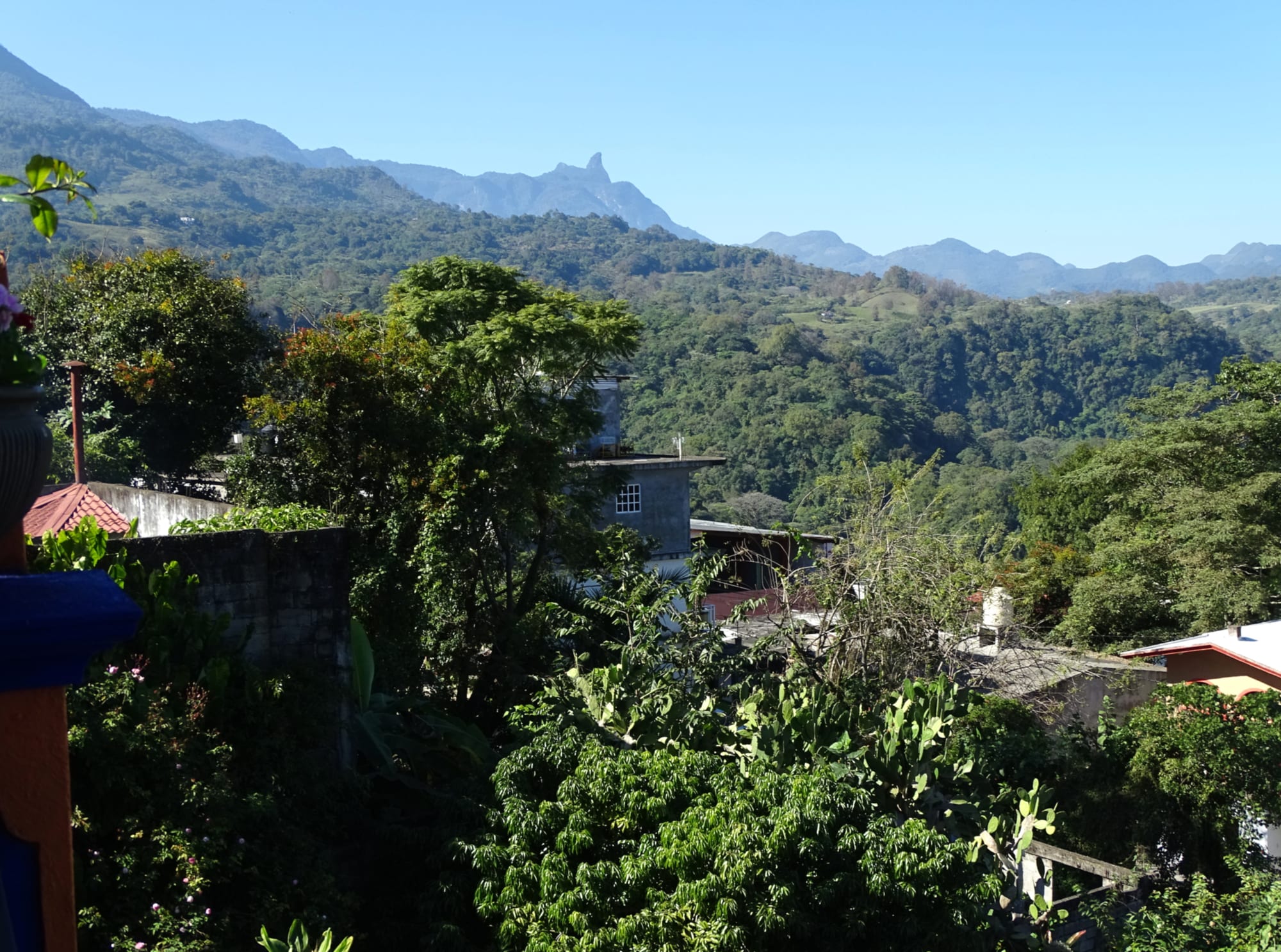
Rooftops among dense green trees on the edge of a town, with forested hills and a jagged mountain peak beyond under a clear sky

The Bajío & the Colonial Heartland, Mexico

Xilitla

The outskirts of Xilitla and the forested mountains of the Huasteca beyond. (Adam Jones from Kelowna, BC, Canada / Wikimedia Commons · CC BY-SA 2.0)

A small mountain town in the Huasteca region of eastern San Luis Potosí, surrounded by forested hills, springs and caves. It has a 16th-century Augustinian convent, its mountains have helped preserve Huastec and Nahuatl cultures, and coffee and citrus are its main crops; just outside town lies Las Pozas, a garden of surrealist concrete sculptures among waterfalls and pools.

Neighbourhoods

  • Town centre
    • First-time visitors
    • Local life

    The small, hilly centre around the main square and the old Augustinian convent, with the Leonora Carrington museum, the bus terminals, shops and most places to eat and stay. Streets climb and drop steeply across the hillside.

    Open in Maps
  • Las Pozas
    • Nature
    • Art

    The garden of surrealist sculptures in the rainforest just outside town, set among natural waterfalls and pools. The surrounding valley is quiet and green, with a few places to stay nearby.

    Open in Maps

Things to do

Art and history

  • Las Pozaspark

    A garden of more than 80 acres of waterfalls and pools in the subtropical rainforest, where Edward James built scores of surreal concrete structures between 1949 and 1984, some up to four storeys tall, such as the Staircase to Heaven.

    Open in Maps
  • Museo Leonora Carrington Xilitlamuseum

    The town's branch of the museum devoted to the surrealist artist, opened in October 2018, with her sculptures.

    Open in Maps
  • Former convent of San Agustínlandmark

    The oldest monument in Xilitla, an Augustinian convent begun in 1553 and twice attacked and burned in the 16th century.

    Open in Maps

Nature

  • Parakeet Caveattraction

    A cave a short walk from town, home to a large number of green parrots that fly out at dawn and return at dusk every day.

    Open in Maps

Short trips from the town

  • Cave of Swallowsattraction

    The Sótano de las Golondrinas, an enormous open pit cave in the municipality of Aquismón, where birds spiral out of the shaft each morning.

    Open in Maps
  • Jalpan de Serraattraction

    A town in the Sierra Gorda of Querétaro, about 53 km away, home to one of the 18th-century Franciscan missions whose carved facades are UNESCO-listed.

    Open in Maps

Seasonal events

  • Coffee fairAugust

    An annual fair celebrating the coffee grown on the slopes around the town.

Eat and drink

Long-standing places and food districts in Xilitla. Hours, ratings and directions come from your maps app, always current.

Huasteca classics

  • Zacahuilrestaurant

    A giant Huastec tamal, three to four feet long, wrapped in banana leaves and filled with pork on one side and chicken on the other; it is seldom found outside the Huasteca.

    Open in Maps
  • Local coffeecafe

    Coffee is one of the town's two main crops, served in the cafés of the centre.

    Open in Maps

Places to eat

  • Restaurants around the main squareneighborhood

    Small restaurants and food stalls in the streets around the central square serve Huastec food alongside everyday Mexican dishes.

    Open in Maps

Experience Xilitla

History

The mountains of Xilitla were Huastec country long before the Spanish arrived, and the rugged landscape has helped shield the area from industrialisation and preserve its Huastec and Nahuatl cultures. Augustinian missionaries began working here in 1537, and in 1553 they began building the convent of Saint Augustine, the oldest monument in town. It was attacked and burned by the local peoples in 1569 and again in 1587, and the Augustinians largely abandoned it. Franciscans established a lasting missionary presence in the region only in the mid-18th century, and Xilitla long remained a remote farming area.

The town's modern fame began when the natural beauty of the area inspired the English artist Edward James. In the forest just outside town, between 1949 and 1984, he built scores of surreal concrete structures among natural pools and waterfalls, with the help of local workers and craftsmen, and he often stayed in a mock-Gothic cement house near the town centre that Plutarco Gastélum had built. After James's death in 1984, Gastélum halted the work, leaving several structures unfinished.

In 2007 a foundation backed by the Fundación Pedro y Elena Hernández, the cement company Cemex and the state government bought Las Pozas for about USD 2.2 million and created Fondo Xilitla to preserve and restore it. In 2011 Xilitla was added to Mexico's list of Pueblos Mágicos. A museum of Leonora Carrington's sculptures opened in the town in October 2018.

Culture & Customs

Xilitla has a large Indigenous population. About 30,000 of its people live in Indigenous households and around 20,000 speak an Indigenous language, principally Huastec, while Nahuatl culture is also strong; most speakers are bilingual in Spanish. Traditional farming life, based on coffee and citrus, shapes the calendar, and the town holds a coffee fair each August.

Surrealism gives the town its other identity. Edward James described Mexico as naturally surrealistic, and his garden at Las Pozas, with its Staircase to Heaven of columns modelled on orchid flowers and structures once meant to house his deer, flamingos and other animals, is the town's main attraction. The Leonora Carrington museum, a branch of the museum in the state capital, adds the work of another artist of the movement.

The landscape itself is central to local life. Many natural springs and caves surround the town, among them a cave a short walk away where green parrots fly out at dawn and return at dusk.

Daily Life

The municipality covers about 415 square kilometres of mountains and had 51,498 people in 2010, of whom 6,576 lived in the town of Xilitla itself; the rest live in villages spread across the hills. About 30,000 people live in Indigenous households, and most speakers of Huastec and other Indigenous languages also speak Spanish.

The economy is mainly agricultural, with coffee and citrus the main crops, grown on steep, fertile slopes watered by many springs. Tourism linked to Las Pozas and the Carrington museum adds guesthouses, restaurants and guiding work, and the town fills up on weekends and holidays, when visitors arrive for the garden.

To the north-east the mountains give way to flat land along the Tancuilín river and Mexican Highway 85, the main road through the Huasteca. A winding road of about 10 km links the town with the highway at La Y Griega, a large T-junction, from where Ciudad Valles lies about 100 km to the north and Tamazunchale about 50 km to the south; buses run hourly to both, and colectivo minivans run from La Y Griega.

Food

Xilitla's food is Huastec. The dish that stands out is zacahuil, also spelled sacahuil, a giant tamal three to four feet long, wrapped in banana leaves and filled with pork on one side and chicken on the other. It is a traditional Huastec food and is seldom found outside the region. The wider Huasteca also makes bocoles, small corn cakes.

Coffee is the town's other contribution, grown on the hillsides around Xilitla alongside oranges and other citrus. It is served in the cafés of the centre and celebrated each August at the coffee fair.

Everyday meals are simple and cheap, from tamales and corn snacks at stalls around the square to home-style cooking in small restaurants. Food changes sharply between the two halves of San Luis Potosí state: where the capital on the dry plateau is known for its orange enchiladas potosinas, the green, humid Huasteca cooks with banana leaves and corn in forms such as zacahuil and bocoles.

Planning tools

Budget

Xilitla is inexpensive, with simple guesthouses, small hotels and cheap local food. Costs rise mainly with tours into the wider Huasteca and with holiday weekends, when visitors arrive in larger numbers.

Daily Budget Midrange
USD 70–150 (comfortable guesthouse, restaurant meals, garden tickets and guided trips into the Huasteca)
Daily Budget Shoestring
USD 30–45 (guesthouse, local food, buses and colectivos)

Plan the stay around Las Pozas, the town's main draw, and avoid holiday weekends for a quieter visit.

Best Time to Visit

Rain falls all year, with most of it in summer. For the wider Huasteca, the region's rivers and waterfalls are at their bluest in the dry months, roughly November to May, while heavy summer rain turns them brown. Avoid holiday weekends for a quieter visit to the garden.

Suggested Number of Days

One or two days are enough for the town and the garden. Three to five allow time to explore the caves, springs and rivers of the Huasteca, which are spread out along winding mountain roads.

First Visit
1–2 days
With Surroundings
3–5 days

Transportation

The town is small enough to walk, though its streets are steep. Taxis run to the garden just outside town. Buses and colectivo minivans link Xilitla with the main highway at La Y Griega, a junction about 10 km away; Ciudad Valles is about 100 km to the north and Tamazunchale about 50 km to the south.

Mountain roads in the Huasteca are winding and slow; drive them by day.

Airport & Station Connections

Most visitors arrive by road. There are daily direct buses to Mexico City and other major cities, and more frequent connections by changing to a colectivo at La Y Griega on highway 85. Ciudad Valles lies about 100 km north along highway 85, and San Luis Potosí city is a long drive west.

Walkability

The centre is compact and walkable, but built on a mountainside with steep streets. The garden of Las Pozas lies just outside town, within reach on foot for strong walkers or by taxi.

Safety

Safety varies enormously by state and even neighbourhood. Parts of San Luis Potosí state are affected by organised-crime violence, especially on some rural highways; Xilitla itself is a quiet small town that receives a steady flow of visitors.

Travel on main roads by day, take care on slippery paths around pools and waterfalls, and keep valuables out of sight. Check current official travel advice before travelling.

Climate

A humid subtropical climate close to tropical monsoon. Rain falls throughout the year, with the most in summer, and winters are less dry than in much of Mexico. No figures are given for the town itself; the temperatures below are the region's for the Huasteca lowlands.

Summer
hot and humid across the Huasteca, often above 33°C in the lowlands, with heavy rain
Winter
less dry than much of Mexico; no figures are given for the town or the Huasteca, and the region's figure of 18–24°C by day is for the plateau, which is higher and cooler

Local Customs

About 30,000 people in the municipality live in Indigenous households, and around 20,000 speak an Indigenous language, mainly Huastec; most also speak Spanish. Greet people with a 'buenos días' or 'buenas tardes'. Tipping in restaurants is customary.

Ask before photographing people, especially in Indigenous communities. Dress modestly in the church. Follow the rules posted at the garden.

Common Payment Methods

The currency is the Mexican peso. Cash is useful: small restaurants and stalls generally expect it, and cards are less widely accepted than in the cities. Bring enough pesos from Ciudad Valles or San Luis Potosí.