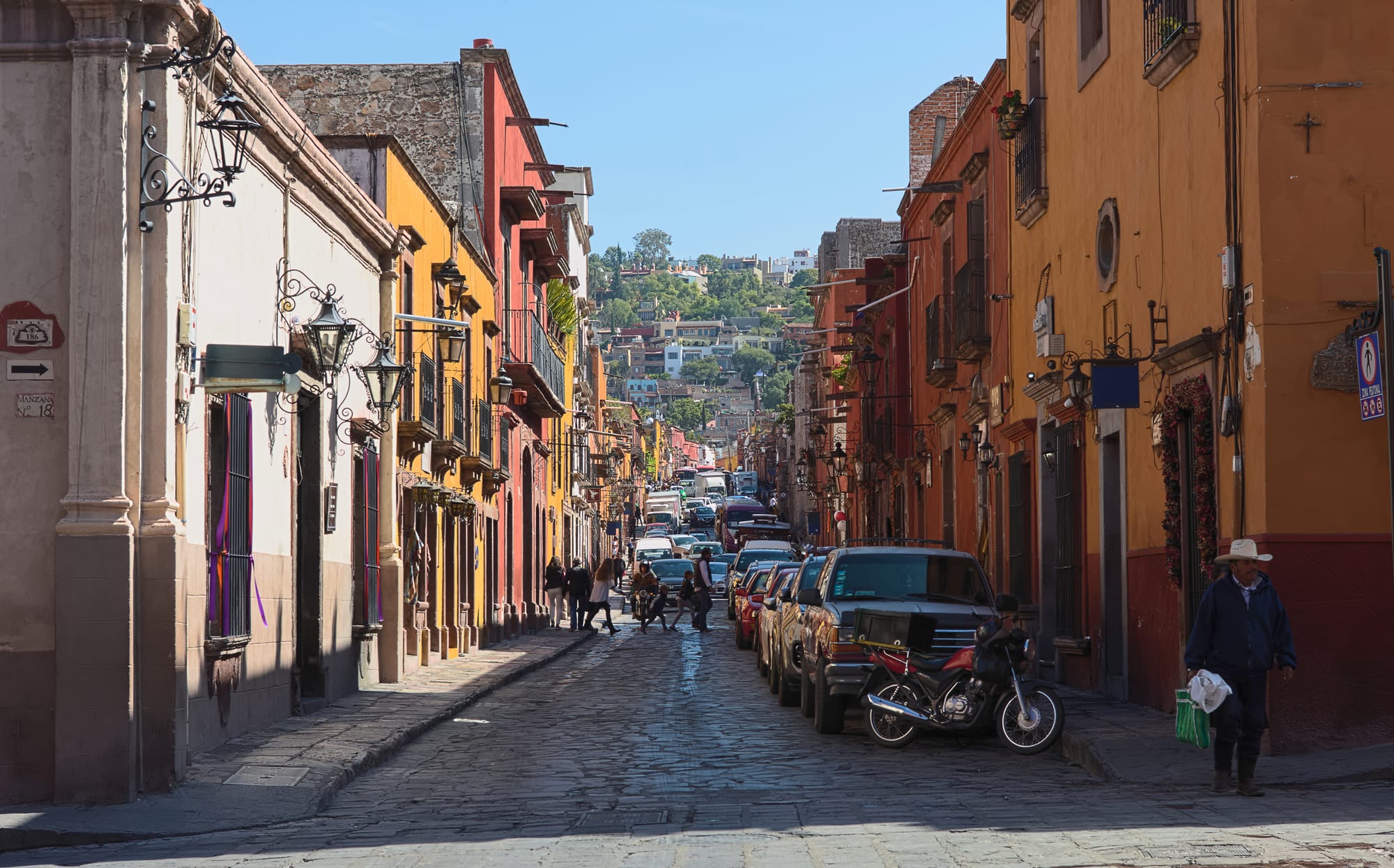
A cobbled street of ochre, red and yellow colonial houses with iron lanterns, climbing towards green hills

The Bajío & the Colonial Heartland, Mexico

San Miguel de Allende

Calle Mesones in the historic centre of San Miguel de Allende, Guanajuato. (Cvmontuy / Wikimedia Commons · CC BY-SA 4.0)

A hill town in eastern Guanajuato, refounded in 1555 on the silver road north from Mexico City, that grew rich in the 18th century and gave the independence war Ignacio Allende. Art schools drew foreign students after 1945, and today its cobbled, UNESCO-listed centre of courtyard houses and the neo-Gothic Parroquia is home to many foreign residents.

Neighbourhoods

  • Centro Histórico
    • First-time visitors
    • Historic district
    • Galleries and nightlife

    The protected core of 64 blocks around the Jardín, with the Parroquia, colonial mansions, churches, galleries, restaurants and more than 80 bars and cantinas. Streets are cobbled and steep in places, and about half the old buildings now hold shops, restaurants, workshops or hotels.

    Open in Maps
  • El Chorro and Parque Juárez
    • Quiet walks
    • Oldest part of town

    The oldest part of the town, around the spring where San Miguel was moved in 1555, with the Santa Cruz del Chorro chapel. Below it lies Parque Juárez, a French-style park of fountains, pools and herons on the southern edge of the centre.

    Open in Maps

Things to do

Churches and landmarks

  • Parroquia de San Miguel Arcángellandmark

    The parish church and emblem of the town, built in the 17th century and given its pink neo-Gothic facade in 1880 by Zeferino Gutiérrez, an indigenous bricklayer and self-taught architect; one of the most photographed churches in Mexico.

    Open in Maps
  • Jardín Allendelandmark

    The main square in front of the Parroquia, shaded by Indian laurel trees, with wrought-iron benches and a kiosk where bands often play at weekends.

    Open in Maps
  • Templo de San Franciscolandmark

    A church begun in 1778 with a Churrigueresque facade of stone figures and a Neoclassical bell tower of 1799 by Francisco Eduardo Tresguerras.

    Open in Maps

Museums, arts and crafts

  • Museo Casa de Allendemuseum

    The 1759 house beside the Parroquia where Ignacio Allende was born, now a regional history museum with rooms kept as they looked in his day.

    Open in Maps
  • Centro Cultural Ignacio Ramírezmuseum

    Bellas Artes, the art school founded in 1938 in an 18th-century convent around a huge courtyard, with galleries and an unfinished mural by David Alfaro Siqueiros.

    Open in Maps
  • Instituto Allendeattraction

    An art institute opened in 1951 in a large former retreat of the De la Canal family, with courtyards, a chapel with colonial-era frescoes and a gallery.

    Open in Maps
  • Fábrica La Auroraattraction

    An old textile mill converted into galleries and shops selling art, furnishings and antiques, with a café and a restaurant.

    Open in Maps
  • Teatro Ángela Peraltaattraction

    The town's main theatre, opened in 1873 and named after the opera singer who inaugurated it, home of the chamber music festival.

    Open in Maps

Gardens and short trips

  • El Charco del Ingeniopark

    A botanic garden on the edge of town with collections of cacti and other plants from the surrounding region.

    Open in Maps
  • Parque Juárezpark

    A park laid out in the early 20th century beside a stream, with fountains, pools, old bridges and many herons.

    Open in Maps
  • Sanctuary of Atotonilcolandmark

    A sanctuary about 14 km north of the town, part of the same UNESCO World Heritage Site, where Hidalgo's insurgent army took up its banner of the Virgin of Guadalupe in 1810.

    Open in Maps
  • Cañada de la Virgenlandmark

    A pre-Hispanic archaeological site in the countryside outside the town.

    Open in Maps

Seasonal events

  • Concheros dancesfirst Thursday and Friday of March

    Dancers from nearby towns in pre-Hispanic regalia dance to drums in honour of the Señor de la Conquista.

  • Holy WeekMarch or April

    Holy Week events begin early with altars to the Virgin of Sorrows, and on Good Friday a Procession of Silence passes through the historic centre.

  • Desfile de LocosJune

    A parade that is one of the town's yearly secular festivals.

  • Chamber Music FestivalAugust

    Concerts in the historic centre, based at the Teatro Ángela Peralta and also taken into streets and public spaces.

  • Fiestas de San Miguellate September

    A week of celebrations around 29 September, the feast of the Archangel Michael, with dances, fireworks castillos on the Jardín and a procession of the saint's image to the town's main churches.

Eat and drink

Long-standing places and food districts in San Miguel de Allende. Hours, ratings and directions come from your maps app, always current.

Markets

  • Mercado Ignacio Ramírezmarket

    A large indoor market a few blocks from the Jardín with fruit and vegetables, meat, flowers and food stalls, next to the alley of the craft market.

    Open in Maps
  • Mercado San Juan de Diosmarket

    The largest indoor market in the historic centre.

    Open in Maps
  • Tianguis de los Martesmarket

    The big Tuesday market on the road out towards Querétaro, with acres of stalls and street food from gorditas and tacos to fresh fruit juices.

    Open in Maps

Restaurants and bars

  • Centro Históriconeighborhood

    Cafés, upscale restaurants and bars ranging from jazz clubs to mariachi bars fill the old houses of the centre.

    Open in Maps

Experience San Miguel de Allende

History

Before the Spanish arrived, the area was the land of Chichimeca peoples. The first Spanish settlement, which took its name from the 16th-century friar Juan de San Miguel, grew up near a Chichimeca village called Itzcuinapan. Attacks by the Guamare, a Chichimeca group, and the lack of water forced a move, and in 1555 the town was refounded about a mile to the east, beside two springs, as a mission and military outpost on the new road between Mexico City and the silver mines of Zacatecas and Guanajuato. It stood at the heart of the Chichimeca War (1540–1590).

Supplying travellers and mining camps, and weaving textiles, made San Miguel rich. By the mid-18th century it was one of the most prosperous towns in New Spain, with a population reaching about 30,000, and most of its mansions and churches date from this time. Ignacio Allende and Juan Aldama, both born here, joined the conspiracy of 1810; after Hidalgo's call to revolt at Dolores, the insurgents took their banner from the sanctuary at Atotonilco and entered San Miguel, which became the first Mexican town to gain its independence from Spain. In 1826 it was renamed San Miguel de Allende.

The 19th century brought decline, and after the end of mining in Guanajuato the town almost emptied. From 1938 the American Stirling Dickinson and the Peruvian Felipe Cossío del Pomar founded art schools, and after the Second World War US veterans came to study on the G.I. Bill. Artists, writers and retirees followed. In 2008 the historic centre and the Sanctuary of Atotonilco were declared a UNESCO World Heritage Site.

Culture & Customs

San Miguel has been known as a haven for artists since the 1950s, when Siqueiros taught at the Escuela de Bellas Artes. The Instituto Allende and Bellas Artes still offer classes, galleries line the centre, and sketch artists sell their work on the street. The town hosts a yearly writers' conference, a free international film festival, the GIFF, with screenings in the Jardín, and a chamber music festival each August.

Most festivals are religious. The week around 29 September honours the Archangel Michael with dances, fireworks and a procession of his image from the Parroquia; concheros dance in March for the Señor de la Conquista, an old image made of corn stalks; and on Good Friday a silent procession passes through the centre. The Grito de Dolores is reenacted each September.

Foreign residents are part of the town's identity. Estimates of their number range from 20,000 to 25,000, at least half from the United States, mostly retirees drawn by the climate and cultural life. They have founded institutions such as the public library in the former convent of Santa Ana, which has the second-largest English-language collection in Mexico and works to build friendships between Mexicans and foreigners. Otomí and Nahua people from rural communities come into town to trade and attend church.

Daily Life

At the 2020 census the town had about 72,000 inhabitants and the municipality about 160,000. Most of the municipality's people live in small rural communities, where most Otomí and Nahua residents live, and about 96 per cent of the population is Catholic.

The economy has shifted from farming and industry towards commerce serving tourists and foreign residents. About half of the colonial buildings in the centre have become shops, restaurants, galleries, workshops or hotels, and with no zoning, homes and businesses stand side by side. The property market has boomed; colonial houses in ruins have sold for more than houses in Mexico City.

Preservation shapes daily life in the centre: building and restoration must keep to the colonial style, the cobbles are maintained, and there are no traffic lights, parking meters or fast-food chains. The Jardín is the town's meeting place. Two springs supplied all the town's water until the 1970s, and several dams in the municipality now manage the water supply.

Food

Daily shopping happens in the markets. The Mercado Ignacio Ramírez, a few blocks from the Jardín, has halls of fruit and vegetables, meat, flowers and cooked food, the Mercado San Juan de Dios is the largest indoor market in the centre, and the Tuesday tianguis on the road out of town fills acres with stalls selling gorditas, tacos and fresh fruit juices alongside clothes and crafts.

The cooking of Guanajuato is on local tables: enchiladas mineras, the miners' enchiladas filled with cheese and served with potatoes and carrots, and cajeta, the goat's-milk caramel associated with nearby Celaya. Dolores Hidalgo, 40 km away, is known for ice creams in unusual flavours.

The centre also has a large international dining scene, built up to serve visitors and foreign residents, with cafés, upscale restaurants and restaurants inside cultural venues such as Bellas Artes and the Fábrica La Aurora. Nightlife runs from jazz clubs and sports bars to cantinas and bars specialising in mariachi.

Planning tools

Budget

San Miguel is the most expensive town in the region: boutique hotels, restaurants and property prices reflect its many foreign residents and weekend visitors from Mexico City. Markets, street food and local buses remain cheap, and most sights are churches and streets that cost nothing to see.

Daily Budget Midrange
USD 100–200 (restored colonial hotel, restaurants, museums, taxis and a trip to Atotonilco)
Daily Budget Shoestring
USD 35–60 (guesthouse or simple hotel, market food and street stalls, walking and local buses)

Book well ahead around Easter, Day of the Dead and Christmas; weekday stays are cheaper.

Best Time to Visit

October to April is dry and clear, with Day of the Dead in early November. March and April bring the Concheros dances and Holy Week processions, late September the town's biggest fiesta. May and June are the hottest months, and the rainy season runs roughly from June to September.

Suggested Number of Days

Two or three days suit the centre, its churches, museums and markets at an unhurried pace. Four or five allow time for the surrounding countryside and the nearby towns of the Bajío, or for a festival.

First Visit
2–3 days
With Surroundings
4–5 days

Transportation

The centre is best on foot; its steep, narrow streets are hard to drive and park in. Taxis are plentiful for the outskirts, and local buses run to places such as the Tuesday market.

Walk or use taxis in the centre rather than driving, and use toll roads and daylight for longer trips.

Airport & Station Connections

San Miguel has no airport of its own. Bajío International Airport near León and Querétaro Intercontinental Airport are the usual gateways, with shuttles and taxis into town. Buses also link the town with other cities of the region.

Walkability

The historic centre is very walkable but hilly: cobbled lanes rise and fall, pavements are narrow and uneven, and some climbs are steep. The Jardín, the main churches, museums and markets are a few minutes apart, and the centre has no traffic lights or parking meters.

Safety

Safety varies enormously by state and even neighbourhood. Guanajuato state has had some of the highest homicide totals in Mexico, concentrated in industrial cities such as Celaya, Salamanca and Irapuato. San Miguel itself is a small town where many residents walk the narrow streets at night in relative safety, and low crime is one of the reasons foreign retirees give for settling here. The usual care with belongings applies in festival crowds.

Stay on the main tourist routes, watch belongings in festival crowds, take official taxis from airports, and travel by day between cities. Check current official travel advice before travelling.

Climate

A highland climate typical of central Mexico, with warm dry days, cool nights and a summer rainy season. Specific figures for the town are not given in the sources used here, so those below are the region's.

Summer
about 24–30°C by day across the plateau, with afternoon showers; in May and June daytime temperatures in San Miguel can reach 35°C
Winter
dry and sunny days of about 18–24°C across the plateau, with cold nights

Local Customs

The town is overwhelmingly Catholic, with processions, pilgrimages, ringing bells and fireworks through the year, and the churches are working places of worship. Spanish is the language of daily life, and many Spanish schools serve visitors. Tipping is customary in sit-down restaurants.

Dress modestly in churches, keep quiet during services and processions, and ask before photographing people, including Otomí and Nahua visitors from rural communities.

Common Payment Methods

The currency is the Mexican peso (MXN). Cards are widely accepted in hotels, restaurants and galleries, and there are ATMs in the centre. Cash is needed in markets, at street stalls and for taxis.