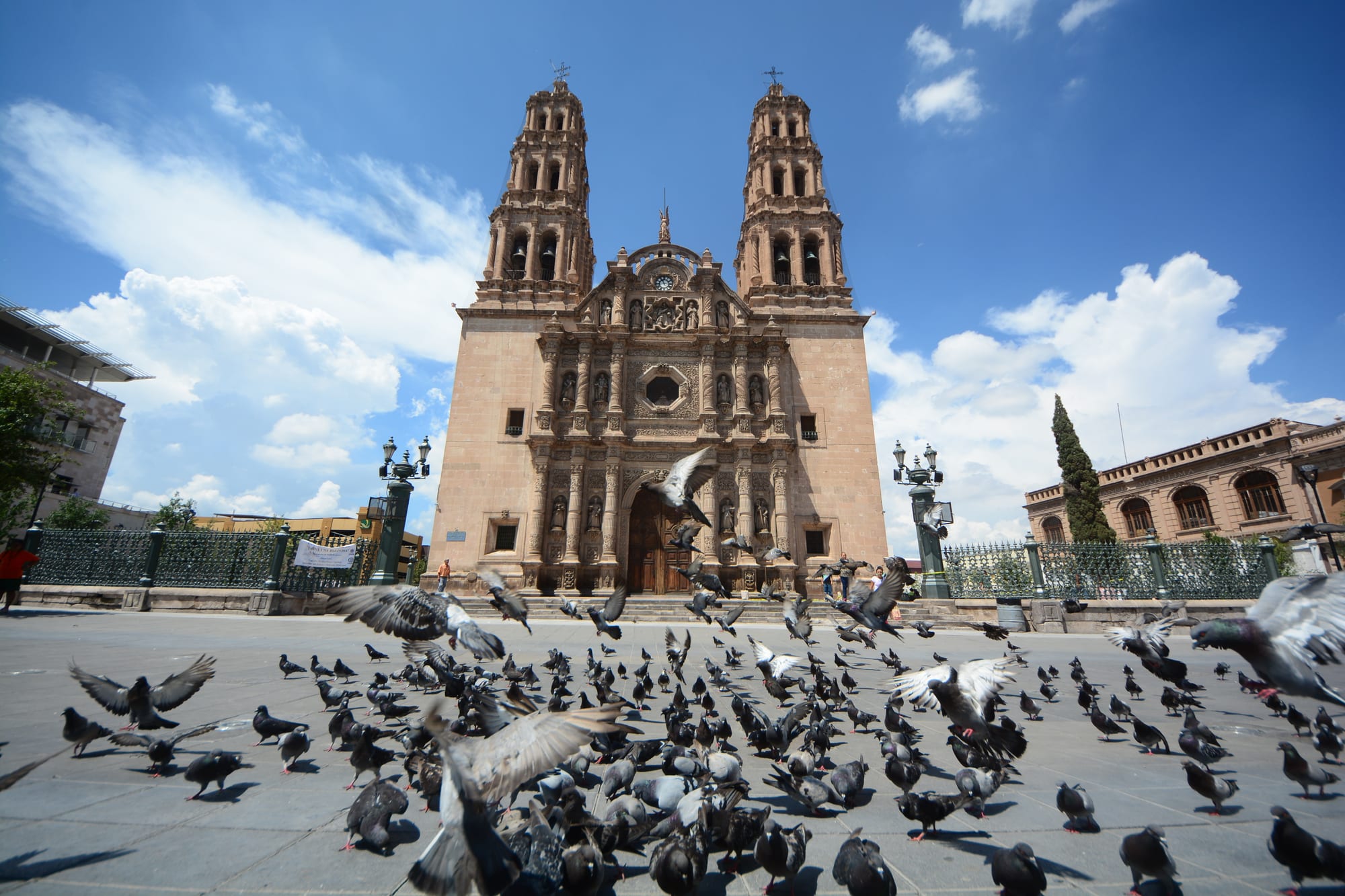
The twin-towered stone baroque cathedral of Chihuahua under a blue sky, with a flock of pigeons on the square in front

Sonora, Chihuahua & the Northwest, Mexico

Chihuahua

The Cathedral of Chihuahua on the Plaza de Armas, in the centre of Chihuahua City. (Comisión Mexicana de Filmaciones from México D. F., México / Wikimedia Commons · CC BY-SA 2.0)

The capital of Mexico's largest state, on the high western edge of the Chihuahuan Desert where two rivers meet. Founded in 1709 on the silver of nearby Santa Eulalia, it was a refuge for Benito Juárez and a base for Pancho Villa, and today it is a prosperous industrial city with a pedestrianised historic centre.

Neighbourhoods

  • Historic downtown
    • First-time visitors
    • Historic district
    • Museums

    The old centre around the Plaza de Armas and the cathedral, with the Government Palace, the former Federal Palace, the Casa Juárez and the Quinta Gameros. Much of the centre is pedestrianised, including the Libertad Street pedestrian way.

    Open in Maps
  • Avenida Zarco and the old mansions
    • Architecture
    • Quiet and residential

    A residential avenue near the centre where some of the most impressive pre-revolutionary houses in the city stand, a reminder of the wealth of the Porfirian era.

    Open in Maps
  • Periférico de la Juventud
    • Shopping
    • Modern city
    • Restaurants

    The ring road on the city's western side, lined since the early 2000s with shopping malls, chain restaurants, offices and newer residential districts.

    Open in Maps

Things to do

Famous landmarks

  • Cathedral of Chihuahualandmark

    Built between 1725 and 1792 with a tax on silver from the Santa Eulalia mines, it is considered perhaps the finest example of colonial architecture in northern Mexico; a museum of sacred art occupies its crypt.

    Open in Maps
  • Government Palacelandmark

    The 19th-century seat of the state government, with murals of Chihuahua's history and a shrine marking the place where Miguel Hidalgo was executed in 1811.

    Open in Maps
  • San Francisco Templelandmark

    One of the few colonial monuments left in the centre, a plain white Franciscan church on Calle Libertad and the original burial place of Miguel Hidalgo.

    Open in Maps
  • Templo de Santa Ritalandmark

    The church of the city's patron saint, Rita of Cascia, dating from 1731, one of the oldest churches in Chihuahua.

    Open in Maps
  • The colonial aqueductlandmark

    Surviving stretches of the 18th-century aqueduct of stone arches that carried water to the town; the Parque Acueducto below the Chuvíscar dam shows several sections among paths and trees.

    Open in Maps

Museums

  • Francisco Villa Museummuseum

    The Historical Museum of the Mexican Revolution, in the house known as Quinta Luz, Villa's former home, which his widow María Luz Corral left to become a museum; the car in which he was killed is on show.

    Open in Maps
  • Museo Casa Chihuahuamuseum

    The early 20th-century former Federal Palace, now a cultural heritage centre with travelling exhibitions and, in the basement, the cell where Miguel Hidalgo was held.

    Open in Maps
  • Museo Casa Juárezmuseum

    The Museum of Republican Loyalty, the house where President Benito Juárez kept his government from 1864 to 1866 during the French intervention, restored to its appearance at the time.

    Open in Maps
  • Quinta Gamerosmuseum

    An Art Nouveau mansion and national historic monument, now the university's cultural centre and a regional museum, furnished with Art Nouveau pieces.

    Open in Maps

Parks and the city

  • El Palomar Central Parkpark

    The largest park in the city, made on the site of what was once one of its poorest districts.

    Open in Maps
  • Plaza Mayorlandmark

    A square of fountains, gardens and monuments to local heroes, centred on the Angel of Liberty, built in 2003.

    Open in Maps

Short trips from the city

  • Nombre de Dios Grottoesattraction

    A cave system of mineral formations in the Sierra de Nombre de Dios on the north-eastern edge of the city, close to the Sacramento River.

    Open in Maps
  • Santa Eulaliaattraction

    One of the oldest settlements in the state, founded in 1652, whose silver mines led to the founding of Chihuahua; the mines later produced zinc and lead.

    Open in Maps
  • Cuauhtémocattraction

    A city west of the capital that grew after Mennonite farmers arrived in the 1920s, known as the City of Three Cultures and the centre of the state's Mennonite community.

    Open in Maps

Seasonal events

  • Feria Internacional Santa RitaMay

    The fair of the city's patron saint, combined since 2013 with the Expogan livestock show, with concerts by internationally known recording artists.

  • International Festival of ChihuahuaSeptember and October

    A state and city arts festival held since 2005, with exhibitions, theatre and concerts.

Eat and drink

Long-standing places and food districts in Chihuahua. Hours, ratings and directions come from your maps app, always current.

Food districts

  • Historic downtown and Calle Libertadneighborhood

    Restaurants, cafés and snack stalls around the cathedral and along the pedestrian Libertad Street, the busiest place to eat in the centre.

    Open in Maps
  • Downtown mansion nightlifeneighborhood

    Some of the large pre-revolutionary houses downtown have become nightclubs and dance halls, many with Chihuahua's live bands.

    Open in Maps
  • Periférico de la Juventudneighborhood

    The main strip of chain and family restaurants in the newer, western part of the city.

    Open in Maps

Experience Chihuahua

History

Chihuahua grew from silver. Mines were found at Santa Eulalia in 1652, and a second rush followed new finds in 1707, but the mining camp sat in rough hills with no room to grow. On 12 October 1709 the governor of Nueva Vizcaya, Antonio Deza y Ulloa, settled a tied vote by choosing the valley where the Chuvíscar and Sacramento rivers meet, and the Real de Minas de San Francisco de Cuéllar was founded there. It became the town of San Felipe el Real de Chihuahua in 1718, and a special tax on Santa Eulalia's silver paid for its great church, now the cathedral. Governors preferred to live here rather than in Durango, the official capital.

The town has seen many turning points in Mexican history. Miguel Hidalgo, the priest who launched the independence war, was imprisoned here and shot in 1811. United States troops occupied the city after the Battle of Sacramento in 1847, and in 1864–66 Benito Juárez made it the seat of his government during the French intervention. In the Porfiriato, after the railway arrived in 1882, it grew rapidly into one of the most important cities in Mexico. In the Revolution it was the base of Pancho Villa's División del Norte, and Villa served as governor of the state from December 1913.

In the 20th century Chihuahua lived on cattle and trade until foreign-owned factories arrived in the 1970s. Many colonial buildings were destroyed in the 1970s to widen streets, and in 1983 the opposition National Action Party won the city for the first time. Much of the historic centre has since been pedestrianised.

Culture & Customs

Chihuahua is at the heart of norteño identity: ranch culture, cowboy hats and boots, plain speaking and pride in the north's role in the Revolution. Pancho Villa is the city's great hero, remembered at his former home, now the revolution museum, and at a mausoleum in the Parque de la Revolución. Miguel Hidalgo and Benito Juárez have their own places of memory in the palaces and museums downtown, and the murals of the Government Palace and the university auditorium tell the history of the state.

Public art is a point of pride. Sculpture lines the main boulevards, including works by the Chihuahuan sculptor Sebastián. The patron saint, Rita of Cascia, gives her name to the city's big annual fair in May, now combined with a livestock show and famous for its concerts, and the International Festival of Chihuahua brings art, theatre and music in September and October. The university symphony orchestra plays at the Paraninfo in summer, and bullfights are held at the La Esperanza bullring in summer and autumn.

The state's Indigenous Rarámuri and its Mennonite farming communities are also part of Chihuahua's identity. Sport includes the Dorados basketball team and the Caudillos American football team.

Daily Life

The 2020 census counted about 925,000 people in the city and about 990,000 in the metropolitan area. Chihuahua ranks among the highest cities in Mexico for human development, literacy is about 98 per cent, and it is rated among the six Mexican cities with very high urban competitiveness.

Industry dominates. Nine major industrial parks hold foreign-owned maquiladora plants making electrical and electronic components for export, alongside domestic heavy industry and consumer goods. Chihuahua is the largest maquiladora centre away from the border, attracting companies that want quick access to the United States without the border's higher costs. Universities such as the Autonomous University of Chihuahua and the Instituto Tecnológico train engineers and managers, and a growing middle class fills the malls along the Periférico de la Juventud.

The city spreads in an L-shape across plains and around three hills, with new gated developments, called fraccionamientos, built on its edges every year. Downtown stays busy by day with shoppers on Libertad Street, and in the evening some of the old mansions turn into dance halls with live bands. The Chuvíscar and Chihuahua dams supply water and hold back floods, and water shortages are a constant issue in the desert cities of the region.

Food

This is beef country. Carne seca, dried beef, is the classic local ingredient; shredded, as machaca, it is scrambled with eggs, and flour tortillas are the northern staple, wrapped around burritos. Dishes in red chile colorado sauce and grilled meats are everywhere, and pan de elote, a corn bread, and chacales appear on the table too. Other northern dishes include lentils, capirotada, chile con queso and discada.

Chihuahua's Mennonite farmers, centred on Cuauhtémoc to the west, make a mild melting cheese sold as queso menonita or queso Chihuahua. The state is also the country's leading producer of apples and nuts.

Sotol, distilled from the desert spoon plant, is the traditional drink of the state; tesgüino, the corn beer of the Rarámuri, belongs to the sierra. The city's restaurants range from northern grills and Chinese buffets to international fast-food chains, many on Libertad Street downtown or the Periférico de la Juventud.

Planning tools

Budget

Chihuahua is a business city, and its hotels are good value by Mexican standards. Museums in the centre are inexpensive, the historic downtown is free to wander, and grilled beef and northern food cost less than in the resort towns. The expensive part of a trip here is usually the Copper Canyon train and lodges further west.

Daily Budget Midrange
USD 80–180 (business hotel, restaurant meals, museum entries, taxis or ride-hailing)
Daily Budget Shoestring
USD 30–50 (budget hotel east of the cathedral, taquerías and markets, city buses)

Prices rise during the Santa Rita fair in May; downtown hotels are the most convenient base for the museums.

Best Time to Visit

March to May and October to November are the transitional months, with warm days and cool nights. June is the hottest month; July and August bring afternoon storms. Winters are mild and sunny by day, with frost at night.

Suggested Number of Days

One or two days cover the historic centre and the main museums. Three or four allow for the caves and mining towns nearby or the Mennonite country to the west; most visitors also continue to the Copper Canyon, which needs several more days.

First Visit
1–2 days
With Surroundings
3–4 days

Transportation

The Bowí bus rapid transit line crosses the city, with supplementary routes into the suburbs, and taxis, Uber and DiDi are widely used. A tourist trolley bus, the Trolley el Tarahumara, starts at the Plaza de Armas and links the main museums and monuments.

Use registered taxis or ride-hailing apps after dark rather than hailing cars on the street.

Airport & Station Connections

Chihuahua International Airport is about 12 km north-east of the city centre, with national and international flights. The large intercity bus station serves cities across Mexico. Highway 45 runs north to Ciudad Juárez and the border, and highway 16 west towards the sierra and east to Ojinaga. The city is the eastern end of the Chepe railway to Los Mochis; the tourist Chepe Express now starts in Creel, while the slower Chepe Regional still serves Chihuahua, so current timetables need checking.

Walkability

The historic downtown is compact, and much of it has been pedestrianised, so the cathedral, palaces and Casa Juárez are a short walk apart. The Villa museum lies near the centre, a short taxi ride away. Beyond the centre the city is spread out and built around the car.

Safety

Safety varies enormously by state and even neighbourhood. The northwest is one of the parts of Mexico most affected by organised-crime violence; Ciudad Juárez, the border towns and remote parts of the Sierra Tarahumara see serious violence. Central Chihuahua City receives visitors. Drug-related murders rose in the city in the late 2000s, and property crime and murder have fallen since 2010, but the situation can change quickly.

Keep to busy central areas after dark, use registered taxis or apps, withdraw cash inside banks and malls, and travel between cities by day on toll roads. Check current official travel advice before travelling.

Climate

On the western side of the Chihuahuan Desert, the city has a hot semi-arid climate, milder than the lower desert to the east. It is sunny most of the year, with most rain falling in summer storms.

Summer
hot — June averages 33°C by day and 19°C at night, sometimes passing 38°C; July and August average about 30°C with afternoon storms
Winter
mild days of about 18°C in January, nights around 2°C, and snow about twice a year

Local Customs

Chihuahuenses are proud of their northern identity, their role in the Revolution and their ranching heritage, and boots and hats are common. A tip of 10–15 per cent is usual in restaurants, less so at street stands. Hats and sunglasses come off on entering a church, and the formal usted is the polite way to address strangers.

The legal drinking age in Mexico is 18; drinking in the street is illegal in many places and can lead to a night in jail.

Common Payment Methods

The currency is the Mexican peso. Cards are widely accepted in hotels, restaurants, malls and larger shops; cash is needed for markets, street food, small shops and tips. Use cash machines inside banks and shopping centres.