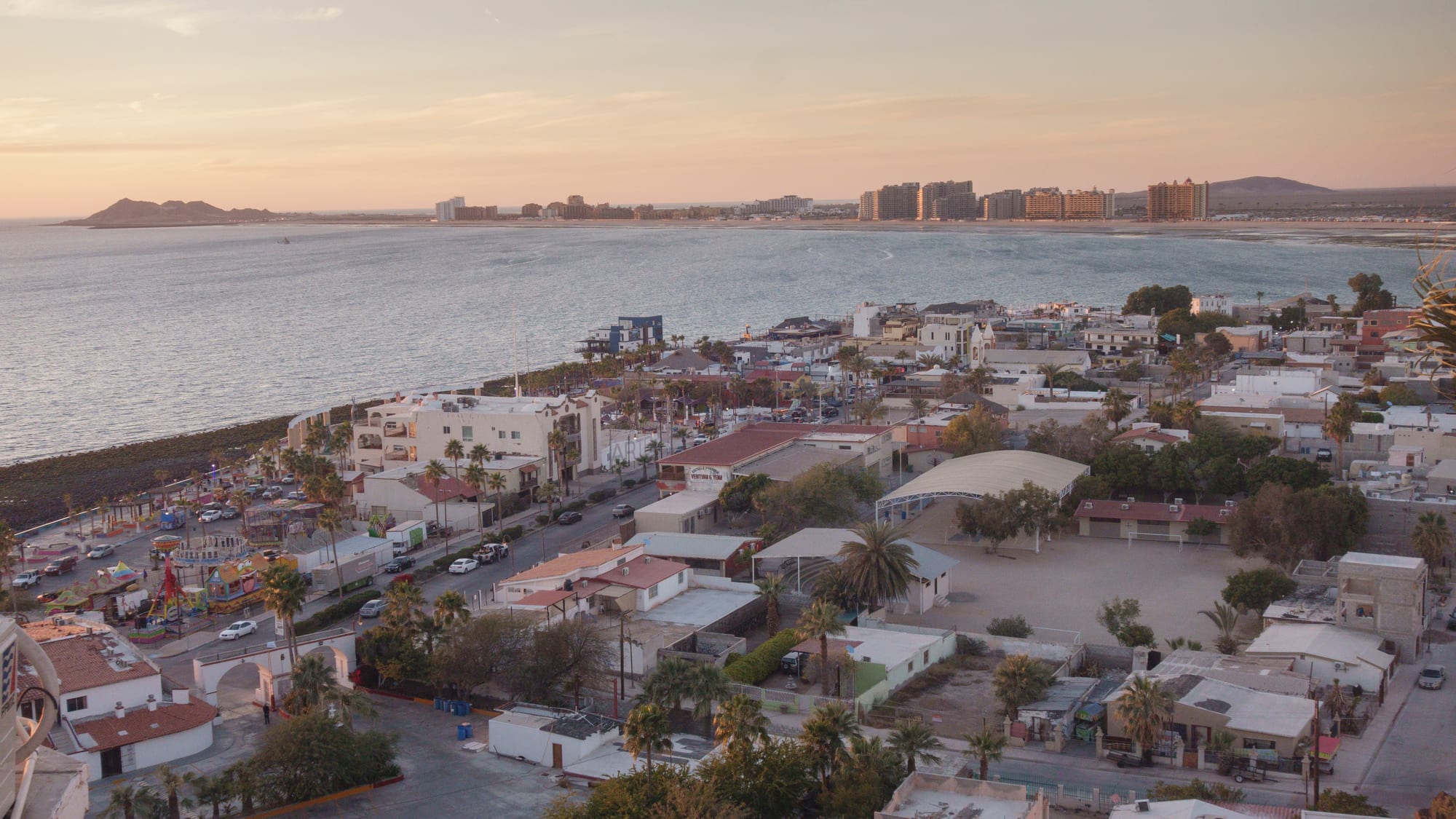
Low-rise houses and palm trees of Puerto Peñasco beside a calm bay at sunset, with high-rise towers along the far shore

Sonora, Chihuahua & the Northwest, Mexico

Puerto Peñasco

Puerto Peñasco at sunset, looking north from Whale Hill towards the Sandy Beach towers and Cholla Bay. (Nhartmannphotos / Wikimedia Commons · CC BY-SA 4.0)

A fishing port on the northern shore of the Sea of Cortez in Sonora's Altar Desert, about 100 km south of the Arizona border. Known in English as Rocky Point and nicknamed 'Arizona's Beach', it grew from a shrimp town into a resort of beaches, condominiums and tide pools beside the volcanic Pinacate desert.

Neighbourhoods

  • The Old Port
    • First-time visitors
    • Best for food
    • Nightlife

    The oldest part of town, between the sea and Whale Hill (Cerro de la Ballena). The Malecón Kino, the fish market, curio shops, seafood restaurants and bars give it the most local character.

    Open in Maps
  • Sandy Beach
    • Beaches
    • Resort stays

    The long sandy shore north-west of town, where most of the newer development stands: high-rise condominiums, resorts, golf courses, restaurants and bars along a couple of miles of beach.

    Open in Maps
  • Playa Mirador and Las Conchas
    • Tide pools
    • Quiet and residential

    The beaches south-east of Whale Hill. Playa Mirador is the oldest developed beach, with rock reefs that become tide pools at low water; further on, the Las Conchas area of beach houses and condominiums reaches towards the Morúa estuary.

    Open in Maps
  • Cholla Bay
    • Quiet and residential
    • Sand dunes

    A small bay community about 8 km north-west of town beyond Sandy Beach, long popular with American and Canadian residents, close to the dunes where quad bikes are hired.

    Open in Maps

Things to do

The town and the sea

  • Malecón Kino and the fish marketmarket

    The seafront walk of the Old Port, lined with curio shops, restaurants and bars, beside the fish market that sells the day's catch, above all shrimp in season.

    Open in Maps
  • Cerro de la Ballenaviewpoint

    Whale Hill, the rocky hill above the port that separates the town's two stretches of beach, with views over the bay, Sandy Beach and the desert coast.

    Open in Maps
  • CET-MAR Aquariumattraction

    A marine research centre open to the public, with displays of sea turtles, octopus and many fish species from the gulf.

    Open in Maps
  • Centro de Estudios del Desiertomuseum

    The University of Sonora's centre for desert studies, with its scientific research centre, both open to visitors; the work began in 1963 with the University of Arizona to find ways to desalinate seawater.

    Open in Maps

Beaches and tide pools

  • Sandy Beachbeach

    The main resort beach, known for its light brown sand, with boat trips, fishing and water sports.

    Open in Maps
  • Playa Mirador tide poolsbeach

    At low tide the sea, which can rise and fall by several metres here, uncovers pools in the volcanic rock reefs where many kinds of sea life can be found.

    Open in Maps
  • Estero Morúapark

    An estuary east of Las Conchas where thousands of birds live, including migratory species.

    Open in Maps

Short trips from the town

  • El Pinacate y Gran Desierto de Altarpark

    A biosphere reserve and UNESCO World Heritage Site north of the town, with volcanic peaks, great maar craters such as El Elegante and wide fields of active dunes, home to pronghorn, bighorn sheep and desert tortoises.

    Open in Maps

Seasonal events

  • Fishing festivalJune, from Navy Day on 1 June

    The town's annual fishing festival, with mariachis, folk dancing and a festival queen.

  • Spring breakspring

    High school and college students from Arizona and California come for the beaches and nightlife; Avenida Matamoros near Playa Mirador was once famous as the party street.

Eat and drink

Long-standing places and food districts in Puerto Peñasco. Hours, ratings and directions come from your maps app, always current.

Food districts and markets

  • The fish marketmarket

    The market on the malecón where locals and visitors buy the fresh catch, especially during the shrimp season from September to March.

    Open in Maps
  • Old Port restaurantsneighborhood

    Seafood restaurants and bars along the malecón in the Old Port, some with sunset views over the sea.

    Open in Maps
  • Cholla Bayneighborhood

    A historic, casual cantina and other bars and restaurants in the bay community favoured by American and Canadian residents.

    Open in Maps

Experience Puerto Peñasco

History

For centuries this stretch of desert coast had no permanent town, because there was no fresh water. Fishermen from Guaymas, Bahía Kino and other ports camped here in season, chasing the totoaba, a large fish prized not for its meat but for use in medicine, and anglers from Arizona came as early as the 19th century. In 1826 Robert William Hale Hardy, a retired British naval officer searching for pearls and precious metals, named the headland Rocky Point, the name that appeared on sea charts until President Lázaro Cárdenas changed it to Puerto Punta Peñasco. The rock in question is solidified lava from ancient eruptions that reached the sea.

Under Cárdenas in the 1930s a railway was built to link Baja California with the rest of Mexico, passing through the port. A police post was set up in 1932, the town was laid out in the 1940s, and shrimp fishing became the mainstay of the economy. Puerto Peñasco became a municipality of its own in 1952.

The push to make the town a major resort began in 1993, when government and private investors began building condominiums and facilities, inspired by Cancún and prompted by falling catches caused by overfishing and pollution. The town was included in the border free zone so that foreigners could drive in without a visa, and the federal government paid for roads and other infrastructure. Economic growth reached twelve per cent between 2002 and 2007 before the US downturn hit the property market. A cruise ship terminal begun in 2014 has been halted for financial reasons.

Culture & Customs

Puerto Peñasco lives between two countries. It is known in English as Rocky Point and as "Arizona's Beach", since Phoenix, Tucson and Yuma are closer than Mexicali or Hermosillo, and it has been called the most American city in Mexico. Many residents are retirees from the United States and Canada, some living in trailers and RVs, and English is heard in shops, restaurants and the town's English-language newspapers.

The port's Mexican identity rests on the sea. The fishing festival begins every year on Navy Day, 1 June, with mariachis, folk dancing and the crowning of a festival queen, and fishing tournaments are part of the calendar. Shell jewellery, ironwork and carved ironwood are the local crafts; the ironwood carvings are a tradition of the Seri people of the Sonoran coast.

Spring break gives the town another face. High school and college students from Arizona and California come for the beaches and for the legal drinking age of 18, and Avenida Matamoros near Playa Mirador was long famous as the party street. Science has a place too: the University of Sonora's desert studies and research centres grew from a 1963 desalination project with the University of Arizona, and an experimental unit founded in 1973–74 to research shrimp raising has led the development of shrimp farming techniques in Mexico.

Daily Life

The 2020 census counted about 63,000 people in the city, the eighth-largest locality in Sonora, and the population has doubled since 2000 because of tourism.

Tourism and fishing are the main sources of work. The town has more than a hundred restaurants, dozens of hotels and motels and many RV parks, and beachfront condominium developments have spread along Sandy Beach, Las Conchas and Cholla Bay since the 1990s. The fishing fleet still works from the port, and shrimp remains the prized catch. Two general hospitals and several smaller colleges, including a technological institute and a technological university, serve the town.

Much of the visitor trade comes by road from Arizona and California, and the town is at its busiest at spring break. The city spreads from the Old Port at Whale Hill along the coast in both directions, with flat streets of houses, shops and condominiums on the volcanic rock and sand of the desert shore.

Food

Seafood is the heart of the local table. Shrimp from the northern gulf is the town's pride, sold fresh at the fish market on the malecón during the season from September to March and served in the Old Port's seafood restaurants. Fish tacos, ceviche and aguachile, raw shrimp cured in lime and chilli with cucumber and red onion, are found all along the coast.

Inland flavours are Sonoran and built on beef: carne seca and machaca, dried shredded beef, often scrambled with eggs at breakfast, burritos and carne con chile colorado. Coyotas are large, flat cookies traditionally filled with brown sugar, and bacanora, an agave spirit made in the Sonoran town of the same name, is the local drink alongside Mexican beer.

Restaurants range from seafood places on the malecón with sunset views over the Sea of Cortez to American-style bars and cafés serving the town's many North American residents, and Cholla Bay has a long-established cantina popular with expatriates.

Planning tools

Budget

Puerto Peñasco is cheaper than the big Mexican resorts, and many visitors drive down and rent a condominium, which keeps costs down for groups and families. Seafood bought at the fish market or eaten in Old Port restaurants is good value. US dollars are widely accepted, but paying in pesos usually works out cheaper.

Daily Budget Midrange
USD 80–180 (condominium or beach hotel, seafood restaurants, a boat trip or quad hire)
Daily Budget Shoestring
USD 30–60 (RV park, camping or a budget motel, tacos and fish market meals, local taxis)

Spring break brings the biggest crowds; quieter times suit families and anyone looking for a calm beach.

Best Time to Visit

October to May is the comfortable season, with warm days on the coast. Spring break brings crowds of students. Summer is very hot, with temperatures of 40°C common, and the warm gulf water keeps nights hot and muggy. Shrimp season runs from September to March.

Suggested Number of Days

Two or three days cover the town, a beach and the tide pools. Four or five allow for a day in the desert reserve and slower beach days; many visitors from Arizona simply come for a long weekend.

First Visit
2–3 days
With Surroundings
4–5 days

Transportation

Most visitors drive down from Arizona and get around by car. Local taxis can be called by hotels or flagged on the main streets, and tourist taxis serve the Sandy Beach area. Quad bikes are hired for the dunes near Cholla Bay, and boat operators run fishing, snorkelling and wildlife trips.

All drivers in Mexico need Mexican car insurance; buy it before crossing the border.

Airport & Station Connections

Puerto Peñasco is about 100 km south of the US border; most visitors cross from Lukeville, Arizona, to Sonoyta and drive the last stretch in about an hour. Phoenix and Tucson are both about four hours away by road. The town is in the border free zone, so foreign visitors can drive in without a visa, though a passport is still needed. The privately funded Mar de Cortés International Airport opened in 2009 but has had only intermittent, seasonal airline service and no regularly scheduled flights.

Walkability

The Old Port and the malecón are compact and easy to walk, and the beaches are good for long walks at low tide. The town is spread along the coast, however, and Sandy Beach, Las Conchas and Cholla Bay are a drive or taxi ride from the centre. Summer heat makes walking hard in the middle of the day.

Safety

Safety varies enormously by state and even neighbourhood. Puerto Peñasco is a busy resort, but the northwest as a whole is one of the parts of Mexico most affected by organised-crime violence, and the situation can change quickly. The sea and the sun are everyday hazards: tides here rise and fall by several metres, and summer heat is extreme.

Drive the border road by day, watch the tide when exploring the rock pools, drink plenty of water in summer, and use registered taxis. Check current official travel advice before travelling.

Climate

A hot desert climate with only about ten days of rain a year. The warm northern gulf keeps the town warmer than Pacific coast cities, but cooler in summer than the inland desert, while the humidity makes the heat feel worse. Hurricanes reach this far north only rarely.

Summer
very hot, with 40°C common, hot and muggy nights and high humidity
Winter
mild and sunny, with the region's coastal figures of 18–26°C; the yearly average low is about 17.5°C and frost is rare

Local Customs

Puerto Peñasco is described as one of the most American towns in Mexico: many residents are from the United States or Canada, most restaurants have menus in English and English-language newspapers are published here. A tip of 10–15 per cent is usual in restaurants. The legal drinking age is 18, which draws students on spring break.

Drinking in the street is illegal in many places in Mexico and can lead to a night in jail; hats and sunglasses come off in church.

Common Payment Methods

The currency is the Mexican peso, but most businesses also accept US dollars. Cards are taken at hotels, condominium rentals and larger restaurants; cash is useful for the fish market, taxis, street food and tips. Withdraw pesos from ATMs inside banks.