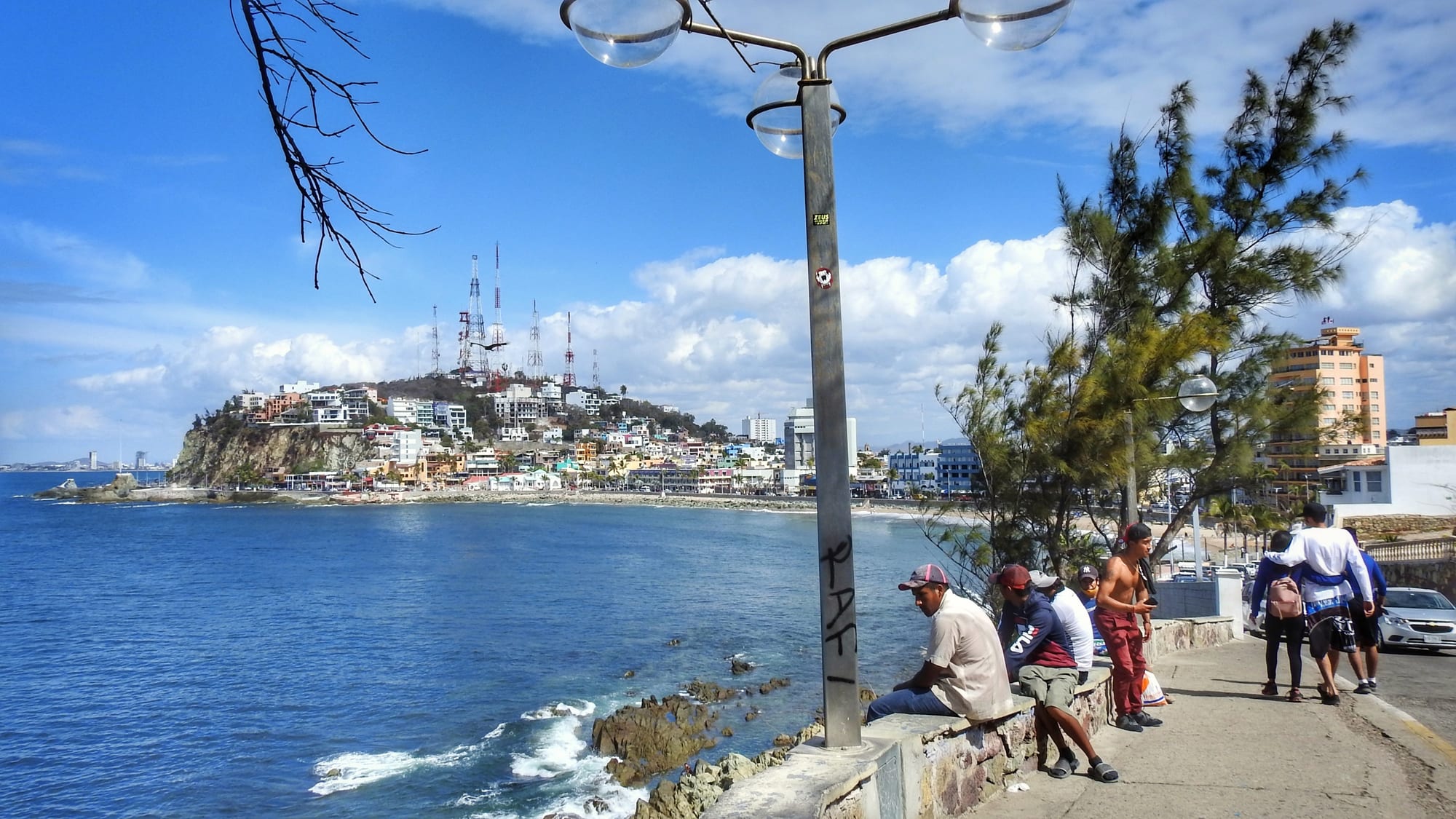
A seafront promenade above rocks and blue water, with a rocky headland of hillside houses and radio masts across the bay

Sonora, Chihuahua & the Northwest, Mexico

Mazatlán

The seafront promenade at Olas Altas, in the old part of Mazatlán. (Dennis Sylvester Hurd / Wikimedia Commons · Public domain)

A Pacific port in southern Sinaloa, across the water from the southern tip of Baja California. Silver-era trade, German immigrants and the Pacífico brewery made the old town; sport fishing and beach hotels made the resort. Today a restored historic centre, a long seafront malecón and a busy fishing fleet sit side by side.

Neighbourhoods

  • Centro Histórico
    • First-time visitors
    • Historic district
    • Best for food

    The old port's grid of plazas and restored 19th-century merchants' houses, declared a Heritage of the Nation in 2001. The cathedral, the Ángela Peralta Theatre and the restaurants around Plazuela Machado are here, and the Mercado Pino Suárez still serves local shoppers.

    Open in Maps
  • Olas Altas
    • Seafront
    • Historic district

    The oldest stretch of the malecón, at the southern edge of the old town, where hotels flourished in the 1940s to 1960s. A short beach, monuments along the promenade and the walk towards the lighthouse headland give it a quieter, older feel than the hotel strip.

    Open in Maps
  • Zona Dorada
    • Beaches
    • Nightlife
    • Resort hotels

    The Golden Zone, the hotel district that grew up on the beaches north of the old city from the 1970s. Large resort hotels, bars, shops and restaurants line the Camarón Sábalo avenue behind the sand.

    Open in Maps
  • Isla de la Piedra
    • Beaches
    • Day trips

    Stone Island, in fact a peninsula across the harbour mouth from the old city, reached by small passenger ferries or by road. It is known for a long sandy beach, coconut groves and simple seafood restaurants.

    Open in Maps

Things to do

The historic centre

  • Mazatlán Cathedrallandmark

    The Cathedral Basilica of the Immaculate Conception, begun in 1856 and completed in 1899, a three-naved church with an octagonal dome in the heart of the old town.

    Open in Maps
  • Teatro Ángela Peraltalandmark

    A theatre of the Porfirian era named after the opera singer who died in Mazatlán in 1883, restored and declared part of the nation's historical heritage in 1990.

    Open in Maps
  • Plazuela Machadolandmark

    One of the city's oldest squares and its first designed as a place for leisure, surrounded by restored buildings, café tables and the theatre.

    Open in Maps
  • Centro Municipal de las Artesattraction

    The city's art school, in the old Hotel Iturbide beside the theatre and facing Plazuela Machado, a gathering place for local artists and musicians.

    Open in Maps
  • Museo de Artemuseum

    The city's art museum in the historic centre, one of the museums opened when the old town was restored around 1990.

    Open in Maps

The malecón and the beaches

  • The Malecóntrail

    A seafront promenade of about 8.5 km, among the longest in the world, running from the lighthouse past Olas Altas and the Puerto Viejo bay towards the Golden Zone, lined with monuments, cliffs and historic buildings.

    Open in Maps
  • El Faroviewpoint

    The lighthouse on Cerro del Crestón, first lit in 1879 and often described as the highest natural lighthouse in the world, a claim that is disputed; a path climbs to it for wide views over the city and the sea.

    Open in Maps
  • Olas Altas beachbeach

    The beach with the longest history in Mazatlán, a short stretch beside the old town with monuments along the promenade above it.

    Open in Maps
  • Playa Nortebeach

    The beach along the north-western edge of the downtown district, with the fishermen's monument and the monument to the city's pulmonía taxis on the promenade.

    Open in Maps
  • Isla de la Piedra beachbeach

    A beach that runs for miles on the peninsula south of the harbour, with coconut groves, boat trips and horseback riding, reached by ferry or water taxi.

    Open in Maps
  • Gran Acuario Mazatlánattraction

    A large aquarium opened in 2023 in place of the city's older aquarium of 1980.

    Open in Maps
  • Observatorio 1873park

    A former military lookout turned weather and earthquake observatory in 1873, opened to visitors in 2020 with an agave garden, a whale museum, an aviary and a zip line.

    Open in Maps

Markets and sport

  • Mercado Pino Suárezmarket

    The municipal market of the historic centre, the commercial hub of the port in the early 20th century, with meat and fruit stalls at its centre and crafts around them.

    Open in Maps
  • Estadio Teodoro Mariscalattraction

    The baseball stadium of the Venados de Mazatlán, rebuilt in 2018, where the Mexican Pacific League season runs from October through the winter.

    Open in Maps

Short trips from the city

  • El Queliteattraction

    A small town about 38 km north-west of the city, noted for its colonial architecture.

    Open in Maps
  • Concordiaattraction

    A former mining town founded in 1565, known for its wooden furniture, the giant chair in its plaza and the ornate baroque church of San Sebastián.

    Open in Maps
  • Copalaattraction

    A four-century-old silver-mining town, founded in 1565 after prospectors found silver veins.

    Open in Maps

Seasonal events

  • Carnaval de MazatlánFebruary or March, the five days before Ash Wednesday

    One of the most important carnivals in Mexico, with float parades along the seafront, the crowning of a queen, giant figures called monigotes around the city, a re-enacted naval battle against the French and banda music everywhere.

  • International Motorcycle WeekEaster week

    A gathering that brings thousands of motorcyclists from across Mexico and abroad.

  • Festival Cultural Mazatlánwinter

    The city's annual arts festival, created as part of the restoration of the historic centre.

  • José Limón International Dance Festivalspring

    An annual international dance festival, one of the city's main cultural events.

  • Pacific International Marathonlate November or early December

    An annual marathon that draws runners from Mexico and abroad.

Eat and drink

Long-standing places and food districts in Mazatlán. Hours, ratings and directions come from your maps app, always current.

Food districts and markets

  • Mercado Pino Suárezmarket

    The historic centre's market, with meat, fruit and food stalls used by local residents.

    Open in Maps
  • Plazuela Machadoneighborhood

    Restaurants and cafés with tables on and around the restored square, the busiest eating area of the old town in the evening.

    Open in Maps
  • Isla de la Piedra seafoodneighborhood

    Simple seafood restaurants along the beach on the peninsula, reached by the short ferry crossing from the old city.

    Open in Maps
  • Golden Zone restaurantsneighborhood

    Seafood, taquerías, bars and international restaurants along the hotel strip north of the old town.

    Open in Maps

Experience Mazatlán

History

Before the Spanish arrived, the Totorames lived along this stretch of coast. Spanish soldiers under Nuño de Guzmán entered the area in 1531, and in 1576 the governor of Nueva Vizcaya sent Captain Martín Hernández to settle the Mazatlán valley — though the name then belonged to the inland presidio that is now Villa Unión. The port itself was a fishing village of huts until the early 19th century, and took the name when the presidio was renamed in 1828.

Declared a port in 1821, it grew quickly as ships from Chile, Peru, the United States, Europe and Asia called to load gold and silver from the mines of the sierra. It became the largest port on Mexico's Pacific coast; Gold Rush fortune-seekers sailed from here for San Francisco, and United States and later French forces occupied it. It served for a time as the capital of Sinaloa until 1873. German merchants arrived in numbers and founded the Pacífico brewery in 1900, the lighthouse on Cerro del Crestón was lit in 1879, and the opera singer Ángela Peralta died of yellow fever here in 1883. During the Revolution the city was bombed from a biplane, one of the first aerial bombardments in history.

From the 1940s Hollywood actors came for the sport fishing and hotels lined Olas Altas; in the 1970s new resorts moved north to the Golden Zone and the old town declined, until a restoration effort from around 1990 reopened the theatre. The historic centre was declared a Heritage of the Nation in 2001, and its restored houses have since filled with homes, galleries and businesses.

Culture & Customs

Mazatlán's carnival, held since the 19th century, is one of the most important in Mexico. For the five days before Ash Wednesday the seafront fills for float parades, the crowning of a queen and a mock naval battle recalling the French attempt to land at the port, while giant figures called monigotes stand in important places around the city. Its soundtrack is banda sinaloense, the brass band music of the state, played by ensembles with tuba and clarinets; its origins are debated, but German immigrants and the military bands of the 19th century both left their mark. Banda El Recodo, formed in 1938 by Cruz Lizárraga of the village of El Recodo inside the municipality, is one of its best-known groups.

The city is also proud of its artistic life. The Festival Cultural Mazatlán, created when the historic centre was restored, is held in winter, the José Limón International Dance Festival takes place in spring, and the art school beside Plazuela Machado draws musicians and painters to the square. The actor and singer Pedro Infante, one of the great stars of Mexican cinema's golden age, grew up here and has a monument on the Olas Altas promenade.

Baseball is the sport people follow most closely. The Venados de Mazatlán play in the winter Mexican Pacific League, and the city has hosted the Caribbean Series several times. Visitors notice the local pulmonías, open-topped taxis that have become a symbol of the city, and the cliff divers who leap into the sea near the lighthouse for tips.

Daily Life

The 2020 census counted about 442,000 people in the city, the second most populous in Sinaloa after Culiacán. The municipality also takes in farming and fishing villages such as Villa Unión, La Noria and El Quelite.

Tourism and fishing are the two main industries. Mazatlán has the second-largest fishing fleet in Mexico, and shrimp and tuna are processed in the port, which also handles ferries to La Paz, freight and visiting cruise ships. The Pacífico brewery, a coffee factory and two power plants add industrial jobs, and the Autonomous University of Sinaloa and a marine sciences unit of the National Autonomous University of Mexico bring students and researchers.

Life moves between the old town, where restored houses stand beside market streets and small businesses, the hotel strip of the Golden Zone, and newer residential districts. Evenings bring families to the malecón for the sea breeze and the sunset. In April 2024 the city was the first in North America to see the total solar eclipse. Football in the city changed in 2026, when the Liga MX club Mazatlán F.C. was dissolved and its stadium, Estadio El Encanto, passed to the second-division Dorados de Sinaloa.

Food

Seafood dominates. Aguachile, raw shrimp cured in lime juice with chilli, cucumber and red onion, comes from this coast, and ceviches and seafood cocktails are everywhere. Pescado zarandeado is a local favourite, as are smoked marlin and tuna and tamales barbones, the "bearded" tamales made with shrimp. Tacos gobernador are another local speciality, and chilorio, pork cooked in a chilli sauce and shredded, and Sinaloa-style grill-roasted chicken are the main meat dishes.

The Mercado Pino Suárez in the historic centre sells meat, fruit and vegetables to local shoppers, and restaurants around Plazuela Machado, along the seafront and on Isla de la Piedra serve fish and shrimp from the port's fleet.

To drink there is Pacífico, the pilsner brewed in the city since 1900, and tonicol, a vanilla-flavoured soft drink of the region. Aguas frescas include horchata, barley and coconut, along with tejuino. Coconut sweets and jamoncillos are the typical sweets.

Planning tools

Budget

Mazatlán has hotels at moderate prices compared with Mexico's best-known resorts, and the old town, the malecón and the beaches cost nothing. Seafood and tacos are good value. Prices rise in carnival week and at Easter, when the city fills with visitors.

Daily Budget Midrange
USD 80–180 (mid-range hotel, seafood restaurants, pulmonía and taxi rides, a boat trip)
Daily Budget Shoestring
USD 30–50 (budget hotel or guesthouse, market and taco meals, city buses)

Book well ahead for the carnival, when the city fills up.

Best Time to Visit

October to April, the dry season, is mild and sunny on this coast, and the carnival falls in February or March. Summer is hot and humid, with the rainy season from July to September and a risk of Pacific hurricanes.

Suggested Number of Days

Two to three days cover the old town, the seafront and a beach. Four or five allow for the hill towns inland and slower beach days; carnival week needs longer, as everything moves more slowly.

First Visit
2–3 days
With Surroundings
4–5 days

Transportation

City buses run along the seafront and between the centre and the hotel zone. The pulmonías, small open-topped taxis that look like golf carts and were created in Mazatlán, work the tourist areas alongside ordinary taxis, and ride-hailing apps operate in the city. Small ferries and water taxis cross the harbour to Isla de la Piedra.

Ride-hailing usually costs less than a pulmonía, which is chosen as much for the open-air ride as for transport.

Airport & Station Connections

Mazatlán International Airport is about 16 km south-east of the city, with flights from Mexican cities, the United States and Canada. Highway 15 and its toll road link the city with Culiacán, Tepic and Guadalajara, and the toll highway 40D crosses the Sierra Madre to Durango by the Baluarte Bridge. Ferries cross the Gulf of California to La Paz, and cruise ships call at the port. Long-distance buses use the city's main bus terminal.

Walkability

The historic centre is compact and best seen on foot, and the malecón makes a long, level walk beside the sea. The Golden Zone lies well to the north along the coast, so most visitors take a bus, taxi or pulmonía between the two.

Safety

Safety varies enormously by state and even neighbourhood. Mazatlán receives visitors, but Sinaloa is one of the parts of Mexico most affected by organised-crime violence, and since late 2024 a violent split within the state's main criminal organisation has brought heavy fighting to Culiacán and nearby areas. Small towns and rural areas of the state are less safe than the city, and the situation can change quickly.

Keep to the busy areas of the historic centre, the malecón and the Golden Zone after dark, use taxis, pulmonías or apps at night, and travel between cities by day on toll roads. Check current official travel advice before travelling.

Climate

Just south of the Tropic of Cancer, Mazatlán has a tropical savanna climate with a long dry season and an average annual temperature of about 25°C. The summer humidity makes the heat feel stronger than the thermometer shows.

Summer
hot and humid, with the region's figures for Mazatlán at 30–35°C; rain from July to September and a hurricane risk
Winter
mild and sunny, with the region's coastal figures of 18–26°C

Local Customs

Mazatlecos are proud of their carnival, their banda music and their seafood. A tip of 10–15 per cent is usual in restaurants, less so at street stands, and a small tip for a pulmonía driver is appreciated. Hats and sunglasses come off on entering a church, and the formal usted is the polite way to address older people and strangers.

The legal drinking age in Mexico is 18; drinking in the street is illegal in many places and can lead to a night in jail.

Common Payment Methods

The currency is the Mexican peso. Cards are widely accepted in hotels, restaurants and shops in the tourist areas; cash is needed for markets, street food, pulmonías and tips. US dollars are taken in some tourist businesses but at poor rates. Withdraw cash from ATMs inside banks and shopping centres.