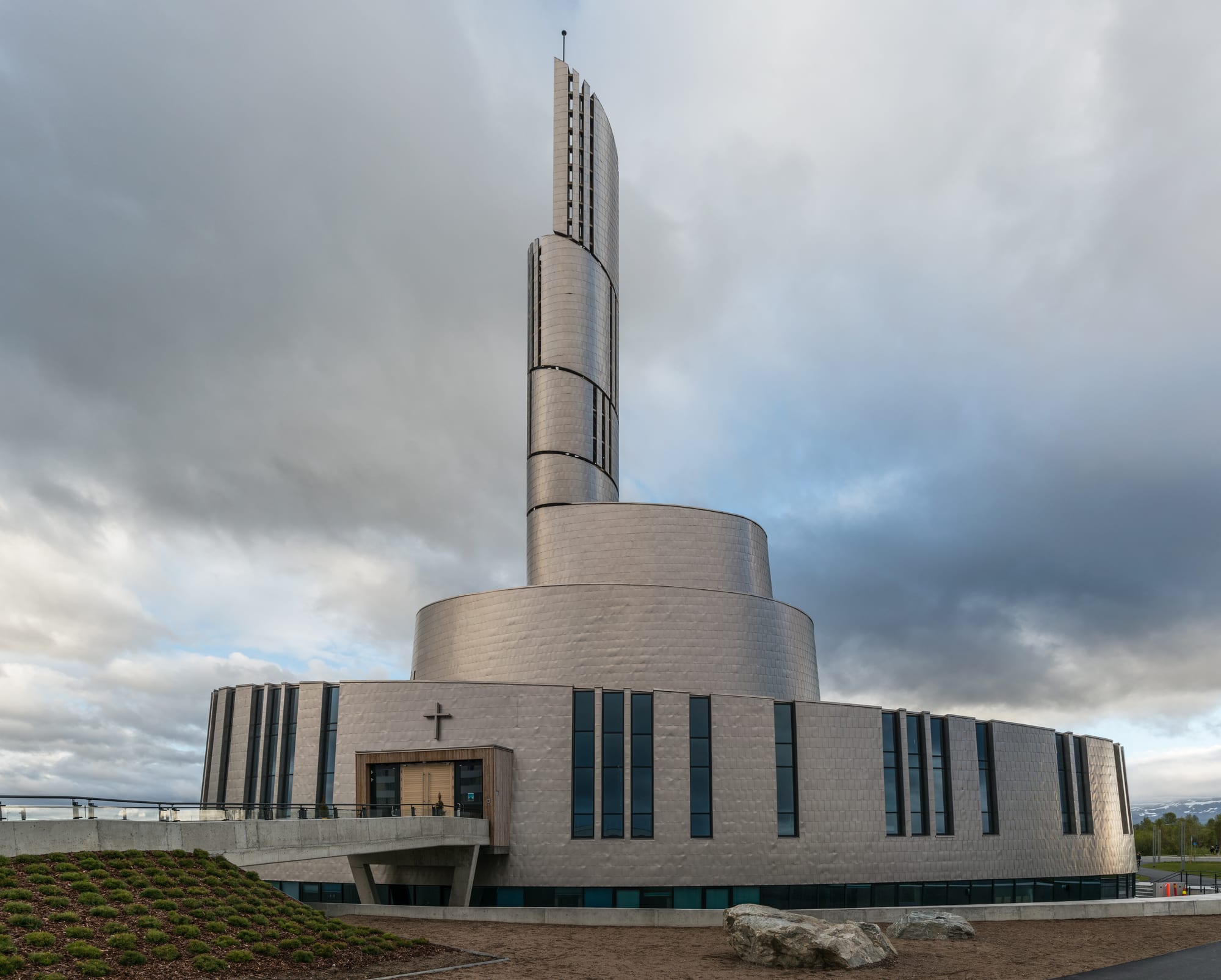
The spiralling silver-clad tower and round body of the Northern Lights Cathedral in Alta under a cloudy sky

Northern Norway, Norway

Alta

The Northern Lights Cathedral in the centre of Alta, completed in 2013. (DXR / Wikimedia Commons · CC BY-SA 4.0)

The largest town in Finnmark, at the head of the Altafjord where the salmon river Altaelva meets the sea. Prehistoric hunters left thousands of rock carvings on its shores, the town was burned in 1944 and rebuilt, and today it is a trading, college and airport hub known as the Northern Lights City.

Neighbourhoods

  • Sentrum
    • First-time visitors
    • Shopping
    • Close to public transport

    The newer town centre that grew up between the two older settlements, with shopping centres, the main hotels and the Northern Lights Cathedral. The town is spread out, but this is where most errands and evenings out happen.

    Open in Maps
  • Bossekop
    • Historic district
    • Fjord views

    The western borough along the fjord and the E6, an old Sámi trading post and marketplace whose name means Whale Bay. The 1858 Alta Church was the only building left standing here in 1944, and the rock carvings lie just to the west.

    Open in Maps
  • Elvebakken
    • Close to the airport
    • River access

    The eastern part of town on the delta of the Altaelva, where the airport runway lies along the fjord shore. It is mostly residential, with Elvebakken Church and easy access to the river.

    Open in Maps
  • Kåfjord
    • Quiet and rural
    • History

    A village on an arm of the Altafjord about 18 km west of town along the E6. It has the oldest surviving church in the municipality, and a track leads from here to the restored Northern Lights observatory on the summit of Haldde.

    Open in Maps

Things to do

Rock art and museums

  • Rock carvings at Altalandmark

    More than 6,000 carvings of reindeer, boats, hunters and bears found around Alta since 1973 — Norway's only prehistoric World Heritage Site. The largest site, at Jiepmaluokta, is an open-air museum; in winter the carvings lie under snow.

    Open in Maps
  • World Heritage Rock Art Centre – Alta Museummuseum

    The museum beside the main carving site at Hjemmeluft, opened in 1991 and named European Museum of the Year in 1993, with exhibitions on the rock art, local culture and historic industries.

    Open in Maps
  • Tirpitz Museummuseum

    A museum in Kåfjord about the German battleship Tirpitz, which lay in the fjord for 18 months during the Second World War and was attacked there by Allied forces.

    Open in Maps

Churches

  • Northern Lights Cathedrallandmark

    The town's main church, a circular building with a spiralling tower completed in 2013 to designs by LINK arkitektur with Schmidt Hammer Lassen, seating about 350.

    Open in Maps
  • Alta Churchlandmark

    A white wooden long church of 1858 in Bossekop, designed by Stephen Henry Thomas — the only building in Bossekop to survive the burning of November 1944.

    Open in Maps
  • Kåfjord Churchlandmark

    A white wooden church of 1837, the oldest surviving church in Alta, where two leaders of the 1852 Kautokeino rebellion were buried just outside the churchyard, their skulls returned and buried at the same spot in 1997.

    Open in Maps

River and fjord

  • Altaelvapark

    The river that reaches the sea in the town, one of Norway's best salmon rivers and known for its large fish.

    Open in Maps
  • Altafjordviewpoint

    The 38 km fjord running north from the town to the islands of Stjernøya and Seiland, with side arms such as Kåfjorden and Langfjorden.

    Open in Maps

Short trips from the town

  • Sautso canyonviewpoint

    The Alta Canyon, about 12 km long and 300–420 m deep, the largest canyon in Northern Europe, cut by the Altaelva below the Finnmarksvidda plateau.

    Open in Maps
  • Seiland National Parkpark

    A national park covering most of the island of Seiland, with Seilandsjøkelen and Nordmannsjøkelen, the northernmost glaciers in Scandinavia.

    Open in Maps

Seasonal events

  • FinnmarksløpetMarch

    Europe's longest sled dog race, held every year since 1981; all classes start in Alta and cross Finnmarksvidda, the longest going as far as Kirkenes and back.

Eat and drink

Long-standing places and food districts in Alta. Hours, ratings and directions come from your maps app, always current.

Alta classics

  • Reindeer and fish dishesrestaurant

    Sámi cooking rests on reindeer, fish and game, salted rather than spiced, and reindeer and local fish such as salmon and char appear on many menus in town.

    Open in Maps
  • Suovaskebabrestaurant

    Sliced smoked reindeer, suovasbierggo, in pita bread with cucumber, salad and garlic dressing — a modern Sámi street dish found at festivals and fairs in the north.

    Open in Maps

Cafés and shops

  • Cafés in the town centrecafe

    Coffee is a fixture of Norwegian life, traditionally drunk black from a mug, often with waffles or homemade cakes.

    Open in Maps
  • Bossekopneighborhood

    The old trading quarter by the fjord, with places to eat along the E6 near the cathedral.

    Open in Maps

Experience Alta

History

People reached the Alta area soon after the ice retreated: the Komsa culture of Stone Age hunter-gatherers is named after Mount Komsa in the municipality, where its remains were first found in 1925, and quartzite from local quarries was made into tools used across northern Norway — a spearhead is on the municipal coat of arms. From around 4200 BC to 500 BC people carved thousands of figures of reindeer, boats, fishing and bear rituals into the shore rocks, rediscovered from 1973 and listed by UNESCO in 1985.

Bossekop grew as a Sámi trading post and marketplace, and in the 19th century copper mines at Kåfjord drew workers to the fjord; men from Alta later took reindeer to Alaska and some joined the Nome gold rush. In 1854 two leaders of the 1852 Kautokeino rebellion were executed at Elvebakken, and their skulls were kept by the university in Oslo until 1985 before being reburied at Kåfjord in 1997. The clear skies made Alta a centre of aurora research: the first successful photograph of the Northern Lights was taken at Bossekop in 1892, and Kristian Birkeland's observatory on Haldde operated from 1899 to 1926.

In the Second World War the battleship Tirpitz lay in Kåfjorden and was damaged there by Allied attacks, and in November 1944 the retreating Germans burned Bossekop, sparing only Alta Church. The rebuilt settlements grew steadily, and in the late 1970s and early 1980s the Alta controversy — protests by Sámi activists and environmentalists against a dam on the river — made national headlines; the power station was completed by 1987. Bossekop, Elvebakken and Alta were joined as a town on 1 January 2000.

Culture & Customs

Alta calls itself Nordlysbyen, the Northern Lights City, and its identity rests on the dark-season sky, the river and the rock art. The Northern Lights Cathedral, opened in 2013, turned the aurora into architecture, and the World Heritage Rock Art Centre draws more summer visitors than any other museum in northern Norway.

The town is a meeting point of Norwegian, Sámi and Kven cultures, reflected in its three names, and the Alta controversy remains a landmark in the Sámi struggle for rights as an Indigenous people. Local figures include the film director Tommy Wirkola, the Sámi actor Mikkel Gaup and the ski jumper Bjørn Wirkola, all born in Alta.

Sport means winter sport and football. Cross-country skiing is very popular, Alta IF is the main team, and every March the town sends off Finnmarksløpet, Europe's longest sled dog race, across the plateau. The Altaelva is one of Norway's great salmon rivers. A winter ice hotel on the riverbank and guided aurora trips have made Alta a winter destination for visitors from across Europe.

Daily Life

About 16,400 people lived in the town in 2025, making it the largest in Finnmark, and the municipality as a whole had about 22,000 in 2025 — a figure that has grown for many years, unlike much of the north. Many live in suburbs and villages strung along the fjord and valley, from Kvenvik and Kåfjord in the west to Øvre Alta and Tverrelvdalen in the south and Rafsbotn in the east.

Trade, education and public services are the backbone of the economy. Alta is the commercial centre of western Finnmark, with a campus of the University of Tromsø, the district court and the region's busiest airport. Industry is small-scale, with slate quarrying the best known, and tourism has grown with winter Northern Lights visitors.

Life follows the extremes of light: almost two months without sun around midwinter, and continuous daylight from late May to late July, when people fish, hike and spend evenings outdoors. Natural hazards are part of life — a landslide destroyed eight houses in 2020 — and when Troms og Finnmark was split again in 2024, Alta's politicians wanted a referendum on whether the municipality should belong to Troms rather than Finnmark.

Food

Food in Alta draws on Sámi and northern Norwegian traditions. Sámi cooking has always been built on fish, game, reindeer and berries, with salt as almost the only seasoning; reindeer, nearly all of it from semi-domesticated herds, is now its centre, and the cloudberry is the most prized berry of the north. A modern Sámi dish, the suovaskebab, wraps sliced smoked reindeer, suovasbierggo, in pita bread with cucumber, salad and garlic dressing, and turns up at festivals and fairs.

Fish is the other staple. Salmon from the Altaelva has made the river famous, and mountain and forest waters give whitefish, perch and char. Across Norway smoked salmon and gravlaks — salmon cured with sugar, salt and dill — are classics, and fiskesuppe, a white, milk-based soup of mixed fish, carrots, onions and potato, is a common home dish.

Coffee is drunk all day, traditionally black and from a mug, and invitations for coffee and cake are a staple of social life. Lefse, a soft flatbread of potato, milk or cream and flour, and brunost, the sweet brown cheese made from caramelised goat or cow milk, are everyday foods found in every supermarket.

Planning tools

Budget

Alta shares the high prices of the rest of Norway and the far north, and remoteness adds to the cost of food and fuel. Guided Northern Lights trips, dog sledding and salmon fishing are where money goes; supermarkets and self-catering keep a visit manageable.

Daily Budget Midrange
USD 270–500 (hotel, restaurant dinners, a guided Northern Lights or sled trip, a hire car)
Daily Budget Shoestring
USD 95–150 (hostel or campsite, supermarket food, local buses)

Self-catering from the town's supermarkets cuts costs sharply; a hire car opens up the fjord villages and the valley.

Best Time to Visit

June to August for the rock carvings, which are free of snow only in the warmer months, and for the midnight sun, which stays above the horizon from mid-May to late July. Late autumn to March for the Northern Lights, which the town's frequently clear skies favour, and March for snow, returning daylight and the start of Finnmarksløpet.

Suggested Number of Days

Two or three days cover the town and its surroundings by the fjord. Four or five allow for the valley, the islands and guided winter trips, and the number grows in the dark season, when Northern Lights viewing depends on clear nights.

First Visit
2–3 days
With Surroundings
4–5 days

Transportation

Alta is a transport centre for Finnmark: the E6, Norway's main road, runs through the town, and the E45 from Finland ends in the centre. The town is spread out along the E6, so most visitors use a hire car, taxis or local buses; tours usually include pick-ups.

Winter driving on the E6 and the plateau roads needs care and winter tyres, and it is dark for weeks around midwinter.

Airport & Station Connections

Alta Airport, the busiest in Finnmark, lies at Elvebakken about 4 km east of the centre. Widerøe, SAS, Norwegian, Finnair and Discover Airlines fly there, with links to Oslo, Tromsø and regional airports across Finnmark. Driving is possible on the E6 along the coast or on the E45 through Finland, but the distances from southern Scandinavia are very long.

Walkability

Within each borough the town is walkable, but Alta is spread thinly along the E6, which runs for about 12 km through the built-up area, so distances are longer than they look. The rock carvings and the fjord villages are beyond a comfortable walk. Pavements are icy and snowy through much of the winter.

Safety

Norway has among the lowest crime rates in the world. In Alta the hazards are natural: winter cold, ice on roads and paths, long darkness around midwinter, and fast-flowing water on the river.

Dress for real cold on Northern Lights trips, drive slowly on icy roads and keep away from riverbanks in the spring melt. Check current official travel advice before travelling.

Climate

A sheltered northern forest climate, less cold than is typical at 70 degrees north and sheltered from the storms of the outer coast, with about 438 mm of precipitation a year. The midnight sun lasts from about 18 May to 27 July, and the sun stays below the horizon from about 26 November to 16 January.

Summer
cool and light — July averages 13.4°C, rarely above 25°C, though south winds can push it close to 30°C
Winter
long, cold and dark — January averages −8.7°C, and only rarely falls below −25°C

Local Customs

Alta has Norwegian, Northern Sámi and Kven names — Alta, Áltá and Alattio — and Sámi culture is part of local life. Manners are informal and direct, and coffee is offered and drunk constantly. Reindeer belong to herders, so animals on or by the road should be passed slowly and left undisturbed.

Ask before photographing people in Sámi dress or reindeer herders at work. Stronger alcohol is sold only through the state monopoly shops.

Common Payment Methods

The currency is the Norwegian krone (NOK). Norway is close to fully cashless: cards and the Vipps app are used for almost everything, and a contactless Visa or Mastercard works everywhere, although staffed shops have had to accept cash since October 2024.