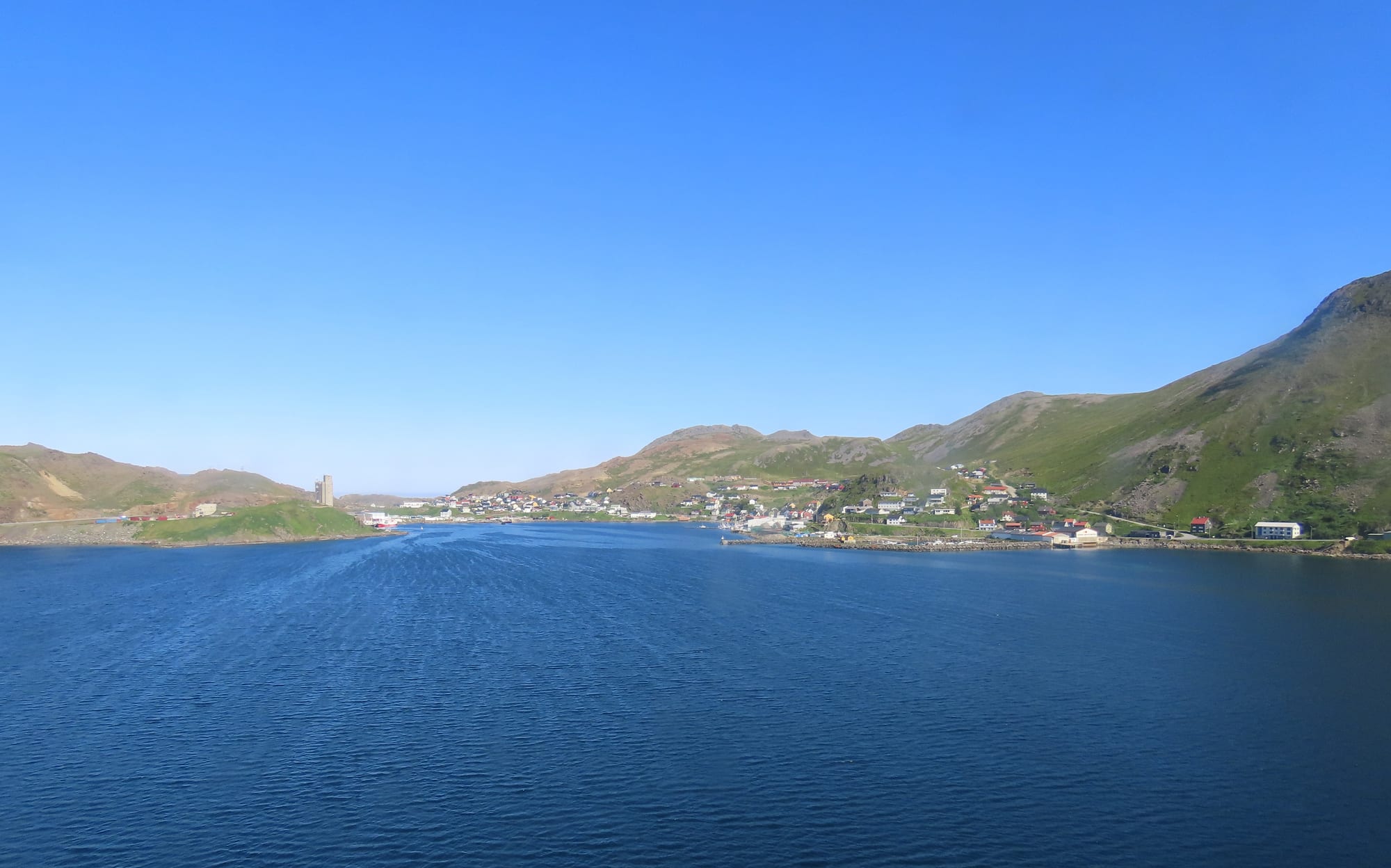
Deep blue water leading to the houses of Honningsvåg spread along the shore beneath bare green hills

Northern Norway, Norway

Honningsvåg

Honningsvåg and its harbour on the island of Magerøya, seen from the water. (Ad Meskens / Wikimedia Commons · CC BY-SA 4.0)

A fishing port on a bay of Magerøya, the island at the top of Norway, and the town through which nearly all traffic to the North Cape passes. Settled for some 10,000 years and caught up in the burning of Finnmark in 1944, it is now a small harbour town busy with coastal ferries, cruise ships and fishing boats.

Neighbourhoods

  • The harbour and town centre
    • First-time visitors
    • Close to the port
    • Walkable

    The compact centre around the inner harbour, where the Hurtigruten ships and cruise ships tie up and the main street, cafés, shops and the 1885 church are all a short walk apart. Fishing boats and the protected white buildings of the old fishermen's service station line the quays.

    Open in Maps
  • Storbukt
    • Quiet and residential
    • Maritime heritage

    A district on the bay outside the centre, on the way to the airport at Valan. It holds a protected slipway from the post-war rebuilding, now part of the Nordkapp Museum.

    Open in Maps
  • Kamøyvær
    • Fishing village
    • Quiet

    A fishing village of about 70 people some 10 km north-west of the town, at the end of a side road off the E69 and sheltered by two islands. Its people descend from coastal Sámi, Kven and Norwegians, and an artist's gallery occupies a house in the centre.

    Open in Maps
  • Skarsvåg
    • Fishing village
    • Close to the North Cape

    A village of about 60 people on the north coast of Magerøya, about 14 km from the North Cape, which calls itself the world's northernmost fishing village; its boats fish mainly for cod.

    Open in Maps

Things to do

In the town

  • Honningsvåg Churchlandmark

    A white neo-Gothic wooden church of 1885 designed by Jacob Wilhelm Nordan, one of the few churches in Finnmark not destroyed during the German retreat at the end of the Second World War.

    Open in Maps
  • Nordkapp Museummuseum

    The town museum near the Hurtigruten quay, covering the coastal culture and fishing history of Finnmark, which also looks after a protected slipway in Storbukt.

    Open in Maps
  • North Cape Tunnellandmark

    The undersea road tunnel of 1999 that links Magerøya with the mainland, one of Norway's longest subsea tunnels, toll-free since 2012 and closed by automatic frost doors in winter.

    Open in Maps

The North Cape and Magerøya

  • North Capeviewpoint

    A 307 m cliff topped by a flat plateau at the end of the E69, the northernmost point in Europe reached by car, with a visitor centre of 1988; in July 2026 the County Governor's office for Troms and Finnmark decided no money may be charged to enter the plateau.

    Open in Maps
  • Knivskjeloddentrail

    The low peninsula 1,450 m further north than the North Cape and the true northernmost point of the island, reached only by a 9 km hike from a parking area on the E69.

    Open in Maps
  • Gjesværattraction

    An old fishing village on the west of the island, the only place in Finnmark known from the Viking Age, mentioned in the Heimskringla saga as Geirsver, and a base for seabird trips.

    Open in Maps
  • Gjesværstappanviewpoint

    A group of high, steep, grass-covered islands north of Gjesvær where puffins and other seabirds nest; people once lived on them, and Kjerkestappen had a church.

    Open in Maps

Seasonal events

  • Nordkapp FestivalJune

    The town's annual summer festival of cultural events.

  • Nordkapp Film FestivalSeptember

    An annual film festival held in the town each September.

Eat and drink

Long-standing places and food districts in Honningsvåg. Hours, ratings and directions come from your maps app, always current.

Honningsvåg classics

  • Cod and fish dishes by the harbourrestaurant

    One of Norway's largest fishing centres, the town eats from its own catch: cod, including the migrating skrei, and dishes such as fiskesuppe, a white, milk-based fish soup with vegetables.

    Open in Maps
  • Cafés on the main streetcafe

    Coffee, traditionally drunk black from a mug, with waffles or cakes, in the small cafés near the quays.

    Open in Maps

Bars

  • Perleporten Kulturhusrestaurant

    The town's culture house on Sjøgata, which has a pub and organises the Oggasjakka music festival.

    Open in Maps

Experience Honningsvåg

History

People settled on Magerøya around 10,300 years ago, probably living mainly from the sea. The town takes its name from the old farm of Honningsvaag, Old Norse Hornungsvágr, probably "the bay beneath the mountain Hornungr", an old name for the horn-peaked Storefjell above the town. The cliff to the north was named the North Cape by the Englishman Steven Borough, captain of the Edward Bonaventure, which sailed past in 1553 in search of the Northeast Passage, and in the last decades of the 19th century it became a popular tourist destination.

Through the centuries Honningsvåg lived from the rich, ice-free fishing grounds of the Barents Sea. During the Second World War the town gave the Free Norwegian Forces their mascot: Bamse, a St Bernard who came from Honningsvåg. In December 1944 the town was caught up in the forced evacuation and burning of Finnmark and northern Troms; its church of 1885 was spared, and the town was rebuilt after the war.

The municipal council declared Honningsvåg a city in 1996, a year before a new law required at least 5,000 inhabitants, so it kept its status as one of the smallest cities in Norway. Valan airport had opened in 1977, and in 1999 the North Cape Tunnel opened, linking the island and the town with the mainland by road. The port is also a stop for ships of the Nordic oil and gas industry: after the 2022 Russian invasion of Ukraine, vessels carrying Russian liquefied gas remained permitted to use its services.

Culture & Customs

Honningsvåg's identity rests on fishing and on its place at the end of the road. The North Cape has been a goal for travellers since the 17th century, when the Italian priest Francesco Negri reached it in the 1660s, and Thomas Cook & Son began arranging tours there as early as 1875. Today around 200,000 people visit during the short summer, and the town lives with the coming and going of ships.

Cultural life is small but busy. The Nordkapp Festival is held each June and the Nordkapp Film Festival each September, and since 2015 the culture house has run the Oggasjakka music festival. A gallery in Kamøyvær shows and sells a local artist's work, and the white buildings of the old fishermen's service station and a post-war slipway are protected as part of the town's maritime heritage.

In the fishing village of Kamøyvær people descend from Norwegians, coastal Sámi and Kven, and no ethnic distinctions are drawn today. Life is shaped by the extremes of light — the midnight sun from mid-May to the end of July and two months of polar night — and by the weather, which can cut the island off in winter storms.

Daily Life

About 2,300 people lived in Honningsvåg in 2025, most of the population of Nordkapp Municipality, which has been shrinking over the past decade. The rest live in fishing villages such as Kamøyvær, Skarsvåg and Gjesvær, some with only a few dozen residents.

Fishing remains the backbone of the economy: Honningsvåg is one of the largest fishing centres in Finnmark and in Norway, and the village fleets fish mainly for cod in the waters north of Magerøya. Tourism is the second pillar, built on the North Cape, the Hurtigruten ships that call twice a day and the cruise ships of summer. The port also serves ships of the Nordic oil and gas industry.

Daily life follows the seasons. In summer the harbour fills with ships and the roads with cars and campers heading for the cape; in winter the town is quiet, storms can close the roads, and the road to the North Cape is open only to a daily convoy behind a snow plough. Despite the latitude, sheltered gardens in town grow small trees.

Food

Honningsvåg eats what its boats land, and cod comes first. Skrei, the migrating Atlantic cod, has been a source of wealth along the Norwegian coast for centuries, and stockfish — dried cod — is Norway's longest sustained export commodity. Lutefisk, stockfish or salted and dried klippfisk steeped in lye, is another traditional preparation.

At home, fiskesuppe, a white, milk-based soup with carrots, onions, potato and several kinds of fish, is a staple, and salmon, herring and mackerel are popular across the country; smoked salmon is the best-known Norwegian fish dish abroad. Gravlaks, salmon cured with sugar, salt and dill, is a classic of the Norwegian table.

Coffee is drunk constantly, traditionally black and from a mug, and visitors are often invited in for coffee and cake. Lefse, a soft flatbread of potato, milk or cream and flour, and brunost, the sweet brown cheese made from caramelised goat or cow milk, are everyday foods, alongside waffles and cakes at cafés.

Planning tools

Budget

Prices are as high as anywhere in Norway, and remoteness raises the cost of food and fuel on the island. Tours to the North Cape and seabird trips add up; self-catering and the bus keep costs down.

Daily Budget Midrange
USD 270–500 (hotel, restaurant dinners, a North Cape or seabird tour, a hire car)
Daily Budget Shoestring
USD 95–150 (campsite or cabin, supermarket food, local buses)

Book accommodation early for the summer season, when the North Cape traffic peaks.

Best Time to Visit

Summer, when the midnight sun lasts from about 13 May to 31 July, the road to the North Cape is open to ordinary traffic and most of the island's roughly 200,000 yearly visitors arrive. From October to April the cape is reached only by convoy behind a snow plough, and from about 21 November to 21 January the sun stays below the horizon, but the dark months bring the Northern Lights and far fewer people.

Suggested Number of Days

One or two days cover the town and the cape; two or three allow for the fishing villages, a longer hike and a seabird trip. Weather sets the pace: fog and storms often hide the view, so an extra day improves the chances.

First Visit
1–2 days
With Surroundings
2–3 days

Transportation

Honningsvåg's centre is easily covered on foot. The North Cape is about 34 km, or half an hour, north by road; in summer local buses and tours make the trip, and Hurtigruten passengers can take special buses while the ship is in port. A hire car is the easiest way to reach the villages.

Strong winds and blizzards can close the island's roads in winter; check the convoy and road status before setting out.

Airport & Station Connections

Honningsvåg Airport at Valan, 4 km north of the town, has Widerøe flights to Tromsø, with connections to Oslo, and to other Finnmark towns. By road the E69 crosses to the island through the North Cape Tunnel, and buses link the town with Alta. Hurtigruten coastal ships call twice a day, and cruise ships call in summer.

Walkability

The town is small and walkable, with the harbour, main street and church a few minutes apart. Beyond the town the island is open tundra, and the cape and villages need wheels. Snow and wind make winter walking hard.

Safety

Norway has among the lowest crime rates in the world. The hazards on Magerøya are the weather: winter storms and blizzards that can close the roads, deep snow and avalanches on steep slopes, fog, and fast-changing conditions for hikers on the open plateau.

Tell someone the route and return time before hiking to Knivskjelodden, carry warm, windproof clothing in every season and keep to marked trails. Check current official travel advice before travelling.

Climate

A subarctic climate softened by the ice-free sea: winters are milder than at Oslo Airport far to the south, but storms, blizzards and deep snow are common, and precipitation falls all year with a small peak in autumn. Many gardens in town have trees, though rarely more than 3–4 metres tall.

Summer
cool and light, though Honningsvåg reached a record 28.4°C in June 2022
Winter
mild for the latitude but stormy and snowy, the coldest month averaging only just below −3°C, with weeks of polar night

Local Customs

Honningsvåg is a working fishing town, and the quays are workplaces as much as sights. The municipality has Norwegian, Northern Sámi and Kven names, and in villages such as Kamøyvær people descend from all three peoples. Manners are informal and direct, and coffee is always on offer.

Keep out of the way of working boats and fish-handling on the quays. Stronger alcohol is sold only through the state monopoly shops.

Common Payment Methods

The currency is the Norwegian krone (NOK). Norway is close to fully cashless: cards and the Vipps app are used for almost everything, and a contactless Visa or Mastercard works everywhere, although staffed shops have had to accept cash since October 2024.