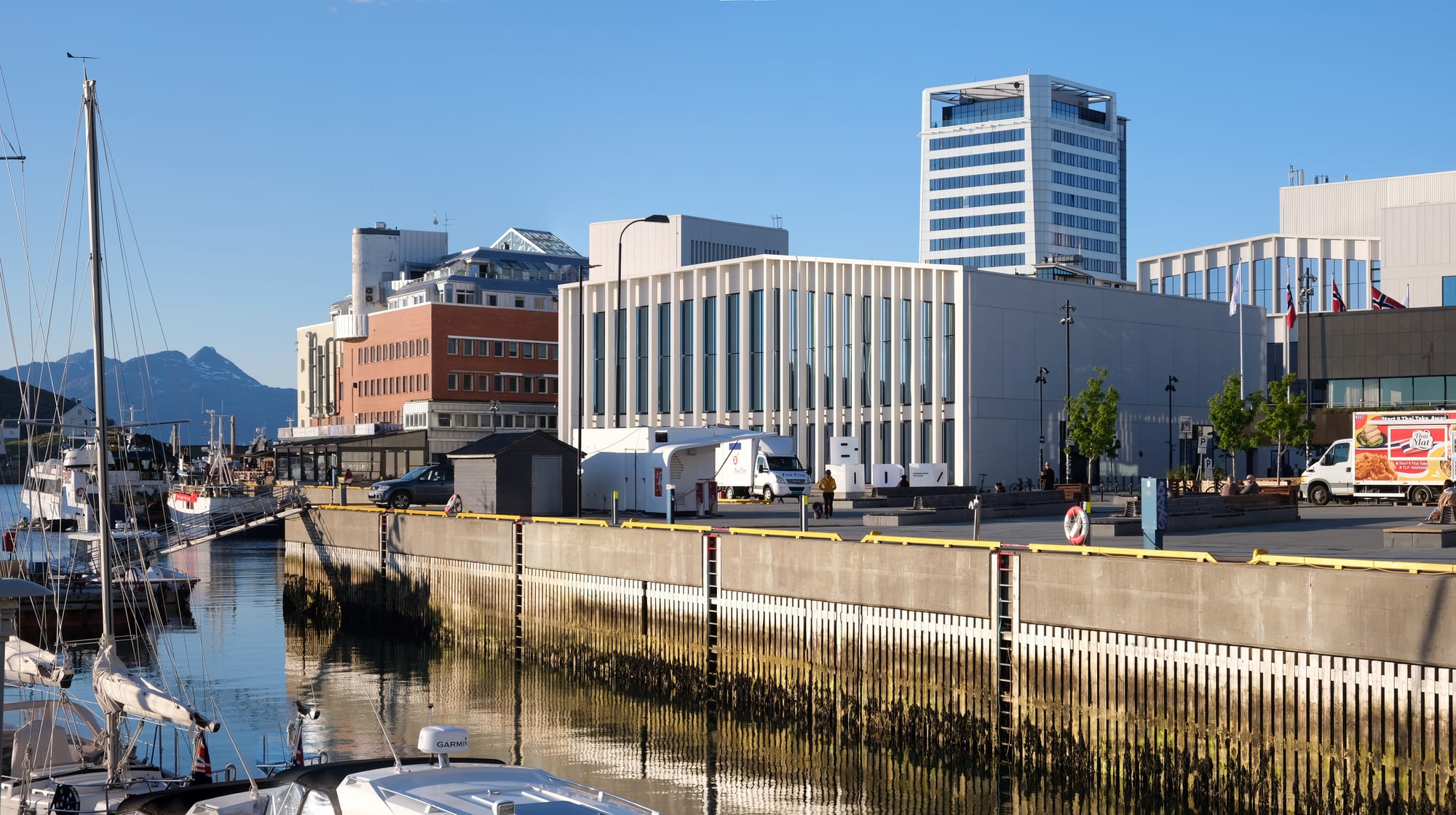
Bodø's harbour quay with moored boats, the pale Stormen library building and modern towers, and a mountain on the horizon

Northern Norway, Norway

Bodø

The harbour in central Bodø, with the Stormen library on the quayside. (kallerna / Wikimedia Commons · CC BY-SA 4.0)

The capital of Nordland county and the second-largest town in Northern Norway, on a peninsula just north of the Arctic Circle between the Vestfjorden and the Saltfjorden. Largely destroyed by bombing in 1940 and rebuilt as a modern town, it is the end of the northern railway, the ferry port for Lofoten, the home of Bodø/Glimt and a European Capital of Culture in 2024.

Neighbourhoods

  • City centre and the harbour
    • First-time visitors
    • Close to public transport
    • Nightlife

    The compact centre rebuilt after 1940, with the pedestrian street, shopping centres, the cathedral and the Stormen cultural centre beside the harbour. The railway station, the ferry and express-boat terminals and the coastal-ferry quay are all within walking distance.

    Open in Maps
  • Aspmyra and the airport side
    • Football
    • Museums

    The area between the centre and the airport, which lies just south of the centre, with Bodø/Glimt's Aspmyra stadium and, nearby, the Norwegian Aviation Museum.

    Open in Maps
  • Eastern suburbs
    • Quiet and residential
    • Close to nature

    Bodø is a long, slender town, 2–3 km wide and over 10 km long from east to west. Its residential districts stretch eastwards past the medieval Bodin Church, with the large City Nord shopping centre and the university campus further out.

    Open in Maps

Things to do

Landmarks and museums

  • Norwegian Aviation Museummuseum

    Norway's national aviation museum and the largest aviation museum in the Nordic countries, opened by King Harald V in 1994.

    Open in Maps
  • Bodø Cathedrallandmark

    A concrete cathedral of 1956, built after the wartime destruction and an example of post-war church architecture, seat of the Bishop of Sør-Hålogaland.

    Open in Maps
  • Bodin Churchlandmark

    A white stone church from the 13th century on the south-eastern edge of the town, a typical medieval stone church.

    Open in Maps
  • Stormenattraction

    The cultural centre on the harbour, opened in 2014, holding the library, a concert hall and a theatre, designed by Daniel Rosbottom and David Howarth.

    Open in Maps
  • Bodø Stationtransit hub

    The northern terminus of the Nordland Line, opened to passengers in 1962 after decades of delay, with trains south to Trondheim.

    Open in Maps

Views, sport and the outdoors

  • Keiservardenviewpoint

    A plateau 366 metres up on the hill above the town, reached by stone steps built in 2016, with views across the Vestfjorden to the Lofoten mountains in clear weather.

    Open in Maps
  • Aspmyra Stadionattraction

    The home of Bodø/Glimt, Norwegian champions in 2020, 2021, 2023 and 2024 and semi-finalists in the 2024–25 UEFA Europa League.

    Open in Maps

Short trips from the town

  • Saltstraumenviewpoint

    A narrow strait south-east of Bodø with one of the strongest tidal currents in the world, where the tide forces water between the Saltfjorden and the Skjerstad Fjord and forms whirlpools.

    Open in Maps
  • Kjerringøy trading postmuseum

    A well-preserved old trading village about 40 km north of Bodø, now an open-air museum, used as a film location for Benoni og Rosa, I Am Dina and Telegrafisten.

    Open in Maps
  • Sjunkhatten National Parkpark

    A national park established in 2010 on a peninsula partly within Bodø Municipality, protecting about 418 square kilometres including an area of sea.

    Open in Maps

Seasonal events

  • Nordland Musikkfestukesummer

    Nordland's music festival week, with concerts across the town and even on the Keiservarden plateau.

  • ParkenfestivalenAugust

    An outdoor music festival held in the Rensåsparken park every year since 2006.

  • Bodø Hardcore Festivalearly winter

    A free, volunteer-run hardcore music festival.

Eat and drink

Long-standing places and food districts in Bodø. Hours, ratings and directions come from your maps app, always current.

Bodø classics

  • Jernbanekaféencafe

    The café on the upper floor of the railway station.

    Open in Maps
  • Fish restaurantsrestaurant

    Some of Bodø's high-end restaurants list typical Norwegian fish dishes among their specialities.

    Open in Maps

Food districts

  • City centreneighborhood

    The pedestrian street and the streets around the harbour hold most of the town's restaurants, kebab shops, bars and late bars.

    Open in Maps

Experience Bodø

History

Bodø takes its name from the old Bodøgård farm on whose land it was built; the name may come from Old Norse words for a skerry and a meadow. The area was part of Hålogaland in the Viking Age, and in 1663 Bodø was recorded as a village with a postal service. It was granted town status in 1816, the first town in Northern Norway, and in 1818 it gave its name to the Bodø affair, when British merchants were caught smuggling and Norway later had to pay them compensation. In the 19th century fish canning made the town grow.

On 27 May 1940 German bombing destroyed most of Bodø's buildings, and the town was rebuilt during and after the war, which is why it looks so modern today. The cathedral of 1956 is part of that rebuilding. The railway arrived at last in 1962, decades after it was approved, and the town expanded through mergers with neighbouring Bodin in 1938, 1959 and 1968.

The air station, built up with NATO funding, shaped the post-war town. During the Cold War it was central to the defence of NATO's northern flank, and in May 1960 Bodø made world headlines when it emerged that the American U-2 pilot Gary Powers had been flying towards it when he was shot down over the Soviet Union. The fighter jets left in 2022, and the land of the old air station is planned for a new town district. In 2024 Bodø was a European Capital of Culture.

Culture & Customs

The sun on Bodø's red coat of arms recalls that it was the first town in Northern Norway and sees the midnight sun every year. Cultural life centres on Stormen, the harbourside complex of library, concert hall and theatre opened in 2014, and on summer festivals: Nordland Musikkfestuke, which takes concerts up to the Keiservarden plateau, the Parkenfestivalen in August and Opptur. The free, volunteer-run Bodø Hardcore Festival comes in early winter, and the experimental music festival Nødutgangfestivalen has run since 2006. Fram Kino, opened in 1908, was the first cinema in Norway.

Football is a passion. Bodø/Glimt became the first club from Northern Norway to win a national title with the cup in 1975, and since returning to the top flight in 2018 has won the league four times in five seasons and reached the semi-finals of the 2024–25 UEFA Europa League, the first Norwegian club to reach the last four of a European competition.

Bodø is also a gateway to the north's other cultures. The town museum's exhibitions cover the Lofoten fisheries, the Sámi and a Viking treasure, and the Kjerringøy trading post preserves the world of the merchants who once dominated the coast.

Daily Life

About 43,000 people live in the town (2023), around 80 per cent of the 54,000 in Bodø Municipality, and the population has been growing. As the county capital, Bodø is a town of public institutions: the main campus of Nord University, which has about 12,000 students, the only police academy outside Oslo, the Norwegian Civil Aviation Authority, the Joint Rescue Coordination Centre of Northern Norway, the regional hospital and the armed forces' headquarters at Reitan, east of the town.

Widerøe, the regional airline, has its head office here, and the largest shopping centre in Nordland, City Nord, is in the town. Bodø is long and narrow, with its suburbs strung out along an east–west line, linked by frequent buses and cycle routes.

Life follows the light: the midnight sun from early June to mid-July, then long dark winters, though thanks to refraction the town has no true polar night. Current debates include the planned new airport and the new district to be built on the old air-station land.

Food

Bodø eats from the northern coast. Skrei, the spawning cod that arrives off Lofoten in winter, is the prize catch, and mølje, poached fish with its roe and liver, is often called the national dish of the north. Stockfish, dried outdoors on racks in Lofoten across the Vestfjorden, is exported to Italy and Nigeria. The town's own 19th-century growth came from fish canning.

The Salten district around Bodø is known for møsbrømlefse, a soft flatbread spread with a sweet brown-cheese sauce. Sámi cooking brings reindeer, such as suovas, lightly salted, cold-smoked reindeer, and cloudberries, molte, grow on bogs and moorland, ripen in early autumn and are served with cream.

Eating out is concentrated in the centre, with a modest choice: restaurants whose specialities include typical Norwegian fish dishes, a café in the railway station, and plenty of kebab shops, pizza places and bars around the pedestrian street. Alcohol is sold through the state Vinmonopolet shops, one near the centre and one in City Nord.

Planning tools

Budget

Bodø is priced like the rest of Northern Norway: expensive for eating out, drinking and taxis, more reasonable for supermarket food. The centre is compact, and town buses are frequent. Guided trips to Saltstraumen or out to sea, and a hire car for the surrounding coast, are the main extra costs.

Daily Budget Midrange
USD 270–530 (hotel, restaurant dinners, museum tickets or a guided excursion, a hire car)
Daily Budget Shoestring
USD 95–150 (hostel or campsite, supermarket food, town buses)

Bikes and town buses cover most of Bodø; taxis cost the same whatever the number of passengers, so they make most sense shared.

Best Time to Visit

June to August for long light, the summer music festivals and walks on the hills and coast; the midnight sun is above the horizon from 1 June to mid- July. Autumn and winter bring the chance of the Northern Lights and the hardcore festival, and the football season runs from spring into autumn.

Suggested Number of Days

One or two days cover the town itself. Allow three or four to see more of the surrounding coast and countryside, and more if Bodø is the start of a trip to the Lofoten islands by ferry.

First Visit
1–2 days
With Surroundings
3–4 days

Transportation

Town buses run frequently along the long east–west line of the town, a circular bus serves the centre, and the fare system is by zone. Cycling is easy almost everywhere in town and the suburbs. Regional buses leave only a few times a day, so a hire car is useful for the surrounding coast and countryside.

Bodø sits on an exposed peninsula and can see strong winds from both west and east; check the forecast before ferry crossings.

Airport & Station Connections

Bodø Airport lies just south of the centre, served by SAS, Norwegian and Widerøe, which has its head office here; a new airport is planned a short way south of the present one. The Nordland Line runs day and night trains from Trondheim. Car ferries sail to Moskenes, Røst and Værøy, express boats to Svolvær and elsewhere, and the coastal ferry calls daily in both directions. Bus 100 connects with Narvik.

Walkability

The centre is compact and easy to walk, with the harbour, station, ferry terminals and cathedral close together. The town stretches more than 10 km from east to west, so the outer districts, the university and the big shopping centre are a bus ride away; the climb to Keiservarden starts on the edge of town.

Safety

Norway has among the lowest crime rates in the world. In Bodø the main hazards are weather and water: strong winds on the exposed peninsula, icy streets in winter, and the dangerous current at Saltstraumen, where the water moves very fast as the tide turns.

Keep well back from the water's edge at Saltstraumen and check the forecast before boat trips. Check current official travel advice before travelling.

Climate

Mild for a town on the Arctic Circle — humid continental or oceanic depending on the definition — with fairly cold winters and cool summers. Long spells of Atlantic rain and cloud can come in any season, but so can settled sunny weather. The midnight sun lasts from 1 June to 14 July, and there is no true polar night.

Summer
cool; the warmest month on record, July 2014, averaged 17.3°C with daily highs of 21.6°C, and the record high is 30.7°C, from July 2019
Winter
fairly cold; the lowest temperature recorded is −18.5°C, in February 1966, and the first overnight frost of autumn comes on average around 12 October

Local Customs

Bodø is a young, growing university and military town with a strong football identity, and Bodø/Glimt's success has become a regional source of pride. Alcohol is sold through the state Vinmonopolet shops and is expensive, and the town's bars are busiest at weekends.

Expect the bars in the centre to be crowded and noisy at weekends, and taxis to be expensive for longer trips.

Common Payment Methods

The currency is the Norwegian krone (NOK). Norway is close to fully cashless: cards and the Vipps app are used for everything, although staffed shops have been required by law to accept cash since October 2024. A contactless Visa or Mastercard works everywhere.