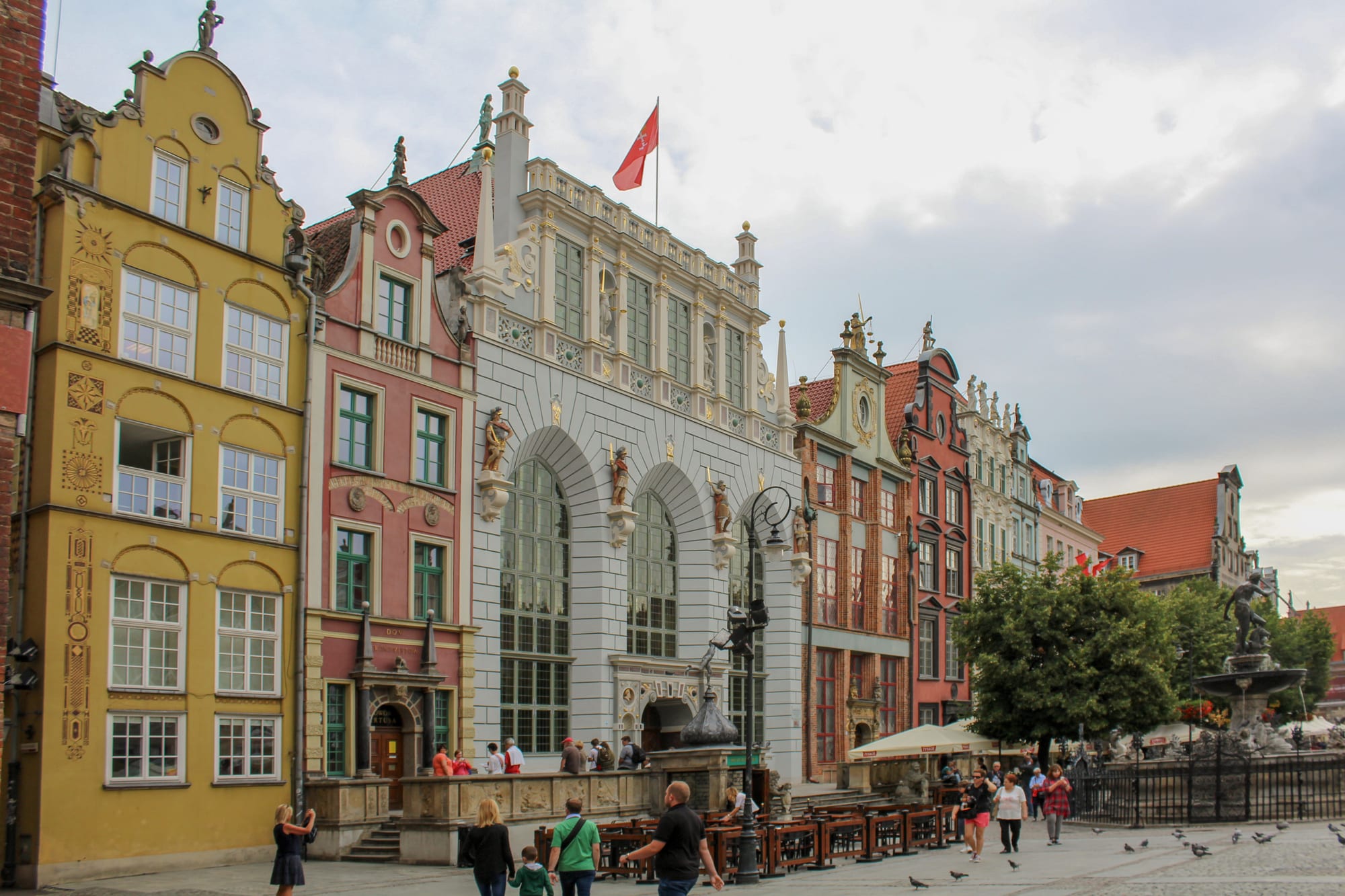
Ornate gabled merchant houses in yellow, pink and red beside the white facade of Artus Court, with Neptune's Fountain on the right

Gdańsk, Pomerania & the Baltic Coast, Poland

Gdańsk

Artus Court and Neptune's Fountain on the Long Market in Gdańsk's Main City. (Szczecinolog / Wikimedia Commons · CC BY-SA 4.0)

Poland's main seaport, at the mouth of the Motława on the Bay of Gdańsk, and the largest city of the Tricity it forms with Gdynia and Sopot. A rich Hanseatic grain port for centuries and a Free City between the wars, it saw the first shots of the Second World War and the birth of Solidarity; its rebuilt merchant streets now draw millions of visitors a year.

Neighbourhoods

  • Main City
    • First-time visitors
    • Historic district
    • Museums

    The historic heart along the Royal Route, from the Highland and Golden Gates down Długa Street and the Long Market to the Green Gate and the Motława. Almost everything here was rebuilt after 1945, with gabled merchant houses, St Mary's Church and the riverside quay.

    Open in Maps
  • Old Town
    • Historic churches
    • Quieter streets

    The oldest part of the city to receive town rights, beside the Main City, with St Catherine's Church and the Great Mill. Its streets lead on towards the shipyard and the European Solidarity Centre.

    Open in Maps
  • Granary Island
    • Riverside walks
    • New development

    The island in the Motława east of the Main City, named after the granaries that lined it when Gdańsk was the great grain port of the Baltic. Its riverside is a short walk from the Long Market.

    Open in Maps
  • Wrzeszcz
    • Students and nightlife
    • Close to public transport

    A former borough north-west of the centre with more than 65,000 people, around one of the main railway stations. Its streets of shops, cafés and bars are busy with students and residents rather than tourists.

    Open in Maps
  • Oliwa
    • Parks
    • Quiet and residential
    • Architecture

    A green northern district bordering Sopot, built around the former abbey with its Gothic cathedral and park, and backed by the forested hills of the Oliwa forests.

    Open in Maps
  • Brzeźno
    • Beaches
    • Family stays

    A seaside quarter on the bay with a sandy beach and a pier dating from the 19th century, reached by tram from the centre.

    Open in Maps

Things to do

The Main City

  • Długa Streetlandmark

    The Long Lane, the main street of the Royal Route, leading from the Golden Gate to the Long Market between rebuilt merchant houses.

    Open in Maps
  • Long Marketlandmark

    The broad market square between Długa Street and the Green Gate, lined with ornate merchant houses and the city's grandest public buildings.

    Open in Maps
  • Main City Hallmuseum

    A Gothic-Renaissance town hall at the junction of Długa Street and the Long Market, now home to the city's history museum.

    Open in Maps
  • Artus Courtmuseum

    The former meeting place of the city's merchants and a centre of its social life, now a branch of the Gdańsk Museum.

    Open in Maps
  • Neptune's Fountainlandmark

    An early 17th-century bronze fountain in front of Artus Court, one of the most distinctive landmarks of the city.

    Open in Maps
  • St Mary's Churchlandmark

    A Brick Gothic church completed in 1502, one of the three largest brick churches ever built, with room for more than 25,000 people.

    Open in Maps
  • Gdańsk Cranelandmark

    The 15th-century crane gate on the Motława, the largest port crane of medieval Europe, now part of the National Maritime Museum.

    Open in Maps

Museums

  • European Solidarity Centremuseum

    A museum and library opened in 2014, telling the story of Solidarity and the other opposition movements of Communist Eastern Europe.

    Open in Maps
  • Museum of the Second World Warmuseum

    A large museum of the war, whose exhibitions opened in 2017, in the city where the fighting began.

    Open in Maps
  • National Maritime Museummuseum

    Founded in 1962, with its main site in the granaries on Ołowianka island, a branch in the Crane and the museum ship Sołdek.

    Open in Maps
  • Uphagen's Housemuseum

    A reconstructed 18th-century merchant house on Długa Street, furnished to show how a wealthy family lived.

    Open in Maps
  • Polish Post Officemuseum

    The Free City's Polish post office, whose staff held out against German attack on 1 September 1939 and were later executed; the building now houses a post office and a museum of the Polish Post.

    Open in Maps

Shipyard, war sites and the coast

  • Gdańsk Shipyardlandmark

    The former Lenin Shipyard, where the strike of August 1980 led to the founding of Solidarity.

    Open in Maps
  • Westerplattelandmark

    The peninsula at the harbour mouth where the first shots of the Second World War were fired at a Polish depot on 1 September 1939, now a memorial site with a monument of 1966.

    Open in Maps
  • Wisłoujście Fortresslandmark

    A historic fortress at the old mouth of the Vistula that guarded the port for centuries and later served as a prison for Polish insurgents.

    Open in Maps
  • Oliwa Cathedrallandmark

    The Brick Gothic church of the former Oliwa abbey, completed in the late 14th century, with a park beside it.

    Open in Maps
  • Brzeźno Pierbeach

    A pier built in the 19th century off the sandy beach of Brzeźno, a tram ride from the centre.

    Open in Maps

Music and theatre

  • Gdańsk Shakespeare Theatreattraction

    A theatre completed in 2014 on the site of a 17th-century playhouse where English travelling players performed.

    Open in Maps
  • Polish Baltic Philharmonicattraction

    The Chopin-named concert hall of the city's orchestra on Ołowianka island, for symphonic concerts and chamber music.

    Open in Maps

Short trips from the city

  • Malbork Castlelandmark

    The Brick Gothic fortress of the Teutonic Order on the Nogat, built in the 13th century and greatly expanded in the 14th, and a UNESCO World Heritage Site since 1997.

    Open in Maps
  • Stutthofmuseum

    The site of the first German concentration camp set up outside Germany's borders in the war, near Sztutowo east of the city, now a memorial museum.

    Open in Maps

Seasonal events

  • Cult Film FestivalJune

    A festival of cult films with indoor and outdoor screenings and concerts, which moved to Gdańsk from Katowice after 2017.

  • St Dominic's Fairlate July to August

    A trade and cultural fair founded in 1260 that fills the Main City with stalls and events for three weeks.

  • Gdańsk Shakespeare Festivalfirst week of August

    An international theatre festival first held in 1993, with plays staged in theatres across Gdańsk, Sopot and Gdynia.

Eat and drink

Long-standing places and food districts in Gdańsk. Hours, ratings and directions come from your maps app, always current.

Gdańsk classics

  • Fish bars on the Motławarestaurant

    Simple fish bars and restaurants along the riverside quay below the Main City, serving fried and smoked Baltic fish.

    Open in Maps
  • Goldwasser in the Main City barsneighborhood

    The city's historic root-and-herb liqueur with flakes of 23-carat gold, made in Gdańsk from 1598 to 2009 and still considered the city's drink.

    Open in Maps

Markets and food halls

  • Market Hallmarket

    The market hall of 1896 on Dominikański Square in the Main City.

    Open in Maps
  • Montownia Foodhallmarket

    A food hall in a big brick building, a former U-boat assembly plant near the shipyard.

    Open in Maps

Cafés and bars

  • Mariacka Streetneighborhood

    St Mary's Street (ulica Mariacka) in the Main City, listed among the notable sights of the historic centre.

    Open in Maps
  • Wrzeszczneighborhood

    The student district's streets have many of the city's everyday cafés, bars and restaurants, away from the Main City crowds.

    Open in Maps

Experience Gdańsk

History

A settlement grew at the mouth of the Motława from the 9th century, and Mieszko I built a stronghold here in the 980s, tying the young Polish state to the Baltic trade. The town is first mentioned in 997, when Saint Adalbert baptised its people. German merchants, mostly from Lübeck, settled from around 1180, and by 1263 the town had city rights under Lübeck law. In 1308 the Teutonic Knights seized it and were accused of a massacre of its inhabitants; under their rule it was rebuilt, joined the Hanseatic League and built the Crane in 1444. In 1454 the city rebelled against the Order and placed itself under the Polish king, who granted it wide autonomy, and from 1466 it was the largest city and principal seaport of the Polish kingdom, shipping Polish grain to Western Europe.

Danzig, as its largely German-speaking population knew it, was annexed by Prussia in 1793. It was a Free City under Napoleon from 1807 to 1814 and again under the League of Nations from 1920 to 1939, with Polish rights to the port, a post office and a garrison at Westerplatte. On 1 September 1939 a German battleship opened fire on Westerplatte while the staff of the Polish Post Office held out in the city, among the first acts of the Second World War. By March 1945, when Soviet and Polish troops took the city, about 90 per cent of the historic centre lay in ruins, and the German population was expelled and replaced by Poles.

The Main City was rebuilt in the 1950s and 1960s to look as it was thought to have looked before 1793. The shipyards made Gdańsk an industrial centre; in December 1970 police and troops fired on protesters, and in August 1980 the Lenin Shipyard strike gave birth to Solidarity. In January 2019 the mayor, Paweł Adamowicz, was murdered, and later that year the city received the Princess of Asturias Award for Concord.

Culture & Customs

Gdańsk sees itself as a city of freedom and of trade. Its centuries as a self-governing port, mixing German, Polish, Kashubian, Scottish, Mennonite and French Huguenot influences, show in the gabled houses of the Royal Route and the size of its churches; its Solidarity history is kept alive by the European Solidarity Centre. In 2025 the city became a UNESCO City of Literature.

St Dominic's Fair, founded in 1260, is one of Europe's oldest trade fairs and today runs for three weeks of stalls, concerts and events. The Gdańsk Shakespeare Theatre, opened in 2014 on the site of a 17th-century fencing school where English actors played, hosts plays of the annual Shakespeare Festival, and the Polish Baltic Philharmonic and the Baltic Opera give the city a full concert season. The astronomer Johannes Hevelius ran his observatory in the Old Town from around 1640, and the first printed summary of Copernicus's theory appeared here in 1540.

Sport is followed closely: Lechia Gdańsk, founded in 1945, plays football at a stadium that hosted matches at Euro 2012, and the city also has speedway, volleyball and ice hockey clubs. Amber is part of the local identity — Gdańsk is sometimes called the amber capital of the world — and Kashubians use their own name for the city and for its Neptune.

Daily Life

Gdańsk had about 489,000 registered residents at the end of 2025, making it Poland's sixth-largest city, and with Gdynia and Sopot it forms a metropolitan area of over a million. The largest districts by population include Śródmieście, Przymorze Wielkie, Chełm and the two halves of Wrzeszcz, and the city now stretches from the Vistula delta to the forested hills above Oliwa. In 2024 it received about 4.5 million tourists, many from Scandinavia and Germany.

Shipbuilding, the port, the oil refinery — the second largest in Poland — and the chemical and food industries remain important, but electronics, IT, pharmaceuticals and cosmetics are growing, and the clothing company LPP and the energy company Energa have their headquarters here. Registered unemployment was 3.6 per cent in 2021. The University of Gdańsk, the University of Technology and the Medical University bring a large student population, and the Polish Space Agency is based in the city.

The rhythm of the year is set by the sea: in summer the beaches fill and the Main City is crowded day and night, while winters are quiet and dark. Since a deadly flood in 2001 the city has built more than fifty retention reservoirs. In quality-of-life surveys Gdańsk ranks among the best places to live in Poland and Europe.

Food

Gdańsk eats from the Baltic, as the whole coast does. Herring, śledź, is pickled, soused in oil or served in cream with onion, and smoked and fried fish come from bars along the Motława and at the beaches. The city's historic drinks are a legacy of its old trading life.

The most famous is Goldwasser, Danziger Goldwasser in German and Wódka Gdańska in Polish, a root and herbal liqueur with tiny flakes of 23-carat gold suspended in it. It was produced in Gdańsk from 1598 until 2009 and is now made elsewhere, though it is still considered the city's drink. Before the Second World War the city's own vodka was Stobbes Machandel, a juniper spirit drunk with a dried plum.

For everyday food there are milk bars and pierogi restaurants in the centre, the market hall of 1896 on Dominikański Square, and Montownia, a food hall in a former U-boat assembly plant near the shipyard. Modern Polish restaurants in the Main City and beyond have been listed in the Michelin Guide.

Planning tools

Budget

Gdańsk's Main City is moderately expensive by Polish standards all year, and prices rise in July and August, when St Dominic's Fair and the beach season bring the biggest crowds. Staying in Wrzeszcz or outside the centre is cheaper, and the commuter trains make that easy. Restaurants on the riverside and the Long Market charge more than those a few streets away.

Daily Budget Midrange
USD 130–250 (Main City hotel, restaurant fish dinners, museum tickets, a train to Malbork)
Daily Budget Shoestring
USD 55–85 (hostel bed, fish bars and milk bars, trams and SKM trains)

Stay in Gdańsk or Gdynia rather than Sopot in summer, and use the SKM trains rather than taxis to move around the Tricity.

Best Time to Visit

May to September, when the weather is mildest and the beaches open; July and August are the busiest months, with St Dominic's Fair filling the Main City. May, June and September are quieter and often bright. Winters are cold, damp and grey, but the museums and the Main City are far less crowded.

Suggested Number of Days

Three days give time for the Main City, the shipyard and the two big museums. Five or six allow for Sopot, Gdynia and a castle or memorial further away. The amount of time spent in museums, which can be long visits, is what changes the number most.

First Visit
3 days
With Surroundings
5–6 days

Transportation

Trams and buses run by the city cover Gdańsk well, and the SKM commuter railway links the main station with Wrzeszcz, Oliwa, Sopot and Gdynia every 10 to 15 minutes. The PKM line links the airport with Wrzeszcz, Gdynia and the centre.

Use the SKM trains rather than taxis for Sopot and Gdynia, and the PKM line for the airport.

Airport & Station Connections

Gdańsk Lech Wałęsa Airport, the country's third busiest, is about 12 km north-west of the city and linked to the centre by PKM trains and buses; most flights are by low-cost airlines. Fast trains reach Warsaw in about three hours and connect with most major Polish cities from Gdańsk Główny, the main station. The A1 motorway runs south.

Walkability

The Main City, the Old Town, Granary Island and the shipyard are all within easy walking distance, and the Royal Route is pedestrianised. Cobbles and crowds slow things down in summer. Wrzeszcz, Oliwa and the beaches are separate districts best reached by train or tram.

Safety

Poland is a safe country with low violent crime. In Gdańsk, pickpockets are common around the main station, and bills in some late-night bars can be inflated. Several beaches have lifeguards in summer.

Watch bags on Długa Street and at the fair, check bar bills, and swim only at beaches with lifeguards. Check current official travel advice before travelling.

Climate

A mild climate with both oceanic and continental influences: seasonal extremes are less marked than inland, the weather is damp and changeable, and the city gets about 1,700 hours of sunshine a year. July and August are the warmest months, January and February the coldest.

Summer
mild with showers — July and August average about 17°C, and the temperature reaches 30°C or more a couple of times a year
Winter
cold and cloudy — January and February average around −1°C, with periods of snow

Local Customs

Gdańsk takes pride in its trading past, its liberal civic spirit and its place in the story of Solidarity. Kashubians, the regional minority, call the city Gduńsk. Many residents and visitors buy amber, sold all over the Main City.

Dress modestly in St Mary's and Oliwa Cathedral, buy amber from established shops, and keep voices low at Westerplatte and the other memorial sites.

Common Payment Methods

The currency is the Polish złoty (PLN). Cards and contactless payment are accepted almost everywhere, including on public transport, and ATMs are easy to find. Carry a little cash for fair stalls and small bakeries.