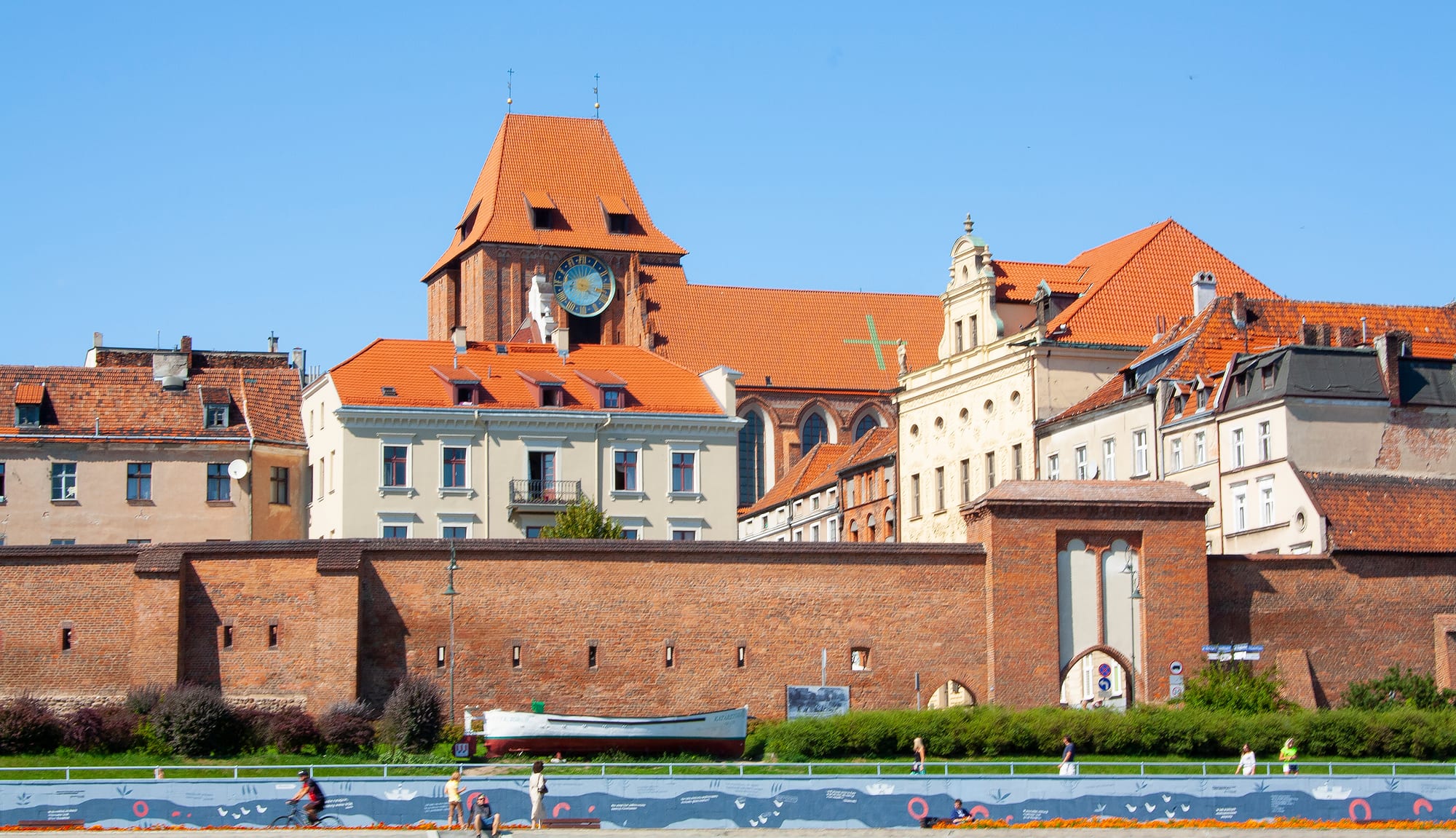
A red-brick medieval city wall below old houses with orange tiled roofs and a brick church tower with a large clock face

Gdańsk, Pomerania & the Baltic Coast, Poland

Toruń

The city walls along Philadelphia Boulevard in Toruń, with the tower of the cathedral behind. (Macieklew / Wikimedia Commons · CC BY-SA 4.0)

A university city on the Vistula in north-central Poland, founded by the Teutonic Knights in 1233 and grown rich in the Hanseatic grain trade. Spared destruction in the Second World War, its brick Gothic Old Town is a UNESCO World Heritage Site; it is the birthplace of Nicolaus Copernicus and is known across Poland for its gingerbread.

Neighbourhoods

  • Old Town
    • First-time visitors
    • Historic district
    • Museums

    The walled medieval town founded in 1233 on the north bank of the Vistula, with the Old Town Hall, the cathedral, Copernicus's house and streets of Gothic merchant houses and granaries. City buses and trams do not enter it, and its cafés spill onto the squares in summer.

    Open in Maps
  • New Town
    • Historic district
    • Quieter streets

    The second medieval town, founded in 1264 for craftsmen and merged with the Old Town in 1454, around its own market square to the east. Its square has stalls of fruit and vegetables.

    Open in Maps
  • Bydgoskie Przedmieście
    • Parks
    • Quiet and residential
    • Architecture

    A mostly residential district west of the Old Town, built in the late 19th and early 20th centuries, with a city park, the zoobotanical garden and timber-framed houses on Bydgoska and Konopnickiej streets.

    Open in Maps
  • Przedmieście Świętej Katarzyny
    • Architecture
    • Local life

    The district east of the Old Town, once called Wilhelmstadt, centred on St Catherine's Church, whose tower of over 80 metres is the tallest building in the city.

    Open in Maps
  • Rubinkowo and Na Skarpie
    • Local life
    • Close to public transport

    Large housing estates built mostly in the 1970s and 1980s east of the centre, home to about 70,000 people between them.

    Open in Maps

Things to do

The Old Town

  • Old Town Hallmuseum

    The Gothic town hall at the centre of the market square, built in stages from the 13th century, housing museum galleries and a tower with a view over the city.

    Open in Maps
  • Copernicus Housemuseum

    A Gothic merchant house owned by the Copernicus family in the 15th century and thought by many historians to be the astronomer's birthplace, with exhibitions on the house, astronomy and his life.

    Open in Maps
  • Toruń Cathedrallandmark

    The brick Gothic church of the two Saint Johns, with a 13th-century font said to have been used for Copernicus's baptism, a 16th-century epitaph to him and the Tuba Dei bell of 1500.

    Open in Maps
  • Leaning Towerlandmark

    A medieval tower of the city walls whose top stands 1.5 metres out of line with its base.

    Open in Maps
  • Toruń Castlelandmark

    The ruins of the Teutonic Knights' castle, dismantled by the townspeople when they rose against the Order in 1454.

    Open in Maps
  • New Town Market Squarelandmark

    The central square of the New Town, laid out in 1264, quieter than the Old Town square.

    Open in Maps

Museums

  • Museum of Toruń Gingerbreadmuseum

    Opened in 2015 with three floors of displays on the city's gingerbread, from historic moulds to a recreated communist-era interior, with baking workshops for visitors.

    Open in Maps
  • Living Museum of Gingerbreadmuseum

    An interactive show in an old granary where visitors grind flour, knead dough and bake their own gingerbread in traditional moulds.

    Open in Maps
  • House Under the Starmuseum

    A merchant house on the market square with a richly decorated late Baroque facade and a painted ceiling, now a museum of Far Eastern art.

    Open in Maps

The river and beyond the walls

  • Kępa Bazarowa viewpointviewpoint

    A viewing point on the island and left bank of the Vistula with the classic panorama of the Old Town across the river.

    Open in Maps
  • Toruń Fortresslandmark

    A ring of Prussian forts built in 1872–1894 around the city, one of the largest fortresses in Central and Eastern Europe; Fort VII was used by the Germans as a prison in 1939.

    Open in Maps
  • Toruń Zoobotanical Gardenpark

    A zoological and botanical garden in Bydgoskie Przedmieście, whose botanical part dates from 1797.

    Open in Maps
  • Dybów Castlelandmark

    The castle built by King Władysław II Jagiełło in the 1420s on the left bank, where the Statutes of Nieszawa were issued in 1454.

    Open in Maps

Short trips from the city

  • Chełmnoattraction

    A small town near the Vistula that gave its name to Chełmno Land and to the Kulm law granted to Toruń, with medieval walls.

    Open in Maps
  • Ciechocinekattraction

    A spa town on the Vistula known for its saline springs and its graduation towers, described as the longest in the world.

    Open in Maps
  • Golub Castlelandmark

    A four-winged Teutonic fortress from around 1300 on a hill above the town of Golub-Dobrzyń.

    Open in Maps

Seasonal events

  • KontaktMay

    An international theatre festival held in the city every year.

  • CamerimageNovember

    An international film festival devoted to cinematography, founded in Toruń in 1993 and back in the city since 2019 after years in Łódź and Bydgoszcz.

Eat and drink

Long-standing places and food districts in Toruń. Hours, ratings and directions come from your maps app, always current.

Toruń classics

  • Gingerbread shopsneighborhood

    Specialist gingerbread shops on the Old Town square and Żeglarska Street sell pierniki toruńskie in many shapes, from plain hearts to moulded figures.

    Open in Maps
  • Pierogi Plusrestaurant

    A restaurant devoted to pierogi, the filled dumplings, near the New Town market square.

    Open in Maps
  • Manekinrestaurant

    A place for naleśniki, large filled crêpes with a wide choice of fillings.

    Open in Maps

Cafés and the river

  • Old Town cafésneighborhood

    In the warmer months the Old Town fills with street cafés and outdoor restaurant tables, and some cafés stand on the riverbank or on boats on the Vistula.

    Open in Maps

Experience Toruń

History

A Slavic settlement stood at a ford of the Vistula from the early Middle Ages, and in the 10th century it became part of the Piast state. The Teutonic Knights, invited to fight the pagan Prussians, crossed the river in 1231, and on 28 December 1233 they granted Toruń and Chełmno their town charters under what became known as Kulm law. The town moved to its present site in 1236 because of flooding, a New Town for craftsmen followed in 1264, and in 1280 both joined the Hanseatic League. Toruń's merchants traded grain along the Vistula and grew rich.

In 1440 the city's gentry helped found the Prussian Confederation against the Knights, and in 1454 the townspeople rose, dismantled the Teutonic castle and placed themselves under the Polish king. The Second Peace of Thorn, signed here in 1466, ended the war and left Toruń as one of Poland's four largest cities. Nicolaus Copernicus was born in 1473, the city adopted Protestantism in 1557, and in 1645, on the initiative of King Władysław IV, a three-month congress of Catholics, Lutherans and Calvinists, the Colloquium Charitativum, met here; tensions rose until the Tumult of Thorn in 1724. Prussia annexed the city in 1793, and apart from the years of the Duchy of Warsaw it remained German until after the First World War, when it became the capital of interwar Poland's Pomeranian Voivodeship.

German forces occupied Toruń from September 1939 to February 1945. More than 1,100 Poles from the city and region were murdered, and Fort VII became a prison and execution site. Yet no battles or bombing damaged its buildings, and the Old Town, entirely preserved, was listed by UNESCO in 1997.

Culture & Customs

Copernicus defines the city's image: the university founded in 1945 carries his name, his probable birthplace is a museum, and his epitaph hangs in the cathedral, whose font is said to have been used for his baptism. The astronomical tradition continues in a planetarium in the centre and an observatory at nearby Piwnice with the largest radio telescope in Central Europe. Learning has deep roots here — a gymnasium founded in 1568 survives as one of Poland's oldest high schools, and the city opened its first museum in 1594.

Gingerbread is the other emblem. The craft dates back nearly a millennium, and old moulds carry the likenesses of kings; the 15-year-old Chopin was smitten with it when visiting his godfather here in 1825. Two museums and several workshops now let visitors bake their own.

Culturally the city punches above its size. The Camerimage festival of cinematography, founded here in 1993, returned in 2019; the Kontakt theatre festival is held every May; and the city has drama, children's and music theatres, a symphony orchestra and a centre of contemporary art opened in 2008. Toruń is also a centre of conservative Catholicism as the home of Radio Maryja. Sport includes speedway, at a purpose-built stadium that has hosted Speedway Grand Prix rounds since 2010, along with volleyball and ice hockey.

Daily Life

Toruń had about 197,000 people in December 2021, down from a peak of about 211,000 in 2001 as people move to the suburbs and to larger cities. Most live on the northern bank of the Vistula, many of them in the large estates of Rubinkowo and Na Skarpie built in the 1970s and 1980s. With Bydgoszcz and their surrounding counties, Toruń forms a metropolitan area of up to about 800,000 people, and the two cities share the role of regional capital.

Nicolaus Copernicus University, with more than 20,000 students, shapes the city's economy and its streets, filling the Old Town's bars and clubs with young people. Tourism is another mainstay, with more than 1.5 million visitors a year, and a special economic zone at nearby Łysomice has drawn electronics plants. About 25,000 firms are registered in the city.

Daily life moves between the compact historic centre, where people meet in cafés and on the squares, and the newer districts linked by trams and buses. Heavy investment in roads, a second Vistula bridge opened in 2013 and new housing have changed whole districts, while forecasts of continued population decline shape debate about the city's future.

Food

Toruń's speciality is piernik, gingerbread. Wheat from the fertile land around the city, honey from nearby villages and spices brought from far away by the Hanseatic trade made it possible, and the city's authorities encouraged the trade with tax breaks. Pierniki toruńskie are shaped in carved moulds; the largest maker today, the Kopernik company, traces its roots to a gingerbread workshop of 1763, and specialist shops on the Old Town square sell them in every form.

Beyond gingerbread, the city eats like the rest of Poland. Pierogi — dumplings filled with potato and curd cheese, meat or cabbage and mushroom — have their own restaurants, naleśniki, large filled crêpes, are a cheap favourite, and żurek, the sour rye soup, and kotlet schabowy, the breaded pork cutlet, are on most traditional menus. In summer the Old Town's street cafés and the bars along the Vistula, some of them on boats, serve beer, ice cream and simple dishes, and the New Town square has stalls of fruit and vegetables.

Planning tools

Budget

Toruń is cheaper than Gdańsk and the coast, and its compact Old Town saves on transport. Prices rise a little in summer and at weekends, when visitors from across Poland come for the Old Town, and during big festivals such as Camerimage. Gingerbread and museum tickets are the typical extras.

Daily Budget Midrange
USD 110–210 (Old Town hotel, restaurant dinners, museum tickets and gingerbread workshops)
Daily Budget Shoestring
USD 45–75 (hostel or guesthouse, pierogi and milk-bar meals, buses and trams)

Several Old Town museums offer combined tickets, and some have a weekly free-entry day for their permanent exhibitions.

Best Time to Visit

May to September, when the cafés move outdoors and the riverside is at its best; May and September are quieter. The gingerbread shops make December a good time too, and Camerimage brings film-lovers in November.

Suggested Number of Days

Two days are enough for the Old Town and its main museums. Three or four allow for the forts, the riverside and nearby towns. Toruń is also easy to combine with a longer journey through northern Poland.

First Visit
2 days
With Surroundings
3–4 days

Transportation

The Old Town is small and closed to buses and trams, so walking is the way to get around it; pedicabs can be hired in summer. Outside it, a tram network of seven lines serves the north bank and about 40 day and six night bus routes cover the rest of the city, including the south bank.

Validate a paper ticket immediately on boarding — inspectors in plain clothes check often — or use a mobile ticket app.

Airport & Station Connections

Toruń is a rail junction with trains from Warsaw, Poznań, Gdańsk, Łódź, Katowice and Olsztyn. The main station, Toruń Główny, is across the Vistula from the Old Town, about 35 minutes on foot or a short bus ride; the smaller Toruń Miasto station is much closer. Bydgoszcz airport, about 50 km away, is the nearest with regular flights, and the A1 motorway passes the city.

Walkability

The Old Town and New Town are compact, largely free of traffic and best seen on foot, with cobbled streets and a riverside boulevard below the walls. The Vistula bridges are long walks, and the suburbs and the forts need a bus or tram.

Safety

Poland is a safe country with low violent crime. Toruń's Old Town is busy and well used day and night, especially in summer when students and visitors fill the bars, and crime against visitors is rare. The usual care with bags in crowds applies.

Watch bags in the busy Old Town on summer evenings and at festivals. Check current official travel advice before travelling.

Climate

A transitional climate between the milder west and north of Poland and the more extreme south and east, with slightly milder winters and more moderate summers than Kraków or Warsaw. The average temperature over the year is about 8°C.

Summer
warm — July averages about 18°C
Winter
cold — January averages about −2.5°C

Local Customs

Toruń is a student city, home to Nicolaus Copernicus University, and also a centre of conservative Catholic culture: the Catholic broadcaster Radio Maryja is based here. Copernicus is everywhere, from the university to the shops, and gingerbread is the standard gift to take home.

Dress modestly in the Gothic churches, which are working parish churches; the cathedral charges for entry and asks an additional fee for photography.

Common Payment Methods

The currency is the Polish złoty (PLN). Cards are widely accepted, but kiosks selling transport tickets often take cash only, and a few small shops and stalls prefer cash. ATMs are easy to find in the Old Town.