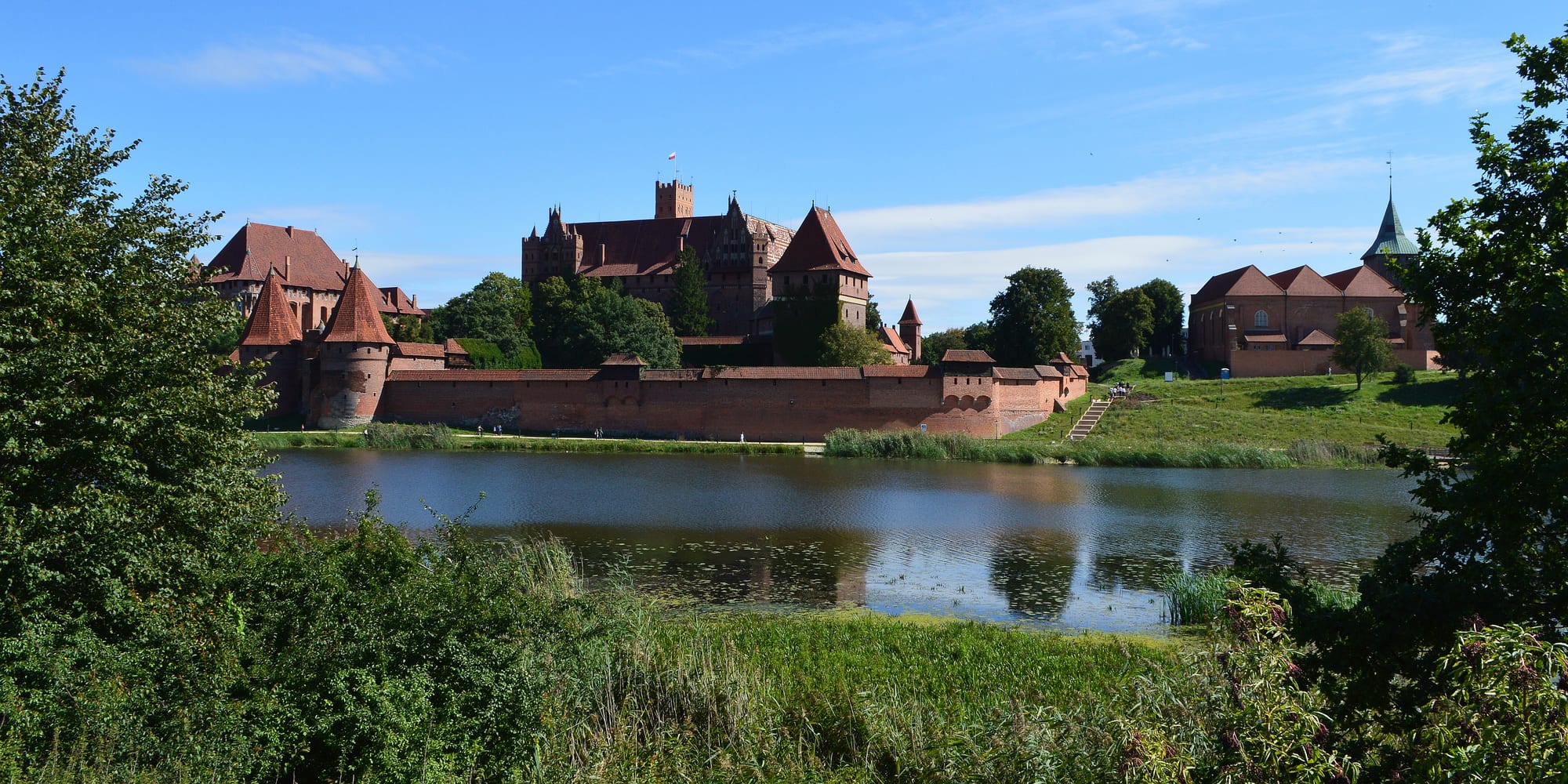
The red-brick walls and towers of Malbork Castle reflected in the calm Nogat river under a blue sky

Gdańsk, Pomerania & the Baltic Coast, Poland

Malbork

Malbork Castle seen across the Nogat river in September 2023. (Scotch Mist / Wikimedia Commons · CC BY-SA 4.0)

A small town on the Nogat river in northern Poland, grown up beside the brick fortress the Teutonic Knights founded in 1274 and made the seat of their order. Malbork Castle, the largest castle in the world by land area and a UNESCO World Heritage Site, still dominates a modest town that was almost destroyed in 1945 and rebuilt largely in post-war style.

Neighbourhoods

  • The castle and the Old Town
    • First-time visitors
    • Historic district

    The area beside the castle where the medieval town once stood. Apart from the Gothic town hall, two town gates and St John the Baptist's church, its old buildings were lost in 1945, and a 1960s housing estate now stands in its place.

    Open in Maps
  • The town centre along Kościuszki Street
    • Shops and cafés
    • Close to public transport

    The main street of the modern town, with the town square and its fountain, the monument to King Casimir IV Jagiellon, the tourist information centre and the town's shopping centre.

    Open in Maps
  • The Nogat riverside
    • Walks
    • Views of the castle
    • Quiet and residential

    The banks of the Nogat below the castle walls. A footbridge from the castle crosses to the west bank, where the river view takes in the whole fortress, and a riverside path leads north towards the campsite and sports grounds on Parkowa Street.

    Open in Maps

Things to do

The castle

  • Malbork Castlelandmark

    The Teutonic Order's headquarters, begun in 1274 and in effect three castles in one on a site of nearly 21 hectares; its museum, founded in 1961, includes an amber exhibition opened in 1965, and the castle church was restored in 2016.

    Open in Maps

Around the town

  • Old Town Halllandmark

    The Gothic town hall of the medieval town, one of the few buildings of the Old Town to survive 1945.

    Open in Maps
  • St John the Baptist's Churchlandmark

    The Gothic parish church of the old town beside the castle, where the first Polish services after the war were held in 1945.

    Open in Maps
  • Mary's Gate and Potters' Gatelandmark

    The two surviving gates in the partly preserved medieval town walls.

    Open in Maps
  • Monument to Casimir IV Jagiellonlandmark

    A monument beside the town square to the Polish king who acquired the castle in 1457, after which it served as a royal residence until 1772.

    Open in Maps
  • Commonwealth War Graves Cemeterylandmark

    A cemetery with 240 graves, mostly of prisoners of war who died in the area during both world wars, many of them in the Stalag XX-B camp in the Wielbark district.

    Open in Maps

Short trips from the town

  • Kwidzyn Castlelandmark

    A castle built in the early 14th century as a chapter house in Pomesania, now a branch of the Malbork Castle Museum, known for its very large dansker, a latrine tower built out from the walls.

    Open in Maps
  • Sztum Castlelandmark

    A castle of the Teutonic Order near Malbork; Kwidzyn and Sztum can be seen on a joint ticket with Malbork.

    Open in Maps
  • Vistula Fensattraction

    Żuławy Wiślane, the flat delta farmland between Malbork, Elbląg, Tczew and Gdańsk, where the lowest point in Poland lies 1.8 metres below sea level.

    Open in Maps

Seasonal events

  • Days of MalborkJune

    The town's annual celebrations, Dni Malborka, with events through the town.

  • Siege of Malborka weekend in July

    Oblężenie Malborka, a three-day medieval festival drawing on the town's knightly tradition, held for the twentieth time in 2019.

Eat and drink

Long-standing places and food districts in Malbork. Hours, ratings and directions come from your maps app, always current.

Food in Malbork

  • Restaurants on Kościuszki Streetneighborhood

    The main street of the town centre, with the town square and shopping centre, a short walk from the castle.

    Open in Maps
  • Restaurants by the castleneighborhood

    Places to eat around the castle and across the footbridge on the west bank of the Nogat, including a restaurant on a boat by the bridge with a view of the castle.

    Open in Maps

Experience Malbork

History

The town grew up beside the fortress the Teutonic Knights founded in 1274 on the east bank of the Nogat, and both were named Marienburg after the order's patron, the Virgin Mary. The Nogat and the flat land around it let barges reach the town from the sea, and the knights collected tolls on the river and held a monopoly on the amber trade. During the Thirteen Years' War their unpaid Bohemian mercenaries sold the castle in 1457 to King Casimir IV of Poland.

Under Polish rule Malbork was the capital of a voivodeship in Royal Prussia and prospered from the grain and timber trade, while the castle became a royal residence, the seat of the Polish Admiralty from 1568 and of a royal mint from 1584. Swedish invasions in 1626 and 1656 and a cholera epidemic in 1710, which killed half the population, hit the town hard. Prussia annexed it in 1772, and in the 1920 plebiscite the town voted overwhelmingly to stay in Germany.

During the Second World War the Germans ran the Stalag XX-B prisoner-of-war camp in what is now the Wielbark district. Fighting with the Red Army in early 1945 almost destroyed the town, and in June it passed to Polish administration. The Old Town was not rebuilt: its bricks went to rebuild Warsaw and Gdańsk, and a housing estate replaced it in the 1960s. The castle, more than half destroyed, has been restored since 1962 and was named a UNESCO World Heritage Site in 1997.

Culture & Customs

Malbork's identity rests on its castle and the Teutonic past, and the town's best-known festival looks back to it: the Siege of Malbork, held each July, is a three-day medieval festival drawing on the knightly tradition. The castle museum, with its amber collection, also connects the town with its own Polish chapter as a royal residence, recalled in the monument to Casimir IV beside the town square. Nicolaus Copernicus is among the visitors the castle received.

Almost the entire population arrived after 1945. The German inhabitants who had not fled were expelled, and the town was gradually repopulated by Poles, many of them expelled from the eastern areas annexed by the Soviet Union. In 1945 a Polish post office opened, the first Polish services were held in St John's church and Polish schools began. A Commonwealth War Graves cemetery holds prisoners of war who died in the area during both world wars.

Local life has its own calendar of events, from the Days of Malbork in June to a Christmas arts festival, dance and theatre reviews. The football clubs Pomezania Malbork and Jastrząb Malbork play in the lower divisions, and the town has clubs for canoeing, swimming, triathlon and karate. Malbork is twinned with towns in France, Germany, Sweden, Lithuania — including the castle town of Trakai — and, since 2023, Volodymyr in Ukraine.

Daily Life

About 36,700 people lived in Malbork in 2024, down from just over 40,000 in 1994. It is the seat of Malbork County, with direct trains to Gdańsk, Warsaw, Elbląg and Olsztyn. The castle draws visitors all year, but the town's working life is that of an ordinary provincial centre.

Post-war industry shaped the economy: a sugar factory was founded in 1946 and a pasta factory in 1962, which became one of the largest in Poland. The airfield east of the town, where a German aircraft factory stood during the war, is now the base of the Polish Air Force's 22nd Air Base. Most residents live in post-war blocks and estates around the centre, including the 1960s housing on the site of the Old Town.

The rhythm of the town follows the seasons. In summer, tour coaches and day-trippers fill the area around the castle, street stalls appear on Kościuszki Street and the riverbanks are busy; in winter Malbork is quiet.

Food

Malbork has no dish of its own, and its restaurants serve the everyday Polish repertoire: pierogi, the filled dumplings; bigos, a stew of cabbage and meat; kotlet schabowy, the breaded pork cutlet; gołąbki, stuffed cabbage leaves; and soups such as żurek. Herring is a common starter, served in cream, in oil or in aspic.

The countryside around the town is the delta of the Vistula and Nogat, known for its excellent soil, and the medieval town had guilds of bakers and butchers. Post-war industry here has included food: sugar from the post-war factory and pasta from one of the country's largest pasta plants.

Most places to eat are along Kościuszki Street in the town centre and around the castle, from canteens and fast food to restaurants serving Polish meals; across the river there is a restaurant on a boat with a view of the castle. For a wider choice of food, Gdańsk is less than an hour away by train.

Planning tools

Budget

Malbork is cheaper than Gdańsk, and many visitors come only for the day by train. The castle ticket, which includes an audio guide, is the largest single cost of a visit; rooms in town are modest in price, and fill up around the summer festival weekends.

Daily Budget Midrange
USD 110–220 (town hotel, restaurant meals, castle ticket with audio guide)
Daily Budget Shoestring
USD 50–80 (hostel or campsite, canteen meals, regional trains)

Allow several hours for the castle itself; the audio-guided visit can take up to three and a half hours.

Best Time to Visit

May to September, when the castle grounds and the riverbanks are at their best and the town holds its summer events, above all the Siege of Malbork in July. Winter is cold and quiet, but the castle stays open all year and is far less crowded.

Suggested Number of Days

Most visitors need one full day, or a long day trip from Gdańsk. Two or three days allow time for the neighbouring castles and the delta countryside; without a car, train and bus times decide how much fits in.

First Visit
1 day
With Surroundings
2–3 days

Transportation

The town is small enough to cover on foot, and town buses have been free since July 2022. Regional minibus companies link Malbork with nearby towns and villages from a stop by the railway station, and PKS buses run to Elbląg, Gdańsk, Olsztyn and other cities. A car is useful for the castles and villages around the delta.

Buying rail tickets online in advance can be considerably cheaper than at the station.

Airport & Station Connections

Malbork has frequent direct trains to Gdańsk and Warsaw. Trains from Gdańsk take between half an hour and an hour, and from Warsaw two and a half to three and a half hours; intercity trains also run to Olsztyn and along the coast to Szczecin. The nearest major airport is Gdańsk Lech Wałęsa Airport, north-west of Gdańsk. By road the town is reached on route 22.

Walkability

Very walkable: the railway station, the town centre and the castle are all within a short walk of each other, and paths follow the Nogat beside the castle walls. The castle itself involves a lot of walking and stairs.

Safety

Poland is a safe country with low violent crime. Malbork is a quiet provincial town; the busiest place is the castle on summer weekends and festival days, when the usual care with bags in crowds applies.

Keep an eye on bags in crowds at the castle and festival events. Check current official travel advice before travelling.

Climate

In Gdańsk, to the north, the nearest large city, winters are moderately cold and cloudy and summers mild with frequent showers; average monthly temperatures there range from about −1°C to 17°C.

Summer
mild with frequent showers in Gdańsk, to the north, where hot spells reach 30–35°C at least a couple of times a year
Winter
in Gdańsk, to the north, January and February average near or below 0°C, with occasional drops to −15°C

Local Customs

A tip of around 10 per cent is usual in restaurants. Drinking alcohol in public places outside licensed venues is illegal and can bring a fine. Churches are places of worship: dress modestly and stay quiet during services.

Information signs at the main tourist sights are often in several languages, but elsewhere in town they are usually in Polish only.

Common Payment Methods

Poland uses the złoty (PLN), not the euro. Cards and contactless payment are widely accepted, and there are cash machines (bankomat) in the town centre; carry a little cash for small shops and market stalls.