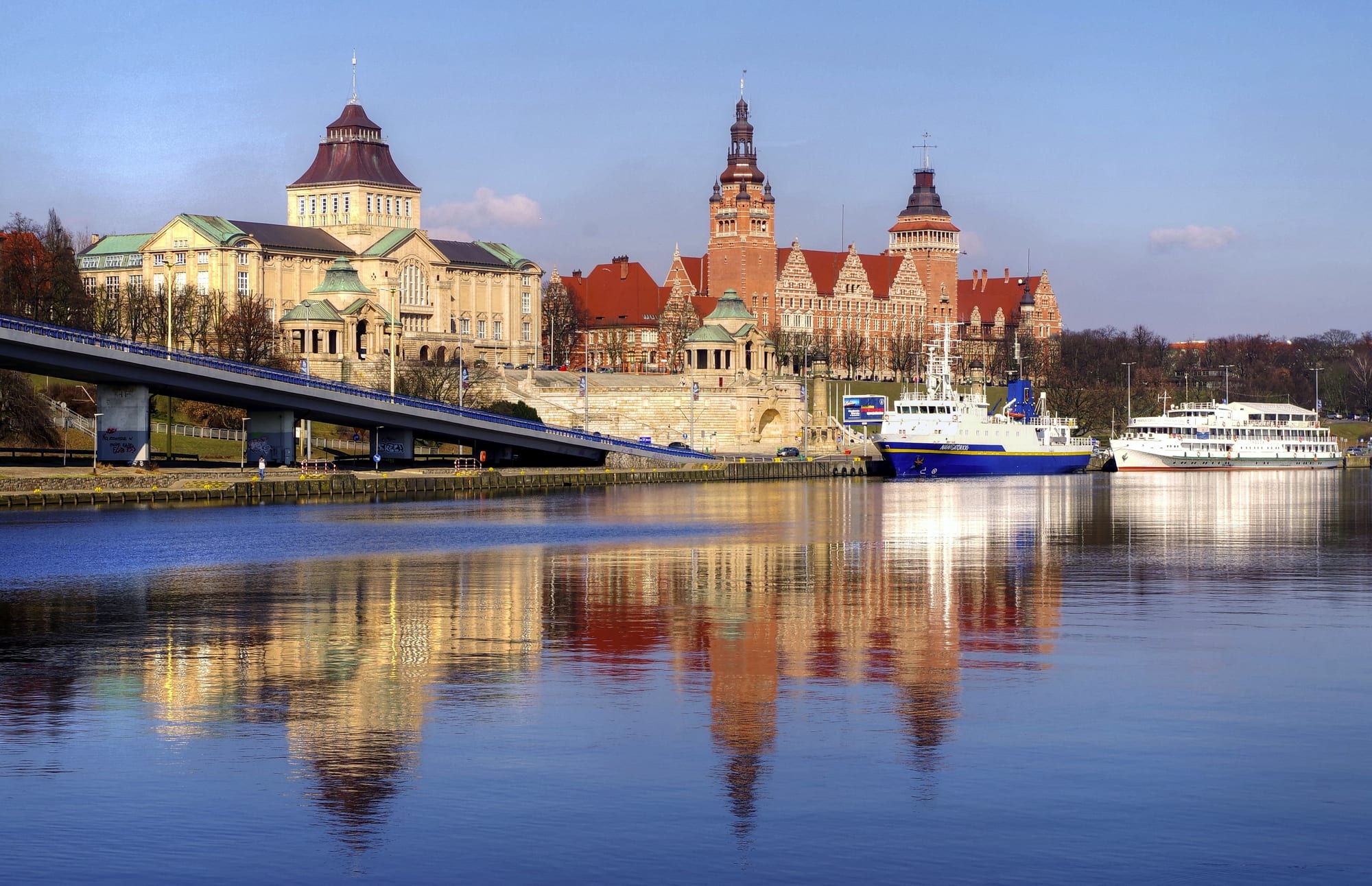
Domed and towered early 20th-century buildings on the Chrobry Embankment reflected in the Oder, with moored ships and a road bridge

Gdańsk, Pomerania & the Baltic Coast, Poland

Szczecin

The Chrobry Embankment above the Oder in Szczecin. (StasiÓ Stachów / Wikimedia Commons · CC BY 3.0)

North-western Poland's largest city and a major seaport on the Oder, close to the German border and south of the Szczecin Lagoon. For centuries the German city of Stettin — seat of the dukes of Pomerania, then Swedish and Prussian — it became Polish in 1945, and today pairs a Haussmann-style plan of boulevards and roundabouts with a rebuilt riverfront, a ducal castle and a busy port.

Neighbourhoods

  • Old Town
    • First-time visitors
    • Historic district
    • Nightlife

    The oldest district, on the left bank of the Oder around the Ducal Castle, the cathedral and the Old Town Hall. Almost all of it was destroyed in the war; rebuilding began only in the late 1990s, with new houses and reconstructions, and its streets hold most of the city's pubs and bars.

    Open in Maps
  • Centrum
    • Architecture
    • Shopping
    • Close to public transport

    The city centre west of the Old Town, laid out from the 1880s with wide tree-lined avenues and star-shaped roundabouts. Historicist and Art Nouveau apartment blocks line the streets around Grunwaldzki Square.

    Open in Maps
  • Łasztownia and the port islands
    • Waterfront
    • Industrial heritage

    The islands between the West Oder and the Regalica, facing the Old Town across the river.

    Open in Maps
  • Pogodno
    • Quiet and residential
    • Historic homes

    A largely low-rise residential district in the west of the city, known as Neu-Westend until 1947, with streets of detached and semi-detached houses.

    Open in Maps
  • Dąbie
    • Lakeside
    • Quiet and residential

    A former town on the right bank of the Oder, part of the city since 1948, on the Płonia river and the south shore of Dąbie Lake, with its own railway station.

    Open in Maps

Things to do

Famous landmarks

  • Ducal Castlelandmark

    The Renaissance castle of the dukes of Pomerania on Castle Hill, on the site of the early medieval stronghold, rebuilt after the war; it houses a museum, the Opera in the Castle, a cinema, cafés and the tourist office.

    Open in Maps
  • Chrobry Embankmentviewpoint

    Wały Chrobrego, a 500-metre terrace above the Oder built between 1902 and 1921, with a monumental flight of steps and a view over the river and the port.

    Open in Maps
  • Szczecin Cathedrallandmark

    The Gothic cathedral of St James, built between the 12th and 14th centuries; it is the second-tallest church in Poland, and its tower is open as a viewpoint.

    Open in Maps
  • Old Town Hallmuseum

    A Gothic and Baroque town hall by the Hay Market square, now home to the Museum of the History of Szczecin.

    Open in Maps
  • King's Gatelandmark

    A Baroque city gate from the Prussian fortress era, also called the Prussian Homage Gate.

    Open in Maps
  • Szczecin water pumpsattraction

    Twenty-eight surviving decorative cast-iron street pumps of 1865–1895, known locally as Berliners.

    Open in Maps
  • Central Cemeterypark

    A landscaped municipal cemetery of more than 167 hectares, the largest in Poland and the third-largest in Europe.

    Open in Maps

Museums and music

  • National Museum in Szczecinmuseum

    A national museum founded in 1945, with art, archaeology, maritime and ethnographic collections; its main building stands on the Chrobry Embankment.

    Open in Maps
  • Museum of Technology and Transportmuseum

    A museum in a former tram depot, opened in 2006, with trams, buses, motorcycles and vintage cars, including an exhibition of cars from the socialist states.

    Open in Maps
  • Szczecin Philharmonicattraction

    The city orchestra, founded in 1948, whose glass-fronted concert hall, opened in 2014, won the European Union Prize for Contemporary Architecture in 2015.

    Open in Maps
  • Pionier 1909 Cinemaattraction

    A cinema that has shown films since 1909.

    Open in Maps

Parks and the water

  • Jan Kasprowicz Parkpark

    A park of about 27 hectares, laid out in 1900, which with the neighbouring Arkona Forest Park forms a long green belt north of the centre.

    Open in Maps
  • Szczecin Landscape Parkpark

    Puszcza Bukowa, a protected beech forest of about 91 square kilometres, part of which lies inside the city boundaries.

    Open in Maps
  • Dąbie Lakepark

    A large lake in the Oder delta on the city's eastern side, with the Dąbie district on its southern shore.

    Open in Maps

Sport and nights out

  • Florian Krygier Municipal Stadiumattraction

    The home ground of Pogoń Szczecin, the city's top football club, first built in 1925 and rebuilt between 2019 and 2022 for about 21,000 spectators.

    Open in Maps

Short trips from the city

  • Crooked Forestpark

    A grove of about 400 pines near Gryfino, planted around 1930, whose trunks bend sharply to the north just above the ground — the cause has never been established.

    Open in Maps
  • Szczecin Lagoonattraction

    The lagoon of the Oder estuary north of the city, shared by Poland and Germany and separated from the Baltic by the islands of Usedom and Wolin.

    Open in Maps
  • Wolin National Parkpark

    A national park on Wolin island, established in 1960, with the sea cliffs of Gosań and Kawcza Góra and a European bison sanctuary.

    Open in Maps

Seasonal events

  • Days of the SeaJune

    Dni Morza, the city's maritime festival.

  • Szczecin MarathonAugust

    The city's annual marathon.

  • PyromagicAugust

    An international fireworks festival.

  • Szczecin OpenSeptember

    A men's tennis tournament on outdoor clay courts, held in the city since 1993 and now part of the ATP Challenger Tour.

Eat and drink

Long-standing places and food districts in Szczecin. Hours, ratings and directions come from your maps app, always current.

Szczecin classics

  • Pasztecik barsrestaurant

    Specialised fast-food bars serving the Szczecin pasztecik, a deep-fried yeast pastry filled with minced beef, sauerkraut and mushrooms, or cheese and mushrooms, usually with a cup of clear red barszcz.

    Open in Maps

Food districts and bars

  • Old Town restaurants and pubsneighborhood

    The rebuilt streets and squares of the Old Town hold most of the city's pubs and bars.

    Open in Maps
  • Cafés on the Chrobry Embankmentcafe

    Cafés along the terrace above the Oder, with views of the river and the port.

    Open in Maps

Experience Szczecin

History

Szczecin's recorded history begins in the 8th century, when West Slavs built a stronghold on the hill where the castle now stands. The town became part of the emerging Polish state in the 10th century, and after Bolesław III Wrymouth took it in 1121–22 its people were converted to Christianity by Otto of Bamberg's missions of 1124 and 1128. Under the Griffin dukes of Pomerania it was a ducal capital; German merchants settled from the 12th century, Duke Barnim I granted Magdeburg rights in 1243, and the city traded herring, grain and timber within the Hanseatic world.

The Thirty Years' War brought Swedish rule: from 1648 Stettin was the capital of Swedish Pomerania and a much-besieged fortress, until Prussia acquired it in 1720. After the fortifications were partly levelled in the 1870s the city was replanned with boulevards and roundabouts, and it industrialised fast — shipbuilding, chemicals, food processing and machinery — growing to 210,000 people by 1900 as the main port serving Berlin.

Bombing and fighting in 1944–45 destroyed 65 per cent of its buildings and almost all of the centre. The Red Army took the city on 26 April 1945, and on 5 July it passed to Poland; its German population was expelled by 1950 and replaced by settlers. The city rose against the communist authorities in 1956, 1970 and 1980, and the first of the August Agreements that legalised Solidarity was signed here on 30 August 1980. Since 1999 Szczecin has been the capital of the West Pomeranian Voivodeship.

Culture & Customs

Modern Szczecin was built by newcomers. About 70 per cent of its post-war settlers came from central Poland; others came from the eastern lands annexed by the Soviet Union, among them Ukrainians, and later Poles repatriated from Harbin in China and Greek refugees from the civil war. Their loyalties shaped the city: many sports clubs, Pogoń Szczecin among them, take their names from clubs of pre-war Lwów. For decades the authorities stressed the Slavic and ducal past, rebuilding the Griffin dukes' castle in Renaissance form, and only from the 1970s did the 19th-century German city come to be valued too.

The cultural calendar is full for a city of its size. The Philharmonic, founded in 1948, moved in 2014 into a concert hall by the Spanish studio Barozzi Veiga that won Europe's main contemporary architecture prize. There are the Opera in the Castle, the Polish Theatre, the alternative Kana Theatre, the Pleciuga puppet theatre and cinemas including the Pionier, open since 1909, and the city bid to be European Capital of Culture for 2016.

Maritime life is part of local identity, celebrated each June in the Days of the Sea, and the city hosted the finale of the Tall Ships Races in 2007, 2013 and 2017. Football is the most popular sport, and Pogoń's matches draw big crowds; sailing, kayaking on the Oder and the lakes, and the September tennis tournament also have a following.

Daily Life

About 392,000 people lived in Szczecin at the end of 2022, making it the largest city in north-western Poland and the seventh-largest in the country, at the centre of a metropolitan area that reaches into the German states of Brandenburg and Mecklenburg-Western Pomerania. Most people live in the left-bank districts around the centre — Śródmieście alone had about 97,000 residents in 2025 — while the right bank holds Dąbie and large post-war estates.

The maritime economy remains important: the Port of Szczecin, a harbour of both the Baltic and the Oder, is the third-largest in Poland and handles more than 32 million tonnes of cargo a year, and the shipping companies Polsteam and Euroafrica are based here. The city is also a university and administrative centre, with the University of Szczecin, the Maritime University and the Pomeranian Medical University, and since 1999 it has hosted the headquarters of NATO's Multinational Corps Northeast.

The German border is close, and Berlin is within easy reach by road. Since Ukraine's Revolution of Dignity in 2014 the city, like other large Polish cities, has also drawn many Ukrainians. Trams, in service since a horse line of 1879, remain the backbone of daily travel along the wide avenues.

Food

Szczecin's best-known food is the pasztecik szczeciński, a deep-fried yeast pastry filled with minced beef — the oldest and most popular filling — or with sauerkraut and dried mushrooms, or cheese and champignons. It became popular in the years of the Polish People's Republic, is sold in specialised bars as fast food, and is eaten hot with a cup of clear, spicy red barszcz, the beetroot soup.

The city's other famous product is paprykarz szczeciński, a reddish canned spread of ground fish, rice, tomato paste and oil, seasoned with onion and spices. Its recipe, inspired by a West African dish that Polish fishermen had tried, was developed by a Szczecin fishing company in the 1960s; cheap and long-lasting, it became popular across Poland and is eaten on sandwiches.

Szczecin also has its own gingerbread, glazed with chocolate or sugar and decorated with motifs of the city's architecture or the sea, and a brewing tradition of light, amber and wheat beers. The Old Town has most of the city's pubs and bars, and cafés line the Chrobry Embankment above the river.

Planning tools

Budget

Szczecin is cheaper than Gdańsk or the Baltic resorts, and prices for rooms and meals are moderate all year. Berlin is close enough to combine with a visit.

Daily Budget Midrange
USD 110–220 (city-centre hotel, restaurant dinners, museum tickets, a river cruise or a concert)
Daily Budget Shoestring
USD 50–80 (hostel, pasztecik bars and canteens, trams and buses)

German regional rail day tickets for Berlin and Brandenburg are also valid on Szczecin's trams and buses, which helps day-trippers from Germany.

Best Time to Visit

May to September, for the riverside terraces, boat trips on the Oder and the lakes, and the summer festivals — the Days of the Sea in June and the Pyromagic fireworks in August. Winters are cold and grey but the city's museums, concerts and theatres keep going.

Suggested Number of Days

Two days cover the centre and the riverfront. Three or four allow time for the forests, the lakes and the Oder lagoon around the city; a concert, a football match or a festival weekend can add to the count.

First Visit
2 days
With Surroundings
3–4 days

Transportation

Szczecin has a large tram network — 12 lines on about 110 km of track — and about 70 bus routes, with night buses and express lines. Local trains are the quickest link between the centre and outer districts on the right bank such as Dąbie. The city is split by the Oder and the Regalica, with the port islands between them, and most sights are on the left bank. Boat trips through the port and the river leave from the bank below the Chrobry Embankment, and kayaks can be hired for the lower Oder.

The roundabouts of the Haussmann-style plan can be confusing for drivers; trams are the easiest way around the centre.

Airport & Station Connections

Solidarity Szczecin–Goleniów Airport is 45 km north-east of the city, with a direct rail link to the main station taking about 50 minutes. Berlin's airport is a common alternative, two to three hours away by minibus, car or train. Szczecin Główny station has trains to the main Polish cities — Poznań in about two and a half hours, Warsaw in under six — and to Germany; works on the line to Berlin have halted direct trains, with a change of train or replacement bus at Angermünde. By road the A6 motorway joins Germany's A11 towards Berlin.

Walkability

The Old Town, the castle, the cathedral and the Chrobry Embankment are close together and easy to explore on foot, and the boulevards of the centre are pleasant walking. Distances grow quickly beyond that, and the wide roads, roundabouts and river crossings make trams the better choice for the port islands, Dąbie or the parks.

Safety

Poland is a safe country with low violent crime. Szczecin is a large port city with the ordinary risks of one: pickpocketing in crowds, on trams and at festival events, and occasional rowdiness around bars at weekends.

Watch bags on busy trams and at festivals, and use taxi apps late at night. Check current official travel advice before travelling.

Climate

An oceanic climate moderated by the Baltic: winters are colder than on the coast itself and summers warm. The average annual temperature is about 8°C, rain falls on about 167 days a year, and the temperature drops below 0°C on about 86 days, mostly in January and February.

Summer
warm — July, the hottest month, averages about 16–20°C
Winter
cold and damp — January averages about −1°C to 3°C, with frost common

Local Customs

A tip of around 10 per cent is usual in restaurants. Drinking alcohol in public places outside licensed venues is illegal and can bring a fine. Churches are places of worship: dress modestly and stay quiet during services. Many residents' families came from central Poland and the former eastern borderlands after 1945, a story that is still part of local identity.

Signs outside the main sights are often in Polish only.

Common Payment Methods

Poland uses the złoty (PLN), not the euro. Cards and contactless payment are widely accepted, and cash machines (bankomat) are common; carry some cash for taxis, as few drivers take cards. Exchange offices (kantor) are widespread; compare rates before changing money.