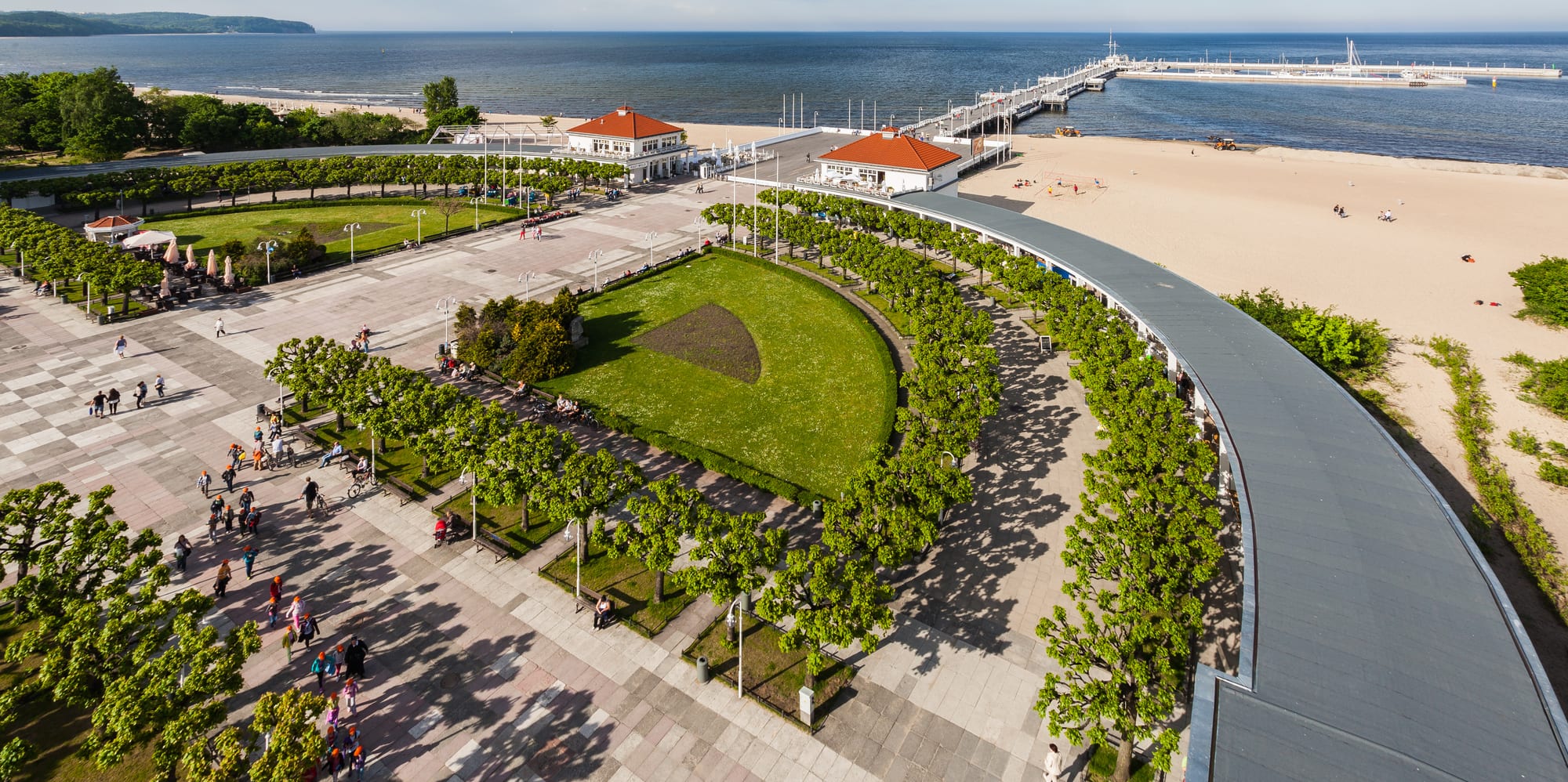
A tree-lined square and lawns leading to a sandy beach and a long white pier stretching into the blue Baltic Sea

Gdańsk, Pomerania & the Baltic Coast, Poland

Sopot

The spa square, the beach and the wooden pier in Sopot on the Bay of Gdańsk. (Diego Delso / Wikimedia Commons · CC BY-SA 3.0)

A small seaside resort and spa on the Bay of Gdańsk, between Gdańsk and Gdynia in the Tricity. A summer retreat for Gdańsk's merchants since the 16th century and a fashionable spa from the 1820s, it has a sandy beach, Europe's longest wooden pier, a pedestrian main street and the open-air Forest Opera, home of a famous song festival.

Neighbourhoods

  • Dolny Sopot
    • First-time visitors
    • Beaches
    • Nightlife

    Lower Sopot, between Aleja Niepodległości and the sea, with Monte Cassino Street, the spa square, the pier and the main beach. Restaurants, cafés, clubs and old villas crowd its streets, and it is the liveliest and most expensive part of town in summer.

    Open in Maps
  • Górny Sopot
    • Quiet and residential
    • Woods and walks

    Upper Sopot, west of Aleja Niepodległości, a quieter residential district away from the seafront crowds.

    Open in Maps
  • Karlikowo
    • Beaches
    • Quieter stays

    The southern part of the town on the sea side of Aleja Niepodległości, towards the Gdańsk border, with the hippodrome and the Sopot Wyścigi commuter station.

    Open in Maps
  • Kamienny Potok
    • Quiet and residential
    • Close to public transport

    The northern district on the border with Gdynia, mostly residential, with its own commuter station.

    Open in Maps

Things to do

The seafront

  • Sopot Pierlandmark

    First opened in 1827 and extended to its present 511.5 metres in 1928, the longest wooden pier in Europe, with a marina beside it.

    Open in Maps
  • Sopot Lighthouseviewpoint

    A lighthouse built in 1903–04 as part of the balneological institute, with a view from the top over the pier and the marina.

    Open in Maps
  • Sopot beachbeach

    The long sandy beach on either side of the pier, the town's main summer attraction.

    Open in Maps

The town

  • Bohaterów Monte Cassino Streetlandmark

    Monciak, the main street, pedestrianised since 1963, running from near the station to the spa square and lined with restaurants, cafés, clubs and shops.

    Open in Maps
  • Krzywy Domeklandmark

    The 'crooked house' of 2004 on Monte Cassino Street, part of a shopping centre, with warped walls inspired by fairy-tale illustrations.

    Open in Maps
  • Grodzisko in Sopotmuseum

    An early medieval settlement with ramparts and a moat in beech woodland, the oldest monument in Sopot, run as a heritage park by the Archaeological Museum in Gdańsk.

    Open in Maps
  • Forest Operaattraction

    An open-air amphitheatre of about 5,000 seats in the woods, opened in 1909 and home of the Sopot Festival.

    Open in Maps
  • Ergo Arenaattraction

    A multi-purpose indoor arena opened in 2010 with the Gdańsk–Sopot boundary running through its middle, which hosted the 2014 World Indoor Athletics Championships.

    Open in Maps

Short trips from the town

  • Gdyniaattraction

    The neighbouring port city, built from the 1920s, whose modernist centre is a historical monument of Poland and inscribed by UNESCO.

    Open in Maps
  • Oliwa Cathedrallandmark

    The Brick Gothic church of the Cistercian abbey in Gdańsk's Oliwa district, just south of Sopot, which owned the Sopot villages in the Middle Ages.

    Open in Maps

Seasonal events

  • Sopot FestivalAugust

    A televised music festival in the Forest Opera, first held in 1961 and described as the biggest song contest in Europe after Eurovision.

Eat and drink

Long-standing places and food districts in Sopot. Hours, ratings and directions come from your maps app, always current.

Sopot classics

  • Bar Przystańrestaurant

    A fish bar by the sea about a kilometre from the pier, known for its fried fish.

    Open in Maps
  • Fish bars on the beachrestaurant

    Smażalnie, simple fried-fish bars near the beach, serve the coast's fried cod and flounder.

    Open in Maps

Cafés and bars

  • Monciakneighborhood

    Monte Cassino Street has the town's best choice of cafés and bars, with courtyard and terrace tables and late-night clubs nearby.

    Open in Maps

Experience Sopot

History

A Slavic Pomeranian stronghold stood here in the 7th century, but by the 10th it had dwindled to a fishing village. New villages grew up in the following century and passed to the Cistercian abbey at Oliwa, which owned the whole area by 1316; Sopot itself is first recorded in 1283. From the 16th century Gdańsk's patricians built summer manor houses here, and during the negotiations of the Treaty of Oliwa in 1660 the Polish king and queen stayed in one of them. Russian troops burned the village during the War of the Polish Succession, and Prussia annexed it in 1772.

The resort began in 1819, when the merchant Carl Christoph Wegner opened the first public bath. It failed, but in 1823 Jean Georg Haffner, a former French army doctor, built a new bath complex, followed by a sanatorium, a park and a 63-metre pier. The railway arrived in 1870, Emperor Wilhelm II, whose favourite spa it was, granted town rights in 1901, and the Forest Opera opened in 1909. Between the wars Sopot belonged to the Free City of Danzig; its casino became a major source of income, Wagner festivals earned it the name 'Bayreuth of the North', and in 1928 the pier reached its present length. In 1938 local Nazis burned the synagogue.

After the war began, many of Sopot's Poles, Kashubians and Jews were arrested and murdered. Soviet troops took the town on 23 March 1945, it became Sopot again, and its German inhabitants were expelled. The resort recovered quickly: Poland's first jazz festival was held here in 1956, the song festival began in 1961, and in 1999 Sopot regained its official status as a spa town.

Culture & Customs

Sopot has long been the Tricity's place for pleasure. In the early 20th century it was so popular with the Polish intelligentsia that a writer called it the extension of Warsaw to the Baltic, and after the war it remained an important centre of culture. The jazz festival of 1956 — the first in Poland, held when jazz had only just stopped being banned — was the forerunner of Warsaw's Jazz Jamboree.

The Sopot Festival, first held in 1961 and staged at the Forest Opera since 1964, is held each August, usually televised, and is described as the biggest song contest in Europe after Eurovision. The Forest Opera itself, an open-air amphitheatre of over 5,000 seats in the woods, also hosted the Wagner festivals of the interwar years and has staged concerts by international stars, among them Whitney Houston in 1999.

Sport and the seaside shape the rest of the calendar. Basketball is the town's most popular team sport, and the Ergo Arena on the boundary with Gdańsk hosted the 2014 World Indoor Athletics Championships. The pier, the beach and Monte Cassino Street, with its street artists, are the social stage of the summer, when its clubs, bars and discos stay busy late into the night.

Daily Life

Sopot is small: about 31,000 people lived here at the end of 2025, down from a peak of about 54,500 in 1977. It is the smallest city in Poland with the status of a county, and its property prices are the highest in the country outside Warsaw.

Tourism, the spa and the hotels drive the economy, with treatments for orthopaedic, rheumatic, heart and respiratory conditions. The insurance company Ergo Hestia is based here, and faculties of the University of Gdańsk and of SWPS University bring students. The SKM commuter railway, which stops three times in the town, ties it closely to its larger neighbours.

The year has two rhythms. In July and August the beach, the pier and Monte Cassino Street are crowded day and night, and the population is outnumbered by visitors. Out of season Sopot is a quiet town of villas, tree-lined streets and walks in the forests of the Tricity Landscape Park. In recent years five-star hotels and spa resorts have been built on the waterfront.

Food

Like the rest of the coast, Sopot eats fish. Herring, śledź, is pickled, soused in oil or served in cream with onion, and fried cod or flounder, typical of the region, comes from the smażalnia bars of the beaches. Bar Przystań, a fish bar by the sea about a kilometre from the pier, is known for its fried fish.

Monte Cassino Street has the town's greatest choice of restaurants, cafés and bars, with tables in courtyards and on terraces in summer, and the fashionable restaurants of the resort serve everything from Polish classics to Italian food. A street market near Sopot Wyścigi station sells fresh fruit and vegetables alongside antiques, old jewellery and clothes, and small shops and stalls sell handmade amber jewellery. Polish staples — pierogi, żurek, kotlet schabowy with potatoes and cucumber salad — are easy to find, and in Gdańsk next door Goldwasser, the herbal liqueur with flakes of gold, is the historic local drink.

Planning tools

Budget

Sopot is one of the most expensive places in Poland: property prices are second only to Warsaw, and in July and August hotels, restaurants and bars charge peak prices as the town fills with Polish holidaymakers. Outside the summer the resort is far better value. Entry to the pier is charged.

Daily Budget Midrange
USD 140–280 (seaside or spa hotel, restaurant dinners, pier and spa entries, a concert)
Daily Budget Shoestring
USD 60–95 (guest room or hostel bed, fish bars, SKM trains)

Stay in Gdańsk or Gdynia rather than Sopot in summer and come in on the SKM trains, which take only minutes.

Best Time to Visit

June to early September for the beach, with July and August busiest and the Sopot Festival in August. May and September are quieter and suit walks on the pier and in the woods. In winter the resort is very quiet and far cheaper.

Suggested Number of Days

A day or two is enough for the town itself. Staying four or five days allows time for the two neighbouring cities of the Tricity as well. Good beach weather is what usually lengthens a stay.

First Visit
1–2 days
With Surroundings
4–5 days

Transportation

Sopot has no public transport of its own but is served by bus lines from Gdańsk and trolleybuses from Gdynia; it is one of only four Polish towns with trolleybuses. The SKM commuter railway stops at three stations — Sopot, Sopot Wyścigi and Sopot Kamienny Potok — with frequent trains to Gdańsk and Gdynia.

The town is barely four kilometres across, so walking and the SKM cover almost every need.

Airport & Station Connections

Gdańsk Lech Wałęsa Airport is about 10 km away. Most visitors arrive by SKM commuter train from Gdańsk or Gdynia; national PKP trains also stop at Sopot station. Sopot station to the pier and beach is about a 20-minute walk.

Walkability

Sopot is compact and very walkable: it is not much over 4 km across and can be crossed in about an hour. Monte Cassino Street is entirely pedestrianised, and a promenade runs behind the beach. The hills of Górny Sopot are steeper.

Safety

Poland is a safe country with low violent crime. Sopot's busy summer nightlife calls for the usual care with bags and bar bills, and swimming is safest at the beaches with lifeguards.

Swim only at beaches with lifeguards and obey their flags, and check bar bills. Check current official travel advice before travelling.

Climate

The sea moderates the weather: summers are cooler than inland Poland and winters a little milder, though damp and windy. In neighbouring Gdańsk monthly average temperatures range from about −1°C in winter to about 17°C in summer, and the weather is changeable all year.

Summer
mild with showers — the warmest months in neighbouring Gdańsk, July and August, average about 17°C
Winter
cold, damp and windy — January and February in neighbouring Gdańsk average around −1°C

Local Customs

Sopot is a resort of promenades, cafés and nightlife, and dress is casual by day. The town is also a spa, with treatments for orthopaedic, rheumatic, heart and respiratory conditions, and the 'inhalation mushroom', a fountain of bromide spring water, is a local curiosity.

Dress is casual; expect to pay a small charge to walk on the pier.

Common Payment Methods

The currency is the Polish złoty (PLN). Cards and contactless payment are accepted almost everywhere, Carry a little cash for beach kiosks, fish bars and the pier entrance in case card machines are busy.