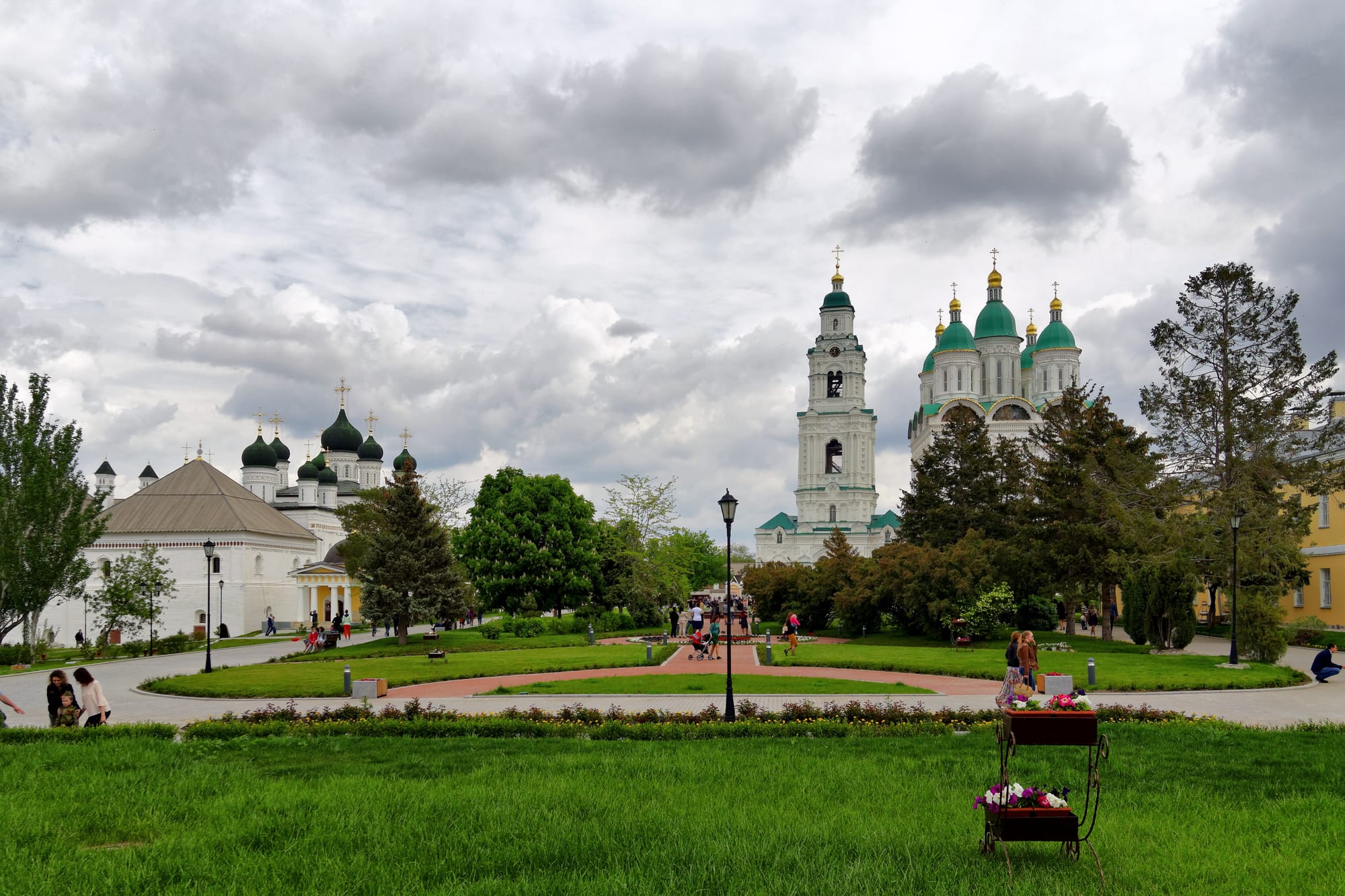
Lawns and paths inside the Astrakhan Kremlin, with a white bell tower, the green-domed Assumption Cathedral and a white church under grey clouds

Southern Russia & the Black Sea, Russia

Astrakhan

Inside the Astrakhan Kremlin, with the bell tower and the Assumption Cathedral. (Alexxx1979 / Wikimedia Commons · CC BY-SA 4.0)

A city on eleven islands at the head of the Volga delta, about 100 km from the Caspian Sea and below sea level — built around the kremlin that Ivan the Terrible raised after taking the Tatar khanate in 1556, and for nearly 400 years Russia's main centre of fish processing. This page is written to explain the city, not to encourage travel.

Neighbourhoods

  • The kremlin and the old centre
    • First-time visitors
    • Historic district
    • Architecture

    The kremlin on its hill above the Volga, and the streets around it with the regional museum, the Armenian and Indian trading houses, churches and the Volga embankment with its monument to Peter the Great. Most of what visitors come to see is within walking distance.

    Open in Maps
  • The canals and bridges
    • Walks
    • Local life

    The city is cut by channels such as the Kutum and the First of May canal, crossed by small bridges and lined with embankments. South of the canal stand some of the historic mosques of the old Tatar quarters.

    Open in Maps
  • Trusovsky District
    • Local life

    One of the city's four districts, linked to the centre by the city's bridges.

    Open in Maps
  • Riverside and the port
    • River trips
    • Fish market

    The Volga waterfront, where river cruise ships call in summer, and the Selenskie Isady fish market on Intercession Square.

    Open in Maps

Things to do

The kremlin

  • Astrakhan Kremlinlandmark

    The fortress built from the 1580s on the highest hill of an island in the delta, with walls and towers raised partly from bricks taken from the ruined Golden Horde cities, now a museum complex.

    Open in Maps
  • Assumption Cathedrallandmark

    The five-domed cathedral inside the kremlin, begun in 1699 and built over almost twelve years, with a tall, light upper church for ceremonial worship in the warm months and a dim, columned lower church.

    Open in Maps
  • Trinity Cathedrallandmark

    The second cathedral of the kremlin, in its northern part, beside the Cyril Chapel.

    Open in Maps

Museums and the old town

  • Astrakhan Regional Museummuseum

    The museum of local history and nature just east of the kremlin, with displays on the fish of the Volga and Caspian basin and the region's archaeology.

    Open in Maps
  • Dogadin Picture Gallerymuseum

    The city's picture gallery, named after P. Dogadin.

    Open in Maps
  • Armenian and Indian trading houseslandmark

    Historic merchant compounds that recall the Armenian, Persian and Indian traders who settled here from the 17th century.

    Open in Maps
  • Monument to Peter the Greatlandmark

    A statue on the Volga riverbank to the tsar who built a shipyard here and used the city as his base against Persia.

    Open in Maps

Places of worship

  • Church of the Assumption of Marylandmark

    The city's Catholic church, begun in 1762 and consecrated in 1778.

    Open in Maps
  • White Mosquelandmark

    One of the historic mosques of the Astrakhan Tatars, south of the First of May canal.

    Open in Maps
  • Black Mosquelandmark

    Another of the old Tatar mosques in the quarters south of the canal.

    Open in Maps

Music and nights out

  • Astrakhan State Opera and Ballet Theatreattraction

    The city's opera house, staging opera and ballet.

    Open in Maps

Short trips from the city

  • Astrakhan Nature Reservepark

    A strict nature reserve covering islands and wetlands of the outer delta, where Dalmatian pelicans nest and the lotus is protected; reserve staff run boat tours on its waterways.

    Open in Maps
  • Volga Deltapark

    The largest river delta in Europe, where the Volga drains into the Caspian Sea, best known for its sturgeon.

    Open in Maps

Eat and drink

Long-standing places and food districts in Astrakhan. Hours, ratings and directions come from your maps app, always current.

Astrakhan classics

  • Selenskie Isady fish marketmarket

    The city's fish market, on Intercession Square.

    Open in Maps
  • Voblamarket

    Dried Caspian roach, a popular dried-fish snack, often eaten with a glass of beer.

    Open in Maps

Food streets

  • Cafés of the old centreneighborhood

    Most of the city's restaurants and beer halls are in the centre around the kremlin and the embankment.

    Open in Maps

Experience Astrakhan

History

The Volga delta was the heartland of earlier empires: the capitals of the Khazars and later of the Golden Horde stood nearby. The town of Hajji Tarkhan, whose founding legend was first recorded by the traveller Ibn Battuta, was burned by Timur in 1395, and from 1459 was the capital of the Astrakhan Khanate of the Astrakhan Tatars, on the higher right bank about 12 km from today's city. Ivan the Terrible conquered the khanate in 1556 and in 1558 built a new fortress on a hill above the Volga, the date counted as the city's foundation. An Ottoman siege in 1569 failed, and the whole Volga was opened to Russian shipping.

Merchants from Armenia, Safavid Persia, Mughal India and the Khivan Khanate settled here, giving the town a cosmopolitan character. Stenka Razin's Cossacks held it for seventeen months in 1670–71, and Kondraty Bulavin's rebels took it in 1707. Peter the Great built a shipyard here and used it as his base against Persia; fires in 1702, 1718 and 1767, a Persian raid in 1719 and cholera in 1830 all struck the city hard.

In March 1919, after a failed workers' revolt against Bolshevik rule, the Cheka executed several thousand people in less than a week. In the autumn of 1942 German scouting units came within about 35 km, but the city was never taken. It became the capital of its own oblast in 1943, and in 2010 a Bridge of Friendship, paid for with donations from Azerbaijan, reflected its ties across the Caspian.

Culture & Customs

Representatives of more than 173 nationalities live in the city, and diversity is Astrakhan's defining trait. Orthodox cathedrals, the mosques of the Astrakhan Tatars, a Catholic church of 1778 and the Armenian and Indian trading houses stand within the old town, and to the west lies Kalmykia, the only region of Europe with a Buddhist majority. Astrakhan Tatars and other Muslims form a substantial part of the population.

The kremlin is the city's emblem, and its two cathedrals, consecrated in 1700 and 1710 and built by masters from Yaroslavl, combine traditional Russian church forms with Baroque decoration. The opera and ballet theatre, opened in 2011, the Dogadin picture gallery and a house-museum of the poet Velimir Khlebnikov anchor the city's cultural life, and since 2018 the airport has carried the name of the painter Boris Kustodiev.

Fishing shapes local identity as much as anything: the region is one of Russia's main destinations for fishing and hunting, and the river and delta are part of everyday leisure. In sport, the Dynamo water polo club won bronze medals in the Russian championship in 2015, 2022, 2024 and 2025.

Daily Life

About 466,000 people lived in the city in 2025. It sits on eleven islands in the upper delta, 28 metres below sea level — the lowest city in Russia — and is divided into four districts, Kirovsky, Leninsky, Sovetsky and Trusovsky, joined by bridges across the Volga and its channels.

For nearly 400 years Astrakhan has been Russia's main centre of fish processing, and the fish trade is still a large part of the economy. The city also has a gas processing plant, and its place on the Caspian has given it a significant role in Russia's relations with Azerbaijan, whose government has funded a bridge, a school and a park here.

The rhythm of the day follows the heat, and summer life moves to the embankments, the canals and the river. The war is far away but not absent: on 13 May 2026 drones attacked the gas processing plant.

Food

Fish is the foundation of Astrakhan's food. Vobla, the dried Caspian roach, is a popular dried-fish snack, often eaten with a glass of beer, and the city's fish market is at Selenskie Isady on Intercession Square. The Volga delta is best known for its sturgeon, prized for caviar, though overfishing and poaching have greatly reduced wild populations of the beluga sturgeon.

River fish and the everyday Russian table meet in local kitchens. A proper meal opens with zakuski — pickled cucumbers and mushrooms, cured fish, herring "under a fur coat", salads and black bread — before soups such as borsch or shchi and dishes such as pelmeni dumplings, stuffed cabbage rolls and blini with smoked fish or caviar. In summer, okroshka, a cold soup, and kvass, a mildly fermented rye drink, are everyday staples, and tea is drunk strong with jam.

Dried fish and beer go together here, and the centre has beer restaurants, at least one brewing its own beer, where Russian dishes are served alongside the local fish.

Planning tools

Budget

Prices are moderate by Russian standards. As everywhere in the country, most foreign bank cards no longer work, so enough cash for the stay has to be brought in. Boat trips into the delta and fishing trips are the main extra costs.

Daily Budget Midrange
USD 85–180 (mid-range hotel, restaurants, a boat trip into the delta)
Daily Budget Shoestring
USD 30–60 (guesthouse or hostel, canteens and market fish, marshrutkas)

Bring enough foreign currency in cash for the whole stay, and agree the price of any boat or fishing trip before setting out.

Best Time to Visit

May to June and September, avoiding the fierce midsummer heat. River cruises arrive from early May to the end of September. Winters are cold.

Suggested Number of Days

One or two days cover the kremlin and the old centre. Boat trips into the delta, or fishing, add a day or two more, and the number depends on the season and how far into the delta a trip goes.

First Visit
1–2 days
With Surroundings
3–4 days

Transportation

Local public transport is provided by buses and marshrutkas, fixed-route minibuses; the trams stopped in 2007 and the trolleybuses in 2017. Bridges link the islands and the two banks of the Volga. Taxis are ordered through apps, and boats are the way into the delta.

Buses and marshrutkas are the only public transport; for the delta, use an established boat operator rather than an informal one.

Airport & Station Connections

Narimanovo Airport, officially named after the painter Boris Kustodiev since 2018, has flights to Moscow and, as of January 2024, international flights to Aktau and Baku. Trains link the city with Volgograd and Moscow to the north, and with Kazakhstan and Makhachkala, and river cruise ships from Moscow arrive in summer.

Walkability

The centre is compact and walkable: the kremlin, the museums, the embankment and the canals are close together, and the bridges make pleasant walks. The heat in July and August makes walking hard in the middle of the day, and the outer districts need a marshrutka or taxi.

Safety

Beyond the ordinary crime of a large European city, the decisive risks are political and legal: near-total loss of consular support, a real risk of arbitrary arrest and lengthy detention of foreigners on politically motivated charges (and their use in prisoner swaps), sweeping wartime censorship laws, and the possibility that men of certain ages, including dual nationals, face conscription or exit bans. Astrakhan is far from the front line but not out of reach: drones attacked the Astrakhan gas processing plant on 13 May 2026; a Russian official said all were shot down or suppressed.

Most governments advise against all travel to Russia, and particularly to areas bordering Ukraine and occupied Ukrainian territory. Do not photograph military or industrial sites, and carry a passport, visa and migration card at all times. Check current official travel advice before travelling.

Climate

A dry, sharply continental semi-desert climate: Astrakhan is one of the driest cities in Europe, with cold winters and some of the hottest summers in Russia.

Summer
very hot — July averages about 26°C, and temperatures can reach 40°C and more
Winter
cold — January averages about −3.6°C

Local Customs

Astrakhan is a meeting place of many peoples — Russians, Astrakhan Tatars and many others — with Orthodox churches, mosques and a Catholic church within a short walk of one another. Visitors dress modestly in churches and mosques. Russian is the language of daily life and English is little spoken.

Cover shoulders and knees in churches and mosques, with a head covering for women; remove shoes in mosques, and ask before photographing people at prayer.

Common Payment Methods

The currency is the Russian rouble (RUB). Most foreign credit and debit cards no longer work in Russia and most cannot be used at Russian ATMs, so visitors rely on cash brought in for the whole stay.