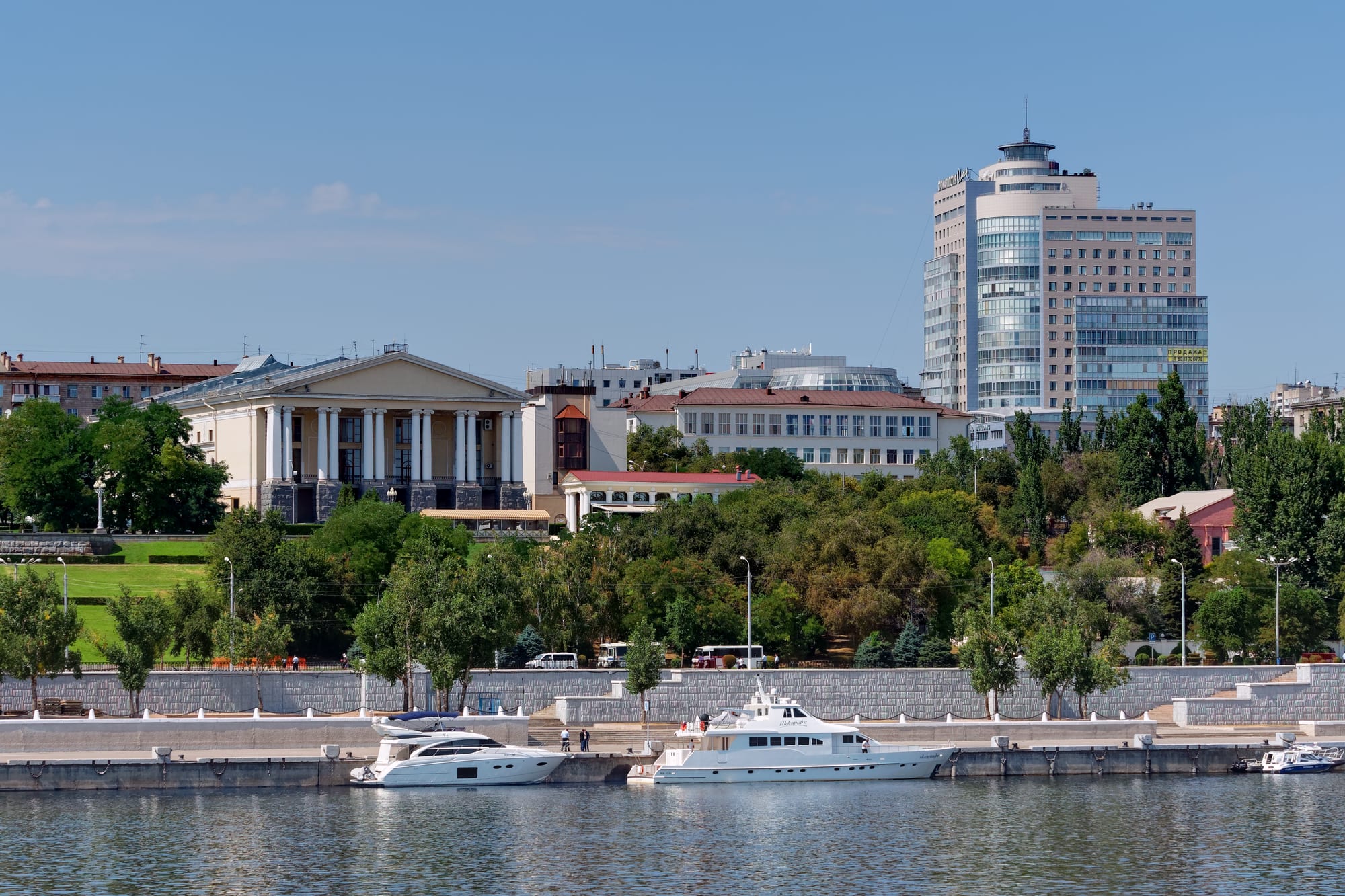
White motor yachts moored below the granite Central Embankment, with a columned building, trees and a tall glass tower behind

Southern Russia & the Black Sea, Russia

Volgograd

The Central Embankment of Volgograd seen from the Volga. (Alexxx1979 / Wikimedia Commons · CC BY-SA 4.0)

A city of about a million people strung for about 60 km along the west bank of the Volga — founded as the fortress of Tsaritsyn, renamed Stalingrad in 1925, and almost entirely destroyed in the battle of 1942–43. Rebuilt after the war, it is defined by the memorial on Mamayev Kurgan and its riverside embankments. This page is written to explain the city, not to encourage travel.

Neighbourhoods

  • Central District
    • First-time visitors
    • Close to public transport
    • Riverside walks

    The heart of the city rebuilt after 1943 in the grand post-war style, around Lenin Avenue and the Central Embankment, the oldest of the city's riverfronts and its port and trading wharf since the city's founding. The Panorama Museum, Pavlov's House, the rebuilt Alexander Nevsky Cathedral and the river terminal are all here.

    Open in Maps
  • Mamayev Kurgan and the northern factory districts
    • History
    • Battle memorials

    North of the centre the hill of Mamayev Kurgan rises above the Volga, crowned by The Motherland Calls. Beyond it the long industrial districts stretch north past the Red October and Barricades works to the Tractor Plant, which kept producing tanks in 1942 until German troops reached it.

    Open in Maps
  • Voroshilovsky District
    • Quiet and residential
    • Local life

    Another historic centre of the city, next to the Central District, and home to a children's railway.

    Open in Maps
  • Old Sarepta (Krasnoarmeysky District)
    • Historic district
    • Day out

    The far southern end of the city, founded in 1765 by Moravian Brethren as a German settlement and absorbed into Stalingrad in 1931. Eighteenth-century buildings that escaped the bombing form an open-air museum, and the Volga–Don Canal begins nearby.

    Open in Maps
  • Volzhsky
    • Local life
    • Industry

    A separate industrial city of about 320,000 on the east bank, across the Volga and the great hydroelectric dam.

    Open in Maps

Things to do

The Battle of Stalingrad

  • Mamayev Kurganlandmark

    The hill fought over again and again in 1942–43, now a memorial complex of terraces, sculptures, the Hall of Military Glory with its eternal flame and an hourly changing of the guard.

    Open in Maps
  • The Motherland Callslandmark

    Yevgeny Vuchetich's 85-metre concrete statue of a sword-bearing woman summoning the nation to battle, the tallest statue in Europe if its pedestal is included, which towers over the river from the top of the hill.

    Open in Maps
  • Panorama Museum of the Battle of Stalingradmuseum

    A large museum on the Volga bank holding a panoramic painting of the battlefield seen from Mamayev Kurgan, the largest painting in Russia, with weapons, uniforms, maps and the rifle of the sniper Vasily Zaytsev.

    Open in Maps
  • Pavlov's Houselandmark

    The apartment block that a small Red Army platoon held for about two months in 1942, rebuilt after the war and still lived in, with a memorial wall of battlefield bricks.

    Open in Maps
  • Gerhardt's Milllandmark

    A mill left in its bombed-out state beside the Panorama Museum, one of only three buildings deliberately not restored after the battle.

    Open in Maps

The city centre

  • Central Embankmentviewpoint

    The city's oldest riverfront, destroyed in the battle and rebuilt after the war in the Stalinist Empire style, with the river terminal where passenger boats call.

    Open in Maps
  • Cathedral of Alexander Nevskylandmark

    The cathedral blown up in 1932, rebuilt under the same name in the city centre and consecrated in 2021.

    Open in Maps
  • Volgograd Planetariumattraction

    Opened in 1954 as a gift from East Germany, only the second purpose-built planetarium in the Soviet Union, and still using its original Zeiss projector.

    Open in Maps
  • Volgograd Metrotramtransit hub

    A light-rail line opened in 1984 that runs partly underground through the centre and along the river to the northern districts, stopping at Mamayev Kurgan.

    Open in Maps

Sport

  • Volgograd Arenaattraction

    The football stadium built on the Volga bank below Mamayev Kurgan for the 2018 World Cup, home of FC Rotor.

    Open in Maps

Short trips from the city

  • Old Sareptamuseum

    The open-air museum of history and ethnography among the surviving 18th-century buildings of the Moravian settlement in the south of the city.

    Open in Maps
  • Volga Hydroelectric Stationlandmark

    The huge dam between Volgograd and Volzhsky, the largest hydroelectric station in Europe and once the largest power station in the world.

    Open in Maps
  • Volga–Don Canalattraction

    The ship canal opened in 1952 to link the Volga and the Don at their closest points, beginning with its first locks in the south of the city.

    Open in Maps

Seasonal events

  • Victory Day9 May

    The national holiday for the end of the war in Europe carries particular weight here, when the city may officially call itself Hero City Stalingrad.

  • End of the Battle of Stalingrad2 February

    The anniversary of the German surrender in 1943, one of the dates each year on which the title Hero City Stalingrad is used in official celebrations.

Eat and drink

Long-standing places and food districts in Volgograd. Hours, ratings and directions come from your maps app, always current.

Markets and food streets

  • Central Marketmarket

    The main food market in the city centre, by the Komsomolskaya stop, for the fruit, vegetables and other produce of the lower Volga.

    Open in Maps
  • Cafés around Lenin Avenueneighborhood

    The central avenue and the streets leading down to the Central Embankment hold most of the city's cafés and restaurants.

    Open in Maps

Experience Volgograd

History

A fortress called Tsaritsyn stood here by 1589, on the right bank of the Volga just above the mouth of the Tsaritsa river. It was a frontier post for two centuries: the Cossack rebels Stepan Razin and Kondraty Bulavin both seized it, raiders from the Kuban carried off thousands of people in 1717, and Yemelyan Pugachev failed to storm it in 1774. Nearby, Moravian Brethren founded the German settlement of Sarepta in 1765.

In the 19th century Tsaritsyn grew into a river port and trading town for grain, timber, fish and salt, especially after the railway reached it, and its population rose from fewer than 3,000 in 1807 to about 84,000 in 1900. It was a crowded, unhealthy place, struck by cholera between 1908 and 1910. In the Civil War the Reds held it against three White assaults in 1918 before Denikin's army took it in 1919; in 1925 it was renamed Stalingrad, for Stalin's part in its defence, and became a centre of heavy industry.

The battle that began on 23 August 1942 with bombing raids that reduced much of the city to rubble lasted until 2 February 1943, when the last German troops surrendered after the Sixth Army was encircled. Mamayev Kurgan changed hands eight times, and 99 per cent of the city was destroyed. Stalingrad was named a Hero City and rebuilt on a grand plan, and in 1961 Khrushchev renamed it Volgograd. The old name returns on nine commemorative days a year, and in 2025 the airport was symbolically renamed Stalingrad.

Culture & Customs

Everything in Volgograd is measured against the battle. The memorial complex on Mamayev Kurgan, completed with The Motherland Calls in 1967, is the city's emblem, and Victory Day, the anniversary of the German surrender on 2 February and the start of the Soviet counter-offensive in November are kept as major civic occasions. The question of the name remains live: proposals to restore Stalingrad have come up repeatedly, and since 2013 the city may officially call itself Hero City Stalingrad on set dates.

Of a pre-war population of more than half a million, only 1,515 people remained when the battle ended, and the Russian spoken in the city today is close to the Moscow standard. Cossack influence from the nearby Don lands is present but lighter than in the Kuban, and the city has sizeable communities from the Caucasus. Religious life has revived since the 1990s, with the rebuilt Alexander Nevsky Cathedral, the restored synagogue and the boat chapel of Saint Vladimir, a self-propelled floating church that sails the Volga.

Football is the main sport, centred on FC Rotor and the Volgograd Arena built for the 2018 World Cup, and the long embankments are where the city goes to walk, meet and watch the river.

Daily Life

About 1.01 million people lived in the city at the start of 2025, making it the 16th largest in Russia, with Volzhsky across the river adding over 300,000 more. The city is very long, running for about 60 km along the Volga, and is divided into eight districts, from the factory districts of the north to the Central and Voroshilovsky districts and Krasnoarmeysky in the far south.

It remains an industrial city: shipbuilding, oil refining at the large Lukoil refinery in the south, steel and aluminium, tractors and heavy machinery, and chemicals, with the great Volga hydroelectric dam just to the north. Many young people consider leaving for Moscow for lack of opportunities, and the population has been slowly falling. During the war in Ukraine the refinery has been hit by drones several times since 2024.

Daily routines follow the climate. Long, hot summers draw people to the city's sandy beaches and embankments, while dust is a common complaint in the dry months and the winter months are cold and grey.

Food

Volgograd eats the food of southern Russia. Meals open with zakuski — pickled cucumbers and mushrooms, cured fish, salads and black bread — and move on to borsch, the beetroot soup, or shchi, cabbage soup, then pelmeni dumplings, stuffed cabbage rolls or kasha. In summer, okroshka, a cold soup, and kvass, a mildly fermented rye drink, are everyday staples, and tea is drunk strong with jam.

The rivers of the south supply fish for soups such as ukha. The lower Volga is also melon country: Kamyshin, upriver in the same oblast, was long famous for its watermelon trade. The Central Market in the city centre, by the Komsomolskaya stop, is the place to see the season's produce.

Most of the city's cafés and restaurants are in the centre, around Lenin Avenue and the streets running down to the embankment, and canteens serving soups, salads and hot dishes remain the cheapest way to eat.

Planning tools

Budget

Volgograd is moderately priced by Russian standards, well below Moscow or the summer resorts of the Black Sea coast. The real difficulty is payment: most foreign bank cards no longer work in Russia, so enough cash for the stay has to be brought in.

Daily Budget Midrange
USD 90–200 (mid-range hotel, restaurants, museum tickets and taxis booked by app)
Daily Budget Shoestring
USD 35–65 (guesthouse or hostel, canteens and market food, buses, trams and the Metrotram)

Bring enough foreign currency in cash for the whole stay; the memorial complex on Mamayev Kurgan and the embankments cost nothing to walk.

Best Time to Visit

Late spring and September, before and after the fierce midsummer heat. Summer is long and hot, and the dry streets can be dusty; from about November to March the weather is cold, windy and grey. Victory Day in May and the anniversary of the battle in early February bring large ceremonies to the memorials.

Suggested Number of Days

Two days cover the battle memorials and the centre. The city is very long and thin, so anything beyond the centre takes time to reach, and adding the southern districts or the east bank of the river calls for an extra day or two.

First Visit
2 days
With Surroundings
3–4 days

Transportation

The city stretches for about 60 km along the river, so distances are long. The Metrotram light-rail line links the centre with Mamayev Kurgan and the northern districts, and buses, trolleybuses, trams and minibuses cover the rest; electric buses joined the fleet in 2023. Taxis are ordered through apps.

Online journey planners are unreliable for the city's buses and minibuses; the Metrotram is the simplest way north from the centre.

Airport & Station Connections

The airport, symbolically renamed Stalingrad International Airport in April 2025 (its official name is unchanged), is 15 km north-west of the city, roughly an hour by bus from the centre. Flights link it with major Russian cities and a few foreign ones. Long-distance trains reach Moscow in about 20 hours, and river cruises call at the Central Embankment from May to September.

Walkability

The centre is pleasant on foot: Lenin Avenue, the Central Embankment, the Panorama Museum and Pavlov's House lie within walking distance of one another. Mamayev Kurgan is a short Metrotram or bus ride north, and everything else is too far to walk. The memorial complex itself means a long climb up steps and terraces.

Safety

Beyond the ordinary crime of a large European city, the decisive risks are political and legal: near-total loss of consular support, a real risk of arbitrary arrest and lengthy detention of foreigners on politically motivated charges (and their use in prisoner swaps), sweeping wartime censorship laws, and the possibility that men of certain ages, including dual nationals, face conscription or exit bans. During the war in Ukraine, drones struck the city's oil refinery in February 2024, January 2025 and October 2025.

Most governments advise against all travel to Russia, and particularly to areas bordering Ukraine and occupied Ukrainian territory. Do not photograph military sites, industrial plants or infrastructure, and carry a passport, visa and migration card at all times. Check current official travel advice before travelling.

Climate

A dry continental climate on the edge of the steppe: summers are hot and long, winters have frequent thaws, and sharp swings in temperature are possible in any season. The city's recorded extremes, both set in 1940, are −33°C and 42.6°C.

Summer
long and hot, from the end of May, and dust can blow in the streets; the record high, set in 1940, is 42.6°C
Winter
cold, with frequent thaws; the record low, set in 1940, is −33°C

Local Customs

The memory of the battle is close to sacred here. Mamayev Kurgan is a mass grave as well as a monument, and visitors keep their voices down in the Hall of Military Glory, dress modestly and treat the guard and the eternal flame with respect. Victory Day and the battle anniversaries are solemn as well as festive. Russian is the language of daily life, and English is not widely spoken.

Cover shoulders and, for women, the head in Orthodox churches; never photograph soldiers, military vehicles or factories, and avoid political discussion of the war in public.

Common Payment Methods

The currency is the Russian rouble (RUB). Most foreign credit and debit cards no longer work in Russia and most cannot be used at Russian ATMs, so visitors rely on cash brought in for the whole stay.