💰 Budget
Krasnodar is moderately priced, well below Moscow and the Black Sea resorts in summer. Payment is the difficulty: most foreign bank cards no longer work in Russia, so enough cash for the stay has to be brought in.
- Daily Budget Midrange
- USD 90–200 (mid-range hotel, restaurants, museums and taxis booked by app)
- Daily Budget Shoestring
- USD 35–65 (hostel bed, canteens and market food, trams and trolleybuses)
Bring enough foreign currency in cash for the whole stay; the parks, Krasnaya Street and the fountain shows cost nothing.
📅 Best Time to Visit
May to June and September to October, when the heat is bearable. Midsummer is hot, and winter weather varies greatly.
⏳ Suggested Number of Days
One or two days cover the centre and the stadium park. A visit that also takes in Adygea and the foothills of the Caucasus, or continues to the Black Sea coast, needs several more days.
- First Visit
- 1–2 days
- With Surroundings
- 3–4 days
🚆 Transportation
Trolleybuses and trams are the main public transport — there is no metro — with buses and marshrutkas, fixed-route minibuses, filling the gaps and a ferry crossing the Kuban. In 2015–16 Krasnodar had more cars per head than any other Russian city. Taxis are ordered through apps.
Trams and trolleybuses are the simplest way between the centre, Theatre Square and the railway station.
🛬 Airport & Station Connections
Krasnodar International Airport, also called Pashkovsky, is about 12 km east of the centre. All civilian flights were suspended on 24 February 2022; the airport officially reopened on 11 September 2025. The railway stations, Krasnodar-1 and Krasnodar-2, have trains to Rostov-on-Don in about three to four hours, Novorossiysk and Volgograd, and buses run to Anapa and Sochi.
🚶 Walkability
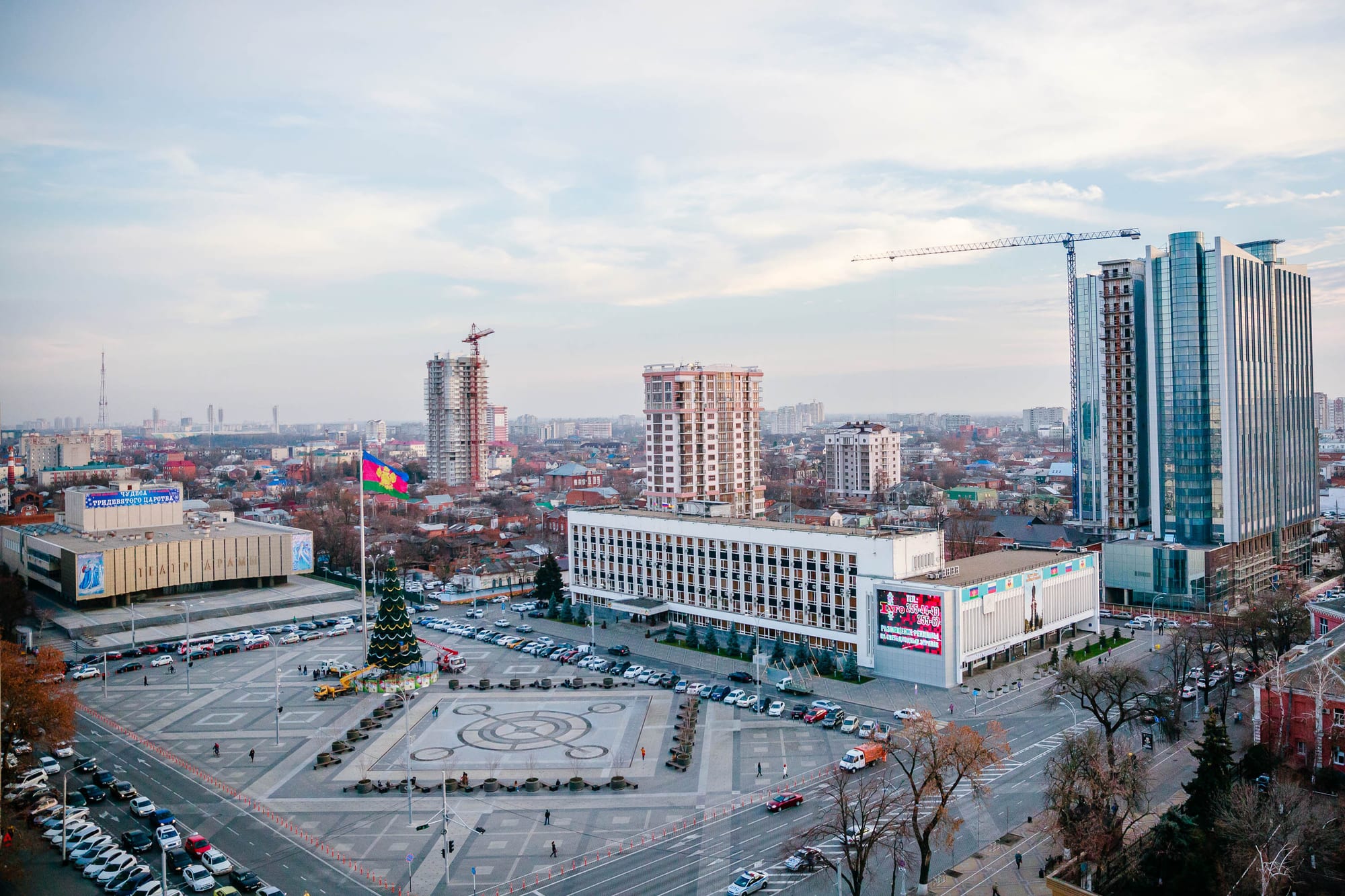
The historic centre is good for walking, especially when Krasnaya Street is closed to traffic in the evenings. Theatre Square is at the end of the centre, but the stadium park and the outer districts are a tram or taxi ride away, and summer heat makes long walks tiring.
🛡️ Safety
Beyond the ordinary crime of a large European city, the decisive risks are political and legal: near-total loss of consular support, a real risk of arbitrary arrest and lengthy detention of foreigners on politically motivated charges (and their use in prisoner swaps), sweeping wartime censorship laws, and the possibility that men of certain ages, including dual nationals, face conscription or exit bans. During the war in Ukraine the port of Tuapse on the krai's coast has been attacked since February 2023, and attacks in April 2026 caused a major industrial and environmental disaster at its oil port.
Most governments advise against all travel to Russia, and particularly to areas bordering Ukraine and occupied Ukrainian territory. Never photograph military sites, vehicles or infrastructure. Check current official travel advice before travelling.
🌦️ Climate
Humid subtropical, close to hot-summer continental. Summers are hot, and because no mountains shelter the city from cold waves, winter weather swings from days above 20°C to cold waves below −20°C. Recorded extremes are −32.9°C (11 January 1940) and 40.7°C (30 July 2000).
- Summer
- hot — July averages about 24°C
- Winter
- changeable — January averages about 1°C, and cold waves below −20°C are not uncommon
🤝 Local Customs
The Kuban Cossack heritage is a matter of pride, kept alive above all by the Kuban Cossack Choir, and the city has long had an Armenian community. Russian is the language of daily life and English is little spoken. Orthodox churches expect modest dress, and war memorials are treated with respect.
Cover shoulders and, for women, the head in Orthodox churches; avoid photographing soldiers or military vehicles, and avoid political discussion of the war in public.
💳 Common Payment Methods
The currency is the Russian rouble (RUB). Most foreign credit and debit cards no longer work in Russia and most cannot be used at Russian ATMs, so visitors rely on cash brought in for the whole stay.