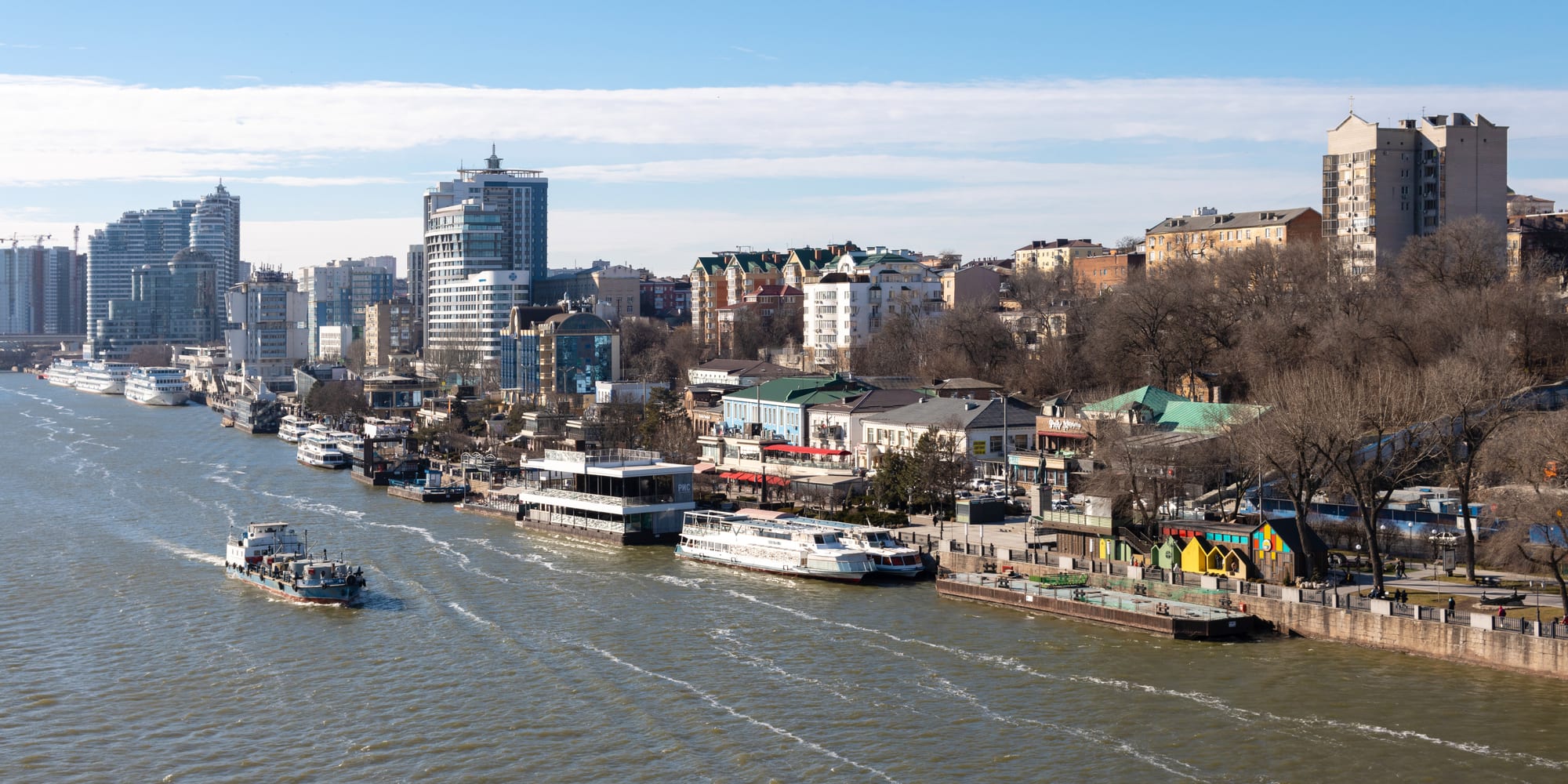
A barge on the wide Don passing river boats moored along the embankment, with old houses, bare trees and tower blocks above

Southern Russia & the Black Sea, Russia

Rostov-on-Don

The Don and the city embankment in Rostov-on-Don. (Vyacheslav Argenberg / Wikimedia Commons · CC BY 4.0)

A city of more than a million people on the Don, 32 km from the Sea of Azov — a customs post of 1749 that grew into a grain port and industrial city, merged with the Armenian town of Nakhichevan-on-Don, and is now the headquarters of Russia's Southern Military District. This page is written to explain the city, not to encourage travel.

Neighbourhoods

  • The historic centre
    • First-time visitors
    • Close to public transport
    • Architecture

    The old streets around Bolshaya Sadovaya, the main avenue, running down to the river, with the cathedral, the Central Market and Gorky Park. Leafy Pushkinskaya Street, the second street of the centre, runs parallel to the river.

    Open in Maps
  • The Don embankment
    • Riverside walks
    • Nightlife
    • Views

    The promenade along the river below the old centre, named after the admiral Fyodor Ushakov, with the river terminal, statues and an illuminated fountain show at night. The ruins of the Paramonov grain warehouses stand on the riverbank nearby.

    Open in Maps
  • Nakhichevan
    • Historic district
    • Armenian heritage
    • Local life

    The former Armenian town founded in 1779 and merged with Rostov in 1928, now the Proletarsky District, which also takes in Teatralnaya Square. Armenian churches, the Museum of Russian-Armenian Friendship and the old Nakhichevan Bazaar give it a character of its own.

    Open in Maps
  • Left bank
    • Sport
    • Parks

    The southern bank across the Voroshilovsky Bridge, opposite the old centre, where the Rostov Arena football stadium, built for 2018, was the first large project on this side of the river.

    Open in Maps
  • Western and northern districts
    • Quiet and residential

    Residential districts north and west of the centre, with the university's botanical garden in the Temernik valley in the north-west.

    Open in Maps

Things to do

Landmarks of the centre

  • Rostov-on-Don Cathedrallandmark

    The five-domed Cathedral of the Nativity of the Theotokos, built between 1854 and 1860 to a model design by Konstantin Thon, beside the Central Market.

    Open in Maps
  • Teatralnaya Squarelandmark

    The city's main square, on the old boundary with Nakhichevan, with the Maxim Gorky Drama Theatre, a 72-metre stele in the memorial to the city's liberators and an ensemble of fountains designed by Yevgeny Vuchetich.

    Open in Maps
  • Paramonov Warehouseslandmark

    The brick ruins of 19th-century grain warehouses on the riverbank, cooled by springs from the slope, which keep grass growing among them almost all year.

    Open in Maps
  • Chekhov Monumentlandmark

    A bronze statue of the writer, from nearby Taganrog, unveiled in 2010 for the 150th anniversary of his birth.

    Open in Maps
  • Church of the Resurrectionlandmark

    An Armenian Apostolic church consecrated in 2011, faced in pink tuff brought from Armenia, with two carved khachkar stones at the door.

    Open in Maps

Museums and memorials

  • Rostov Regional Museum of Local Loremuseum

    The main museum of the region's history and ethnography, on Bolshaya Sadovaya.

    Open in Maps
  • Rostov Regional Museum of Fine Artsmuseum

    A collection on Pushkinskaya Street that includes works by Repin, Surikov, Levitan and Aivazovsky.

    Open in Maps
  • Zmievskaya Balkalandmark

    The ravine where 27,000 Jews and other Soviet civilians were murdered by the SS Einsatzgruppe D in 1942–43, marked by a memorial unveiled in 1975.

    Open in Maps

Parks, the river and sport

  • Gorky Parkpark

    A park founded in 1813 on the edge of what was then the city, now in the centre between Pushkinskaya and Bolshaya Sadovaya, protected as a heritage site since 1998.

    Open in Maps
  • Don embankmentviewpoint

    The riverside promenade below the centre, the city's favourite place to walk, with views of the Don, its bridges and the left bank.

    Open in Maps
  • Pushkinskaya Streetneighborhood

    One of the main streets of the centre, a tree-lined boulevard of old houses, university buildings and the Don State Public Library.

    Open in Maps
  • Southern Federal University Botanical Gardenpark

    The first botanical garden in the treeless steppe of southern Russia, in the valley of the Temernik river in the north-west of the city.

    Open in Maps
  • Rostov Zooattraction

    The city zoo, whose animals include tigers, lions, Asian elephants and flamingos.

    Open in Maps
  • Rostov Arenaattraction

    The stadium on the left bank of the Don built for the 2018 World Cup, home of FC Rostov.

    Open in Maps

Short trips from the city

  • Starocherkasskayaattraction

    The old capital of the Don Cossacks, now a village on the Don with more than forty historic sites, including the Resurrection Cathedral of 1719 and its gilded wooden iconostasis.

    Open in Maps
  • Novocherkasskattraction

    The city to which the Don Cossacks moved their capital from flood-prone Cherkassk, still the cultural centre of the Don Cossacks.

    Open in Maps
  • Tanaisattraction

    The excavated remains of an ancient Greek trading city in the Don delta, founded in the 3rd century BC, with an archaeological museum-reserve.

    Open in Maps
  • Azovattraction

    The old fortress town closer to the Sea of Azov, known in Ottoman times as Azak, which gradually lost its commercial importance to Rostov.

    Open in Maps

Seasonal events

  • Victory Day9 May

    One of only two days a year when the historic flag of Rostov is carried out of the city hall by a guard of honour.

  • City Daythird Sunday of September

    The city's birthday celebrations, the other occasion when the historic flag leaves the city hall.

Eat and drink

Long-standing places and food districts in Rostov-on-Don. Hours, ratings and directions come from your maps app, always current.

Markets

  • Central Marketmarket

    The Old Bazaar, known locally as Starbaz, the city's main market, first recorded in the 1840s, beside the cathedral.

    Open in Maps
  • Nakhichevan Bazaarmarket

    The old market of the Armenian quarter, a local food market on Bazarnaya Square.

    Open in Maps

Food streets

  • Bolshaya Sadovaya and the embankmentneighborhood

    The main avenue and the riverfront below it hold most of the city's cafés, bars and restaurants, from shawarma counters to river-view terraces.

    Open in Maps

Experience Rostov-on-Don

History

The lower Don has been a trading crossroads since antiquity: Scythian and Sarmatian tribes were among its ancient inhabitants, the Greeks founded Tanais in the delta, the Genoese held Tana and the Ottomans Azak. Rostov itself began in 1749, when Empress Elizabeth set up a customs house on the Temernik river to control trade with Turkey, beside a fortress named after St Dimitry of Rostov. In 1779 Armenians resettled from Crimea founded Nakhichevan next door; the town was formally named Rostov-on-Don in 1806.

Railways to Kharkiv, Voronezh and Vladikavkaz in the 1870s made it a major hub. Wheat, timber and iron ore left from its harbour, coal from the Donets Basin and iron ore from Krivoy Rog had supported an iron foundry since 1846, and by the end of the 19th century about 119,500 people lived there. It was the most industrialised city in South Russia when Reds and Whites fought over it in the Civil War. In 1928 Nakhichevan was merged into it, the regional government moved here from the old Cossack capital of Novocherkassk, and the Bolsheviks demolished two of its principal landmarks.

German forces occupied the city twice in the Second World War, briefly in November 1941 and then from July 1942 to February 1943, and in 1942–43 murdered 27,000 Jews and other Soviet civilians at Zmievskaya Balka. Restoration took ten years. Rostov hosted World Cup matches in 2018 and is the seat of Russia's Southern Military District, which made it a key logistical hub for the invasion of Ukraine; on 23–24 June 2023 the Wagner group took control of the city during its brief mutiny.

Culture & Customs

Rostov grew as a merchant city, and its identity draws on several sources. The Don Cossacks shaped the history of the region, and their old capitals, Starocherkasskaya and Novocherkassk, are close by. Nakhichevan's Armenian heritage remains visible in its churches, including the Church of the Resurrection built in 2011, and tens of thousands of Armenians live in the city. There is also a synagogue, a mosque, an Old Believers' cathedral and Greek Orthodox and Catholic churches.

Literature runs deep here. Pushkin wrote his poem The Don after visiting in 1831, Maxim Gorky worked as a docker in his youth, and Mikhail Sholokhov and Alexander Solzhenitsyn, who studied mathematics at Rostov University, are among the writers tied to the city; Chekhov, from nearby Taganrog, has a statue in the centre. The Maxim Gorky Drama Theatre on Teatralnaya Square, the philharmonic, the musical theatre and the Kim Nazaretov jazz centre lead a lively stage scene, and the city hosts the Accordion Plus festival and jazz festivals.

Football is followed passionately: FC Rostov plays in the top division at the Rostov Arena. Victory Day and City Day in September are the main public celebrations.

Daily Life

The 2021 census counted 1,142,162 people, making Rostov the 11th-largest city in Russia and the administrative centre of both Rostov Oblast and the Southern Federal District. It is a regional capital of banks, universities — above all the Southern Federal University — and the headquarters of the North Caucasus Railway, as well as helicopter and farm-machinery plants and a river port handling minerals and timber.

People live in the old centre, in Nakhichevan, now the Proletarsky District, and in the districts to the north and west. The embankment, a favourite place of rest for residents since the post-war years, and the parks of the centre are where the city spends its summer evenings, and daily routines follow the southern heat.

Since 2022 the city has been a key logistical hub for the war in Ukraine, and Platov airport has been closed to all civilian flights since 24 February 2022, still so in late 2025.

Food

Rostov eats the food of the Don, built on the river and the farmland around it, and ukha, the Russian fish soup, is a familiar dish. The Central Market beside the cathedral, first recorded in the 1840s and known locally as Starbaz, is the city's main market, and the old Nakhichevan Bazaar on Bazarnaya Square still trades in the former Armenian town.

Everyday Russian dishes fill the menus: borsch, shchi, pelmeni, blini and pirozhki, with zakuski such as pickled cucumbers, cured fish and black bread before a proper meal, and kvass in summer. Shawarma is a familiar street snack in the centre. Many of the city's cafés and restaurants are on Bolshaya Sadovaya, the main avenue, and along the embankment below the old centre.

The Rostov region is one of Russia's main wine-growing areas, with native Don valley grape varieties such as Tsimlyansky Cherny. Tea, strong and often with jam, ends the meal.

Planning tools

Budget

Rostov-on-Don is moderately priced, cheaper than Moscow and far cheaper than the Black Sea resorts in summer. The difficulty is payment rather than cost: most foreign bank cards no longer work in Russia, so enough cash for the stay has to be brought in.

Daily Budget Midrange
USD 90–200 (mid-range hotel, restaurants, museum tickets and taxis booked by app)
Daily Budget Shoestring
USD 35–65 (hostel or guesthouse, canteens, shawarma and market food, buses and trams)

Bring enough foreign currency in cash for the whole stay; the embankment, Gorky Park and the cathedral cost nothing.

Best Time to Visit

May to June and September to early October, avoiding the midsummer heat. City Day falls on the third Sunday of September. Winters are moderately cold.

Suggested Number of Days

Two days are enough for the centre, the embankment and Nakhichevan. Adding the Cossack villages and ancient sites of the lower Don calls for a day or two more, more if travelling by public transport.

First Visit
2 days
With Surroundings
3–4 days

Transportation

Buses, trolleybuses, trams and marshrutkas — fixed-route minibuses — cover the city; there is no metro, and plans for one were dropped in favour of a high-speed tram. The centre is compact, and taxis are ordered through apps. The city's two main railway stations are Rostov-Glavny and Rostov-Prigorodny.

The centre, the embankment and Nakhichevan are close enough to combine on foot and by tram; use app taxis rather than street taxis.

Airport & Station Connections

Platov International Airport, which replaced the old city airport in 2017, has been closed to all civilian flights since 24 February 2022 and remained closed in late 2025. Most visitors arrive by train at Rostov-Glavny, a major station on the North Caucasus Railway with long- distance trains from Moscow and the south, or by road on the M-4 Don highway.

Walkability

The historic centre is easy and pleasant on foot: Bolshaya Sadovaya, Pushkinskaya, Gorky Park, the cathedral, the Central Market and the embankment are all close together, though the streets run downhill to the river. Nakhichevan is a longer walk or a short tram ride east, and the left bank is reached on foot across the Voroshilovsky Bridge.

Safety

Beyond the ordinary crime of a large European city, the decisive risks are political and legal: near-total loss of consular support, a real risk of arbitrary arrest and lengthy detention of foreigners on politically motivated charges (and their use in prisoner swaps), sweeping wartime censorship laws, and the possibility that men of certain ages, including dual nationals, face conscription or exit bans. Rostov-on-Don hosts the command of Russia's Southern Military District, and Rostov Oblast borders Ukraine's Donetsk and Luhansk oblasts; the city has been a key logistical hub for the war, and on 23–24 June 2023 the Wagner group briefly took control of it during its rebellion.

Most governments advise against all travel to Russia, and particularly to areas bordering Ukraine and occupied Ukrainian territory. Never photograph military sites, vehicles or infrastructure. Check current official travel advice before travelling.

Climate

A humid continental climate with warm, humid summers and moderately cold winters. January averages −3°C and July about 23°C. The record low, −31.9°C, was set in January 1940, and the record high, 40.2°C, on 7 July 2020.

Summer
warm and humid — July averages about 23°C, and the record high is 40.2°C
Winter
moderately cold — January averages −3°C, and the record low is −31.9°C

Local Customs

Rostov is a southern trading city, more relaxed than Moscow, and proud of its Don Cossack and Armenian heritage. Russian is the language of daily life and English is little spoken. In Orthodox and Armenian churches visitors dress modestly and keep quiet during services, and the war memorials are treated with respect, above all around Victory Day.

Cover shoulders and, for women, the head in Orthodox churches; avoid photographing soldiers, military vehicles or infrastructure, and avoid political discussion of the war in public.

Common Payment Methods

The currency is the Russian rouble (RUB). Most foreign credit and debit cards no longer work in Russia and most cannot be used at Russian ATMs, so visitors rely on cash brought in for the whole stay.