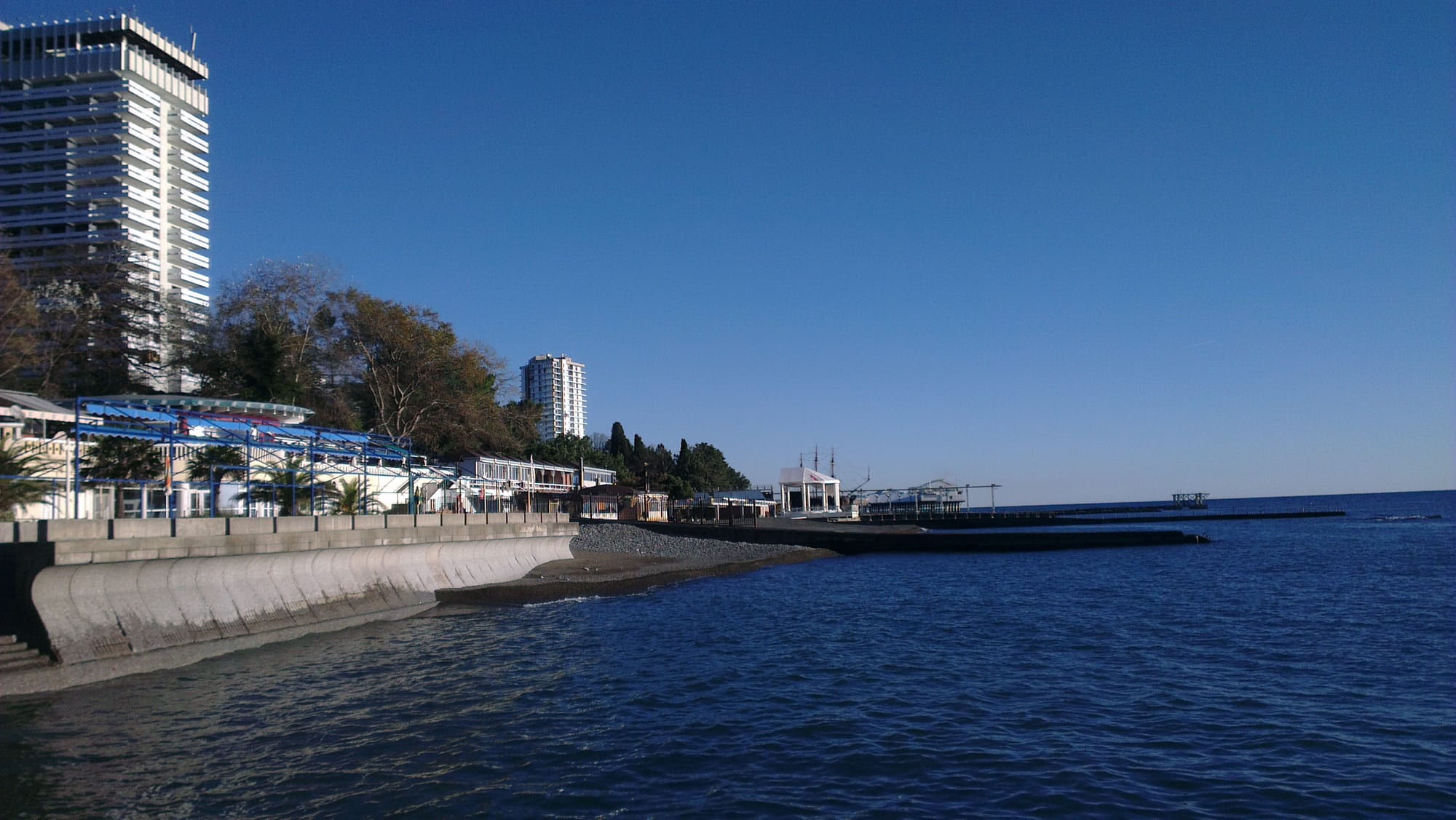
A curved concrete seawall and pebble beach with white pavilions and breakwaters on the calm blue Black Sea, below tall apartment towers

Southern Russia & the Black Sea, Russia

Sochi

The seafront and beaches of Sochi on the Black Sea. (Stranneek / Wikimedia Commons · CC BY 3.0)

Russia's largest resort, a subtropical city strung for about 145 km along the Black Sea between the Caucasus and the border with Abkhazia — Circassian land conquered in 1864, Stalin's favourite holiday coast and the host of the 2014 Winter Olympics, with pebble beaches below and the ski slopes of Krasnaya Polyana above. This page is written to explain the city, not to encourage travel.

Neighbourhoods

  • Central Sochi
    • First-time visitors
    • Close to public transport
    • Best for food

    The smallest but most populous district and the core of the resort, around the seaport, the main railway and bus stations and Kurortny Prospekt. Most of the city's sights, shopping centres and the only real seafront promenade, between Riviera Park and the arboretum, are here, and it is crowded and jammed with traffic in summer.

    Open in Maps
  • Khosta and Matsesta
    • Nature
    • Spas

    The district south-east of the centre, crossed by the Khosta and Matsesta rivers, with the spa of Matsesta, Mount Akhun, the yew and box grove and Stalin's former dacha among the wooded hills above the coast.

    Open in Maps
  • Adler and the Imereti Lowland
    • Beaches
    • Sport
    • Close to the airport

    The southernmost district, once a separate town, by the border with Abkhazia. It holds the airport, the Adler railway terminal and, on the Imereti Lowland, the Olympic Park and its stadium and arenas, now in the federal territory of Sirius.

    Open in Maps
  • Dagomys and the northern coast
    • Quiet beaches
    • Tea gardens

    North-west of the centre, the coast becomes a looser chain of resort villages — Dagomys with its botanical garden and tea plantations, Loo and, far beyond, Lazarevskoye — separated by stretches of forest and often poorly connected.

    Open in Maps

Things to do

Landmarks of the resort

  • Saint Michael's Cathedrallandmark

    The oldest Orthodox church in Sochi, built in 1874–1890 to Alexander Kaminsky's design to mark the end of the Caucasian War, neglected in the Soviet era and restored in 1993.

    Open in Maps
  • Marine Stationlandmark

    The seaport's Stalinist passenger terminal of 1955, crowned by a 71-metre steepled tower with sculptures of the seasons and the cardinal points.

    Open in Maps
  • Stalin's Dachamuseum

    A former merchant's estate in the Khosta district rebuilt as Stalin's residence by the architect Miron Merzhanov, now a museum with his belongings and a waxwork figure.

    Open in Maps
  • Sochi Art Museummuseum

    The city's art museum on Kurortny Prospekt, in one of the monumental buildings of the Stalin era.

    Open in Maps

Parks and gardens

  • Sochi Arboretumpark

    A landscaped collection of subtropical plants with 76 species of pine, 80 of oak and 24 of palm, a protected monument of landscape architecture.

    Open in Maps
  • Riviera Parkpark

    An all-season park in the centre at one end of the seafront promenade, with an open-air Green Theatre used for concerts and festivals.

    Open in Maps
  • Tree of Friendshippark

    A hybrid citrus tree planted in 1934, onto which people from 167 countries have grafted citrus sprigs, with a garden museum of gifts from around the world.

    Open in Maps

Mountains and nature

  • Mount Akhunviewpoint

    The highest point of the Sochi coast at 663 metres, topped by a limestone tower of 1936 with views of the Western Caucasus; the Eagles' Rocks and the Agura Falls lie below.

    Open in Maps
  • Yew and box grovepark

    A 3-square-kilometre forest of yew and box on the slopes of Mount Akhun, a detached part of the Caucasus Biosphere Reserve.

    Open in Maps
  • Sochi National Parkpark

    Russia's oldest national park, created in 1983, covering almost all of Greater Sochi beyond the coast and the reserve, with forest, gorges and rivers in the Western Caucasus.

    Open in Maps

The Olympic legacy

  • Sochi Olympic Parkattraction

    The coastal cluster of the 2014 Winter Olympics on the Imereti Lowland, with the ceremonies stadium, ice arenas, the former Olympic Village and the motor-racing circuit.

    Open in Maps
  • Fisht Olympic Stadiumattraction

    The stadium built for the Olympic ceremonies and later used for World Cup football in 2018.

    Open in Maps
  • Bolshoy Ice Domeattraction

    The Olympic ice hockey arena, home since 2014 to HC Sochi of the Kontinental Hockey League.

    Open in Maps

Short trips from the city

  • Dagomys tea housesattraction

    Tea plantations in Dagomys and Uch-Dere, part of the tea growing that began around Sochi in 1887; tea-party houses on the hill serve tea from a samovar with pirozhki, pancakes and jam.

    Open in Maps
  • Rosa Khutorattraction

    The ski resort above Krasnaya Polyana that hosted the Olympic Alpine events, with lifts climbing to 2,320 metres and a vertical drop of more than 1,700 metres.

    Open in Maps
  • Krasnaya Polyanaattraction

    The mountain settlement where the end of the Caucasian War was proclaimed in 1864, now a year-round resort for skiing and mountain walks.

    Open in Maps

Eat and drink

Long-standing places and food districts in Sochi. Hours, ratings and directions come from your maps app, always current.

Sochi classics

  • Krasnodar teacafe

    Tea grown on the plantations of Dagomys, Solokhaul and Adler, one of the northernmost teas in the world.

    Open in Maps
  • Kuban and Abkhazian winesmarket

    Most Russian wine comes from Krasnodar Krai, including the sparkling wines of Abrau-Dyurso, and Abkhazian wines such as Lykhny, made from Isabella grapes, are sold across the city.

    Open in Maps

Food districts and markets

  • Central Sochi restaurantsneighborhood

    Restaurants serving local, Italian, European, Japanese and Mediterranean fish and seafood cooking in the centre and along the beachfront.

    Open in Maps
  • Adler marketmarket

    The central market of Adler, a hub for local buses; home-made wine is among the things sold at the city's markets.

    Open in Maps

Experience Sochi

History

The coast was home to the Zygii, ancestors of the Adyghe, in antiquity; from the 6th to the 11th centuries it belonged to the Georgian kingdoms of Lazica and Abkhazia, which built a dozen churches in the area — the wall of an 11th-century basilica still stands at Loo — and Genoa kept trading posts here in the late Middle Ages. From the 14th to the 19th centuries this was Ubykhia, part of historic Circassia. Russia occupied the coast in 1829, and in 1838 founded the fort of Alexandria, soon renamed Navaginsky, at the mouth of the Sochi river. The Russo-Circassian War ended here in 1864: at its close almost all the Ubykhs and much of the Circassian population of the area were killed or expelled to the Ottoman Empire, in what is known as the Circassian genocide.

Settlers from across the empire — Russians, Armenians, Ukrainians, Greeks, Germans and Georgians — arrived from 1866. The settlement took the name of the river in 1896, its first resort opened in 1909, and it became a town in 1917. The coastal railway arrived in 1923, and under Stalin, who had his favourite dacha here, the coast filled with Neoclassical sanatoriums and the population grew from 17,000 in 1932 to 72,000 in 1939. Greater Sochi, stretching from near Tuapse to Adler, was created in 1961.

After the Soviet collapse Sochi took over from Crimea as the country's unofficial summer capital and the president's holiday residence. It won the 2014 Winter Olympics in 2007; the budget grew from 12 to about 51 billion dollars, making them the most expensive Games in history. The city hosted the Russian Grand Prix from 2014 to 2021 and World Cup matches in 2018. After the invasion of Ukraine in 2022 it lost the Grand Prix, and two earthquakes struck the city in January 2025.

Culture & Customs

Sochi's culture is that of a resort and a showcase. Stalin-era landmarks — the seaport, the railway terminal, the Winter Theatre and the art museum — set its tone, and its sanatoriums, palms and beaches have made it the place Russians associate with the south and with luck: a well-known saying runs, 'If I'd known the trump card, I'd live in Sochi.' It was also long the home of Kinotavr, at one time Russia's largest national film festival, held each June from 1991 until it was cancelled in the wake of the invasion of Ukraine; it was not held in 2022 or 2023.

The city is unusually diverse. Russians make up about 70 per cent of the population and Armenians about 20 per cent, most of them descendants of Hamshen Armenians from Turkey's Black Sea coast, with more than half the population of the Adler district. Around thirty Orthodox churches, about ten Armenian churches, two Catholic churches and a mosque built in 2008 serve them, and a small Muslim Shapsug community, part of the Circassian nation, lives in the hills near Lazarevskoye. Many place names come from Ubykh, Abkhaz and Circassian.

Sport has been central since the Olympics. HC Sochi plays ice hockey in the Kontinental Hockey League at the Bolshoy Ice Dome, PFC Sochi plays football, and Krasnaya Polyana has become a major ski resort. Grand Slam tennis champions Maria Sharapova and Yevgeny Kafelnikov both learned the game at a local tennis school.

Daily Life

The city had about 445,000 residents in 2025, and up to 600,000 live in the wider urban area, mostly in a narrow strip along the coast divided among four districts: Tsentralny, Lazarevsky, Khostinsky and Adlersky. In summer the number of people in the city at least doubles with visitors, and millions come each year. Since 2019 part of the Imereti Lowland around the Olympic Park has formed the separate settlement of Sirius, made Russia's first federal territory in 2020.

The economy rests on trade, construction and tourism, with hundreds of hotels, dozens of sanatoriums and close to two hundred beaches. Retail sales per head are among the highest in Russia, driven by tourists and by high local wages. Farms grow vegetables, citrus, feijoa, medlar, kiwi and flowers, and five companies grow and process tea. The city has its own universities, including Sochi State University and the Russian International Olympic University, and research institutes working on subtropical crops, mountain forests and medical primatology.

Life follows the seasons: crowded beaches, traffic jams and rented rooms in summer; quieter streets, rain and ski trips to the mountains in winter. The president's residence at Bocharov Ruchey, near Dagomys, regularly brings foreign leaders to the city. Since 2022 the war has been close, with civil flights at other southern airports suspended for years and drone strikes on the oil port of Tuapse up the coast.

Food

Sochi's most local product is its tea. Grown around Sochi since 1887, on plantations at Dagomys, Solokhaul and Adler, Krasnodar tea is one of the northernmost teas in the world, and visitors to the tea houses of Dagomys and Uch-Dere drink it from a samovar with pirozhki, pancakes and jam. The subtropical climate also produces citrus fruit, feijoa, medlar and kiwi, and trout is farmed in the Adler district.

The everyday table is that of southern Russia. Borscht, the soup of beetroot, cabbage and other vegetables in meat or bone stock, is a staple, and home-made wine is sold at the city's markets. Adyghe or Circassian cheese, a mild cheese often eaten fresh, comes from the Circassian lands of the North Caucasus.

Wine is the region's other pride. Most Russian wine comes from Krasnodar Krai, where Abrau-Dyurso near Novorossiysk has made sparkling wine since the 19th century; local brandy is also made in the krai. Wines from neighbouring Abkhazia are widely sold, among them the semi-sweet red Lykhny from Isabella grapes and the dry red Chegem. Restaurants in the centre serve everything from Russian standards and fish to Italian and Japanese food.

Planning tools

Budget

Prices in Sochi rise in summer, when hotel stays can seem overpriced even by European standards, and the off-season is cheaper. Many Russian visitors rent rooms in private homes, which costs less than hotels. Most foreign cards no longer work in Russia, so money has to be brought in as cash.

Daily Budget Midrange
USD 95–240 (mid-range hotel, restaurants, ski passes or excursions; higher in July and August)
Daily Budget Shoestring
USD 35–65 (private room or hostel, canteens and markets, buses and suburban trains)

Expect summer prices to be well above the rest of the year, and bring enough cash from outside Russia, as most foreign cards do not work.

Best Time to Visit

The swimming season runs from about late May to late October, with the peak in July and August. September and October, the 'velvet season', are often the most pleasant, with a warm sea and fewer crowds. The ski season at Krasnaya Polyana is at its best in February and March. November to January is the least appealing time on the coast, with rain and cloud.

Suggested Number of Days

Three or four days give time for the central district and the coast. Because Greater Sochi stretches so far, adding the mountains or the outlying districts takes close to a week, and a ski trip or a beach holiday usually lasts longer.

First Visit
3–4 days
With Surroundings
6–7 days

Transportation

Sochi has no trams or trolleybuses; buses and minibuses are frequent, cheap and the main way around, though summer traffic jams are heavy. The coastal railway, built in 1923 within a kilometre or two of the shore, links the districts, and lines built for the Olympics run from Adler to the airport, the Olympic Park and Krasnaya Polyana. Cable cars serve the mountain resorts.

Carry passport, visa and migration card at all times; for anything beyond the centre, the train or bus is usually faster than a taxi in summer traffic.

Airport & Station Connections

Sochi International Airport, in the Adler district, is one of the busiest in Russia, with frequent flights to Moscow and St Petersburg; trains link it with Adler. Krasnodar's airport, to the north, had its civil flights suspended from February 2022 until it reopened in September 2025. Long-distance trains from Moscow take a day or more, and the M4 road runs north through Krasnodar.

Walkability

Central Sochi is walkable, though hilly. The rest of the city is not: the districts are far apart and the roads between them often lack pavements. Most of the land behind the beaches is taken by the railway, so the only long seafront promenade runs between Riviera Park and the arboretum, with another in the Olympic Park.

Safety

Beyond the ordinary crime of a large European city, the decisive risks are political and legal: near-total loss of consular support, a real risk of arbitrary arrest and lengthy detention of foreigners on politically motivated charges (and their use in prisoner swaps), sweeping wartime censorship laws, and the possibility that men of certain ages, including dual nationals, face conscription or exit bans. Sochi lies in the region closest to the war, where military traffic is heavy and drones have repeatedly hit the port of Tuapse further up the coast. Pickpocketing in crowded markets and stations and fraud at the summer resorts are the everyday risks.

Most governments advise against all travel to Russia, and particularly to areas bordering Ukraine and occupied Ukrainian territory. Never photograph military sites or movements, and avoid unlit areas at night. Check current official travel advice before travelling.

Climate

A humid subtropical climate, with about 2,200 hours of sunshine and around 1,700 mm of rain a year. Cold north winds make winters cooler than in Nice, at the same latitude, and the temperature drops below freezing at least once every winter. The mountains of Krasnaya Polyana are much colder, with snow for skiing.

Summer
warm and humid, May to October; days average about 24°C and nights about 16°C, warmest in July and August
Winter
mild and wet, December to March; days average about 10–11°C and nights about 3–4°C, with occasional snow on the coast

Local Customs

Russian manners apply, with a relaxed resort atmosphere in summer. Sochi is a multinational city, with a large Armenian community, especially in Adler, and smaller Georgian, Greek and Circassian ones; many place names come from the Abkhaz and Circassian languages. Churches expect modest dress, and the city's few mosques expect the same.

Ask before photographing people, never photograph military sites, avoid drinking or gambling with newly met people, and remember that public expression on the war is restricted by law.

Common Payment Methods

The currency is the rouble (RUB). Western credit and debit cards such as Visa and Mastercard do not work in Russia, and most foreign bank cards cannot be used at Russian ATMs, so cash brought in and exchanged is the only reliable way to pay. Exchange only at official bank counters, which ask for a passport.