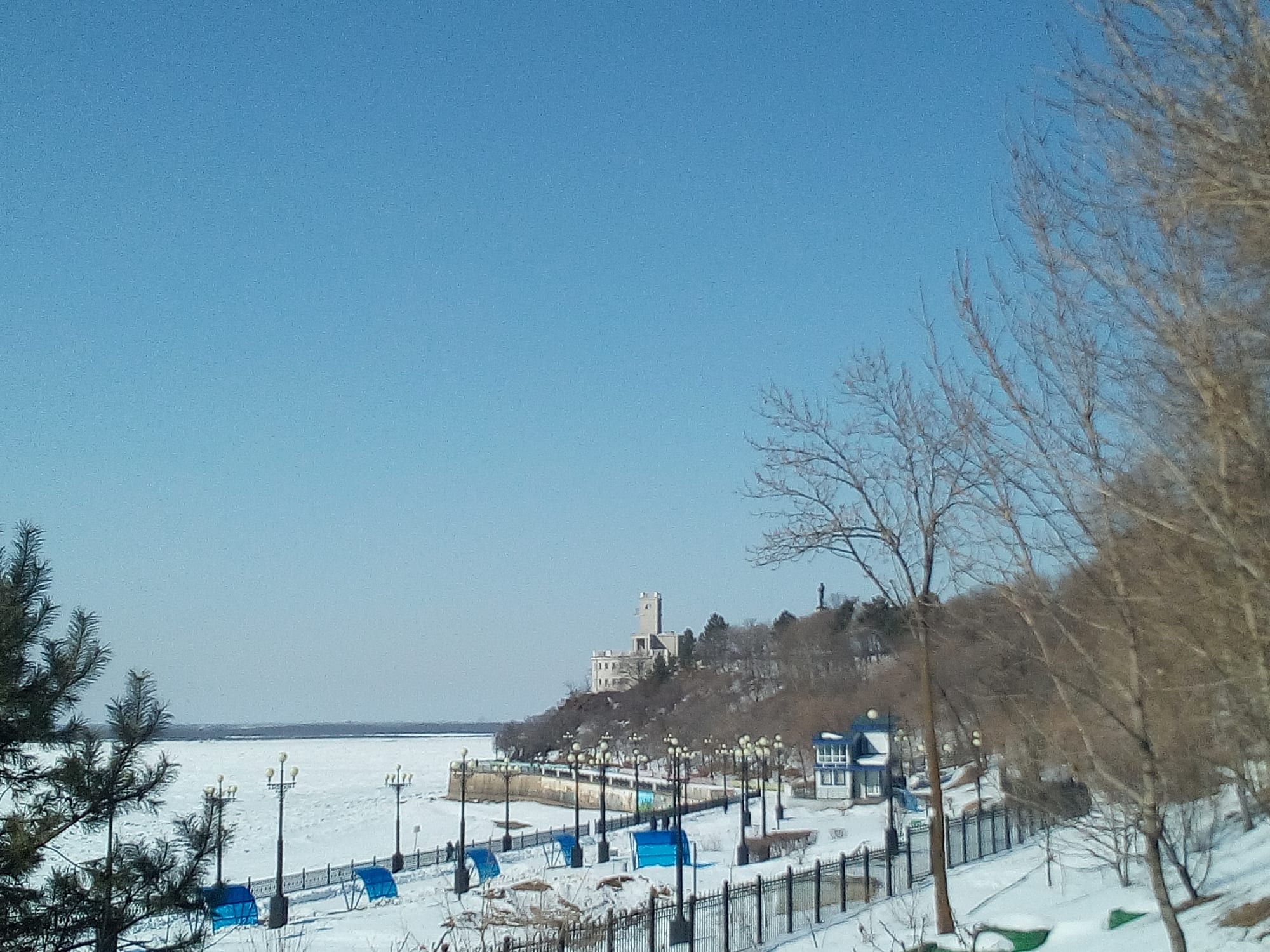
A snowy riverside promenade with lamp posts and bare trees, below a wooded cliff topped by a stone tower, beside a frozen river

The Russian Far East, Russia

Khabarovsk

The Amur promenade in Khabarovsk in winter, with the river frozen over. (Contributor21022018 / Wikimedia Commons · CC0)

The largest city of the Russian Far East, on the high bank of the Amur where it meets the Ussuri, 30 km from the Chinese border. Founded as the military post of Khabarovka in 1858, it grew into a Trans-Siberian rail and river city, known for its long Amur promenade, pre-revolutionary brick streets and museums. This page is written to explain the city, not to encourage travel.

Neighbourhoods

  • Muravyov-Amursky Street and Lenin Square
    • First-time visitors
    • Historic district
    • Best for food

    The main street runs from Lenin Square down to the Amur, lined with all sorts of shops and places to eat. It is the natural spine for exploring the centre on foot.

    Open in Maps
  • Komsomolskaya Square and the museum quarter
    • Museums
    • Riverside walks

    The riverside end of the centre, where the Dormition Cathedral stands on Komsomolskaya Square and the regional, art and military museums cluster on Shevchenko Street, a short walk from the promenade.

    Open in Maps
  • The Amur promenade and Glory Square
    • Waterfront
    • Summer evenings
    • Viewpoints

    The long riverside walk and city beach below the bluff, crowded on warm summer days, with the Transfiguration Cathedral and the war memorial of Glory Square on the high bank above.

    Open in Maps
  • Dynamo Park
    • Families
    • Sport
    • Parks

    A central park with log-carved statues, children's rides and cafés, beside the Platinum Arena, home of the city's ice hockey team, and the musical comedy theatre.

    Open in Maps
  • Amursky Boulevard and the station
    • Close to public transport
    • Local life

    The broad boulevard leading from the railway station towards the centre, with many shops and a local market, followed by the most useful tram route for visitors.

    Open in Maps

Things to do

Landmarks

  • Transfiguration Cathedrallandmark

    Built in 2001–04 on a steep bluff over the Amur, 96 metres tall and said to be the third-tallest church in Russia.

    Open in Maps
  • Dormition Cathedrallandmark

    A five-domed cathedral about 60 metres tall, built in 2000–02 and one of the largest churches in the Russian Far East.

    Open in Maps
  • Glory Squarelandmark

    The square on the high bank by the Transfiguration Cathedral, with a war memorial and eternal flame facing the Amur.

    Open in Maps
  • Khabarovsk Bridgelandmark

    The road and rail bridge over the Amur; the original railway bridge of 1916 let Trans-Siberian trains cross without ferries, and it was rebuilt with two tracks and a roadway in 1991–2009.

    Open in Maps
  • Khabarovsk railway stationtransit hub

    An important station on the Trans-Siberian Railway.

    Open in Maps

Museums

  • Far East Regional Museummuseum

    One of the oldest museums in the Russian Far East, in a red-brick building of 1894, with nearly half a million objects and a strong section on the indigenous peoples of the Amur.

    Open in Maps
  • Far Eastern Art Museummuseum

    Founded in the 1930s and housed in a former officers' club, known for its rare collection of old Russian icons.

    Open in Maps
  • Far Eastern Military Museummuseum

    Military history on Shevchenko Street, with Second World War posters and a 1920s officers' railway carriage in the courtyard.

    Open in Maps
  • Museum of Archaeologymuseum

    Part of the regional museum, in a former brewery owner's house, with ancient ceramics and replicas of the Sikachi-Alyan petroglyphs.

    Open in Maps
  • Geological Museummuseum

    A large collection of rocks and minerals on Lenina Street, including fragments of a great iron meteorite that fell in the Sikhote-Alin mountains.

    Open in Maps
  • Far Eastern Railway Museummuseum

    A museum of the history of the Far Eastern Railway, on Vladivostokskaya Street.

    Open in Maps
  • Khabarovsk City History Museummuseum

    The city's own story from its founding to today, in a museum opened in 2004.

    Open in Maps

Parks and the river

  • Amur promenade and city beachbeach

    The riverside walk and beach below the cathedral, hugely popular on warm summer days; the current is strong for swimming.

    Open in Maps
  • Khabarovsk Arboretumpark

    A garden of about 800 kinds of trees, shrubs and flowers from nearly every continent.

    Open in Maps

Sport and nights out

  • Platinum Arenaattraction

    The 7,100-seat arena opened in 2003, home of Amur Khabarovsk of the KHL.

    Open in Maps
  • Theatre of Musical Comedyattraction

    The oldest theatre in Khabarovsk Krai, staging operettas and comedies in a 900-seat hall in Dynamo Park that is also the main concert venue.

    Open in Maps

Short trips from the city

  • Bolshekhekhtsirsky Nature Reservepark

    A strict nature reserve on the Big Khekhtsir ridge about 20 km south of the city, unusually close to a city and open to hikers on certain trails.

    Open in Maps
  • Sikachi-Alyanattraction

    A small Nanai village on the Amur famous for its ancient petroglyphs of masks carved on basalt boulders, with a museum and an open-air reconstruction of an ancient village.

    Open in Maps

Eat and drink

Long-standing places and food districts in Khabarovsk. Hours, ratings and directions come from your maps app, always current.

Khabarovsk classics

  • Russian classicsrestaurant

    Blini, patties, borscht, and sturgeon or meat served sizzling on hot stones appear on the menus of the city's traditional restaurants.

    Open in Maps
  • Korean saladsrestaurant

    Morkovcha, the spicy marinated carrot salad of the Koryo-saram, the ethnic Koreans of the former Soviet Union.

    Open in Maps

Food districts and markets

  • Vyborg Marketmarket

    A huge, lively market on Vyborgskaya Street with indoor halls of fruit, vegetables and meat and many Chinese traders.

    Open in Maps
  • Summer beer tentsneighborhood

    In warm weather, outdoor beer tents, some with live music, take over from the bars along the river and in the parks.

    Open in Maps
  • Muravyov-Amursky Streetneighborhood

    The main street has all sorts of shops and places to eat, from cafés to cheap fast food.

    Open in Maps

Experience Khabarovsk

History

The confluence of the Amur and the Ussuri has a long past. Tungusic peoples, among them the Nanai, lived here, and in 722 the Tang dynasty set up the seat of its Heishui Protectorate near the site, which Chinese records call Boli. In 1651 the Cossacks of Yerofey Khabarov built a fortified winter camp somewhere in the area and fought off a Manchu attack the following spring, but the Treaty of Nerchinsk of 1689 left the region to Qing China for the next century and a half.

The Treaty of Aigun passed the land to Russia in 1858, and the military post of Khabarovka was founded and named after Khabarov. It became a town in 1880 and took the name Khabarovsk in 1893; a branch of the Russian Geographical Society, set up in 1894, founded libraries, theatres and museums. In 1916 the bridge across the Amur allowed Trans-Siberian trains to cross without ferries. Japanese forces occupied the city in September 1918 during the Civil War.

After the Second World War, Khabarovsk hosted the trials of twelve members of Japan's Kwantung Army and Unit 731 for making and using biological weapons, and the last Chinese emperor, Puyi, was held here from 1945 to 1950. Trams arrived in 1956 and trolleybuses in 1975. Between 1989 and 2003 a memorial to those executed in the Great Terror was built. From the early 2000s Khabarovsk was the centre of the Far Eastern Federal District, until that role passed to Vladivostok in December 2018. In July 2020 the arrest of the regional governor, Sergei Furgal, set off weeks of street protests.

Culture & Customs

Khabarovsk's cultural life has grown since the 1890s, when the Geographical Society began founding its institutions, and a cluster of museums now stands on Shevchenko Street near the river. The regional museum's ethnographic displays on the peoples of the Amur, the art museum's old Russian icons, and the petroglyphs of Sikachi-Alyan, carved by the river to the north, connect the city to the region's indigenous history, much of it Nanai.

Sport is a passion, especially on ice. Amur Khabarovsk, named after the river, plays in the KHL at the Platinum Arena, far from every other team in the league except Admiral Vladivostok, and SKA-Neftyanik, founded in 1947, plays bandy in Russia's top division; the city hosted the Bandy World Championship in 1981.

Military memory is strong: the city was named a "City of Military Glory" in 2012, and the war memorial with its eternal flame stands on the high bank. In summer life moves outdoors, to the promenade, the beach and the beer tents.

Daily Life

About 617,000 people lived in Khabarovsk at the 2021 census, making it the largest city of the Russian Far East and the administrative centre of Khabarovsk Krai. The great majority of residents are Russian, with small Ukrainian, Korean, Chinese, Tatar and Uzbek communities.

Industry includes iron processing and steel, a shipyard, machine-building, oil refining, flour milling, pharmaceuticals and meatpacking, and the city is a major railway centre on the Trans-Siberian, with river transport on the Amur and the Ussuri and road links west and south. A fibre-optic cable links it with Fuyuan across the border in China, and Chinese traders are a familiar sight in its markets. A toll bypass road around the city was completed in 2021.

The rhythm of the year follows extremes: average temperatures swing from about −19°C in January to about 21°C in July. Winters are dry, with only light snow, and the Amur freezes; summers are humid and bring most of the rain. Universities, including Pacific National University and the medical, transport and humanities universities, give the centre a student population.

Food

Khabarovsk eats in the Russian way, with Far Eastern touches. Traditional restaurants serve blini pancakes, patties, borscht, and sturgeon or meat brought sizzling on hot stones, and cheap fast food is easy to find. In summer the city's drinking moves out of the bars into beer tents by the river and in the parks, some with live music.

The wider Russian table is here too: soups such as shchi, solyanka and the cold, kvass-based okroshka in summer, pelmeni dumplings, and kasha porridges. The stolovaya, a cheap café surviving from the Soviet era, is the quick way to eat traditional food. Morkovcha, the spicy marinated carrot salad of the Koryo-saram, the ethnic Koreans of the former Soviet Union, is a reminder of the Korean presence in the region.

The city's closeness to China shows in its markets. The Vyborg Market on Vyborgskaya Street is huge and lively, with halls of fruit, vegetables and meat and many Chinese traders selling imported goods alongside Russian stallholders.

Planning tools

Budget

Khabarovsk is moderately priced for the Far East, which is one of the costlier parts of Russia. Cheap street food, canteens and public transport keep daily costs down. The practical difficulty is payment rather than cost: Western cards do not work, so every rouble has to come from cash brought into the country.

Daily Budget Midrange
USD 110–220 (mid-range hotel, restaurants, museum tickets, taxis)
Daily Budget Shoestring
USD 35–70 (hostel bed, canteens and street food, trams and buses)

Bring enough cash for the whole stay; the promenade, the cathedrals and the parks cost nothing.

Best Time to Visit

Summer, when the promenade, beach and beer tents come alive — the city is at its best in sunshine — though it is also the wettest season. Winters are bitterly cold and dry, with the Amur frozen. Timing matters less than the national picture: most governments advise against all travel to Russia.

Suggested Number of Days

Two days are enough for the centre, the river and the museums. Allow three or four to add the nature reserve and a longer excursion along the Amur.

First Visit
2 days
With Surroundings
3–4 days

Transportation

Trams (eight routes), trolleybuses (four) and about a hundred bus and marshrutka routes cover the city. The most useful tram line runs from the railway station along Amursky Boulevard towards the centre, and trolleybus line 1 links the airport with Komsomolskaya Square and the museums. In summer, hydrofoils run up and down the Amur.

Carry passport, visa and migration card at all times.

Airport & Station Connections

Khabarovsk Novy Airport lies in the eastern part of the city, linked to the centre by trolleybus. The railway station is a principal stop on the Trans-Siberian, 8,523 km from Moscow by rail and about 800 km north of Vladivostok, with several trains a day in each direction and lines north to the Baikal–Amur Mainline.

Walkability

The centre is good for walking: Muravyov-Amursky Street leads from Lenin Square down to the river, the museums sit together near Komsomolskaya Square, and the promenade runs along the bank below. The station and the outer districts are a tram or bus ride away. Pavements are icy in winter.

Safety

Beyond the ordinary crime of a large European city, the decisive risks are political and legal: near-total loss of consular support, a real risk of arbitrary arrest and lengthy detention of foreigners on politically motivated charges (and their use in prisoner swaps), sweeping wartime censorship laws, and the possibility that men of certain ages, including dual nationals, face conscription or exit bans. The city lies close to the Chinese border. At the city beach the Amur's current is strong, and swimmers should stay close to the shore.

Most governments advise against all travel to Russia and against any travel near the Ukrainian border. Do not photograph bridges, military or border sites, and dress for severe cold in winter. Check current official travel advice before travelling.

Climate

Strongly continental and monsoonal: very warm, humid summers that bring most of the year's rain, and bitterly cold, dry winters with little snow, when days above freezing are very rare.

Summer
warm and humid — July averages about 21°C, and nights stay mild
Winter
bitterly cold — January averages about −19°C

Local Customs

Tipping was traditionally frowned upon in Russia but has become more common: it is not obligatory in restaurants, is not given in self-service canteens, and is not customary in taxis, where the fare is agreed before setting off. Victory Day and the city's military history are taken seriously, and the war memorial on Glory Square is a place of respect.

LGBT people face severe legal repression in Russia, and photographing military or infrastructure sites can bring espionage charges.

Common Payment Methods

The currency is the Russian rouble. Western credit and debit cards — Visa, Mastercard, American Express — do not work in Russia, and most foreign cards cannot be used at Russian ATMs, so all money needs to be brought in as cash and exchanged.