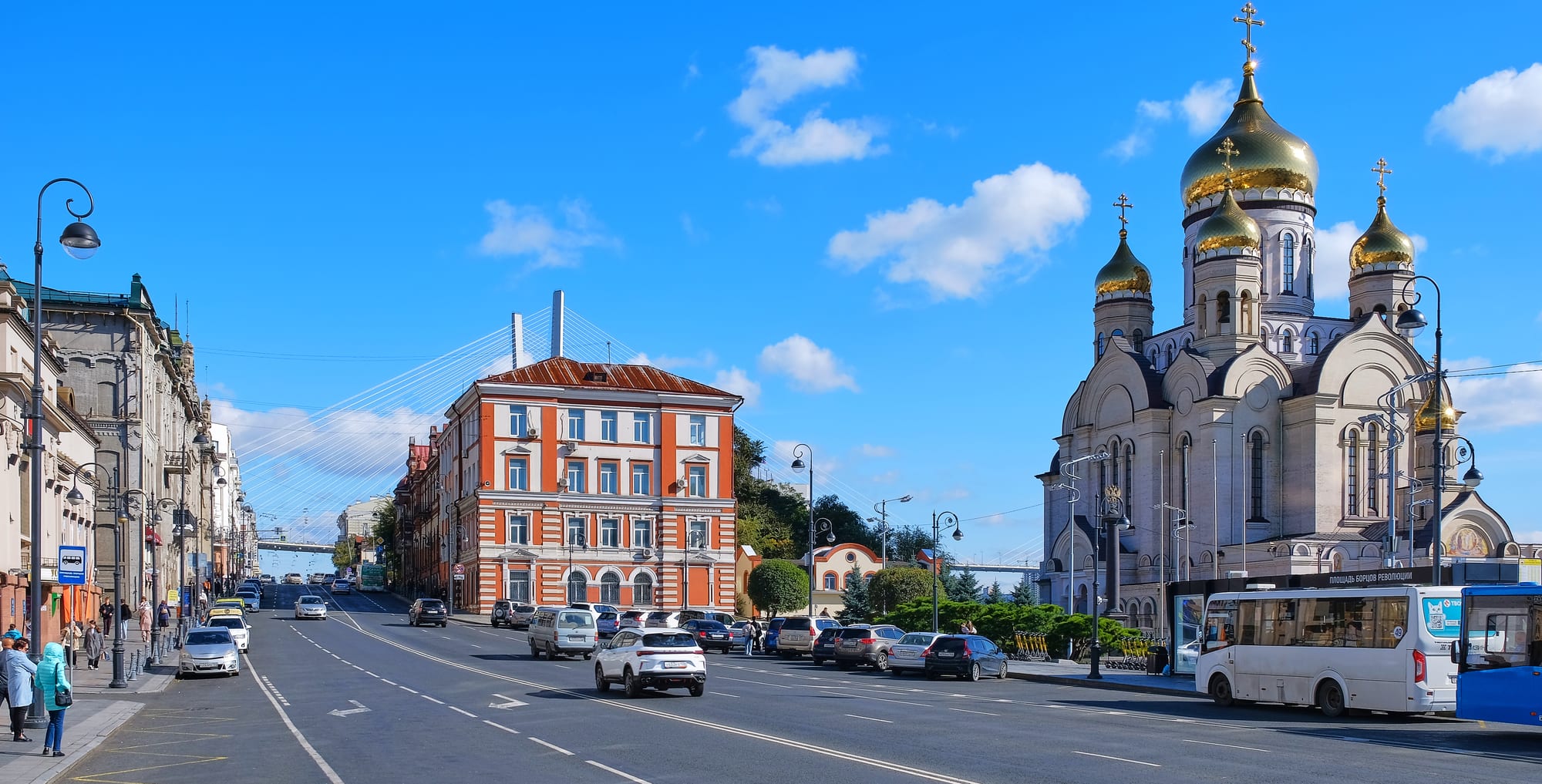
A wide street of old brick and stone buildings beside a white cathedral with golden domes, with the pylons of a cable-stayed bridge behind

The Russian Far East, Russia

Vladivostok

Svetlanskaya Street in central Vladivostok, with the Transfiguration Cathedral on the right. (Vyacheslav Bukharov / Wikimedia Commons · CC BY-SA 4.0)

Russia's main Pacific port, built on hills around Golden Horn Bay on the Sea of Japan — founded as a military outpost in 1860, home of the Pacific Fleet and the eastern end of the Trans-Siberian Railway. Closed to foreigners until 1992, it is now crossed by long cable-stayed bridges built for a 2012 summit. This page is written to explain the city, not to encourage travel.

Neighbourhoods

  • Svetlanskaya and the centre
    • First-time visitors
    • Historic district
    • Close to public transport

    The old city along the north shore of Golden Horn Bay. Svetlanskaya, the first street, follows the coastline past the central square and century-old buildings, while Aleutskaya climbs inland past the railway station; side streets rise steeply up the hills.

    Open in Maps
  • Millionka
    • Best for food
    • Cafés
    • Historic district

    The former Chinese quarter north of the station and beside the port, once a maze of three-storey buildings with hidden courtyards housing up to 50,000 people. Cleared on Stalin's orders in 1936, it is now becoming the centre of the city's café life.

    Open in Maps
  • Sportivnaya Harbour
    • Waterfront
    • Families
    • Summer evenings

    A short walk from the central square, the city's favourite summer promenade and beach, beside the main marina, with the Dinamo stadium and an aquarium nearby.

    Open in Maps
  • The hills
    • Viewpoints
    • Local life

    Away from the waterfront, the streets rise up the slopes of steep hills above the bay. Eagle's Nest Hill, at about 200 metres, is the highest point of the centre.

    Open in Maps
  • Russky Island
    • Nature
    • Students
    • Beaches

    The large island across the Eastern Bosphorus strait, reached by the Russky Bridge, with the Far Eastern Federal University campus, the oceanarium and quiet shores for swimming and cycling on gravel roads.

    Open in Maps

Things to do

Famous landmarks

  • Golden Bridgelandmark

    The cable-stayed bridge across Golden Horn Bay in the centre, opened in August 2012 and now part of the city's skyline.

    Open in Maps
  • Russky Bridgelandmark

    The bridge to Russky Island across the Eastern Bosphorus, built for the 2012 APEC summit; its central span of 1,104 metres made it the second-longest cable-stayed bridge in the world as of 2025.

    Open in Maps
  • Vladivostok railway stationtransit hub

    The eastern terminus of the Trans-Siberian Railway, completed in 1894 at the junction of the city's two first main streets.

    Open in Maps
  • Svetlanskaya Streetlandmark

    The first and main street of the city, laid out along the bay and lined with pre-revolutionary buildings, the central square and the GUM department store.

    Open in Maps
  • Central Squarelandmark

    Ploshchad Bortsov Revolyutsii, the main square, on Svetlanskaya between Aleutskaya and Uborevicha streets.

    Open in Maps
  • Triumphal Archlandmark

    The Nikolai Gate, a decorative arch at the eastern end of the Korabelnaya Embankment.

    Open in Maps

Museums and the fortress

  • Arseniev Museum of Far East Historymuseum

    The main museum of Primorsky Krai, opened in 1890, on the corner of Svetlanskaya and Aleutskaya, telling the history of the city and region; its collection includes the 15th-century Yongning Temple steles from the lower Amur.

    Open in Maps
  • Vladivostok Fortressmuseum

    A ring of forts and batteries built between 1889 and 1918 around the city, the most heavily fortified of its time; a museum on Batareynaya Street opens part of it to visitors.

    Open in Maps
  • S-56 submarinemuseum

    A Second World War Soviet submarine, launched in 1939, now a museum ship on land by the naval memorial on the Korabelnaya Embankment.

    Open in Maps
  • Primorsky State Art Gallerymuseum

    The regional art gallery on Aleutskaya Street in the centre.

    Open in Maps
  • Primorsky Oceanariumattraction

    A large aquarium on Russky Island with coral fish, moray eels and sharks among its exhibits.

    Open in Maps

Waterfront and islands

  • Sportivnaya Harbourbeach

    The promenade and city beach next to the marina, the place locals swim in summer.

    Open in Maps
  • Korabelnaya Embankmenttrail

    The waterfront walk along the bay with the naval memorial, the closest view of the warships of the Pacific Fleet.

    Open in Maps
  • Egersheld lighthouseviewpoint

    A white lighthouse of 1910 on the edge of a spit at Cape Egersheld, in sight of everyone returning from the sea.

    Open in Maps
  • Russky Islandpark

    The largest island of the Eugénie Archipelago, joined to the city by the Russky Bridge, with the university campus and the oceanarium.

    Open in Maps
  • Popov Islandattraction

    A small island 20 km south of Golden Horn Bay, between Reyneke and Russky islands, administered as part of Vladivostok.

    Open in Maps

Music, sport and nights out

  • Mariinsky Theatre Primorsky Stageattraction

    The city's opera and ballet theatre, a branch of St Petersburg's Mariinsky Theatre since January 2016.

    Open in Maps
  • Maxim Gorky Academic Theatreattraction

    A drama theatre founded in 1931, staging drama, musical and children's productions.

    Open in Maps

Short trips from the city

  • Land of the Leopard National Parkpark

    A national park founded in 2012 to protect the Amur leopard, widely considered the world's rarest wild cat, south-west of the city.

    Open in Maps

Seasonal events

  • Pacific MeridianSeptember

    An international film festival of the Asia-Pacific region, held every September since 2003.

  • Eastern Economic ForumSeptember

    An international investment forum held in September each year since 2015, except 2020, at the Far Eastern Federal University on Russky Island.

Eat and drink

Long-standing places and food districts in Vladivostok. Hours, ratings and directions come from your maps app, always current.

Vladivostok classics

  • Local seafoodrestaurant

    Scallops, mussels, octopus, crab, flounder, herring and trepang, the sea cucumber, all come from the waters around the city.

    Open in Maps
  • Korean carrot saladrestaurant

    Morkovcha, the spicy marinated carrot salad of the Koryo-saram, the ethnic Koreans of the former Soviet Union.

    Open in Maps

Food districts and markets

  • Sportivnaya Marketmarket

    The largest market in Vladivostok, by the Sportivnaya tram stop, known for the range of its food.

    Open in Maps
  • Millionkaneighborhood

    The old Chinese quarter, whose courtyards are filling with cafés and shops.

    Open in Maps
  • Svetlanskaya Streetneighborhood

    The main street holds many of the centre's cafés, bars and canteens.

    Open in Maps

Experience Vladivostok

History

The land around Golden Horn Bay was part of Outer Manchuria until the Treaty of Aigun and the Convention of Peking passed it from Qing China to Russia. On 2 July 1860 the transport Mandzhur landed a military unit on the bay to found a post, named Vladivostok after the bay itself. In 1872 Russia's main Pacific naval base moved here, and the town grew fast: 4,163 people at the first count in 1878, about 29,000 in 1897, and three times that a decade later. The railway station opened in 1894, the first tram ran along Svetlanskaya in 1908, and a free port regime made the city an economic hub of the Asia-Pacific.

By 1914 more than 100,000 people lived here, and ethnic Russians were less than half of them. Chinese, Koreans and Japanese made up much of the population, and the Chinese quarter of Millionka, a warren of courtyards with its own shops, theatres and opium dens, housed up to 50,000 people. Under Stalin this world was destroyed: Millionka was cleared in 1936, repression and migration cut the population, and in the late 1930s and early 1940s a forced labour camp stood near Vtoraya Rechka station.

For most of the Soviet era Vladivostok was a closed naval city, opened to foreign visitors only on 1 January 1992. Its population peaked at about 648,000 that year, then fell. The 2012 APEC summit on Russky Island brought two cable-stayed bridges, a new university campus and an upgraded airport, and in December 2018 the city replaced Khabarovsk as the seat of the Far Eastern Federal District.

Culture & Customs

Vladivostok's culture is shaped by the sea and by its Asian neighbours. The Pacific Fleet has its headquarters here, the naval memorial and the museum submarine stand on the embankment, and the Pacific Fleet has its own drama theatre. The Chinese name for the bay, Haishenwai, means "bay of the trepang", a reminder of the city's older history, and Korean and Chinese minorities remain, alongside newer arrivals from Central Asia, mostly Uzbekistan.

Performing arts have grown in recent years. In January 2016 the city's opera and ballet theatre became the Primorsky Stage of the Mariinsky Theatre of St Petersburg, and the Gorky drama theatre, founded in 1931, a puppet theatre and a youth theatre fill out the stage. Contemporary art centres such as Zarya and Salt, the latter growing out of the university's art museum, have become active. The Pacific Meridian film festival each September brings filmmakers from across the Asia-Pacific, and the city also holds an international jazz festival.

Sport is followed closely: Admiral Vladivostok joined the KHL ice hockey league in 2013, which made it one of only two teams from the Russian Far East, with Amur Khabarovsk. The waterfront at Sportivnaya Harbour is the city's summer meeting place, and locals swim from its beach between the yachts.

Daily Life

About 600,000 people lived in Vladivostok at the 2021 census, with about 635,000 in the wider urban area. It is the administrative centre of Primorsky Krai and the capital of the Far Eastern Federal District, home to consulates and foreign businesses, and host of the Eastern Economic Forum each September.

The port and the navy drive the economy. The main industries are shipping, commercial fishing and the naval base; fishing accounts for almost four-fifths of the city's commercial production, and the import of Japanese cars is a major employer and source of income. The Zelyony Ugol market is the largest car market in Russia. The Far Eastern Federal University, the largest of the city's universities, has its campus on Russky Island, alongside maritime, medical and fisheries universities.

The city is built on steep hills: the old centre lies at the water's edge, while the streets running inland rise up the slopes of the hills. Getting around means buses and marshrutkas on winding roads, and the Golden Bridge, opened in 2012, took about half the traffic off the congested Lugovaya Square. Summer life turns to the beaches and islands; winter brings cold, dry days on the bay.

Food

Vladivostok eats from the sea around it. The waters around the city hold herring, smelt, navaga and flounder, as well as mussels, scallops, octopus, crab and trepang, the sea cucumber that gave the bay its Chinese name. Fishing accounts for almost four-fifths of the city's commercial production, and fish and seafood fill the restaurants and the stalls of Sportivnaya Market, the largest market in the city.

The long presence of Korean, Chinese and Japanese communities shows in what people eat. Morkovcha, a spicy marinated carrot salad, comes from the cuisine of the Koryo-saram, the Korean community of the former Soviet Union, and is a variant of the Korean side dishes called banchan. Millionka, the old Chinese quarter, is being transformed into the centre of the city's café life.

Everyday Russian food is here as everywhere: soups such as shchi, borscht and solyanka, pelmeni dumplings, and cheap meals at the stolovaya, a self-service canteen surviving from the Soviet era.

Planning tools

Budget

Vladivostok is moderately priced for the Far East, which is one of the costlier parts of Russia, and seafood is the main indulgence. The practical difficulty is payment rather than cost: Western cards do not work, so every rouble has to come from cash brought into the country.

Daily Budget Midrange
USD 110–240 (mid-range hotel, seafood restaurants, taxis, theatre or museum tickets)
Daily Budget Shoestring
USD 35–70 (hostel bed, canteens and markets, buses and trams)

Bring enough cash for the whole stay; the waterfront walks, Svetlanskaya Street and the views from the hills cost nothing.

Best Time to Visit

Late summer and early autumn. August is the warmest month, and September brings the film festival; summer can also bring tropical storms. Winters are cold, dry and sunny. Timing matters less than the national picture: most governments advise against all travel to Russia.

Suggested Number of Days

Two or three days are enough for a first visit. Allow four or five to take in the islands and the country beyond the city as well; the hills and bridges make distances longer than they look on a map.

First Visit
2–3 days
With Surroundings
4–5 days

Transportation

Buses — many of them second-hand from Korea — and marshrutka minibuses are the main transport, alongside trams, trolleybuses, suburban trains, a funicular and ferries to the islands. Russky Island is reached by road over the Russky Bridge.

Carry passport, visa and migration card at all times.

Airport & Station Connections

Vladivostok International Airport, the main air hub of the Russian Far East, lies near Artyom about 44 km north of the centre — roughly an hour's drive — and commuter express trains, which replaced the Aeroexpress in 2015, link it with the railway station. The station is the eastern end of the Trans-Siberian; Khabarovsk is about 700 km and almost a day away by rail.

Walkability

The centre is walkable along the flat waterfront: Svetlanskaya, the central square, the station and Sportivnaya Harbour are close together. Everywhere else the city climbs steep hills, with stairs and long slopes, and Russky Island and the outer districts need transport. Winter pavements can be icy.

Safety

Beyond the ordinary crime of a large European city, the decisive risks are political and legal: near-total loss of consular support, a real risk of arbitrary arrest and lengthy detention of foreigners on politically motivated charges (and their use in prisoner swaps), sweeping wartime censorship laws, and the possibility that men of certain ages, including dual nationals, face conscription or exit bans. Vladivostok is the base of the Pacific Fleet, and warships are moored in the bay in the centre. Swim at the city beach, not in Golden Horn Bay.

Most governments advise against all travel to Russia and against any travel near the Ukrainian border. Do not photograph warships, ports or military sites, and watch the forecast for tropical storms in summer. Check current official travel advice before travelling.

Climate

A monsoon-influenced continental climate, much colder in winter than its latitude suggests: warm, humid and rainy summers, with tropical storms at times, and frigid, dry winters.

Summer
warm and humid — August is the warmest month, averaging about 20°C
Winter
frigid and dry — January averages about −12°C, and nights can fall below −20°C

Local Customs

Tipping was traditionally frowned upon in Russia but has become more common: it is not obligatory in restaurants, is not given in self-service canteens, and is not customary in taxis, where the fare is agreed before setting off.

LGBT people face severe legal repression in Russia, and photographing military or infrastructure sites can bring espionage charges.

Common Payment Methods

The currency is the Russian rouble. Western credit and debit cards — Visa, Mastercard, American Express — do not work in Russia, and most foreign cards cannot be used at Russian ATMs, so all money needs to be brought in as cash and exchanged.