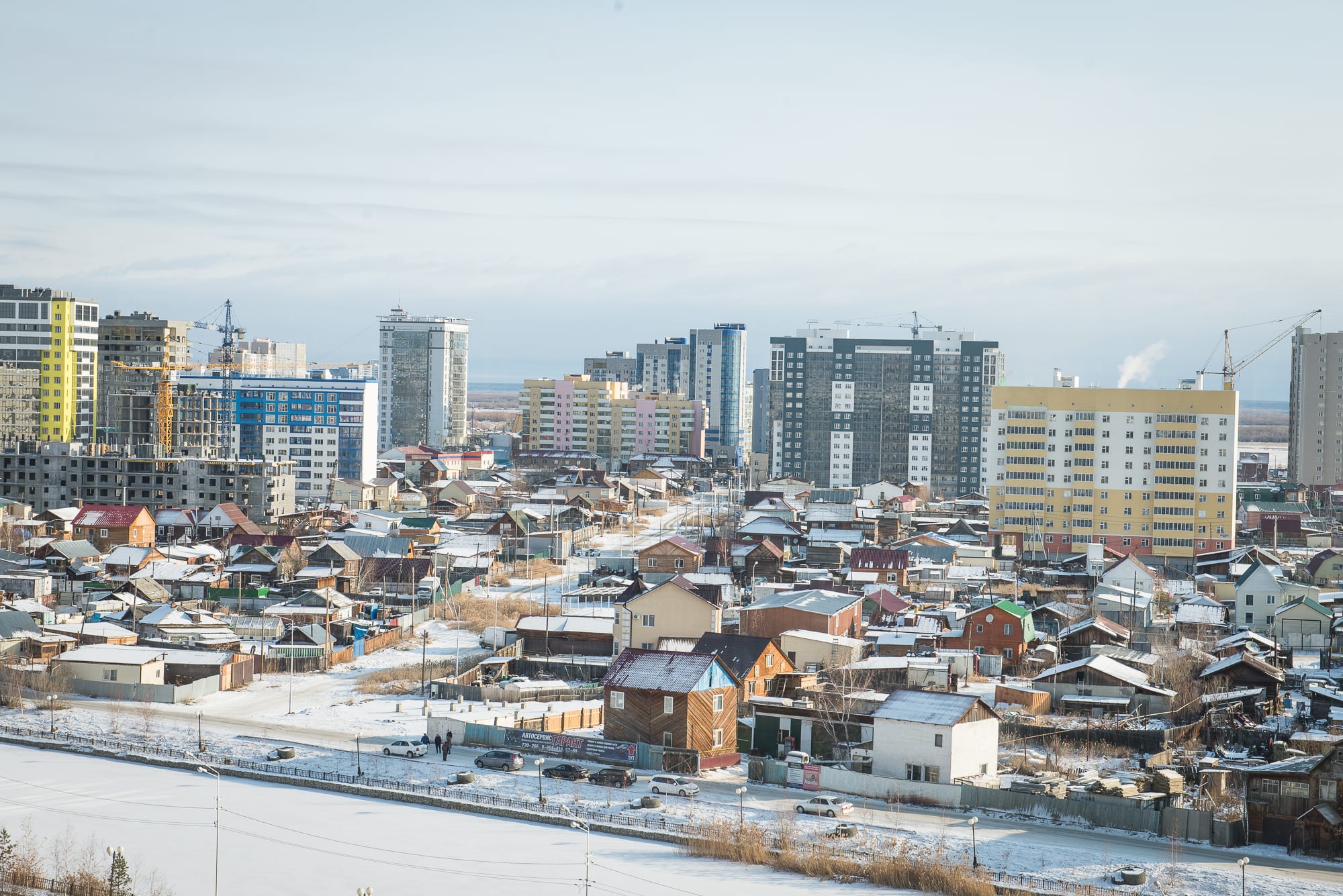
Snow-covered Yakutsk, with small timber houses in the foreground and new high-rise apartment blocks behind under a pale sky

The Russian Far East, Russia

Yakutsk

Old wooden houses and new apartment towers side by side in Yakutsk in the cold season. (Якупова Инна / Wikimedia Commons · CC BY-SA 4.0)

The capital of the Sakha Republic, on the left bank of the Lena in eastern Siberia — a Cossack fort of 1632 that became a base for Russian expeditions into the Far East and the far north, and now the coldest major city in the world, built on continuous permafrost, with many houses on concrete piles, and growing fast on mining money. This page is written to explain the city, not to encourage travel.

Neighbourhoods

  • The Old City
    • First-time visitors
    • Historic district
    • Cafés

    A small quarter in the very centre rebuilt in the style of the 19th century, bounded by Ammosov and Arzhakov streets and the Square of the Fallen Soldiers. Its streets are closed to traffic and paved with wooden blocks, with the restored Transfiguration Church, a monument to the city's founders, a museum and cafés.

    Open in Maps
  • Lenin Prospect and Lenin Square
    • Museums
    • Shopping
    • Close to public transport

    The main avenue and the administrative heart of the city. The squares named after Lenin and Ordzhonikidze were laid out in the 1970s and 1980s in a Soviet modernist style, with the House of Soviets and the opera and ballet theatre, while shops and boutiques line the prospect and the National Art Museum stands on Lenin Square.

    Open in Maps
  • The university and Teploye Lake
    • Students
    • Museums
    • Walks

    The campus of the North-Eastern Federal University, home to the mammoth and archaeology museums, faces an older district of wooden houses across Teploye ('Warm') Lake. Bridges cross the water, fountains play on it in summer and people skate on it in winter.

    Open in Maps
  • Saisary and Zalog
    • Quiet and residential
    • Wooden architecture
    • Local life

    Residential districts around Lake Saisary, one of the largest of the many lakes inside the city, where timber houses in the traditional Siberian style of the first half of the 20th century survive among newer blocks. Saisary was once seen as a rough part of town but has changed for the better.

    Open in Maps

Things to do

Landmarks and the old town

  • The Old Cityneighborhood

    A pedestrian quarter rebuilt in 19th-century style, with wooden-block streets, cafés, a memorial to fallen soldiers and a column marking the 375th anniversary of Yakutia's union with Russia.

    Open in Maps
  • Transfiguration Churchlandmark

    The restored Preobrazhenskaya church, whose cupola marks the Old City and is a landmark on walks through the centre.

    Open in Maps
  • Fort towerlandmark

    A re-creation of the gate tower of the 17th-century log fort and a symbol of Yakutsk; after the earlier reconstruction burned in 2002, the tower was rebuilt in the Old City about two years later.

    Open in Maps
  • Holy Trinity Cathedrallandmark

    Built between 1708 and 1728, one of the oldest stone buildings in Yakutsk, replacing a wooden cathedral of 1641.

    Open in Maps
  • Victory Stelelandmark

    A tall Second World War memorial at the north end of Victory Square, topped by a figure of Nyurgun Bootur, hero of the Yakut epic Olonkho.

    Open in Maps
  • Abakayade monumentlandmark

    A statue of a Russian settler, his Yakut wife and their child at the corner of Kirov and Poyarkov streets, a symbol of the meeting of the two peoples.

    Open in Maps

Museums of cold and the north

  • Yaroslavsky Museum of History and Culture of the Peoples of the Northmuseum

    The city's main museum, covering Yakutia from prehistory to the 1990s, with a large collection of northern wildlife and one of the world's few complete woolly mammoth skeletons.

    Open in Maps
  • Mammoth Museummuseum

    A university museum with one of the world's most varied collections from the Ice Age, centred on the frozen, preserved head of a woolly mammoth; labels are in Russian.

    Open in Maps
  • Museum of Archaeology and Ethnographymuseum

    Everyday objects and mythology of the Sakha, Evens, Evenks, Yukaghirs and other peoples of Yakutia, on the university campus.

    Open in Maps
  • National Art Museum of the Sakha Republicmuseum

    Art by Yakut, Russian and foreign artists from the 16th century to today, with a strong collection of Yakut folk arts and crafts.

    Open in Maps
  • Khomus museummuseum

    A museum devoted to the khomus, the Sakha jaw harp, and to jaw harps of other peoples of the world.

    Open in Maps
  • Melnikov Permafrost Institutemuseum

    A research institute founded in 1960, whose underground laboratory in the frozen ground can be visited on guided tours and which measures how fast the permafrost under the city is thawing.

    Open in Maps
  • Permafrost Kingdomattraction

    A tourist complex opened in 2005 inside the permafrost near Chochur-Muran hill, with ice sculptures of local pagan gods and other characters, at about −7°C in summer and colder in winter.

    Open in Maps
  • Gagarin Center for Culture and Contemporary Artmuseum

    A contemporary art centre opened in 2020 in the city's Gagarin District.

    Open in Maps

Lakes and open spaces

  • Teploye Lakepark

    The lake between the university and an old wooden quarter, popular with young people, with fountains in summer and skating in winter.

    Open in Maps
  • Lake Saisarypark

    One of the largest of the floodplain lakes inside the city, a lake sacred to the Sakha people.

    Open in Maps
  • Us Khatynattraction

    The open ground on the edge of the city built for the Ysyakh festival, where tens of thousands gather for the midsummer parade and rites.

    Open in Maps

Theatre and the circus

  • Sakha Academic Theatreattraction

    The Oyunsky drama theatre, which performs in the Yakut language, with simultaneous translation into Russian.

    Open in Maps
  • Opera and Ballet Theatreattraction

    The state opera and ballet company, staging Russian and international classics as well as works written in Yakutia, in a Soviet modernist building on Lenin Prospect.

    Open in Maps
  • Yakutsk State Circusattraction

    A circus billed as the northernmost in the world, mixing Russian circus traditions with Yakut culture and known for its acrobats.

    Open in Maps

Short trips from the city

  • Orto Doidu Zooattraction

    A zoo founded in 2001, centred on the animals of the Russian Far North and Far East.

    Open in Maps
  • Lena Historical and Architectural Museum-Reservemuseum

    An open-air museum at Sottintsy on the right bank of the Lena, on the site of the original fort, with old wooden buildings of Yakutia, a copy of the Zashiversk church and a hilltop view over the river.

    Open in Maps
  • Lena Pillarsviewpoint

    Limestone towers 150–300 metres high lining the Lena, a UNESCO World Heritage Site, visited by boat from the Yakutsk river station in summer and on ice-fishing trips in winter.

    Open in Maps

Seasonal events

  • Ysyakhlate June, around the summer solstice

    The Sakha summer festival of renewal and the new year, with a blessing ceremony, rites at sunrise, osuokhai circle dancing, kumis, horse racing, khapsagai wrestling, jaw-harp music and national food at Us Khatyn.

  • Yakutsk City Dayearly September

    The city's own holiday at the start of autumn.

  • Day of the Republic27 September

    The public holiday of the Sakha Republic, celebrated in the capital.

Eat and drink

Long-standing places and food districts in Yakutsk. Hours, ratings and directions come from your maps app, always current.

Yakutsk classics

  • Stroganina and indigirkarestaurant

    Stroganina is long, thin shavings of raw frozen whitefish such as nelma or muksun, also made with foal meat; indigirka is cubes of frozen fish with onion, salt and pepper.

    Open in Maps
  • Foal meat and khaanrestaurant

    The meat of the Yakutian horse, a local delicacy for its rich fat, and khaan, a blood sausage made from horse or beef blood.

    Open in Maps
  • Kumis and kierchekhcafe

    Kumis is fermented mare's milk, drunk widely and at Ysyakh; kierchekh is a dessert of cream with berries and sugar.

    Open in Maps

Markets

  • Krestyansky marketmarket

    The farmers' market, the place for fresh local produce.

    Open in Maps
  • Stolichny marketmarket

    One of the city's big general markets, where warm coats and fur-lined boots sell alongside everyday goods.

    Open in Maps
  • Saisary marketmarket

    A neighbourhood market in the Saisary district, one of several that supply the city.

    Open in Maps

Experience Yakutsk

History

People lived in the Tuymaada valley long before Russians arrived: more than 200 archaeological sites have been explored within the city. The Sakha, a Turkic people who mixed with the Evenks and Yukaghirs, settled the valley between the 13th and 16th centuries.

In September 1632 a Cossack detachment under Pyotr Beketov built the Lensky fort on the right bank of the Lena, about 70 km downstream of today's city. In 1638 it became the seat of a new Yakutsk voivodeship, and in 1642–43, under the governor Pyotr Golovin, the fort was moved across the river to the Tuymaada valley. From here the tsar's men set out on expeditions into the Far East and the far north. Yakutsk received town status in 1708, when work also began on the stone Holy Trinity Cathedral; in 1851 it became the capital of a separate Yakutsk province. Birch-bark letters from the governor's chancery, lost in a fire of 1700, were found in the city in 2024.

Soviet power came in 1918, fell, and returned in December 1919; in 1922–23 the White general Anatoly Pepelyayev's march on Yakutsk was the last campaign of the Russian Civil War. The Yakut Autonomous Soviet Socialist Republic was proclaimed in April 1922 with Yakutsk as its capital. In March 1986 a fight at Teploye Lake grew into three days of ethnic clashes. In December 1991 the republic was renamed Sakha (Yakutia); since 1980 the city's population has almost doubled, and in 2019 passenger trains began running to the far bank of the Lena.

Culture & Customs

Yakutsk is the capital of Sakha culture. The Sakha Academic Theatre performs in Yakut, alongside a Russian drama theatre, an opera and ballet house and a children's theatre, and Yakut musicians give concerts across the city. The khomus, the Sakha jaw harp, has its own museum, and Olonkho, the Yakut heroic epic recognised by UNESCO, is honoured everywhere from the Victory Stele to the Arctic Center of Epos and Arts, whose construction began in 2021. The city also has a punk scene and a regional film industry, nicknamed "Sakhawood", whose films have drawn international attention.

Ysyakh, the midsummer festival of renewal and the Sakha new year, is the high point of the year. At Us Khatyn on the edge of the city, crowds watch a blessing ceremony, greet the sunrise, dance the osuokhai in great circles, drink kumis, race horses and compete in Yakut archery, stick fighting and khapsagai wrestling. Freestyle wrestling is strong — Yakutsk has hosted Soviet and Russian championships — and since 1996 the city has staged the Children of Asia international games.

Faith is mixed. Orthodox Christianity is the largest religion, and the city is the seat of an Orthodox diocese restored in 1993; traditional Sakha belief and Rodnovery have large followings, the world's largest temple of the Aiyy faith stands here, a mosque has served the Muslim community since 2005, and a Catholic parish dates from 1993, on a tradition begun by exiled Poles. Many residents are not religious at all.

Daily Life

Yakutsk had about 355,000 people at the 2021 census and about 373,000 by a 2025 estimate, more than a third of everyone in the Sakha Republic. Yakuts make up about 59 per cent and Russians about 26 per cent, with Kyrgyz, Evenks, Tajiks, Chinese and Armenians among the rest; people from the republic's villages have been moving to the capital since the early 1990s, and many migrants from Central Asia, the Caucasus and China work in trade and services. Growth has outpaced the city's housing, kindergartens, schools and hospitals.

The city is the republic's capital and its centre of trade rather than heavy industry: mining companies for diamonds, gold and coal have their headquarters here, diamond cutting is a significant local business, and around 60 per cent of working-age residents are employed in trade and services. Yakutia Airlines is based here, and the city is home to the North-Eastern Federal University and many research institutes.

Permafrost shapes everything. Modern buildings stand on concrete piles with an unheated ground floor so that their warmth does not thaw the soil beneath. In winter people wear thick furs, spend as little time outdoors as possible, and fog can hang over the city for days; the city has never recorded a thaw between mid-November and mid-March. Summer brings white nights, river trips and outdoor life on the lakes. The thawing of the permafrost under the city, measured by the Permafrost Institute, is one of its long-term worries.

Food

Sakha cooking is built on dairy, meat, fish and what can be gathered, prepared by boiling, fermenting or freezing. Its best-known dish is stroganina: long, thin shavings of raw frozen fish — whitefish such as nelma, muksun, chir or omul — also made with foal meat and liver. Indigirka is a salad of frozen fish cubes with onion, salt and pepper, sometimes topped with caviar. The Yakutian horse, a breed that survives the winter without shelter, is reared mainly for its meat, a local delicacy, and khaan, a blood sausage made from horse or beef blood and intestines, is a popular dish. Other Sakha dishes include salamat, a thick mixture of flour and dairy products, crucian carp cooked the Yakut way, and Yakut flatbreads.

Milk has always mattered most: it is drunk fresh and turned into butter, curds and suorat, a thick yogurt. Kumis, fermented mare's milk, is drunk widely and at Ysyakh, and kierchekh, cream with berries and sugar, is one of the most popular desserts. Russian settlers brought bread, sugar, tea and vodka, and Russian dishes and sausages are part of everyday eating.

Most people eat out rarely, mainly for special occasions, and restaurant customers are mostly younger people. Sushi is everywhere and popular with younger people, made with frozen fish, and there are Chinese and Korean restaurants, pizzerias, plentiful coffee houses known for their cakes, and public canteens in office buildings serving simple, inexpensive meals. Fresh local produce is sold at the Krestyansky market.

Planning tools

Budget

Yakutsk is remote, and rooms and flights are the main costs, and trips to the Lena Pillars or into the countryside usually mean tours or boat tickets. Western cards do not work, so the whole budget has to be carried in cash.

Daily Budget Midrange
USD 110–230 (mid-range hotel, Yakut and Russian restaurants, taxis, museum tickets; more with Lena river trips)
Daily Budget Shoestring
USD 40–75 (hostel or guesthouse bed, canteens and markets, city buses and minibuses)

Carry more cash than planned and some in reserve: winter fog can strand flights for days, and there is no easy way to get more money.

Best Time to Visit

June and July bring white nights, warm days, the river season and the Ysyakh festival in late June. March is still very cold but sunny, the season for dog sledding, skiing and ice sculptures. From November to March the cold is extreme and fog can close the airport, which appeals only to travellers who come for the cold itself.

Suggested Number of Days

Two or three days are enough for a first visit to the city. Allow four to six to add trips along the river and into the countryside, which depend on boat schedules and tours. In winter build in spare days, because fog can delay flights for a long time.

First Visit
2–3 days
With Surroundings
4–6 days

Transportation

Buses and marshrutka minibuses are the only public transport, run mostly by private operators and reaching nearly every part of the city and some nearby settlements. Taxis are ordered by phone or through the Yandex Go and inDrive apps. In deep winter visitors take taxis door to door rather than walk.

In deep winter take a taxi door to door rather than walk, even for short distances.

Airport & Station Connections

Platon Oyunsky Yakutsk International Airport, a hub of Yakutia Airlines and Polar Airlines, is about 7 km from the city centre, with flights to Moscow and other Russian cities. There is no bridge over the Lena: trains and the Lena and Kolyma highways end at Nizhny Bestyakh on the far bank, linked by ferry in summer and an ice road in winter. A bridge at Staraya Tabaga has been under construction since 2024, with completion proposed for 2028.

Walkability

The centre is compact: the Old City, Lenin Prospect, the main museums and Teploye Lake are close together, and in summer it is pleasant on foot. In winter walking is the problem, not distance — in −50°C air even well-dressed people tire fast and risk frostbite within minutes, so short walks between warm buildings are the rule. Stray dogs can be a nuisance in winter.

Safety

Far from the front line, but the national risks apply in full: arbitrary detention of foreigners on political charges, wartime censorship laws and near-total loss of consular support. Yakutsk's central streets are well lit and patrolled; pickpocketing on buses and in markets is the usual crime. The greatest everyday danger is the cold, which can cause frostbite or worse very quickly.

Most governments advise against all travel to Russia and against any travel near the Ukrainian border. Do not drink in public at night, carry passport, visa and migration card at all times, keep valuables in inner pockets on buses, and in winter dress in many layers, cover the face and limit time in the open air. Check current official travel advice before travelling.

Climate

An extreme continental subarctic climate: the coldest winters of any city its size on Earth and short, sunny, sometimes hot summers. It is dry, with most precipitation in summer. Temperatures have ranged from −64.4°C in 1891 to 38.4°C in 2011, and the city has never recorded a temperature above freezing between 10 November and 14 March.

Summer
short and warm — July averages about 19.9°C, and daytime highs can pass 30°C; in June and July it never gets fully dark
Winter
long and severe — January averages about −36.9°C, frosts near −50°C come in most winters, and fog can hang over the city for days

Local Customs

Yakuts make up most of the population, and the city's theatres perform in both Yakut (Sakha) and Russian. Orthodox Christianity is the largest faith, alongside traditional Sakha belief, Rodnovery and a mosque, and many people are not religious. Ysyakh is treated with respect as a sacred as well as festive occasion. Museum labels and theatre are in Russian or Yakut, rarely in English.

Ask before photographing people and rituals, and never photograph military sites, airports or infrastructure. Drinking in public, especially at night, draws police attention.

Common Payment Methods

The currency is the Russian rouble. Visa, Mastercard and other Western cards do not work in Russia, and most foreign cards cannot be used at Russian ATMs, so travellers depend on cash brought in and exchanged.