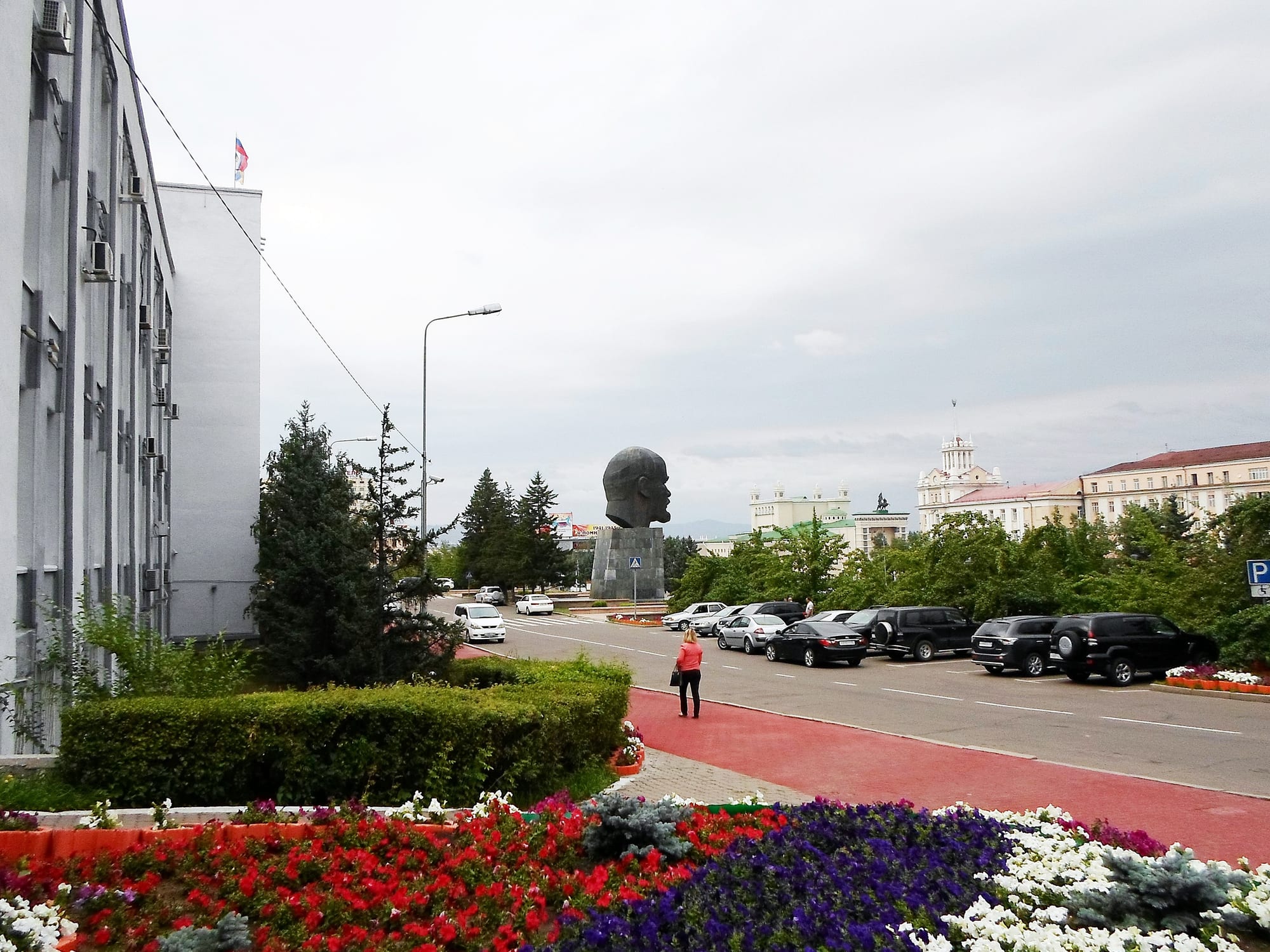
A giant bronze head of Lenin on a stone plinth at the end of a wide street, with flower beds and a towered building beyond

The Russian Far East, Russia

Ulan-Ude

The Lenin head on the Square of the Soviets in central Ulan-Ude. (Alava / Wikimedia Commons · CC BY-SA 4.0)

The capital of Buryatia, on the Selenga and Uda rivers about 100 km south-east of Lake Baikal — a Cossack fort of 1666 that grew into a trade town between Russia, China and Mongolia. Today it is the centre of Tibetan Buddhism in Russia, known for its giant Lenin head and the Ivolginsky Datsan nearby. This page is written to explain the city, not to encourage travel.

Neighbourhoods

  • Lenina Street and the old town
    • First-time visitors
    • Historic district
    • Best for food

    The historic centre near the meeting of the Uda and the Selenga, where Lenina Street — also called the Arbat — runs past old merchants' mansions decorated with wood and stone carving, museums and cafés, with the Odigitrievsky Cathedral nearby on the Uda.

    Open in Maps
  • Square of the Soviets
    • Landmarks
    • Close to public transport

    The main square on Lenina Street, dominated by the giant Lenin head and the opera and ballet theatre. Airport buses stop here, and the railway station is a short walk away.

    Open in Maps
  • The Selenga embankment
    • Riverside walks
    • Local life

    The riverside of the broad Selenga near the main bus station and a shopping mall, where the city meets the river that carries almost half the water flowing into Lake Baikal.

    Open in Maps
  • Verkhnyaya Berezovka
    • Museums
    • Nature

    A village 8 km north-east of the centre, home to the open-air Ethnographic Museum, with Cossack houses, Buryat yurts and reconstructed streets.

    Open in Maps

Things to do

Landmarks

  • The Lenin Headlandmark

    The world's largest statue of Lenin's head, 7.7 metres high and weighing 42 tons, built on the Square of the Soviets for the centenary of his birth in 1970.

    Open in Maps
  • Odigitrievsky Cathedrallandmark

    The first stone building in the city, built between 1741 and 1785 in the Siberian Baroque style on the bank of the Uda near its confluence with the Selenga.

    Open in Maps
  • Lenina Streetneighborhood

    The main street of the old town, also called the Arbat, lined with carved merchants' mansions, shops and cafés.

    Open in Maps
  • Rinpoche Bagshalandmark

    A Buddhist centre on Streletskaya Street.

    Open in Maps

Museums and theatre

  • Ethnographic Museum of the Peoples of Transbaikaliamuseum

    One of Russia's largest open-air museums, 8 km north-east of the centre, opened in 1973, with ancient stone graves, Evenki tents, Buryat yurts, old Cossack houses and reconstructed streets.

    Open in Maps
  • Sampilov Museum of Fine Artsmuseum

    Known as the East Siberian Hermitage, with more than 7,000 works of art from Buryatia.

    Open in Maps
  • Geological Museummuseum

    A geological museum on Lenina Street in the centre.

    Open in Maps
  • Museum of Buryatia Historymuseum

    The republic's history museum on Profsoyuznaya Street in the centre.

    Open in Maps
  • Museum of Buryatia Naturemuseum

    A natural history museum on Lenina Street in the centre.

    Open in Maps
  • Buryat Opera and Ballet Theatreattraction

    The republic's music theatre on the Square of the Soviets, with its own music and dance schools, staging opera and ballet.

    Open in Maps
  • Ulger Puppet Theatreattraction

    A children's theatre founded in 1967, whose name means 'legend', with several plays in the Buryat language.

    Open in Maps

Short trips from the city

  • Ivolginsky Datsanlandmark

    The centre of the Buddhist Traditional Sangha of Russia, 23 km from the city, opened in 1945 as the only Buddhist centre in the Soviet Union, with temples, a Buddhist university and a temple honouring the lama Dashi-Dorzho Itigelov.

    Open in Maps

Eat and drink

Long-standing places and food districts in Ulan-Ude. Hours, ratings and directions come from your maps app, always current.

Buryat classics

  • Buuzarestaurant

    The Buryat steamed dumpling, also called pozy, usually filled with lamb or beef and onion; in Mongolia it is buuz.

    Open in Maps
  • Khuushuur and sharbinrestaurant

    Fried meat pies, usually of mutton, fried in sunflower oil; sharbin are the round kind.

    Open in Maps

Food districts

  • Lenina Streetneighborhood

    The old-town street and the blocks near the Lenin head hold many of the city's restaurants serving Buryat and Russian food.

    Open in Maps

Experience Ulan-Ude

History

Evenks and, later, Buryat Mongols were the first people of the valley where the Uda meets the Selenga. Russian Cossacks built the fort of Udinskoye here in 1666, and its position made it a busy trading town on the routes linking Russia with China and Mongolia; from 1690 it was the administrative centre of the Transbaikal region. Known as Udinsk from around 1735, it received town status in 1775 and was renamed Verkhneudinsk, "Upper Udinsk", in 1783. Merchants built stone and timber mansions along the river, and after a great fire in 1878 the town was almost entirely rebuilt.

The Trans-Siberian Railway arrived in 1900 and set off rapid growth: from 3,500 people in 1880, the population reached 126,000 by 1939. From April to October 1920 Verkhneudinsk was the capital of the Far Eastern Republic, a nominally independent state that lasted until 1922. On 27 July 1934 the city was renamed Ulan-Ude, "red Uda" in Buryat. In the 1930s much of the original Buryat culture and its religious buildings were destroyed, and the city remained closed to foreigners until 1991.

After the Soviet collapse, formal housing could not keep pace with the growing population, and unplanned settlements of private houses known as nakhalovki spread over farmland on the outskirts, many of them still short of basic infrastructure. The population has kept growing, from about 404,000 in 2010 to about 438,000 in 2021.

Culture & Customs

Ulan-Ude is the centre of Tibetan Buddhism in Russia. Buddhism reached the Buryats from Mongolia in the 17th century and was recognised as an official religion of the Russian Empire in 1741. After decades of Soviet repression, the Ivolginsky Datsan opened outside the city in 1945 as the only Buddhist centre in the Soviet Union, and today it is the seat of the Buddhist Traditional Sangha of Russia, with temple rites, traditional medicine and a monastic school. A temple there honours the 12th Pandito Khambo Lama, Dashi-Dorzho Itigelov, who asked to be buried and checked on 30 years later; when exhumed, his body was found showing no sign of decay.

The Buryat and Russian worlds sit side by side. About a third of the city's people are Buryats, and the Mongolian cultural influence is very noticeable, while the old centre's merchants' mansions, with their wood and stone carving, are fine examples of Russian classicism. The opera and ballet theatre runs its own music and dance schools, and the Ulger puppet theatre, founded in 1967, performs several plays in the Buryat language.

The giant Lenin head on the main square, built for the centenary of 1970 and the largest in the world, has become the city's best-known symbol. Ulan-Ude is also the finishing point of the Mongol Rally.

Daily Life

About 438,000 people lived in Ulan-Ude at the 2021 census, and roughly 600,000 in the wider urban area, making it the third-largest city in the Russian Far East and the capital of the Republic of Buryatia. Russians make up about 61 per cent of the population and Buryats about 35 per cent. The city is divided into three districts — Sovetsky, Zheleznodorozhny and Oktyabrsky.

As well as the seat of the republic's government, the city is a transport hub: it sits at the junction of the Trans-Siberian and Trans-Mongolian lines and on the main federal highway east, and the Ulan-Ude Aviation Plant is based here. The informal nakhalovki districts on the outskirts remain a lasting problem, lacking much of the necessary infrastructure.

The year swings between extremes. Winters are long, dry and bitterly cold, with lasting snow cover, while summers, from mid-May to early September, are warm and bring most of the year's rain. People get around by tram, bus and marshrutka.

Food

Buryat cooking is simple and hearty, with very little spice, and shares many dishes with Mongolian cuisine while also borrowing from Russian and Soviet cooking. Most dishes are based on lamb or beef. Buuza, also called pozy (buuz in Mongolia), are steamed dumplings usually filled with lamb or beef and onions. Khuushuur are fried meat pies, usually of mutton, cooked in sunflower oil, and sharbin are a round version of the same.

Soups include bukhleor, a lamb soup with hand-cut noodles and potatoes, and shulen, a mutton or beef soup with egg noodles. Shan'gi are flatbreads with melted local cheese, and salamat is a dessert of rye and sour cream. Near Lake Baikal fish dishes are common, among them sagudai, fresh lake fish prepared raw, and the Selenga is home to omul and other prized fish.

Dairy foods include airhan, a dried cottage cheese; khuruud, a hard cheese; and urme, the thick skin skimmed from boiled fat milk. Buryat and Russian restaurants cluster along Lenina Street and around the Lenin head, and a local brand of vodka is a popular souvenir.

Planning tools

Budget

Ulan-Ude is one of the more moderately priced cities of the Far East, with cheap canteens and buuza cafés, inexpensive buses and short taxi rides. The practical difficulty is payment rather than cost: Western cards do not work, so every rouble has to come from cash brought in.

Daily Budget Midrange
USD 110–200 (mid-range hotel, restaurants, taxis, a trip to the Ivolginsky Datsan)
Daily Budget Shoestring
USD 30–60 (hostel bed, buuza cafés and canteens, buses and trams)

Bring enough cash for the whole stay; the Lenin head, the cathedral and the old-town streets cost nothing.

Best Time to Visit

Summer, from about mid-May to early September, is warm and brings most of the year's rain; the area is known for having more sunny days than its surroundings. Winters are long, dry and very cold. Timing matters less than the national picture: most governments advise against all travel to Russia.

Suggested Number of Days

Two days are enough for the city itself. Allow three or four to add the Buddhist and open-air sites on the outskirts, which take a half-day or more each by bus.

First Visit
2 days
With Surroundings
3–4 days

Transportation

Trams, buses and marshrutka minibuses cover the city. Buses for the Ivolginsky Datsan leave from the southern bus station to Ivolginsk, with a connecting minibus to the monastery; the journey takes 40 minutes to an hour each way.

Carry passport, visa and migration card at all times.

Airport & Station Connections

Baikal International Airport is 12 km west of the city, about twenty minutes by taxi, with buses to the Square of the Soviets. The railway station is in the centre: all Trans-Siberian trains stop here, about 5,640 km from Moscow, and the city is the junction where the Trans-Mongolian line branches south towards Mongolia and China. The city also lies on the main federal highway to Vladivostok.

Walkability

The centre is compact and pleasant on foot: the railway station is a five-minute walk from Lenina Street, which runs from the Square of the Soviets through the old town. The outer districts and the outlying sights need a bus or taxi. Pavements are icy in winter.

Safety

Beyond the ordinary crime of a large European city, the decisive risks are political and legal: near-total loss of consular support, a real risk of arbitrary arrest and lengthy detention of foreigners on politically motivated charges (and their use in prisoner swaps), sweeping wartime censorship laws, and the possibility that men of certain ages, including dual nationals, face conscription or exit bans. In winter the cold itself is a danger.

Most governments advise against all travel to Russia and against any travel near the Ukrainian border. Avoid photographing military or infrastructure sites, and dress for severe cold in winter. Check current official travel advice before travelling.

Climate

A dry steppe climate on the edge of the continental and subarctic zones: long, dry and very cold winters with lasting snow cover, and warm summers from mid-May to early September that bring most of the city's light annual rain.

Summer
warm — the warmest spells can be hot, and the record high is 40.6°C
Winter
very cold — January averages about −23°C, and from late December to early February the temperature has never risen above freezing

Local Customs

Tipping was traditionally frowned upon in Russia but has become more common: it is not obligatory in restaurants, is not given in self-service canteens, and is not customary in taxis, where the fare is agreed before setting off.

LGBT people face severe legal repression in Russia, and photographing military or infrastructure sites can bring espionage charges.

Common Payment Methods

The currency is the Russian rouble. Western credit and debit cards — Visa, Mastercard, American Express — do not work in Russia, and most foreign cards cannot be used at Russian ATMs, so all money needs to be brought in as cash and exchanged.