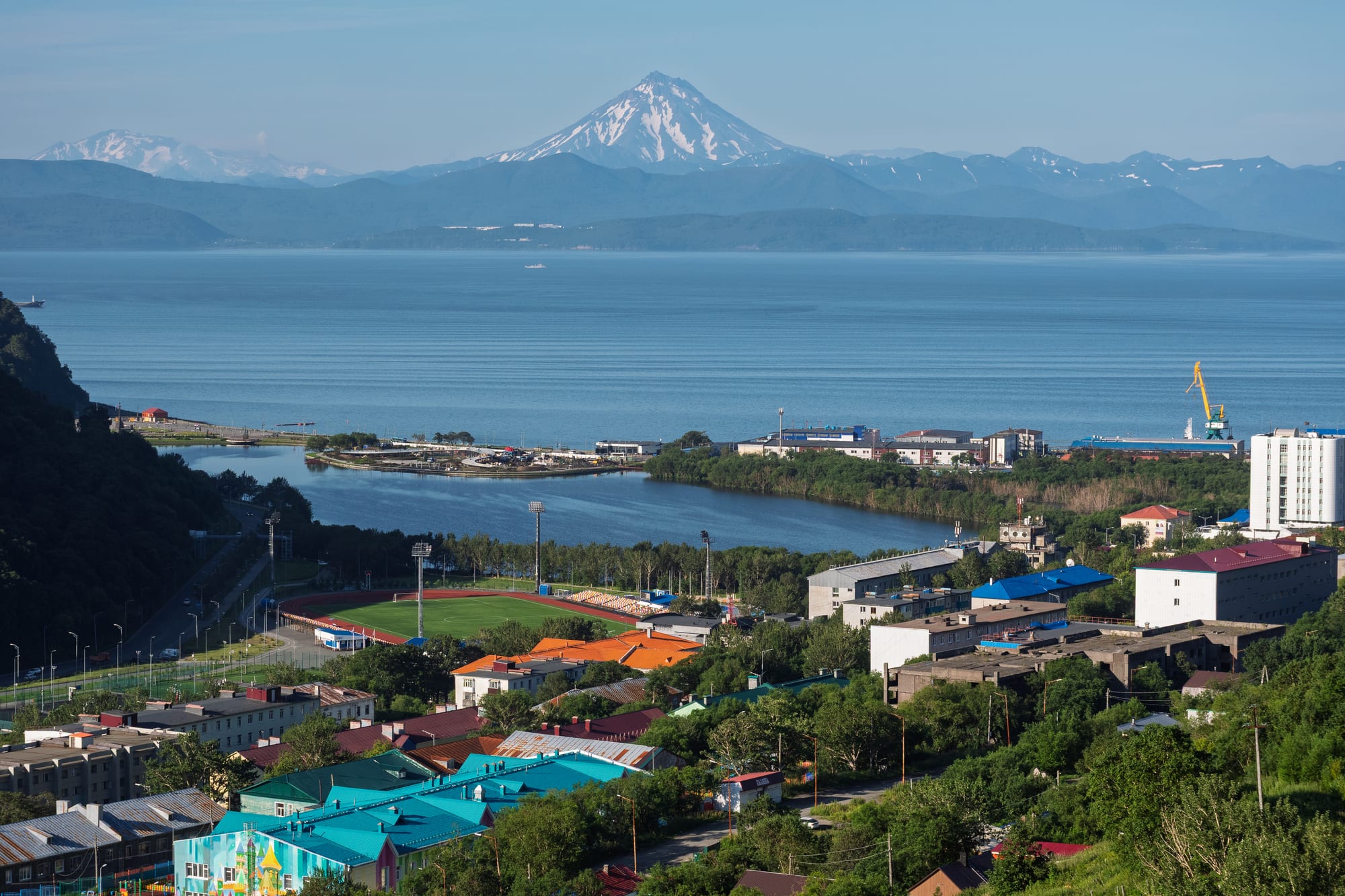
Low city buildings and a stadium beside a small lake, with a wide blue bay and a snow-capped volcanic cone beyond

The Russian Far East, Russia

Petropavlovsk-Kamchatsky

Central Petropavlovsk-Kamchatsky and Lake Kultuchnoye, with Avacha Bay and the Vilyuchinsky volcano behind. (Nikita Zhuravlev / Wikimedia Commons · CC BY-SA 4.0)

The capital of Kamchatka, a port on Avacha Bay ringed by volcanoes, founded by Vitus Bering's expedition in 1740 and named after his two ships. A fishing and naval city reached in practice only by air, it is the gateway to the peninsula's volcanoes, wildlife and wilderness. This page is written to explain the city, not to encourage travel.

Neighbourhoods

  • The historic centre
    • First-time visitors
    • Historic district
    • Viewpoints

    The old town on the bay below Nikolskaya Sopka, where the city began. Theatre Square, the venue for the main city events, and Lenin Square are here, with Leninskaya, Sovetskaya and Partizanskaya streets running out from the centre past the monuments to Bering and to the defenders of 1854.

    Open in Maps
  • Lake Kultuchnoye and the port
    • Waterfront
    • Close to the sights

    The small lake in the city centre, and the port along Avacha Bay, where fishing boats and, in the warmer months, cruise ships come in. The hills above give the classic views over the bay.

    Open in Maps
  • The outer microdistricts
    • Local life
    • Transport links

    The outer microdistricts administered by the city — Avacha, Dalny, Zavoyko and others — away from the historic centre, with buses to the centre and to Yelizovo.

    Open in Maps

Things to do

Landmarks and viewpoints

  • Nikolskaya Sopkaviewpoint

    The hill by the historic centre, scene of fighting during the siege of 1854 and now a natural monument and park, with views of the city and bay and the Monument of Glory to the city's defenders, erected in 1882.

    Open in Maps
  • Vitus Bering monumentlandmark

    Built between 1823 and 1826 in honour of the navigator who founded the city, and described as the oldest monument in Russia's Far East.

    Open in Maps
  • Lenin Squarelandmark

    The central square by Lake Kultuchnoye, with its statue of Lenin and, nearby, a statue of the French navigator La Pérouse, whose expedition sailed from here in 1787 and was later lost.

    Open in Maps
  • Holy Trinity Cathedrallandmark

    The main Orthodox church of the city, with a museum of the history of Orthodoxy in its lower church and a small church close by.

    Open in Maps

Museums

  • Kamchatka Regional Museummuseum

    The regional museum, covering the native peoples of Kamchatka, the history of Russians on the peninsula and its plants and animals.

    Open in Maps
  • Museum of Volcanoesmuseum

    A museum with a large collection of rock and mineral samples from volcanoes around the world, and film of eruptions.

    Open in Maps
  • Kamchatka Regional Art Museummuseum

    The regional museum of fine arts in the city.

    Open in Maps

The bay and the shore

  • Avacha Bayviewpoint

    The Pacific bay, 24 km long, on which the city stands; boat trips go out for views, fishing and whale-watching.

    Open in Maps
  • Tri Brataviewpoint

    Three rocks at the entrance to Avacha Bay; local lore says they are three brothers who went to defend the town from a tsunami and were turned to stone.

    Open in Maps
  • Khalaktyrskoye Lakepark

    A lake on the eastern outskirts of the city, more than 100 metres deep.

    Open in Maps

Short trips to the volcanoes

  • Avachinskytrail

    The active volcano in sight of the city, about 2,700 metres high, a common venue for annual climbs; with Koryaksky it is a Decade Volcano, studied closely for its explosive history and nearness to people.

    Open in Maps
  • Koryakskyviewpoint

    At about 3,450 metres, the tallest of the city's home volcanoes and, with Avachinsky, a Decade Volcano.

    Open in Maps
  • Yelizovoattraction

    The small airport town on the Avacha River, about 26 km north-west of the city, served by frequent buses.

    Open in Maps

Eat and drink

Long-standing places and food districts in Petropavlovsk-Kamchatsky. Hours, ratings and directions come from your maps app, always current.

Kamchatka classics

  • Salmon and red caviarmarket

    Salmon has long been the city's great catch, and its roe is prized as caviar; much of the local fishing industry works seasonally on salmon.

    Open in Maps
  • Kamchatka crabrestaurant

    Crab meat, with salmon, was the city's main contribution to Soviet food supplies in the 20th century.

    Open in Maps

Food districts

  • Leninskaya Streetneighborhood

    One of the three main streets running out from the centre, with restaurants and shops.

    Open in Maps

Experience Petropavlovsk-Kamchatsky

History

Cossacks reached the shores of Avacha Bay from 1697, but the city dates from Vitus Bering's second expedition. The navigator Ivan Yelagin laid the foundations in 1740, and when Bering arrived late that year he named the settlement Petropavlovsk after his two ships, the Saint Peter and the Saint Paul, built in Okhotsk for the voyage. Its sheltered harbour at the mouth of the Avacha River made it the most important settlement in Kamchatka, and it gained town status on 9 April 1812.

The city's defining moment came in the Crimean War. In August and September 1854 an Anglo-French squadron besieged Petropavlovsk, defended by a garrison of a few hundred men and sixty-seven guns. Landings south of the town on 1 September and east of it on 5 September were both driven back, and the allied ships withdrew from Russian Pacific waters two days later. The Monument of Glory on Nikolskaya Sopka, erected in 1882, honours the defenders. The word "Kamchatsky" was added to the city's name in 1924.

In the Soviet era Petropavlovsk became a great source of fish, above all salmon, and of crab meat, while the naval base across the bay at Vilyuchinsk grew into Russia's largest submarine base. In September 1945 United States Navy Seabees were sent to build a naval weather station about ten miles outside the city. After the end of the Soviet era, fishing rights were also granted to foreign interests. Earthquakes are part of the city's story: in July 2025 a magnitude 8.8 earthquake 119 km to the south-east caused moderate to severe damage along the coast.

Culture & Customs

Life here is shaped by the landscape. The city sits at sea level ringed by volcanoes, so that no clear horizon can be seen from anywhere in town, and Koryaksky and Avachinsky, its "home" volcanoes, are a constant presence. Since 2000 the city has held an annual Volcano Day, and Avachinsky is the scene of an annual climb. The memory of 1854 is a source of local pride, kept alive by the monuments and a reconstruction of the battery that was most crucial to the defence.

The cultural institutions are those of a small regional capital: the first professional theatre opened in 1933, and today there are a drama and comedy theatre and a puppet theatre, a regional museum covering the peoples, history and nature of Kamchatka, an art museum, and museums of volcanoes and of salmon, the fish on which the city was built. The regional museum gives particular attention to the native peoples of the peninsula.

The Spartak Stadium, with room for 5,000, is the main football ground. The city is the main entry point to the peninsula, and its tourism runs from wildlife viewing and volcano climbing to paragliding, fishing and whale-watching on Avacha Bay.

Daily Life

About 165,000 people lived in Petropavlovsk-Kamchatsky at the 2021 census, down from about 180,000 in 2010–13. It is home to over half the population of Kamchatka Krai, and on its own it has more people than all of neighbouring Chukotka or Magadan Oblast. Ethnic Russians form the majority.

Fishing, the port and the military drive the economy. Much of the fishing industry consists of small companies working seasonally on salmon, and poaching of salmon for caviar remains a problem. The port on Avacha Bay is a key strategic harbour, and the closed town of Vilyuchinsk across the bay is home to the Rybachiy submarine base, whose piers were damaged by tsunami waves in the 2025 earthquake.

Isolation defines everyday life: the city is about 6,770 km from Moscow, and people get around by bus and marshrutka on the few roads. Winters bring heavy snow: in January 2026 snowdrifts reached five metres, and the storm paralysed daily life.

Food

Petropavlovsk has always lived from the sea. In the 20th century it supplied the Soviet Union with fish, especially salmon, and with crab meat, and salmon remains the heart of local eating, prized above all for its roe, sold as caviar. The scale of salmon fishing, and of poaching for caviar, shows how valuable the fish remains. A small museum in the city is devoted to the history and biology of salmon, caught and processed since Neolithic times.

Beyond the sea, the city eats as the rest of Russia does: soups such as shchi, borscht, solyanka and ukha, pelmeni dumplings filled with minced meat, and kasha porridges of buckwheat or oats. In summer there is okroshka, a cold soup made with kvass, the mildly fermented bread drink, or with kefir, mixed with chopped vegetables and meat or fish. The stolovaya, a café surviving from the Soviet era, is the cheap and quick way to eat traditional food, and supermarkets are good for food and drink.

Planning tools

Budget

Kamchatka is one of the costliest parts of Russia, and the classic trips to the volcanoes and wildlife need guides, four-wheel-drive vehicles or helicopters. The city itself is cheaper than the excursions. Foreign cards do not work, so every rouble must come from cash brought in.

Daily Budget Midrange
USD 110–240 (mid-range hotel, seafood restaurants, taxis; far more with guided excursions)
Daily Budget Shoestring
USD 45–80 (hostel or guesthouse, canteens and supermarkets, city buses)

Carry far more cash than planned: helicopter and boat trips are paid in large sums, and there is no easy way to get more money.

Best Time to Visit

Summer is the mildest time, and May to July are the driest months; autumn is the wettest season, and from November to April most precipitation falls as heavy snow. Timing matters less than the national picture: most governments advise against all travel to Russia.

Suggested Number of Days

The city itself takes a day or two. Most visitors come for the peninsula, and trips into the interior depend on weather, guides and helicopter seats, so a week or more is common, with spare days for delays.

First Visit
2 days
With Surroundings
5–7 days

Transportation

Buses and marshrutka minibuses are the main public transport, with frequent buses to Yelizovo. A handful of roads link the city with the airport and nearby towns, and public transport across the peninsula is limited to buses.

Expect weather delays on flights and excursions and allow spare days.

Airport & Station Connections

The only practical way to reach Kamchatka is by air, to Elizovo Airport in Yelizovo, north-west of the city, linked to it by the A-401 road. The city is about 6,770 km from Moscow and 2,220 km from Vladivostok. In the warmer months cruise ships call for the day.

Walkability

The historic centre around Theatre Square, Lenin Square and Nikolskaya Sopka is walkable, but the city is long and hilly, stretched along the bay, and its outer districts need a bus. Snow and ice cover the pavements for much of the year.

Safety

Far from the front line, but the national risks apply in full: arbitrary detention of foreigners on political charges, wartime censorship laws and near-total loss of consular support. Across the bay lies the closed town of Vilyuchinsk, home to a major submarine base. Nature is the other danger: active volcanoes, earthquakes and tsunamis — a magnitude 8.8 earthquake struck offshore in July 2025 — brown bears, and heavy snow.

Most governments advise against all travel to Russia and against any travel near the Ukrainian border. Travel in the wilderness only with licensed local guides, never approach bears, and do not photograph ships, ports or military sites. Check current official travel advice before travelling.

Climate

Subarctic but strongly influenced by the Pacific, with much milder winters than Siberia, cool summers and heavy precipitation, most of it snow between November and April. October and November are the wettest months and June the driest. In January 2026 a storm brought the heaviest snowfall in about sixty years.

Summer
cool — August, the warmest month, has daytime highs around 17°C, and about twenty days a summer pass 20°C
Winter
snowy and milder than Siberia — January daytime highs average about −4°C

Local Customs

Tipping was traditionally frowned upon in Russia but has become more common: it is not obligatory in restaurants, is not given in self-service canteens, and is not customary in taxis, where the fare is agreed before setting off. Wildlife and the outdoors are central to local life, and guides' instructions in the field are to be followed.

LGBT people face severe legal repression in Russia, and photographing military or infrastructure sites can bring espionage charges.

Common Payment Methods

The currency is the Russian rouble. Western credit and debit cards — Visa, Mastercard, American Express — do not work in Russia, and most foreign cards cannot be used at Russian ATMs, so all money needs to be brought in as cash and exchanged.