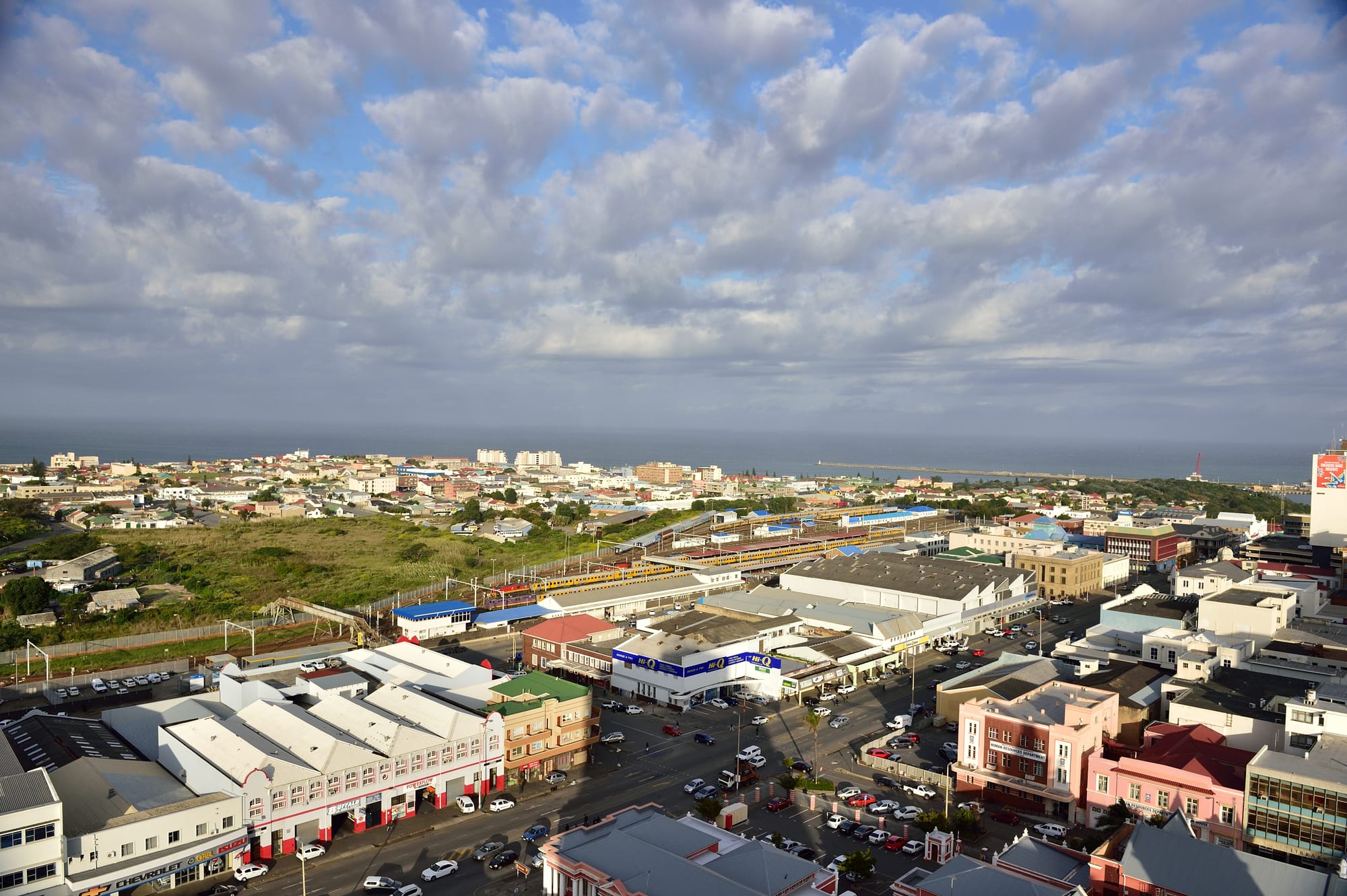
A coastal city of low white buildings and warehouses seen from above, with railway lines crossing the middle and the ocean along the horizon

The Eastern Cape & the Wild Coast, South Africa

East London

East London seen from above the city centre, looking across the railway yards towards the harbour and the Indian Ocean. (South African Tourism from South Africa / Wikimedia Commons · CC BY 2.0)

A port city on the Indian Ocean coast of the Eastern Cape, built where the Buffalo River meets the sea and generally described as South Africa's only river port. Founded at the river mouth in 1836 and officially renamed KuGompo City in 2026, it grew into a harbour and motor-manufacturing town, and is known today for its surf beaches, its museum's coelacanth, and its position at the start of the Wild Coast.

Neighbourhoods

  • The city centre and the Esplanade
    • First-time visitors
    • Historic district
    • Close to public transport

    The old commercial grid above the harbour, with Victorian and early twentieth-century facades along Oxford Street, the city hall and the museum. Below it the Esplanade runs along Orient Beach and the harbour entrance. Busy and workaday by day, and quiet after the shops close.

    Open in Maps
  • Quigney
    • Beaches
    • Budget stays

    The narrow suburb between the centre and the beachfront, laid out on a slope above Eastern Beach. Older flats and guesthouses, corner shops and a mixed, long-settled population; the beach promenade and the surf are a few minutes' walk downhill.

    Open in Maps
  • Vincent and Berea
    • Quiet and residential
    • Best for food
    • Shopping

    The leafy older suburbs on the ridge west of the centre, where most of the city's restaurants, shopping centres and better-known schools are. Streets of 1920s and 1930s houses with deep gardens, and a short drive from both the centre and the beaches.

    Open in Maps
  • Beacon Bay and Gonubie
    • Beaches
    • Families
    • Quiet and residential

    Suburbs spreading north-east across the Nahoon River towards Gonubie, about 20 km out. Modern housing, shopping centres and estuary and beach frontage; the area where much of the city's newer growth has gone, and where many visitors stay for the calmer water.

    Open in Maps
  • Mdantsane
    • Local life
    • Music and sport

    A large township about 15 km inland, formally established in 1963 under apartheid and the second largest township in the Eastern Cape. It has produced a long line of boxing champions and a strong music scene, and is served by its own taxi ranks and the Sisa Dukashe Stadium.

    Open in Maps

Things to do

Beaches and the coast

  • Orient Beachbeach

    The sheltered, netted beach beside the harbour entrance below the Esplanade, with tidal pools and lawns and the easiest swimming in the city.

    Open in Maps
  • Eastern Beachbeach

    A long open sweep of sand below the Quigney, backed by a promenade and grassed banks, and used by surfers and walkers more than by bathers.

    Open in Maps
  • Nahoon Beachbeach

    The city's main surfing beach, at the mouth of the Nahoon River, with a long stretch of sand and the reef break off Nahoon Point at its eastern end.

    Open in Maps
  • Bonza Baybeach

    A quieter beach and estuary at the end of the Nahoon River suburbs, popular with families and for walks at low tide.

    Open in Maps
  • Gonubiebeach

    A seaside suburb about 20 km north-east, with a tidal pool, a boardwalk along the dunes and a river mouth behind the beach.

    Open in Maps

Museums and the old city

  • East London Museummuseum

    The city's natural and cultural history museum, established in 1921 and best known for the type specimen of the coelacanth, a fish thought extinct for millions of years until one was found at the Chalumna River mouth near the city in 1938. Beadwork and maritime galleries fill the rest.

    Open in Maps
  • East London City Halllandmark

    The Victorian civic building on Oxford Street, with its clock tower, at the heart of the old commercial district.

    Open in Maps

Parks and nature

  • Nahoon Point Nature Reservepark

    Dune forest and boardwalks on the headland at the eastern end of Nahoon Beach, where fossilised trackways including three hominid footprints are preserved in the rock.

    Open in Maps
  • The Buffalo River harbourtransit hub

    The port that gave the city its reason to exist, built into the river mouth, where ships are worked within sight of the city centre.

    Open in Maps

Short trips from the city

  • Qonce and the Steve Biko Centremuseum

    The town, formerly King William's Town, beside the Ginsberg township where Steve Biko grew up and is buried in what is now the Steve Biko Garden of Remembrance; a centre there, opened in 2012, tells the story of his life and of Black Consciousness.

    Open in Maps
  • Chintsabeach

    A village either side of the mouth of the Chintsa River, with white sand beaches backed by forested dunes and lagoons, the first of the Wild Coast resorts north of the city.

    Open in Maps
  • Hogsbackattraction

    A mountain village among indigenous forest and waterfalls on the Amathole escarpment, cool and often misty, with walking trails between the peaks.

    Open in Maps

Eat and drink

Long-standing places and food districts in East London. Hours, ratings and directions come from your maps app, always current.

East London classics

  • The harbour and Quigney fish placesneighborhood

    Fish and chips, calamari and prawns are the city's default meal, eaten at the river waterfront and along the beachfront roads.

    Open in Maps
  • Vincent and Beacon Bay restaurantsneighborhood

    Most of the city's sit-down restaurants, coffee shops and steakhouses are in the suburbs on the ridge and out towards Beacon Bay rather than in the centre.

    Open in Maps
  • Mdantsane shisa nyamaneighborhood

    Grill spots where meat is bought by weight from a butchery counter and cooked over coals, eaten with pap and chakalaka — the township's weekend social centre.

    Open in Maps
  • Buffalo City marketsmarket

    Weekend markets around the city sell farm produce, pineapples and citrus from the coastal belt, baked goods and Eastern Cape crafts.

    Open in Maps

Experience East London

History

The Buffalo River mouth was Xhosa country, close to the frontier that the Cape Colony and the Xhosa chiefdoms fought over for a century. John Bailie, one of the 1820 Settlers, surveyed the Buffalo River mouth and founded the town in 1836; it was first known as Port Rex. The British built Fort Glamorgan on the west bank in 1847 and annexed the area to the Cape Colony in the same year, and the place was later renamed London, and then East London, for the British capital. German settlers arrived as the port grew, which is why villages inland are called Berlin and Stutterheim.

The harbour made the town. Engineers spent decades fighting the sandbar at the river mouth, cutting away rock and building breakwaters, and by the early twentieth century East London was shipping wool, maize and hides, with the railway running inland to the Free State goldfields. Industry followed: textile mills, food processing and motor assembly, which became the Mercedes-Benz plant that still anchors the local economy.

Apartheid reshaped the city. Black residents were moved out to Mdantsane, some 15 km inland and formally established in 1963, and the township was later attached to the Ciskei homeland, so that people commuted daily across a nominal international border. Mdantsane became a stronghold of resistance politics, boycotts and boxing. In 2000 the city and its surrounding towns were combined into the Buffalo City municipality, which was upgraded to metropolitan status in 2011, and King William's Town, its inland neighbour, has since been renamed Qonce. In January 2026 the national government approved changing the city's own official name to KuGompo City, after the Gompo Rock on the shore, and the change took effect the following month.

Culture & Customs

East London is a Xhosa city with English, Afrikaans and German-descended threads running through it. isiXhosa, with its click consonants and its clan-name introductions, is heard everywhere, and Xhosa customs — initiation seasons, ceremonies at which an animal is slaughtered, the authority of family elders — shape family life in the townships and the rural districts that feed the city. The old commercial families of the centre and the farming communities inland give the place a settler-town formality that sits alongside it.

Sport is close to an identity. Mdantsane has produced a remarkable run of world boxing champions, and fight nights at the township's halls are a serious local occasion. Rugby and football have strong followings, and the city's surf beaches have supported a board culture since the 1960s; Nahoon reef is known along the whole coast.

Music is the other export. The city and its township have long-standing gospel, jazz and choral traditions, and a hip hop and house scene that draws on Xhosa lyrics. Weekends run to a familiar pattern: shisa nyama grills and beer on Saturday, church and a family lunch on Sunday, and the beachfront full from mid-morning. Manners are unhurried and greeting comes before business, as it does across the province.

Daily Life

About 267,000 people live in East London proper and roughly 755,000 in the Buffalo City metro, which also takes in Qonce, Mdantsane and the surrounding farmland. Mdantsane alone holds a large share of the population, and the commute between it and the city is one of the busiest minibus-taxi corridors in the country.

Motor manufacturing dominates the formal economy. The Mercedes-Benz plant, with its component suppliers, exports vehicles through the port, and the harbour also handles grain, cars and containers. Government offices, the university's local campuses, the hospitals and retail employ many others, and pineapple and dairy farming surrounds the city. Unemployment is nevertheless high, as it is across the Eastern Cape, and many households rely on social grants and on wages sent home from Gauteng and Cape Town.

Daily issues in the city are infrastructural: water supply and treatment, roads, and the interruptions to electricity that have affected South Africa generally. The provincial government's spending and the future of the motor plant dominate local news. The rhythm of the day starts early, with taxis filling before dawn, and the beachfront takes over in the late afternoon, when walkers, joggers and surfers use the cooler hours before an early nightfall in winter.

Food

Seafood is the everyday pleasure. Fish and chips, hake, calamari and prawns are served at the harbour, along the beach roads and at suburban restaurants, and line fishing from the piers and rocks is a common weekend habit. Beef and lamb from the Eastern Cape interior fill the steakhouses, and the braai is the default way to cook anything at home.

Xhosa food is the city's foundation. Umngqusho — samp, the crushed dried maize kernels, slow-cooked with sugar beans — is the staple dish of the province. Umphokoqo, a dry crumbly maize porridge, is eaten with amasi, fermented milk, and inyama yenkomo, beef from a ceremonial slaughter, is served at weddings and ancestral rituals. Umqombothi, the thick home-brewed maize and sorghum beer, belongs to those occasions. In Mdantsane, shisa nyama grills sell meat by weight to be cooked over coals with pap and chakalaka relish, and vetkoek, fried dough with a savoury or sweet filling, is sold from roadside stalls.

The coastal belt around the city is pineapple country, and the fruit turns up fresh, dried and in juice and jam; chicory was long grown to the west, and citrus, avocados and macadamias come from the river valleys. German-descended villages inland keep a tradition of sausage and smoked meat, sold in butcheries across the city.

Planning tools

Budget

East London is one of the cheaper South African cities for visitors. Beachfront and suburban guesthouses cost well below Cape Town prices, seafood and steak are inexpensive, and the beaches, promenades and reserves cost nothing. Prices rise over the December school holidays, when Gauteng families fill the coast. A hire car is the main additional expense.

Daily Budget Midrange
USD 120–250 (guesthouse or hotel, car hire, restaurant meals, a day trip along the coast)
Daily Budget Shoestring
USD 40–70 (backpacker or guesthouse room, self-catering and takeaways, minibus taxis)

Book well ahead for December and Easter, and price a hire car for at least part of the stay — the beaches, museum and suburbs are spread along the coast.

Best Time to Visit

The coast is mild all year. September to April is warmest for swimming, with sea temperatures comfortable from about November to April. Winter, from June to August, brings sunny days, cool nights and the cleanest surf conditions, and the sardine run passes up the coast around that time. The December school holidays are the busiest and priciest weeks.

Suggested Number of Days

One or two nights is the usual length of stay. Three or four suit those using the city as a base for the coast and the mountains inland. Many travellers stop for a single night while changing planes or cars.

First Visit
1–2 days
With Surroundings
3–4 days

Transportation

Most visitors drive. The city spreads for about 20 km along the coast, and its beaches, suburbs and museum are too far apart to link on foot. Minibus taxis run constantly between the centre, Mdantsane and the suburbs, and a municipal bus service covers some routes; ride-hailing apps operate in the city. Long-distance coaches and the airport are both a short drive from the centre.

Keep car doors locked in traffic and park in guarded or paid bays at the beaches; avoid leaving anything visible inside.

Airport & Station Connections

King Phalo Airport, about 10 km west of the centre, has daily flights to Johannesburg and Cape Town; it was renamed from East London Airport in 2021 after a Xhosa king. The N2 runs south-west to Makhanda and Gqeberha, about three hours away, and north-east towards Mthatha and the Wild Coast. Intercity coaches connect with Durban, Gqeberha and Johannesburg, and the port handles cargo rather than passengers.

Walkability

The city centre and the beachfront are walkable by day, and the promenade between Orient Beach and Eastern Beach is the best stretch on foot. Beyond that, distances open up: the suburbs on the ridge, Nahoon and Gonubie all need a vehicle. The centre empties after working hours, and walking there after dark is not advisable.

Safety

East London has the urban crime patterns common to South African cities, with street robbery in and around the centre and the transport ranks, and theft from parked cars at the beaches. The suburbs, the beachfront by day and the main coastal roads are routine for visitors. Rip currents on unguarded beaches are a real risk, and only some beaches are netted against sharks.

Avoid driving after dark, swim only where locals advise, and hike the Wild Coast with a guide or lodge-arranged transfers. Check current official travel advice before travelling.

Climate

A mild, humid subtropical coast with rain in every season and no dry period, moderated year-round by the warm Agulhas Current. In the southern hemisphere summer runs from December to February and winter from June to August, and frost is unknown in the city.

Summer
warm and humid — 22–28°C most days, with afternoon showers and thunder
Winter
mild and often sunny — 8–22°C, with cool nights and warm sea

Local Customs

isiXhosa is the first language of most residents, with English and Afrikaans also widely spoken; a greeting in isiXhosa is appreciated. The city has a long-settled German-descended farming community inland and an older English-speaking commercial community, and place names are being changed steadily to Xhosa forms. Dress is casual, and beachwear stays at the beach.

Tip around 10 per cent in restaurants and a few rand to car guards and petrol attendants, and ask before photographing people, ceremonies or homes.

Common Payment Methods

The currency is the South African rand. Cards and contactless payments are taken by shops, fuel stations, hotels and restaurants, and ATMs are common in the malls and shopping streets. Cash is needed for minibus taxis, car guards, market stalls and small traders.