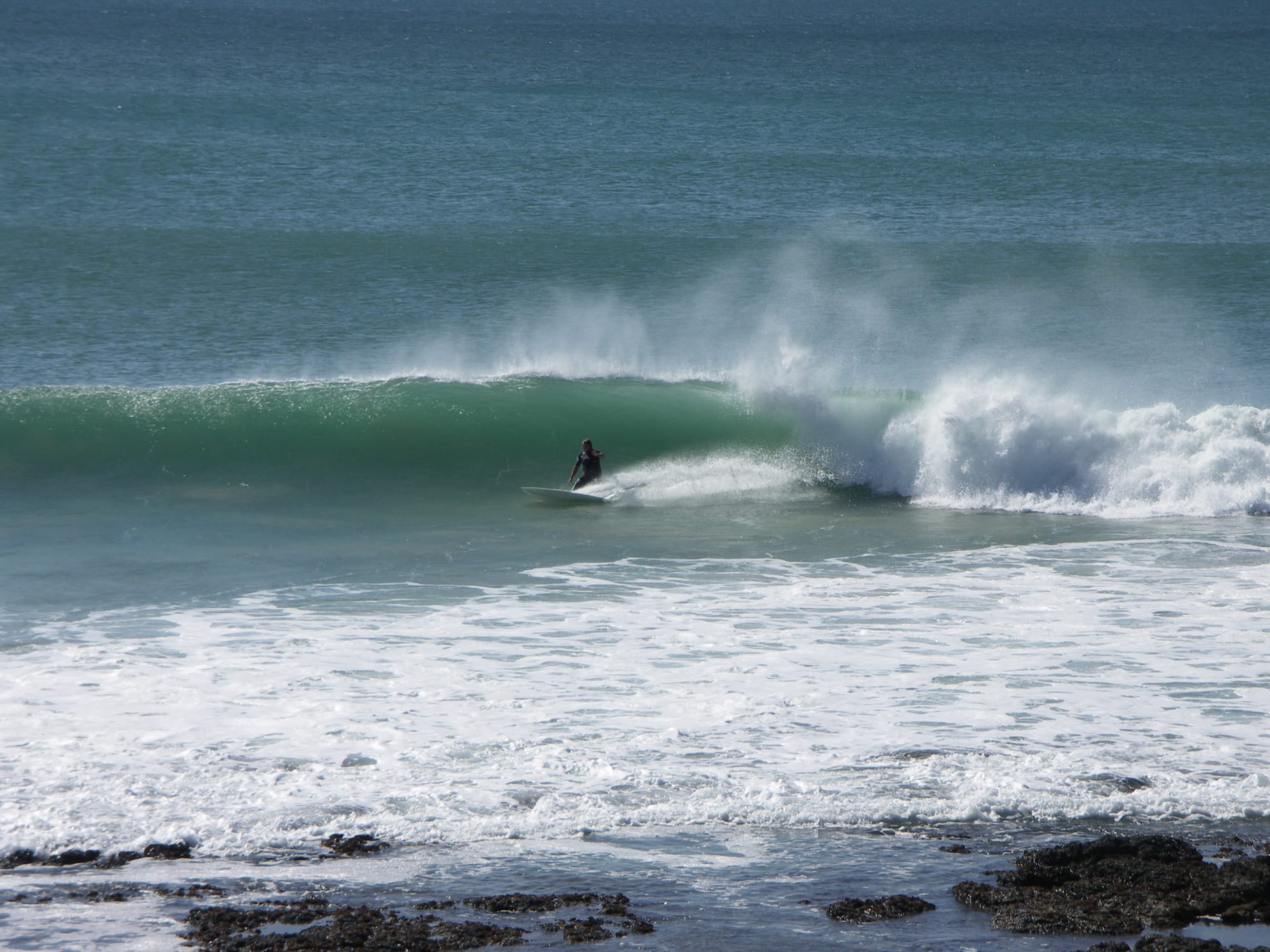
A surfer riding along the face of a hollow green wave that peels towards rocks in the foreground

The Eastern Cape & the Wild Coast, South Africa

Jeffreys Bay

A surfer on the right-hand point break at Supertubes in Jeffreys Bay. (NJR ZA / Wikimedia Commons · CC BY-SA 3.0)

A surfing town on the shore of St Francis Bay in the Eastern Cape, an hour west of Gqeberha. A right-hand point break called Supertubes made its name among surfers in the 1960s and still brings a professional contest each winter. Around it are long dunes, two river estuaries, shell-strewn sand and a sprawl of holiday houses.

Neighbourhoods

  • The centre and Main Beach
    • First-time visitors
    • Beaches
    • Best for food

    The original town above Main Beach, with the tourism office, shops, restaurants and the surf-brand factory stores that draw shoppers off the highway. The beach below is sheltered and the promenade runs along it.

    Open in Maps
  • Supertubes and Pepper Street
    • Surfing
    • Beaches
    • Nightlife

    The rocky point north-east of the centre where the famous wave breaks, backed by guesthouses, backpacker lodges, surf shops and a boardwalk along the dunes. It fills with surfers and spectators whenever a swell arrives.

    Open in Maps
  • Wavecrest and Kabeljous
    • Quiet and residential
    • Walks and viewpoints

    The northern suburbs running out towards the Kabeljous River estuary and its nature reserve, a spread of holiday houses behind the dunes with long, quiet beaches and birdlife on the lagoon.

    Open in Maps
  • Paradise Beach and Aston Bay
    • Beaches
    • Families
    • Quiet and residential

    Two low-rise holiday settlements about 10 km west along the coast at the Seekoei River mouth, almost empty out of season and busy with South African families in December.

    Open in Maps
  • Pellsrus and Tokyo Sexwale
    • Local life

    The older township and informal settlements on the inland side of the town, home to much of the permanent workforce, with taverns, churches, small shops and a strong football culture.

    Open in Maps

Things to do

Surf and beaches

  • Supertubesbeach

    The long right-hand point break that made the town's name, breaking over a reef and rock shelf for 300 m or more and rated the best section of a wave that has made Jeffreys Bay one of the world's most famous surfing destinations.

    Open in Maps
  • Main Beachbeach

    The town's sheltered swimming beach below the centre, with lifeguards in season, gentle surf and a promenade behind it.

    Open in Maps
  • Dolphin Beachbeach

    A broad sandy beach between the centre and the point, used for walking, bodyboarding and beginners' surf lessons.

    Open in Maps
  • Shell beaches at the pointbeach

    The shore around the point is known for the shells washed up on it, which the town is as famous for as for its waves.

    Open in Maps

Rivers, dunes and wildlife

  • Kabeljous estuary and nature reservepark

    The Kabeljous Nature Reserve on the river just north-east of town, with dunes, walking paths and waterbirds on what is counted one of the best-preserved estuaries in the Eastern Cape.

    Open in Maps
  • Seekoei Riverpark

    The Seekoei River Nature Reserve between Aston Bay and Paradise Beach, on the estuary of the Seekoei and Swart rivers, a quiet stretch of water known for its waterbirds.

    Open in Maps
  • Jeffreys Bay Wind Farmlandmark

    A large wind farm on the hills inland from the town, in operation since 2014 and one of the first utility-scale wind projects in South Africa.

    Open in Maps

Short trips along the coast

  • St Francis Bayattraction

    A planned village of white houses under black thatch, built around canals off the Kromme River about 25 km south-west, with the harbour of Port St Francis and its squid boats beside it.

    Open in Maps
  • Cape St Francisattraction

    The headland at the western end of the bay, with clean beaches, the Irma Booysen Floral Reserve and the surf break that The Endless Summer made famous in 1966.

    Open in Maps
  • Seal Point Lighthouselandmark

    The masonry lighthouse on the rocky point at Cape St Francis, begun in 1875 and in operation since July 1878.

    Open in Maps
  • Gqeberhaattraction

    The largest city of the Eastern Cape, about 75 km east, with museums, beaches, an airport and the game reserves of Algoa Bay beyond it.

    Open in Maps

Seasonal events

  • The professional surf contest at SupertubesJuly

    The annual World Surf League event at Supertubes, held in the July winter swell season, which fills the town with surfers and spectators from around the world.

  • Whale and dolphin seasonroughly June to November

    Southern right and humpback whales pass along the coast in the southern winter and spring, and dolphins are seen in the bay through the year.

  • The December holiday seasonmid-December to mid-January

    The town's population multiplies as South African families arrive, with markets, beach events and packed restaurants for a few weeks.

Eat and drink

Long-standing places and food districts in Jeffreys Bay. Hours, ratings and directions come from your maps app, always current.

Jeffreys Bay classics

  • Da Gama Road and the centreneighborhood

    The main road through town and the streets off it hold most of the restaurants and coffee shops, from seafood grills and steakhouses to pizzerias and breakfast cafés.

    Open in Maps
  • The Supertubes cafésneighborhood

    Coffee shops and casual kitchens near the point serve surfers from early morning, with smoothies, burgers and breakfasts overlooking the wave.

    Open in Maps
  • Seafood along the coastneighborhood

    Line fish, calamari and prawns dominate the menus, with squid landed at the harbours of St Francis a regional speciality.

    Open in Maps

Markets

  • Weekend and holiday marketsmarket

    Craft and food markets run in the town and along the coast in the holiday season, selling bread, preserves, biltong, cooked food and local crafts.

    Open in Maps

Experience Jeffreys Bay

History

Khoekhoe herders and, later, trekboer farmers used this stretch of dune and fynbos long before a town existed; the bay itself was named by Portuguese navigators for St Francis. The settlement dates from 1849, when the firm of Jeffrey & Glendinnings opened a store on the shore, and the place took the senior partner's name. For its first century it was a modest fishing and holiday village of a few streets above the beach, known chiefly for the shells that wash up around the point.

Surfing changed everything. The right-hand point break at what became known as Supertubes was found by travelling surfers in the 1960s, and the town appeared in the surf films and magazines that carried the search for perfect waves around the world, most famously in the 1966 film The Endless Summer, which reached the nearby Cape St Francis. Surfers began to arrive from Australia, the United States and Europe, camping in the dunes and then staying, and the point now hosts a World Surf League contest each July.

From the 1970s the town spread along the coast with holiday houses, retirement developments and, later, factory stores for the surf clothing brands that grew up here. The population has increased rapidly since 1994, with the townships inland growing alongside the coastal suburbs, and the municipality has struggled to extend services at the same pace. A wind farm on the hills behind the town, in operation since 2014, added a new industry to a local economy otherwise built on holidays and the sea.

Culture & Customs

Surfing is the town's culture more than its pastime. The point governs the daily routine of a large part of the population: the swell forecast is checked before anything else, board shapers and repairers work from garages and small factories, and surf-clothing labels founded here export worldwide. In July the professional contest brings international competitors and crowds, and the town runs on the rhythm of heats and waiting periods for a week or more.

Away from the water, life is that of an Eastern Cape coastal town. Afrikaans is widely spoken, isiXhosa is the language of the townships inland, and English is common in the visitor economy. Churches are numerous and well attended, rugby and football are followed keenly, and the school year and the December holidays shape the calendar as much as the swells do.

Shell collecting is an older local tradition, the beaches around the point being unusually rich in them, and the town is known for its shells as much as its surf. Craft markets, biltong makers and small food producers work the holiday trade. The gap between the holiday suburbs along the sea and the settlements inland is wide and openly discussed, and community organisations, surf outreach schemes and church groups work across it.

Daily Life

About 27,000 people lived in the town at the 2011 census, with the wider Kouga municipality taking in St Francis Bay, Humansdorp and the farming country behind the coast. That number rises steeply over the December holidays, when holiday houses fill and traffic backs up along the seafront road.

The economy runs on tourism, construction and property, on surf-related manufacturing and retail, and on farming, fishing and the squid industry of the nearby harbours. Seasonal work is the norm in hospitality and building, and unemployment is high, especially among young people in Pellsrus and the settlements inland. Many households depend on grants and on wages sent from larger cities.

The day starts before dawn on the beach, with surfers, walkers and fishermen out early, and the town is quiet by mid-evening outside the holiday weeks. Shops and services cluster along the main road, and residents drive to Humansdorp or Gqeberha for anything larger. Water supply in dry years, the state of roads and municipal services, and the pressure of new development on the dunes and estuaries are the constant local arguments.

Food

Seafood is the mainstay. Line fish such as kob, elf and yellowtail are caught off the rocks and from small boats, calamari and squid landed at the harbours around St Francis are a regional speciality, and hake and chips is the common cheap meal. Prawns, mussels and calamari fill the seafood platters that most restaurants build a menu around, and smoked snoek and fish pâté are sold at the markets.

Inland traditions supply the rest. The braai is the weekend default, with boerewors, lamb chops and sosaties over coals, often followed by potjiekos, the slow stew cooked in a three-legged pot. Biltong and droëwors, air-dried spiced meat, are sold in butcheries and farm stalls, and Karoo lamb appears on steakhouse menus. Xhosa staples — umngqusho, samp and beans, and umphokoqo with soured milk — are the everyday food of the townships, and shisa nyama grills cook meat to order.

Sweet things follow the Cape repertoire: koeksisters, melktert and malva pudding. Coffee shops along the seafront are busy from early morning with surfers, and rooibos, the red bush tea of the Western Cape, is the standard alternative. Craft beer is brewed in the district, and the fortified and table wines of the Eastern Cape and the Klein Karoo turn up on local wine lists alongside those of the Western Cape.

Planning tools

Budget

Jeffreys Bay is inexpensive by South African beach-town standards, with backpacker lodges aimed at surfers and a wide range of self-catering holiday flats. Prices climb over the December holidays and during the surf contest in July. The beaches, the dunes and the estuaries cost nothing, and surf lessons and board hire are the usual extras.

Daily Budget Midrange
USD 110–220 (guesthouse or holiday flat, restaurant meals, hire car, surf lessons)
Daily Budget Shoestring
USD 35–65 (backpacker lodge or self-catering flat, supermarket food, board hire)

Book well ahead for July and for the December holidays, when the town is full; at other times rooms are easy to find at short notice.

Best Time to Visit

Surfers come for the winter swells from about May to September, when the waves at the point are at their best and the weather is cool and often clear. Swimmers and families prefer the warmer months from November to April, though December and early January are crowded. Whales pass along the coast in winter and spring.

Suggested Number of Days

Two days cover the beaches, the point and the estuaries. Three or four suit anyone adding the coast to the south-west or using the town as a base between the Garden Route and the city. Surf conditions are what usually lengthen a stay.

First Visit
2 days
With Surroundings
3–4 days

Transportation

Most visitors arrive by car, and the town is spread along several kilometres of coast, so a car or a bicycle helps. The centre, the point and the beaches between them can be covered on foot along the promenade and the dune boardwalks. Minibus taxis serve residents, and ride-hailing is limited compared with the city.

Driving is on the left; take care crossing the N2 slip roads outside town, and park in busy, overlooked places at the surf spots.

Airport & Station Connections

The town lies just off the N2 about 75 km west of Gqeberha, whose airport has flights from Johannesburg, Cape Town and Durban and is roughly an hour away by road. Cape Town is some 750 km west along the Garden Route. Intercity coaches on the Cape Town–Gqeberha route stop here, and shuttle services run from the airport.

Walkability

The seafront is the walkable part: a promenade and boardwalks link the centre, Dolphin Beach and Supertubes, and the beaches themselves are hard sand at low tide and good for long walks. The residential suburbs behind spread far inland with few pavements, and Paradise Beach and Aston Bay are too far to reach on foot.

Safety

The town is quieter than the nearby cities, but break-ins at parked cars near the surf spots and beach paths, and opportunistic theft of unattended belongings, are the common problems, along with burglaries in empty holiday houses. In the sea, strong currents, a rocky shelf at the point and the presence of sharks are the risks surfers and swimmers weigh.

Violent crime rates are high, but most of it is concentrated in areas visitors do not go; the main tourist routes — Cape Town centre, the Winelands, the Garden Route, Kruger and the private reserves — are heavily travelled and generally fine with sensible precautions. Leave nothing in a parked car at the beach, avoid the dune paths after dark, and swim at lifeguarded beaches rather than at the point. Check current official travel advice before travelling.

Climate

Mild and maritime, with rain spread through the year and persistent wind off the sea. In the southern hemisphere summer runs from December to February and winter from June to August; frost does not occur on the coast and the water stays cool, so surfers wear wetsuits for much of the year.

Summer
warm and breezy, roughly 18–27°C, with humid spells and strong afternoon wind
Winter
mild, roughly 9–21°C, sunny between cold fronts that bring rain and the best swells

Local Customs

Afrikaans and isiXhosa are the main home languages, with English used widely in the tourist trade. The town is informal, and surfing sets the tone: early mornings, casual dress and conversation about conditions. In the water, a local etiquette of waiting a turn and not dropping in on another surfer is taken seriously at the point.

Tip about 10–15 per cent in restaurants and a few rand to car guards and petrol attendants, ask before photographing people, and keep swimwear for the beach rather than the shops.

Common Payment Methods

The currency is the South African rand (ZAR). Cards and contactless payment are accepted in shops, restaurants, surf shops and fuel stations, and cash machines are in the shopping centres. Small notes are useful for car guards, market stalls and informal traders.