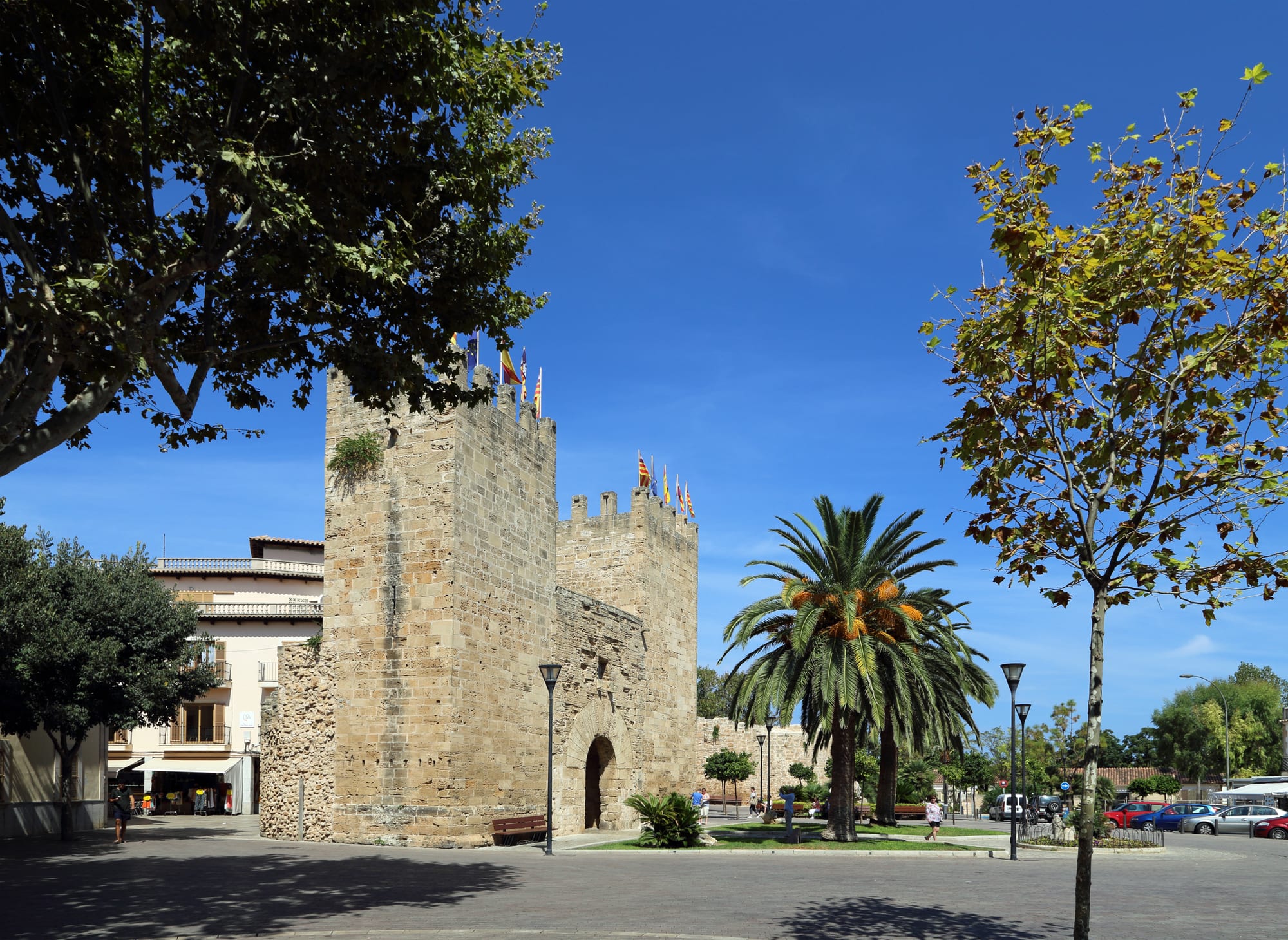
A medieval stone gateway with two crenellated towers and flags, palm trees and a paved square under a deep blue sky

The Balearic Islands, Spain

Alcúdia

The Porta del Moll, one of the surviving gates in Alcúdia's medieval walls, beside Plaça de Carles V. (Marc Ryckaert / Wikimedia Commons · CC BY 3.0)

A town on a small peninsula between the bays of Pollença and Alcúdia in the north of Mallorca. Founded in 1298 beside the ruins of the Roman city of Pollentia, it keeps its medieval walls almost complete, while its port and a sandy beach about 14 kilometres long have made it the main resort of the island's north.

Neighbourhoods

  • The old town
    • First-time visitors
    • Historic district

    The walled town laid out in 1298, whose street plan survives almost unchanged, with houses going back to the 13th century. It is pedestrianised, has several restaurants and bistros inside the walls and fills on Sunday and Tuesday mornings for the market by the Porta del Moll.

    Open in Maps
  • Port d'Alcúdia
    • Families
    • Seafront
    • Nightlife

    The harbour on the bay of Alcúdia, which grew from the 1970s into a major resort, with a leisure marina ringed by restaurants and bars, a ferry terminal and the start of the long beach.

    Open in Maps
  • Platja d'Alcúdia
    • Beaches
    • Package holidays

    The hotel strip along the sandy beach running south towards Platja de Muro and Can Picafort, where most of the area's hotels stand.

    Open in Maps
  • Alcanada
    • Quiet and residential
    • Golf

    A traditional summer holiday area on the headland east of the port, with a shore of rocks rather than sand, a golf course and a small island with a lighthouse.

    Open in Maps

Things to do

The walled town

  • City wallslandmark

    Walls built between 1298 and 1362, with a walkway along the top that runs almost all the way round the town.

    Open in Maps
  • Porta del Molllandmark

    One of the surviving city gates, two towers set around an entrance through the walls.

    Open in Maps
  • Church of Sant Jaumelandmark

    The parish church founded in 1302 and built into the line of the walls so that it doubled as a watchtower, with a museum of religious art.

    Open in Maps

Roman Alcúdia

  • Pollentialandmark

    The Roman city just outside the walls, said to have been founded in 123 BC, with a residential quarter, the forum and a small theatre; finds are shown in the Museu Monogràfic beside Sant Jaume.

    Open in Maps

Beaches, nature and viewpoints

  • Alcúdia beachbeach

    A sandy bay about 14 kilometres long running from the port to Can Picafort, with coves to the north and west such as the one facing the islet of S'Illot.

    Open in Maps
  • S'Albufera de Mallorcapark

    The largest and most important wetland in the Balearic Islands, a nature reserve behind the beach at Platja de Muro, popular with birdwatchers.

    Open in Maps
  • Ermita de la Victòrialandmark

    A baroque church on the headland north-east of the town, built as a watchtower in 1679, home of the image of the town's patron, the Virgin of Victory.

    Open in Maps
  • Talaia d'Alcúdiaviewpoint

    The peak of the headland north-east of the town, above the hermitage of the Victòria.

    Open in Maps
  • Alcanada Lighthouselandmark

    A lighthouse completed in 1861 on a small island off Alcanada, automated in 1960.

    Open in Maps

Short trips from the town

  • Pollençaattraction

    The inland town founded by people who left Roman Pollentia for a better defended site, about six kilometres from its own port.

    Open in Maps
  • Cap de Formentorviewpoint

    The northernmost point of Mallorca, at the tip of the Formentor peninsula across the bay of Pollença.

    Open in Maps

Seasonal events

  • Fira de la SípiaApril

    A nautical fair built around the cuttlefish.

  • Sant PereJune

    The feast of Saint Peter on 29 June, patron of Port d'Alcúdia.

  • Mare de Déu de la Victòriaearly July

    A pilgrimage on 1 and 2 July to the hermitage of the Virgin of Victory, patron of Alcúdia.

  • Festes de Sant JaumeJuly

    Nine days of festivities for the town's patron saint, with streets decorated by theme, a Night of the Romans with locals in Roman dress, theatre, concerts and a closing night of fireworks and music by the old walls.

  • Alcúdia Jazz Festivallate August to September

    A month of jazz that begins at the end of August.

  • Agricultural fairearly October

    An autumn fair celebrating the farming of the area.

Eat and drink

Long-standing places and food districts in Alcúdia. Hours, ratings and directions come from your maps app, always current.

Alcúdia classics

  • Old town restaurantsneighborhood

    Several restaurants and bistros inside the walls.

    Open in Maps
  • Port d'Alcúdia marinaneighborhood

    Most of the port's restaurants are around the leisure marina, and most open only in the tourist season.

    Open in Maps

Markets

  • Alcúdia marketmarket

    The twice-weekly market held all year beside the Porta del Moll on Sunday and Tuesday mornings.

    Open in Maps

Experience Alcúdia

History

People lived here from the Bronze Age, but the town's recorded history begins with the Romans, who landed on the beaches of the bay when they conquered Mallorca in 123 BC. They founded Pollentia on this neck of land between two bays; it became a port for Mediterranean trade, while Palma served Africa and Hispania. When Roman power faded, Pollentia was attacked by pirates and several times by the Vandals, until its people abandoned it for a better protected site inland, the town that became Pollença.

The name Alcúdia comes from the Arabic for "on the hill", after a Muslim farmstead near the Roman ruins. James I of Aragon took the area in 1229, and in 1298 James II bought the farmstead and founded a new town, with a church, a cemetery, a priests' house and a square laid out in the same year. Its walls, begun at the same time, were finished in 1362 in the reign of Peter IV, protecting both the town and the north of the island. During the Black Death of 1348–50 the disease reached the port, and nobles and wealthy Mallorcans took refuge behind the walls.

Pirate attacks in the 16th century made the town's population shrink; in 1551 a Turkish landing at Cap des Pinar was beaten off by a local captain with 150 men. A second, outer wall was planned in 1598 and later demolished. A new harbour, decided in 1779, saved the town's economy, though it stayed small and poor. The first tourists came in the 1920s; from the early 1970s tourism took over, and within fifteen years the port had become a major European resort.

Culture & Customs

Alcúdia's culture centres on its walled town and its festivals. The patron festival of Sant Jaume runs for nine days in July: each street chooses a theme for its decorations, there are outdoor theatre performances, sports tournaments and exhibitions, and on the Night of the Romans locals fill the streets in ancient Roman dress. It ends with fireworks and a concert by the old walls. In early July comes the pilgrimage to the hermitage of the Virgin of Victory on the headland, and on 29 June Port d'Alcúdia honours its patron, Saint Peter.

The most solemn tradition is the Triennial of Sant Crist, held every three years, when townspeople walk barefoot and in silence through the streets for several hours. It dates back to 1507, when, according to tradition, an image of Christ sweated blood and water and ended a drought. Other celebrations include a summer jazz festival lasting a month, the cuttlefish fair in April, an agricultural fair in October, and summer evenings of dramatised tours of the old town and plays in the Roman theatre.

Mallorcan Catalan is the language of daily life. The port has become a venue for international sport, including an Ironman triathlon, beach volleyball and beach rugby, and the local football club, UD Alcúdia, plays at the small Els Arcs ground.

Daily Life

About 21,900 people lived in the municipality in 2025, in the old town, the port and the resorts strung along the bay, including Mal Pas-Bonaire. The population rises sharply in summer, when the beach strip and the port's hotels and apartments are full.

Tourism is almost the whole economy. After the building boom of the 1970s and 1980s, the 1990s brought regulations to raise the quality of the resort, and the old town was preserved and pedestrianised, becoming one of the most visited villages in Mallorca. The port mainly handles passenger ferries, but also some bulk cargo and gas carriers.

The year divides sharply into seasons. From spring to autumn the restaurants of the port and the beach strip are busy; most of the port's restaurants open only in the tourist season. In winter many of them close, and life returns to the old town, its markets on Sunday and Tuesday mornings and its squares.

Food

Alcúdia's cooking is Mallorcan, and the sea plays a large part: the town holds a fair each April built around the cuttlefish, and most of the port's restaurants are around the marina. Fish and seafood feature prominently in Balearic cooking, from arròs de peix, rice cooked in a fish broth with pieces of fish, to frita de calamar, fried squid with potatoes, and baked fish such as grouper.

From the land come tombet, layers of fried potatoes, aubergines and red peppers, found in almost every local restaurant and often served beside fish or meat; sobrassada, the island's raw cured pork sausage seasoned with paprika; and arròs brut, saffron rice cooked with chicken, pork and vegetables. Sopes mallorquines are made of vegetables, broth and slices of bread.

The bakeries sell the ensaïmada, a spiral pastry made with saïm, a reduced pork lard, and dusted with sugar, and coques, flat breads similar to pizza but without cheese. Olive oil is the everyday cooking fat, and the island's red wines come from the Binissalem and Pla i Llevant areas. The Sunday and Tuesday market beside the Porta del Moll is the place to find local produce.

Planning tools

Budget

Alcúdia is one of Mallorca's main package-holiday areas, so the cost of a stay depends heavily on the season: rooms on the beach strip are dear in July and August and much cheaper in spring and autumn, when many hotels close or reduce. The old town and the beach cost nothing, and island buses are cheap.

Daily Budget Midrange
USD 180–340 (mid-range beach hotel, restaurant dinners, Pollentia entry, bike or car hire)
Daily Budget Shoestring
USD 80–130 (simple guesthouse or apartment, bakery and menú del día meals, island buses)

Book summer stays well ahead and visit in May, June or September for warm sea and lower prices.

Best Time to Visit

May, June and September are warm without the August crowds, and the Sant Jaume festivities fill July. High summer is hot and very busy along the beach. Spring and autumn suit walking on the headland and birdwatching at S'Albufera, and many resort businesses close in winter.

Suggested Number of Days

The walled town and the Roman ruins can be seen in a day or two. Most visitors come for a beach holiday of a week, and four days or more leave time for the surrounding nature reserves, headlands and towns of the north.

First Visit
1–2 days
With Surroundings
4–7 days

Transportation

The old town is compact and car-free. Local buses link it with the port, the beach strip, Alcanada and Can Picafort, and others run to Pollença and the east coast. Bikes are a good way to reach S'Albufera, where some trails are long. A hire car helps for the headlands and the mountains.

The fast bus from Palma cannot be used for short local hops; take the local lines between the town, port and beach.

Airport & Station Connections

Alcúdia is about 55 kilometres north-east of Palma by a good highway. Island buses from Palma take about an hour via Inca. Palma de Mallorca Airport is the arrival point for most visitors. From the port, ferries sail to Ciutadella on Menorca and to the mainland.

Walkability

The old town is small, flat and pedestrianised, and the walkway on the walls gives an easy circuit. Pollentia is just outside the gates. The port is a walk or short bus ride away, and the beach strip stretches for kilometres beyond it, best covered by bus or bike.

Safety

Spain is a safe country with low violent crime. Alcúdia is a family resort, and the usual concerns are bag theft on the beach and at the markets, rough seas and the strong summer sun.

Respect red flags on the beach, keep valuables out of sight on the sand, and carry water on the headland trails. Check current official travel advice before travelling.

Climate

Mediterranean, with short, cool and damp winters and long, warm summers, softened by sea breezes. Summer days can pass 35°C, and the highest temperatures recorded are just below 40°C.

Summer
long and hot — July and August often pass 35°C, tempered by sea breezes
Winter
short and cool — January and February around 15°C

Local Customs

Mallorcan Catalan is the local language, though Spanish, English and German are heard constantly in the resort. Religious tradition remains strong: every three years the Triennial of Sant Crist sees townspeople walk barefoot in silent procession for hours. Spanish meal times apply in the old town.

Dress modestly in the churches, and respect the silence of religious processions.

Common Payment Methods

The currency is the euro. Cards and contactless payments are widely accepted in shops, bars and restaurants; a little cash is useful at the market. ATMs are found in the old town, the port and along the beach strip.