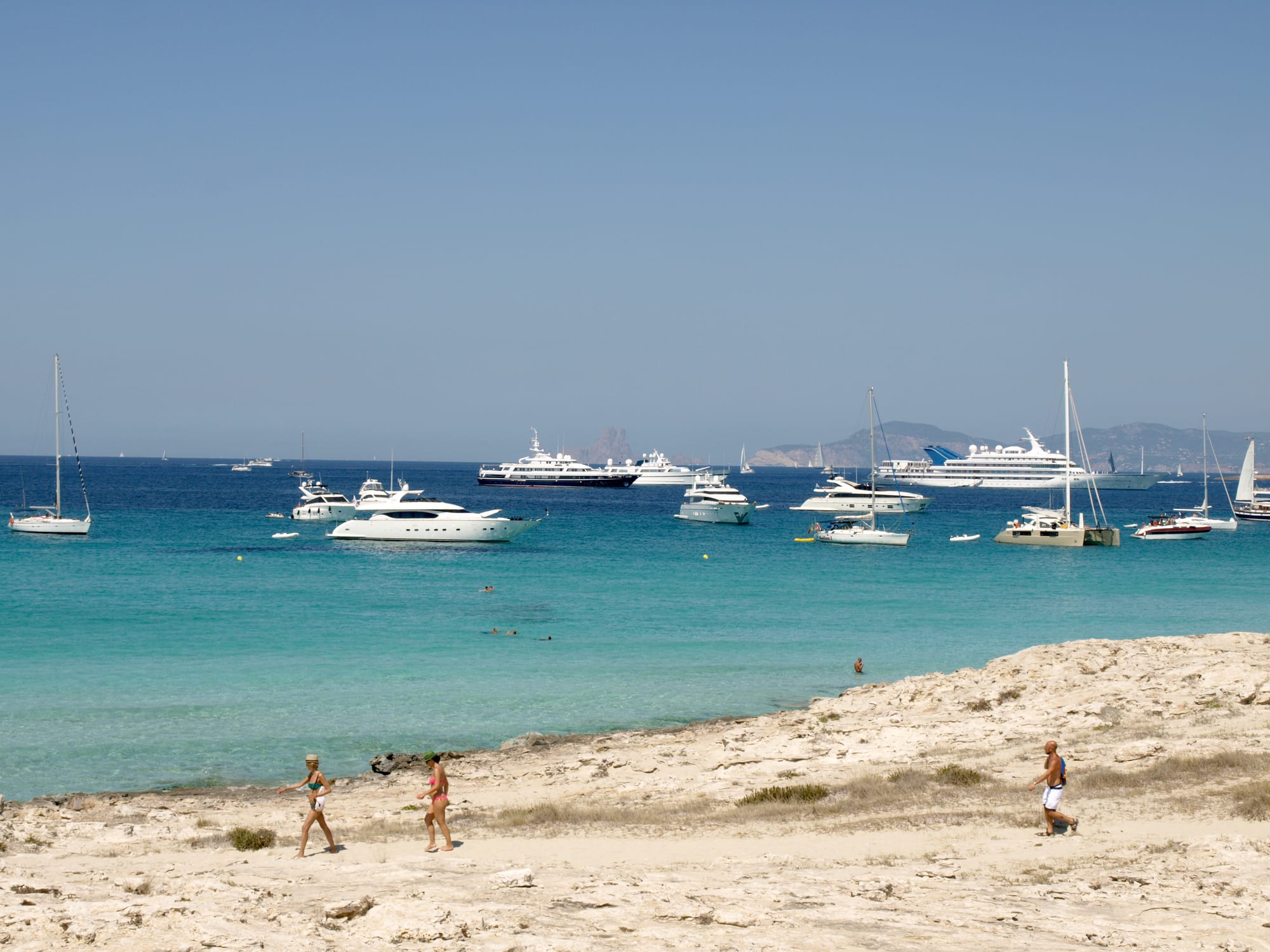
Turquoise shallow water off the pale rocky shore of Ses Illetes, with yachts at anchor and Ibiza's hills on the horizon

The Balearic Islands, Spain

Formentera

Yachts anchored off Platja de ses Illetes in the north of Formentera, with Ibiza beyond. (MrPepanos / Wikimedia Commons · CC BY 3.0)

The smallest and most southerly of the Pityusic Islands, a low, flat island about 19 km long lying just south of Ibiza and reached only by sea. Abandoned for three centuries because of pirate raids and resettled from Ibiza in the 1690s, it drew hippies from the 1960s and is now known for pale beaches, clear shallow water and a quiet pace outside high summer.

Neighbourhoods

  • La Savina
    • Ferries
    • Close to the northern beaches

    The port village where the ferries from Ibiza arrive. Restaurants line the harbour, and buses leave from the port for the villages and the main beaches.

    Open in Maps
  • Sant Francesc Xavier
    • Local life
    • Shops and services

    The island's capital and largest village, where the public administration is based, around its 18th-century church. It is the most lived-in place on the island, with shops, cafés and a cultural centre on its history.

    Open in Maps
  • Es Pujols
    • Beaches
    • Restaurants and bars

    The island's most important tourist settlement, with a town beach, restaurants and bars, and small naturist beaches nearby.

    Open in Maps
  • Sant Ferran de ses Roques
    • Central base
    • Quiet and residential

    A village in the middle of the island at the crossroads of the main road, between Sant Francesc Xavier, Es Pujols and El Pilar de la Mola, handy for reaching every coast.

    Open in Maps
  • El Pilar de la Mola
    • Views
    • Quiet and residential

    A village on the high La Mola peninsula at the island's eastern end, the highest ground on Formentera, with wide views back across the island and a road out to the lighthouse.

    Open in Maps

Things to do

Beaches

  • Platja de ses Illetesbeach

    A beach in the north of the island with plenty of sand and little swell, one of the beaches most frequented by families with children.

    Open in Maps
  • Platja de Llevantbeach

    One of the island's quieter beaches.

    Open in Maps
  • Platja de Migjornbeach

    The long southern beach, with stretches free of hotels and beach bars along its length.

    Open in Maps
  • Cala Saonabeach

    A sandy cove with little swell, popular with families, backed by pine woods.

    Open in Maps
  • S'Espalmadorbeach

    A small, privately owned and uninhabited island just north of Formentera, separated from it by a shallow sandbar and visited by yachts and canoeists; its mud bath lies in a protected nature reserve and may only be looked at.

    Open in Maps

Villages, lighthouses and history

  • Far de la Molaviewpoint

    The lighthouse on a 158-metre cliff at the highest point of Formentera, on the La Mola peninsula; Bob Dylan once slept there.

    Open in Maps
  • Far des Cap de Barbariaviewpoint

    The lighthouse at the island's south-western point, with the island's most visited sea cave nearby; it appears in the film Sex and Lucía.

    Open in Maps
  • Ca na Costalandmark

    A megalithic tomb from the island's earliest settlement, one of the archaeological sites of the period between about 2000 and 1600 BC.

    Open in Maps
  • Estany Pudent and Estany des Peixpark

    Two large lagoons, the Estany Pudent in the north of the island and the Estany des Peix, with cycle tracks and green lanes around them; the north of the Estany des Peix is a boat harbour.

    Open in Maps

Seasonal events

  • Formentera Jazz Festivalearly June

    An annual jazz festival with musicians from the island and abroad.

  • Festes de Sant Jaumearound 25 July

    The island's main festival, in honour of Saint James, its patron saint.

Eat and drink

Long-standing places and food districts in Formentera. Hours, ratings and directions come from your maps app, always current.

Food districts

  • La Savina harbourneighborhood

    Restaurants around the port where the ferries come in.

    Open in Maps
  • Es Pujolsneighborhood

    The island's main tourist settlement, with a cluster of restaurants and bars.

    Open in Maps

Beach bars

  • Blue Barcafe

    A bar above Migjorn beach that has been open since the 1960s, known for its sea views at sunset.

    Open in Maps
  • Migjorn beach barsneighborhood

    Small bars and restaurants reached by side roads off the La Mola road along the long southern beach.

    Open in Maps

Experience Formentera

History

The island's name is said to come from the Latin frumentarium, a granary. People lived here as early as about 2000–1600 BC, leaving sites such as the megalithic tomb of Ca na Costa and remains at Cap de Barbaria and the Cova des Fum. Carthaginians and then Romans held the island, followed by Vandals, Byzantines, Visigoths and Arabs, and in 1109 it was devastated by the Norwegian king Sigurd I on his crusade. After the conquest by James I it passed to the Crown of Aragon and the Kingdom of Majorca.

From 1403 the threat of Barbary pirates made the island effectively uninhabitable, and for most of the next three centuries it was only occasionally occupied by people from Ibiza. Resettlement began for good in 1695, when the island was granted to two Ibizans in payment for their services, and coastal watchtowers protected the new settlers. There were about 400 inhabitants by the mid-18th century and nearly 2,000 by the end of the 19th.

Change came late. The island had no electricity until 1968, but from the end of the 1960s it became a destination for hippies, a movement that left a lasting mark on its character; Joni Mitchell wrote the album Blue here, and King Crimson named a song after it. After long campaigning Formentera won its own island council, separate from Ibiza's, in 2007, and a constitutional reform in 2026 gave it a senator of its own.

Culture & Customs

The island's identity is bound up with its decades as a hippie refuge. The hippie movement that arrived at the end of the 1960s left a deep mark on its character, and nude sunbathing is accepted on most beaches. Writers and musicians have long been drawn to it: Jules Verne wrote of it in his novels, Pink Floyd, King Crimson and Gilberto Gil sang about it, and Bob Dylan is said to have slept at the Far de la Mola. The lighthouse at Cap de Barbaria is central to Julio Medem's film Sex and Lucía, which was filmed on the island.

The islanders speak a local Ibizan variety of Balearic Catalan alongside Spanish, though in summer Italian, English, German, French and Dutch are all heard widely. The year's main festival is held around 25 July for Saint James, the island's patron, and the Formentera Jazz Festival brings local and international musicians in early June. Cultural sights are few — some megalithic sites, watchtowers, four Martello towers, the 18th-century church of Sant Francesc Xavier and a small ethnological museum — and life centres on the sea, the beaches and village squares.

Daily Life

About 11,700 people were registered on the island in 2025, making it the least populated of the Balearic Islands. Sant Francesc Xavier, with about 6,400, holds the public administration, followed by Sant Ferran de ses Roques and El Pilar de la Mola. The island forms a single municipality, also called Formentera, run by its own island council.

Tourism is by far the largest part of the economy, and the island depends heavily on the money made in July and August, when it receives huge numbers of visitors. Some islanders still make a living from small-scale traditional fishing.

Pressure on the island's fragile dunes and waters has led to stricter management: boardwalks protect regenerating dunes, areas of sea are protected for their plants and fish, and the number of vehicles is limited in summer. In winter the island empties, the buses are reduced to a single route, and daily life returns to a small, local scale.

Food

Formentera's cooking belongs to the Balearic tradition, in which fish and seafood feature prominently on islands surrounded by the sea. The best-known sweet is the flaó, a cheese tart claimed by Majorca, Ibiza and Formentera; the Ibiza and Formentera version is round and filled with sheep's or goat's cottage cheese, eggs and sugar and flavoured with peppermint and aniseed. Sobrassada, the raw cured sausage of the Balearic Islands made with ground pork, paprika and salt, is eaten across the island.

Some islanders still fish on a small, traditional scale, and restaurants line the harbour at La Savina. The island's very name is said to come from the Latin for a granary.

Eating out is relaxed. The island has many small restaurants varying in price and style, with clusters around the port, at Es Pujols and along the southern beach of Migjorn, where bars such as the Blue Bar, open since the 1960s, are known for sunset views.

Planning tools

Budget

One of the most expensive places in the Balearics in July and August, when rooms, scooters and beach restaurants are at their dearest and hotels are booked far ahead. The ferry from Ibiza is an added daily cost for anyone staying on Ibiza.

Daily Budget Midrange
USD 190–380 (mid-range hotel, restaurant dinners, scooter hire, the ferry from Ibiza)
Daily Budget Shoestring
USD 90–150 (simple hostal or apartment, bakery and supermarket meals, island buses or a bicycle)

May, June, September and early October are cheaper and calmer; camping is forbidden on the island.

Best Time to Visit

Late spring and early autumn, when the sea is warm and the island is quieter. July and August bring huge numbers of visitors, mostly from Italy, and the island's festival around 25 July. Winter is very quiet, with a reduced bus service and many places closed.

Suggested Number of Days

Many visitors come for a single day by ferry from Ibiza. Two days allow time for both ends of the island, and three to five suit a beach stay. Wind direction matters: on a rough day some beaches are calm and others are not, so a longer stay gives more choice.

First Visit
1–2 days
With Surroundings
3–5 days

Transportation

The island is flat, and many people rent a moped or a bicycle; there are dedicated cycle tracks and green lanes in many places, and paved roads reach every part of the island. In summer several bus routes link the port with the villages and the main beaches; in winter only one remains. Cars can be hired at the port, but the number of vehicles on the island is limited in summer.

Visiting vehicles need a permit from June to September, so check before bringing a car on the ferry; buses stop at different stops depending on the route.

Airport & Station Connections

There is no airport. Visitors fly to Ibiza and take a ferry from Ibiza port, about half an hour on fast catamarans that sail very frequently in high season. All passenger ferries land at La Savina, and in summer there are direct ferries from Dénia on the Spanish mainland.

Walkability

The villages are small and easy on foot, but they are spread across an island 19 km long, so walking between them takes time in the heat. Most visitors combine short walks with a bicycle, scooter or bus. Sandy paths and boardwalks lead to the beaches, and the routes around the lagoons and out to the capes are popular with cyclists.

Safety

Spain is a safe country with low violent crime. Crime on Formentera is low, and the most common problem is petty theft of small items such as jewellery and documents. The strong sun, wind-driven waves on exposed beaches and traffic on narrow roads are the main hazards.

Use sun protection, choose beaches according to the wind, and take care on scooters on the island's roads. Check current official travel advice before travelling.

Climate

Semi-arid and mild, with hot, very dry summers and warm, dry winters. The island is so flat that rain is scarce — about 370–420 mm a year — and temperatures are fairly even, averaging about 18.6°C over the year with close to 2,900 hours of sunshine.

Summer
hot and very dry — in nearby Ibiza town, August averages about 26°C, with daily highs around 30°C
Winter
mild and mostly dry — in nearby Ibiza town, January averages about 12°C

Local Customs

Nude sunbathing is allowed on most of the island's beaches and is common, with clothing optional the general rule, though the town beach at Es Pujols is an exception in peak season. A local Ibizan variety of Catalan is spoken on the island, and Spanish is spoken by everyone; in summer Italian is heard more than any other language.

Stay on the boardwalks through the dunes, leave the protected mud of S'Espalmador alone, and dress more fully away from the beach.

Common Payment Methods

The currency is the euro. Cards are widely accepted in shops, hotels and restaurants, and there are ATMs in the main villages. Cash is handy for the buses and small beach bars.