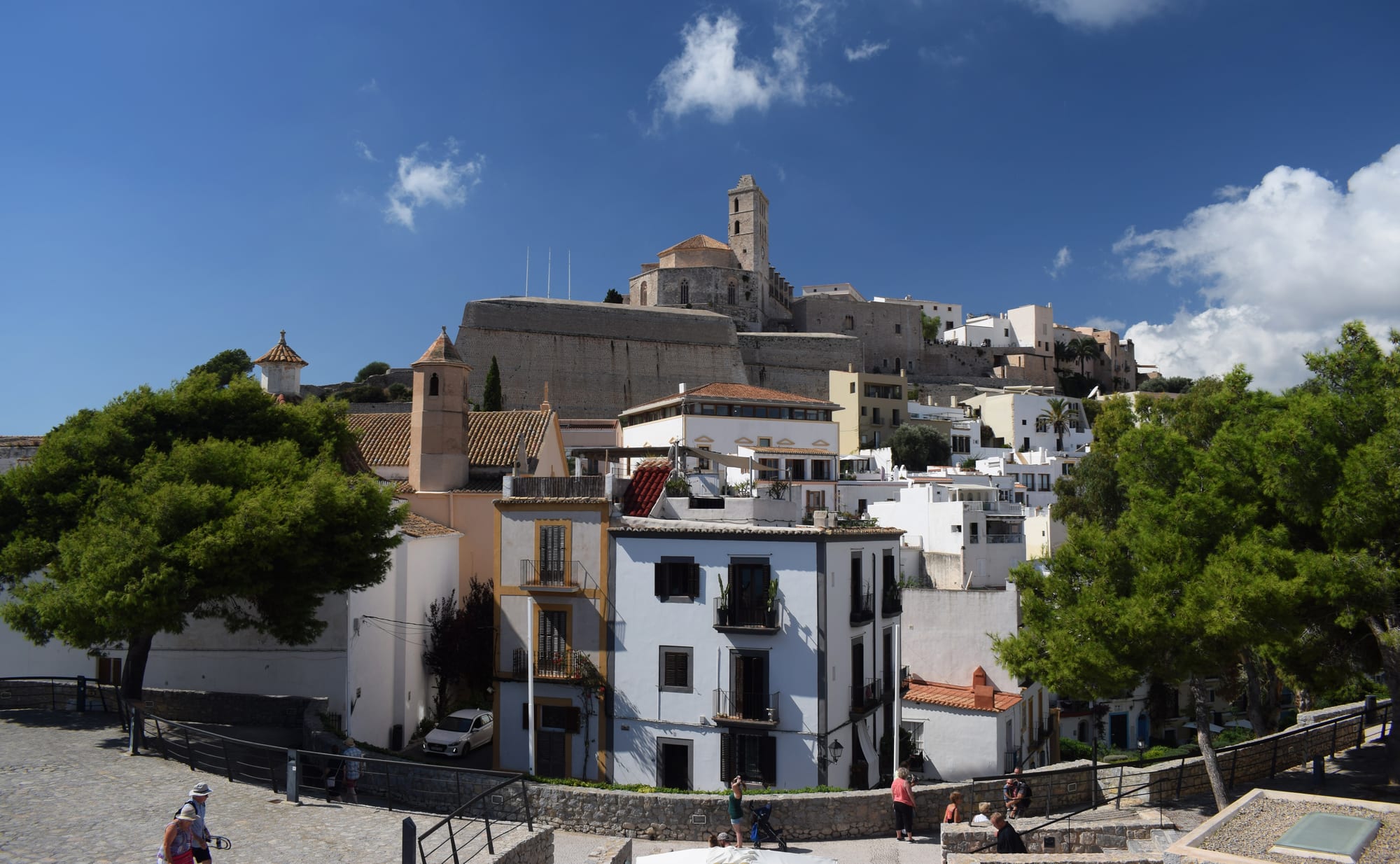
White and pastel houses climbing a hill to massive stone walls and a church bell tower under a blue sky

The Balearic Islands, Spain

Ibiza Town

Houses below the walls of Dalt Vila, with the cathedral tower at the top of the old town. (Mark from Brighton / Wikimedia Commons · CC BY 2.0)

The capital of the island of Ibiza, on its south-east coast, founded by Phoenicians in the 7th century BC. Its walled hilltop old town, Dalt Vila, and the Punic necropolis of Puig des Molins are UNESCO World Heritage, while the harbour below and the nearby clubs have made it one of Europe's best-known nightlife destinations.

Neighbourhoods

  • Dalt Vila
    • First-time visitors
    • Historic district

    The Upper Town on its hill above the harbour, enclosed by 16th-century Renaissance walls and climbed by steep lanes to the cathedral at the top. Bastions, museums, old mansions and the town hall in a former Dominican convent fill the quiet streets inside the walls.

    Open in Maps
  • Sa Penya and the port
    • Nightlife
    • Shopping
    • Views of the old town

    The harbour quarter below the walls of Dalt Vila, where the architect and painter Erwin Broner built his house in 1960. The ferry terminal and marina are a short walk away.

    Open in Maps
  • The Eixample
    • Local life
    • Close to public transport

    The Extension, the modern part of the city beyond the old town, with its shopping streets and offices and the island's main bus stops along Avinguda d'Isidor Macabich.

    Open in Maps
  • Ses Figueretes
    • Beaches
    • Budget-friendly

    A beach district about a kilometre from the centre, with a string of small beaches between rock jetties and a promenade of bars and restaurants, within walking distance of Dalt Vila.

    Open in Maps
  • Platja d'en Bossa
    • Beaches
    • Nightlife

    A major holiday resort about three kilometres south of the city in the neighbouring municipality of Sant Josep, built along a long sandy beach and known for its many bars and nightclubs.

    Open in Maps

Things to do

Dalt Vila and its monuments

  • Ibiza Cathedrallandmark

    The cathedral of Our Lady of the Snows at the top of Dalt Vila, a parish church founded after the conquest of 1235, built in Catalan Gothic style and remodelled in the 18th century, a cathedral since 1817.

    Open in Maps
  • Baluard de Sant Jaumemuseum

    One of the bastions of the walls, holding a hands-on exhibition of military technology from the 16th to the 18th centuries.

    Open in Maps
  • Ibiza and Formentera Archaeological Museummuseum

    Three thousand years of the two islands' history, from the first settlers to the Catalan conquest of 1235, in a museum opened in 1907 inside Dalt Vila.

    Open in Maps
  • Museu Pugetmuseum

    A museum in Dalt Vila showing about 130 paintings by Narcís Puget Viñas and his son Narcís Puget Riquer.

    Open in Maps
  • Museum of Contemporary Artmuseum

    The city's museum of modern and contemporary art, the MACE, on Ronda de Narcís Puget in the old town.

    Open in Maps

Ancient Ibiza

  • Puig des Molinsmuseum

    The hill of windmills just outside the old town, chosen by the Phoenician founders as their burial ground and holding one of the world's best-preserved necropolises, with around 3,000 tombs of the Punic era and a museum opened in 1966.

    Open in Maps
  • Casa Bronerlandmark

    The modernist house built in Sa Penya in 1960 by the architect and painter Erwin Broner as his own home.

    Open in Maps

Beaches and nature

  • Platja d'en Bossabeach

    The long sandy beach and resort south of the city, one of the island's busiest resorts in summer.

    Open in Maps
  • Ses Figueretes beachbeach

    The town beach within walking distance of the centre, backed by a promenade.

    Open in Maps
  • Ses Feixespark

    An area of wetland on the northern side of the city, within the municipality.

    Open in Maps

Nights out

  • Pachaattraction

    One of the original Ibiza nightclubs of the 1970s, still open and among the first and last clubs of each season's opening and closing parties.

    Open in Maps
  • Amnesiaattraction

    A club opened in 1976 near the village of Sant Rafael on the road from Ibiza Town to Sant Antoni, named Best Global Club at the International Dance Music Awards in 2007, 2008, 2009 and 2011.

    Open in Maps

Short trips from the town

  • Formenteraattraction

    The neighbouring island to the south, reached by daily ferries from Ibiza Town, with the beaches of Ses Illetes and the lighthouse at Cap de Barbaria.

    Open in Maps
  • Sant Antoni de Portmanyattraction

    The island's second town, on a bay on the west coast, the other centre of Ibiza's club scene and known for its sunsets.

    Open in Maps

Seasonal events

  • Club opening partieslate April to May

    The clubbing season opens over about three weeks at the end of April, with opening parties at the big clubs.

  • Medieval festivalMay

    A medieval fair in the old town marking the city's listing as a World Heritage Site.

  • Festa de la Mare de Déu de les NeusAugust

    The feast of Our Lady of the Snows, patron of Ibiza, on 5 August.

  • Sant CiriacAugust

    The town's festival on 8 August, also known as the day of the conquest, recalling the Catalan capture of the city in 1235.

  • Club closing partiesOctober

    The season ends around mid-October with the closing parties at the clubs.

Eat and drink

Long-standing places and food districts in Ibiza Town. Hours, ratings and directions come from your maps app, always current.

Ibiza classics

  • Dalt Vila restaurantsneighborhood

    Restaurants on the squares and lanes inside the walls, where diners eat on terraces in the old town.

    Open in Maps
  • Port and Sa Penya restaurantsneighborhood

    Restaurants and bars along the harbour front and the lanes behind it.

    Open in Maps

Food districts

  • Eixample bars and cafésneighborhood

    The modern centre's streets have the bars and cafés used by residents year-round, from breakfast to evening tapas.

    Open in Maps
  • Ses Figueretesneighborhood

    A beach district whose promenade is lined with bars and restaurants.

    Open in Maps

Experience Ibiza Town

History

Phoenician settlers founded a port here in 654 BC on a sheltered bay, and by the 5th century BC the town had several thousand inhabitants. Under Carthage it became a busy trading centre exporting goods around the western Mediterranean, and its dead were buried in thousands of tombs on the hill of Puig des Molins. In the Second Punic War the Scipio brothers attacked it in 217 BC, but it stayed loyal to Carthage; it later made a favourable treaty with Rome, keeping its Punic institutions and coinage, and in AD 70 Vespasian made it a Roman municipality as Ebusus.

Vandals took the island in 424 and the Byzantines in 535. In the 10th century it became part of al-Andalus, when a new irrigation system was laid out, and the triple ring of walls around the hilltop dates from the Muslim town. On 8 August 1235 Guillem de Montgrí captured it for the Crown of Aragon; a local government established in 1299 lasted until 1717. Castile attacked in 1354, and in the 16th century Philip II had the medieval town enclosed in new Renaissance walls against Ottoman and Barbary pirate raids.

Charles III granted the town the title of city in 1782 so that it could become the seat of a new diocese. It remained a small island capital until tourism arrived in the mid-20th century. Hippies came in the 1960s and 1970s, the first big clubs opened in the 1970s, and the island's nightlife grew into an industry. In December 1999 UNESCO listed the old town, together with the island's Phoenician sites and its seagrass meadows, as a World Heritage Site.

Culture & Customs

Locals call the town Vila, and Eivissenc, the island's form of Catalan, is spoken alongside Spanish. The calendar is marked by the feast of Our Lady of the Snows, the patron of Ibiza, on 5 August, and by Sant Ciriac on 8 August, the anniversary of the conquest of 1235. In May a medieval festival in the old town celebrates the World Heritage listing.

Ibiza's modern fame rests on its nightlife. The club culture grew out of the hippie gatherings of the 1960s and 1970s, when people of many nationalities met to talk and play music; in that decade Pacha and Amnesia opened, and both are still in business. In the 1980s the music played in the island's clubs became known as Balearic beat, a forerunner of British acid house, and DJ-led club culture took over as rave spread across Europe. The season now opens with parties at the end of April and closes in mid-October, and the rules now include the closing of all nightclubs by 6am at the latest.

The town also has an artistic side. The architect and painter Erwin Broner built his house in Sa Penya in 1960, and some 130 paintings by Narcís Puget Viñas and his son fill a museum in Dalt Vila; the museum of contemporary art occupies part of the old town. Sailing is popular, and the island's waters host regattas such as the Ruta de la Sal.

Daily Life

About 55,000 people lived in the municipality in 2025, on just 11 square kilometres around the bay, making it the island's largest town. The economy rests almost entirely on services: tourism and small shops are the main sources of work, and the port, in a natural bay, is the island's main gateway by sea alongside the airport.

The rhythm of the year follows the season. From June to September the clubbing calendar dominates, the harbour fills with yachts and ferries, and many jobs are seasonal; in recent years luxury tourism has grown, with new restaurants, clubs and an improved marina. In winter the town returns to a quieter routine of school, office and shop.

Most residents live in the modern districts that have spread out around the old town. The cost of housing is a pressing local issue: in 2024 Ibiza saw protests by residents who said excessive tourism was driving it up.

Food

Ibizan cooking draws on the sea and the farm. The best-known fish dish is bullit de peix, a stew of rockfish and potatoes; borrida de ratjada is made with ray, and tuna is also cooked in the island style. From the farm come sofrit pagès, made with lamb, chicken or both, and arròs de matances, alongside the island's own sobrassada and botifarró sausages. Sobrassada is a raw cured pork sausage seasoned with paprika, tied to the autumn and winter pig slaughter, the matança.

Desserts are distinctive. Flaó is a curd-cheese tart scented with mint; greixonera is a pudding made with ensaïmada pieces left over from the day before; orelletes are made from an aniseed-flavoured dough; and bunyols are fritters. Hierbas ibicencas is a well-known aniseed liqueur, while palo is a local aperitif, and the island also makes its own wines.

In town, the harbour front, Sa Penya and the terraces of Dalt Vila are where most visitors eat, while residents favour the bars and cafés of the Eixample.

Planning tools

Budget

Ibiza is one of the most expensive places in Spain in July and August, when rooms, club entry and beach restaurants are priced for the peak season. Prices are far lower in spring and autumn, and the town stays open in winter when the resorts close. Eating where residents eat in the modern centre saves a good deal over the harbour front.

Daily Budget Midrange
USD 200–400 (mid-range hotel, restaurant dinners, the ferry to Formentera, occasional club entry)
Daily Budget Shoestring
USD 90–150 (hostel or simple guesthouse, bakery and menú del día meals, island buses)

Visit in May, June, September or early October for open venues and lower prices, and book summer rooms and ferries early.

Best Time to Visit

May, June, September and early October are warm and less crowded. July and August are hot, busy and expensive, and are the height of the club season, which runs from late April to mid-October. Winter is mild and quiet, a good time for the old town and museums.

Suggested Number of Days

Two or three days are enough for the town itself. Five days to a week leave time for beaches around the island and a day on the neighbouring island, and visitors who come for the clubs often stay longer.

First Visit
2–3 days
With Surroundings
5–7 days

Transportation

The centre and old town are walkable. Island buses leave from stops along Avinguda d'Isidor Macabich for Platja d'en Bossa, Ses Salines, the airport, Santa Eulària and Sant Antoni, and in summer a late-night Disco Bus links the clubs. Ferries to Formentera leave from the port daily. A hire car or scooter helps for reaching the island's coves.

Use the Disco Bus or a taxi between clubs rather than driving, and book scooters and cars early for summer.

Airport & Station Connections

Ibiza Airport is seven kilometres south-west of the city and is linked to it by bus and taxi. The port is the island's main gateway by sea, with ferries from the mainland and from Mallorca, and frequent boats across to Formentera.

Walkability

The port, Sa Penya, the Eixample and Ses Figueretes are flat and close together. Dalt Vila is a steep climb on cobbles and steps, best walked in the cooler hours in summer. Platja d'en Bossa is a bus or taxi ride, or a long walk along the coast.

Safety

Spain is a safe country with low violent crime. In Ibiza Town the problems are those of a nightlife capital: pickpocketing and bag theft in crowded streets, drunken incidents and drink-spiking in the club season, and accidents on the roads at night. Heat and the sun cause more trouble than crime for most visitors.

Watch drinks in clubs, use the Disco Bus or licensed taxis late at night, and carry water in the summer heat. Check current official travel advice before travelling.

Climate

Mediterranean and dry, with mild winters; the sea keeps freezes and extreme temperatures rare. Rain falls mostly in autumn, October being the wettest month, and July is almost dry.

Summer
hot — August, the warmest month, averages about 26°C
Winter
mild — January, the coolest month, averages about 12°C

Local Customs

Eivissenc, the island's form of Catalan, is co-official with Spanish, and locals often call the town Vila. Ibiza's open, free-spirited reputation dates from the hippies of the 1960s and 1970s, but people live year-round in the old town's lanes. Meals follow Spanish hours, and in summer nightlife starts very late.

Keep noise down in Dalt Vila's residential lanes at night, and dress respectfully in the cathedral.

Common Payment Methods

The currency is the euro. Cards and contactless payments are widely accepted, though a little cash is useful for small bars and kiosks. ATMs are easy to find in the centre and the port.