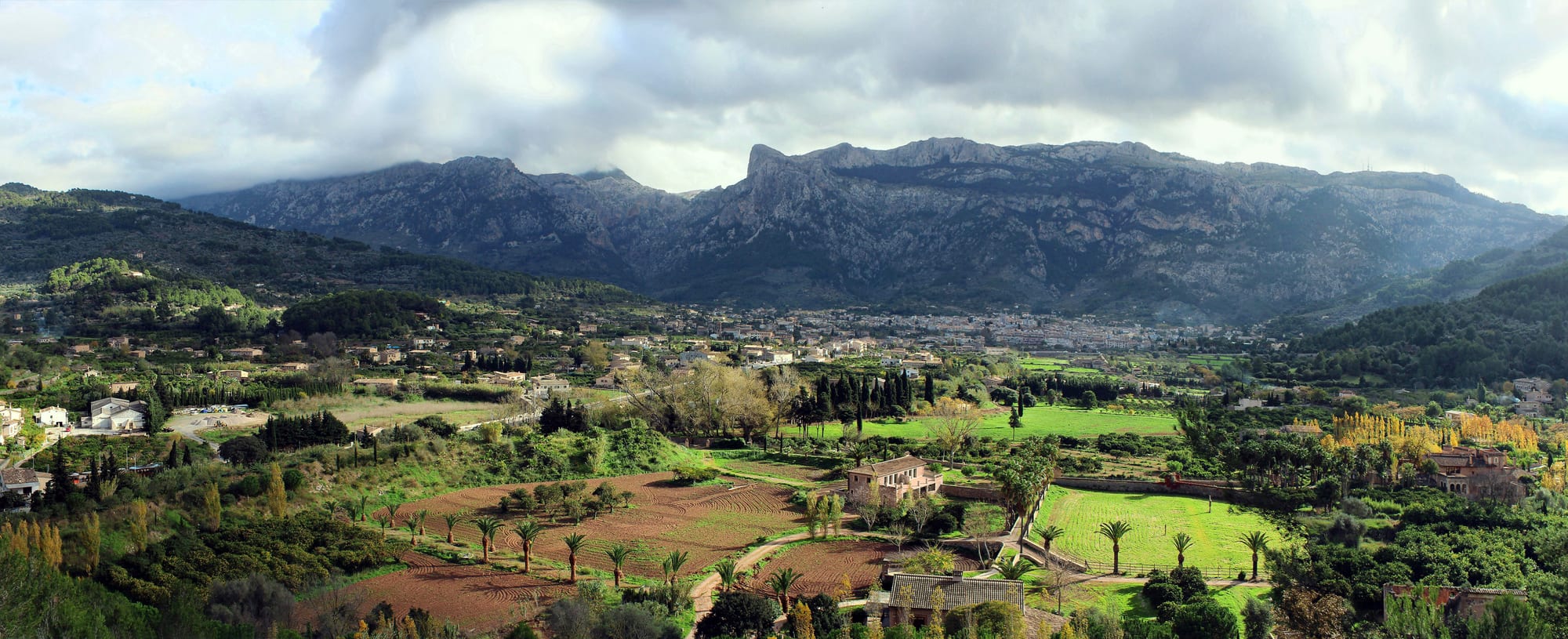
A green valley of fields, palms and groves leading to a small town beneath a long range of grey limestone mountains

The Balearic Islands, Spain

Sóller

Sóller in its valley below the mountains of the Serra de Tramuntana. (Heuschrecke (Dmitry Tonkonog and Ksenia Fedosova) / Wikimedia Commons · CC BY-SA 3.0)

A Mallorcan town in a bowl-shaped valley of orange and olive groves, enclosed by the Serra de Tramuntana three kilometres inland from its harbour, Port de Sóller. Isolation made it trade by sea with France, and citrus money paid for its railway to Palma; today its heritage train and tram carry visitors through the valley.

Neighbourhoods

  • The town centre
    • First-time visitors
    • Historic district

    The streets around Plaça de la Constitució, a square of plane trees, a fountain and cafés crossed by the tram, with the parish church, the town hall and the Modernista bank on one side. The old street plan is of Islamic origin, lined with houses of the 16th to 18th centuries.

    Open in Maps
  • Port de Sóller
    • Seafront
    • Families

    The village on the bay three kilometres from the town, reached by tram, with a marina, a beach, shops, restaurants and bars, and a lighthouse on the headland to the west.

    Open in Maps
  • Biniaraix and the valley
    • Walking
    • Quiet and residential

    A hamlet strung out east of the town, where old public wash-houses recall the days before piped water, at the foot of the ravine path into the mountains. Orchards and farmhouses spread across the valley floor around it.

    Open in Maps

Things to do

In the town

  • Church of Sant Bartomeulandmark

    The parish church on the main square, founded before 1236, with a largely baroque interior of 1688–1733 and a façade of 1904 by Joan Rubió i Bellver, a follower of Gaudí.

    Open in Maps
  • Banco de Sóllerlandmark

    A Modernista bank of 1912 by Joan Rubió beside the church, known for its ironwork, built for a bank founded in 1889 with money from emigrants who had returned rich.

    Open in Maps
  • Can Pruneramuseum

    A Modernista townhouse of 1911, now a museum.

    Open in Maps
  • Sóller railway station museummuseum

    The restored station of the Palma line, which includes rooms devoted to Picasso and Joan Miró.

    Open in Maps
  • Jardí Botànic de Sóllerpark

    A botanical garden on the road to the port, laid out with plants of the Balearics and other Mediterranean islands, with the Museum of Balearic Natural Sciences in its Modernista mansion.

    Open in Maps

The port and the coast

  • Sóller tramtransit hub

    The heritage tramway between the town station and Port de Sóller, one of only two first-generation tramways to survive in Spain.

    Open in Maps
  • Museu de la Marmuseum

    A maritime museum in the 13th-century oratory of Santa Caterina d'Alexandria above Port de Sóller.

    Open in Maps
  • Cap Gros lighthouseviewpoint

    A lighthouse of 1842 on the headland west of the port, a favourite place to watch the sunset.

    Open in Maps

Short trips from the town

  • Sóller Railwaytransit hub

    The electric narrow-gauge line to Palma, built on the profits of the orange and lemon trade, which crosses the mountains through 13 tunnels.

    Open in Maps
  • Fornalutxattraction

    A small village in the hills about two kilometres east of the town, reached by a walking path through Binibassi.

    Open in Maps
  • Deiàattraction

    A small coastal village in the Serra de Tramuntana, known for its literary and musical residents, where the poet Robert Graves settled.

    Open in Maps
  • Puig Majorviewpoint

    Mallorca's highest peak, at 1,445 metres, in the Serra de Tramuntana.

    Open in Maps

Seasonal events

  • Three KingsJanuary

    The Magi process from the port to the town square on Epiphany, throwing sweets to children — traditionally a bigger occasion than Christmas Day.

  • FiróMay

    The town's best-known festival, commemorating the pirate raid of 11 May 1561 with mock battles in the port, the countryside and the square, where locals dressed as turbaned pirates or in traditional dress fight it out with fireworks.

  • Sa MostraMay to July

    A week-long international folklore festival held since 1980, started by the local dance group Aires Sollerics.

  • Sant BartomeuAugust

    The patron saint's festival, with bonfires and a correfoc, a fire-run of devils through the square, followed by a correaigua in which the fire brigade cools the crowd.

Eat and drink

Long-standing places and food districts in Sóller. Hours, ratings and directions come from your maps app, always current.

Sóller classics

  • Plaça de la Constitució cafésneighborhood

    The terraces around the main square, under the plane trees, are the centre of the town's social life.

    Open in Maps
  • Port de Sóller waterfrontneighborhood

    The restaurants and bars of the small resort around the bay at the port.

    Open in Maps

Markets

  • Covered marketmarket

    The town's covered market, in a valley whose oranges are famous across Mallorca.

    Open in Maps

Experience Sóller

History

The valley was settled long before the town took shape — three bronze statues of the 4th or 3rd century BC found at the Roca Roja are kept in the Museum of Mallorca — and the old street plan of Sóller is of Islamic origin. The first parish church dates from before 1236. Hemmed in by the Serra de Tramuntana, the valley was cut off from the rest of Mallorca by land, and its trade looked out to sea, above all to merchants arriving from France.

That exposure brought danger. On 11 May 1561 a fleet of Algerian corsairs landed to attack Sóller; the islanders marched out towards the port and drove them back to the cliffs. Local memory honours the women of Can Tamany, who tricked and killed the pirates who broke into their house, and a band of outlaws whose part in the fighting earned them a pardon from Philip II. Part of the town was then fortified, though only a fragment of wall survives beside the church.

In the late 19th and early 20th centuries many people emigrated, to Puerto Rico and France and also to Belgium, Germany, Luxembourg and Switzerland, and some took part in the settlement of French Algeria. Those who returned rich founded the Banco de Sóller in 1889 and built Modernista houses on the Gran Via. Profits from the orange and lemon trade paid for the railway to Palma in the early 20th century, followed by the tram to the port. A road tunnel opened in 1997, ending the long climb over the Coll de Sóller.

Culture & Customs

Sóller's identity was shaped by its isolation and by its people's travels abroad. The houses of returned emigrants, with the Art Nouveau styles of fin-de-siècle France, still line the Gran Via, and Can Prunera, a Modernista townhouse of 1911, is now a museum. Mallorcan Catalan is spoken in daily life.

The great festival is the Firó in May, which recalls the pirate raid of 1561. Four battles are re-enacted — two in the port, one in the orchards and one in the town square — as locals dressed as turbaned pirates or as islanders in traditional dress clash amid fireworks. In August the feast of the patron, Sant Bartomeu, brings bonfires and a correfoc, in which groups of devils invade the square as an allegory of hellfire before the fire brigade drives them back with the correaigua. Since 1980 the dance group Aires Sollerics has run Sa Mostra, an international folklore festival.

Epiphany is a bigger occasion here than Christmas Day: the Three Kings process from the port to the square, throwing sweets to children. The railway and the wooden tram are themselves part of the town's culture, and the railway station includes rooms devoted to Picasso and Joan Miró.

Daily Life

About 13,900 people lived in the municipality in 2025, spread between the town, Port de Sóller, the farming district of L'Horta and the hamlet of Biniaraix. Tourism and the spending of foreign residents are now the main sources of income, and the valley's agriculture continues alongside them, with vegetables, citrus and olives still grown on the terraces and in the orchards.

The town's isolation has eased: the tunnel under the Coll de Sóller opened in 1997 and has been free to use since 2018, bringing Palma within easy reach, and a second tunnel now links the town with the port so that the seafront could be pedestrianised. In summer the trains, trams and coaches arrive full, and the square and the waterfront are busy from morning to night; in winter the valley quietens and the town returns to its own routines.

Life centres on Plaça de la Constitució, the covered market and the streets around them. Local weekly newspapers are published in Catalan, and the life of the town still revolves around its festivals, its associations and the seasons of the orchards.

Food

Sóller's oranges are famous across Mallorca, and the valley's citrus groves, olive groves and vegetable terraces still supply the town. The town has a covered market, and Port de Sóller has its own shops, restaurants and bars.

The cooking is Mallorcan. Tombet layers fried potatoes, aubergines and red peppers and is found in almost every local restaurant, often beside fish or meat. Sobrassada, the island's raw cured pork sausage seasoned with paprika, belongs to the autumn and winter pig slaughter, the matança. Sopes mallorquines are a dish of vegetables, broth and slices of bread; arròs brut is saffron rice cooked with chicken, pork and vegetables; and frita de calamar is fried squid with potatoes.

Bakeries sell the ensaïmada, a spiral pastry made with saïm, a reduced pork lard, and dusted with sugar, and coques, flat breads similar to pizza but without cheese. Panades are pasties of lamb and peas, and robiols are pastries filled with cottage cheese or jam. Olive oil is the main cooking fat, and the island's red wines come from the Binissalem and Pla i Llevant areas.

Planning tools

Budget

Sóller is priced like the rest of Mallorca's mountain and coastal towns: rooms are the main cost and rise steeply in summer, while bars and bakeries in the town are cheaper than the restaurants on the port. The heritage train is a costly way to arrive; the bus from Palma is much cheaper.

Daily Budget Midrange
USD 180–350 (mid-range hotel, restaurant dinners, the train and tram, museum entry)
Daily Budget Shoestring
USD 80–130 (guesthouse room or mountain refuge, bakery and menú del día meals, island buses)

Take the train one way and the bus the other, and book rooms early for spring and autumn, the walking seasons.

Best Time to Visit

Spring and autumn suit walking in the Tramuntana, and May brings the Firó. Summer is hot and the port is busy, though the sea is warm. Winter is quiet, with many seasonal businesses closed at the port.

Suggested Number of Days

The town and port can be seen in a day or two. Walkers and those who want to explore the mountain villages and the coast often stay four to six days, and the weather in the mountains can stretch a stay.

First Visit
1–2 days
With Surroundings
4–6 days

Transportation

The town centre is small and walkable, and the tram runs between the railway station and the port. TIB buses link the town with Palma, Port de Sóller and Fornalutx, and in season a bus runs over the mountains to Lluc, Pollença and Alcúdia. Cyclists and walkers cannot use the road tunnels and must take the old mountain road.

Parking in the centre and at the port is scarce in summer; use the tram or bus between the two.

Airport & Station Connections

From Palma, the heritage railway climbs through the mountains to the station in the centre of the town, while the main road passes through a tunnel beneath the Coll de Sóller, opened in 1997 and toll-free since 2018. Buses from Palma take about half an hour. Palma's airport is the nearest.

Walkability

The centre is compact and flat, and the walk to the botanical garden is short. The port is three kilometres away, a level walk alongside the tram line. Beyond the town, old paths lead to Biniaraix, Fornalutx and into the mountains, including stages of long-distance walking routes through the Tramuntana.

Safety

Spain is a safe country with low violent crime. Sóller is a quiet town, and the main risks are on the mountain paths and roads: heat, steep ground and sudden changes of weather in the Tramuntana, and narrow winding roads busy with cyclists and coaches.

Carry water and check the weather before walking in the mountains, and take care on the hairpin roads. Check current official travel advice before travelling.

Climate

Mediterranean, in a valley enclosed by the Serra de Tramuntana. In Palma, August averages highs of about 30°C and January highs of about 16°C, and autumn is the wettest season.

Summer
hot — in Palma, August highs average about 30°C
Winter
mild — in Palma, January highs average about 16°C and lows about 9°C

Local Customs

Mallorcan Catalan is the everyday language, and the town has its own strong identity, shaped by its isolation and its links with France. Festivals matter: the Firó and Sant Bartomeu draw the whole town. Spanish meal times apply, with long lunches and late dinners.

Dress modestly in the church, keep to paths across private farmland and close gates behind, and expect the Firó crowds to be loud with fireworks.

Common Payment Methods

The currency is the euro. Cards and contactless payments are accepted in most shops, bars and restaurants; a little cash is useful at the market and small bars. There are ATMs in the town centre.