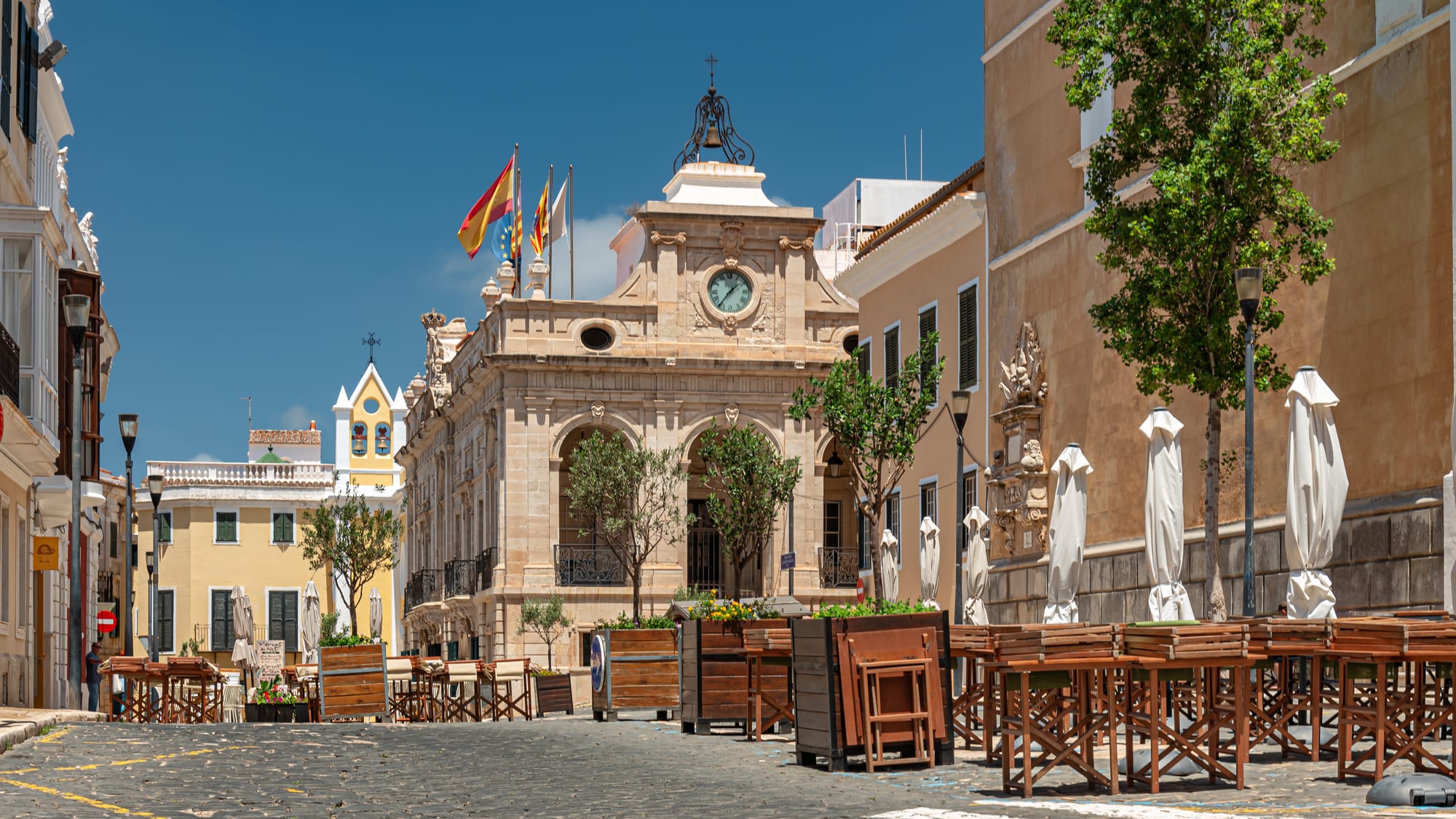
Mahón's stone town hall with a clock and flags above a square of folded café tables and parasols under a blue sky

The Balearic Islands, Spain

Mahón

The town hall of Mahón and the square in front of it. (Jorge Franganillo / Wikimedia Commons · CC BY 2.0)

Menorca's capital, Maó in Catalan, on the island's eastern coast above a long, deep natural harbour that made it one of the most fought-over ports in the western Mediterranean. British rule in the 18th century moved the island's capital here and left a naval past still visible on the water; today it is a compact, lived-in town of churches, squares and harbourside restaurants.

Neighbourhoods

  • The old town
    • First-time visitors
    • Historic district
    • Best for food

    The centre on the cliff above the harbour, around the church of Santa Maria and the town hall. Narrow traffic-restricted streets link small squares, the Carmelite church and its cloister, the Museum of Menorca and the medieval Portal de Sant Roc, and the area is best explored on foot.

    Open in Maps
  • The harbourfront
    • Waterfront
    • Restaurants and bars
    • Ferries and boat trips

    The quays of Moll de Ponent and Moll de Llevant run along the water below the old town, lined with restaurants, bars and the gin distillery. Ferries from the mainland and cruise ships tie up here, and boat trips leave for the islands in the harbour.

    Open in Maps
  • Es Castell
    • Quiet and residential
    • Harbour views

    A small separate town just east of Mahón on the south shore of the harbour, founded by the British in 1771 as Georgetown. It looks across to Illa del Rei and sits beside the remains of St Philip's Castle.

    Open in Maps

Things to do

Churches and the old town

  • Santa Maria de Maólandmark

    The main church of the town, built between 1748 and 1771 on the site of an older Gothic church, with a monumental organ completed in 1810.

    Open in Maps
  • Town halllandmark

    An elegant neo-baroque building of 1789, standing just north of Santa Maria.

    Open in Maps
  • Portal de Sant Roclandmark

    A gateway of 1359, the last surviving piece of the medieval town walls.

    Open in Maps
  • Església del Carmelandmark

    A neoclassical church from the 1750s, once part of a Carmelite convent whose cloisters now hold a shopping centre.

    Open in Maps
  • Teatre Principal de Maóattraction

    One of the oldest opera houses in Spain, opened in 1829 to an Italian design, and the home of the town's annual opera week.

    Open in Maps

Museums

  • Museum of Menorcamuseum

    The island's history museum, in a former Franciscan monastery, covering prehistory, the Roman and Byzantine eras and Muslim Menorca through to modern times.

    Open in Maps
  • Xoriguer distilleryattraction

    A gin distillery on the harbourfront, established in the 18th century, that also makes liqueurs.

    Open in Maps

The harbour

  • Illa del Reiattraction

    Hospital Island, in the harbour channel, where the British built a naval hospital in 1711 beside the remains of a 6th-century basilica; the restored buildings now hold an art gallery.

    Open in Maps
  • Llatzeretlandmark

    The quarantine station built on an island near the harbour mouth between 1793 and 1807, visited by boat trips.

    Open in Maps
  • Harbour boat tripsattraction

    Glass-bottomed boats run cruises around the harbour, one of the longest natural harbours in the world at about 5 km.

    Open in Maps

Short trips from the town

  • St Philip's Castlelandmark

    The remains of the fortress guarding the harbour entrance at Es Castell, rebuilt by the British around a Spanish fort of about 1554 and besieged in 1756 and 1781.

    Open in Maps
  • La Mola Fortresslandmark

    The fortress of Isabel II, built in the mid-19th century on the peninsula at the north side of the harbour mouth, beside the easternmost point of Spain.

    Open in Maps
  • Taula de Trepucólandmark

    A prehistoric village about 2 km from the town, with two talaiots and a taula, a table-like stone monument of Menorca's Talaiotic culture.

    Open in Maps
  • Talatí de Daltlandmark

    One of the emblematic prehistoric villages of Menorca, with talaiots and a taula enclosure, a short drive from the town.

    Open in Maps
  • Es Grau beachbeach

    A beach about 8 km north of the town, reached by a footbridge from Es Grau village and suited to children's bathing.

    Open in Maps
  • Ciutadella de Menorcaneighborhood

    The island's other main town, at its western end, and its capital until 1722.

    Open in Maps

Seasonal events

  • Festes de Gràciaearly September

    The town's patronal festival in honour of the Virgin of Gràcia, when riders on Menorcan horses enter the town hall square in fours and the crowd makes them rear up, in the jaleo, followed by a street dance.

Eat and drink

Long-standing places and food districts in Mahón. Hours, ratings and directions come from your maps app, always current.

Mahón classics

  • Mercat des Peixmarket

    The former fish market on Plaça d'Espanya, now a food court.

    Open in Maps
  • Xoriguer distillery shopmarket

    The harbourside home of the town's best-known gin, made here since the 18th century.

    Open in Maps

Food districts

  • Moll de Ponentneighborhood

    The western quay below the old town, where restaurants and cocktail bars line the water near the ferry terminal.

    Open in Maps
  • Plaça del Carmeneighborhood

    The square by the Carmelite church and its cloister, with tapas bars.

    Open in Maps

Experience Mahón

History

The town's name is usually traced to the Carthaginian general Mago Barca, Hannibal's brother, who is thought to have sheltered in the harbour in 205 BC. Mago became a Roman town, then passed to the Eastern Roman Empire; it suffered raids until the Caliphate of Córdoba took it in 903. Alfonso III of Aragon captured it in 1287, and the harbour, one of the most strategically important in the western Mediterranean, was refortified. It was not enough: in 1535 an Ottoman fleet under Hayreddin Barbarossa sacked the town and carried 600 captives off to Algiers.

The harbour shaped the next century of the town's history. A British and Dutch force took Menorca in 1708, the Treaty of Utrecht confirmed British possession in 1713, and the British moved the island's capital from Ciutadella to Mahón and built a naval dockyard on the north shore and a hospital on Illa del Rei. The island changed hands repeatedly — to France after the siege of Fort St Philip in 1756, back to Britain in 1763, to a Franco-Spanish force in 1782, to Britain again in 1798 — before passing finally to Spain in 1802. British rule left its mark on the island, whose architecture mixes colonial and local styles.

In the Spanish Civil War Menorca stayed loyal to the Republic until 1939, and Mahón was bombed by Nationalist aircraft supported by Fascist Italy. In the late 20th century income from tourism paid for the restoration of the historic centre.

Culture & Customs

The biggest event in the town's year is the Festes de Gràcia in early September, in honour of the Virgin of Gràcia. On two days well over a hundred riders on Menorcan horses enter the square in front of the town hall four at a time, and the crowd makes the horses rear up — the jaleo — before the night turns into a street dance. The horses, the caixers, the fabioler and the giants are the festival's main figures.

Music has a long history here. The Teatre Principal, opened in 1829, is one of the oldest opera houses in Spain and hosts an opera week each year with singers of the bel canto repertoire, the town also holds an international organ festival, and Santa Maria's great organ was completed in 1810. The island's British century left traces in speech as well as stone: Menorquí, the local Catalan, still uses a few English loanwords such as 'grevi' for gravy and 'xoc' for chalk.

Among the people connected with the town are the toxicologist Mathieu Orfila, the linguist Francesc de Borja Moll and the historian Juan Ramis. Sport is local in scale; in basketball, CB Menorca, who play at the Pavelló Menorca, won promotion to Spain's second division in 2023.

Daily Life

About 30,700 people lived in the municipality in 2025, out of roughly 102,000 on the whole island. As the capital, Mahón is the seat of the Island Council of Menorca and holds the Hospital Mateu Orfila, the airport, a power station and the commercial port, so much of its working life is administrative and practical rather than built around resorts. Dairy farming, which gives the island its cheese, remains important in the surrounding countryside, and the harbour is still home to a Spanish naval station on the site of the old British dockyard.

The town has no beach of its own — its waterfront is a working and leisure harbour — and in summer residents and visitors head out to the coves and sandy beaches elsewhere on the island. In season the quays fill with diners and cruise passengers, while winter returns the town to a quieter local rhythm of school runs, shopping in the centre and evening walks.

Food

Mahón gives its name to two famous products. Mayonnaise is commonly said to have originated here and to take its name from the town, though the many stories linking it to the French capture of Mahón in 1756 are contradictory, and the sauce is used constantly in island cooking, with or without garlic. Mahón cheese is a cows'-milk cheese, its rind usually orange from being rubbed with butter or oil and paprika; its designation of origin dates from 1985, and since 1997 the protected name has been Mahón-Menorca.

The best-known Menorcan dish is caldereta de llagosta, lobster stew, once a poor fishermen's meal when lobsters were easy to find; the lobster is cooked with onion, tomato, garlic and parsley. Oliaigua is a thin, simple soup, sometimes eaten with figs, and Menorcan sobrassada, the cured pork sausage of the Balearics, is thinner and less spicy than Mallorca's. Sweets include amargos, almond biscuits made with egg whites.

Gin arrived with the British in the 18th century, and the Xoriguer distillery still makes it on the harbourside. Pomada mixes gin with lemon juice, and pellofa is gin with a twist of lemon peel and a splash of soda. Menorca also makes its own wine.

Planning tools

Budget

Mahón follows the Balearic pattern of high summer prices, though it is generally calmer than Ibiza. Rooms are the main cost in July and August. The town is easy to see on foot, and the bus network and a hire car cover the rest of the island.

Daily Budget Midrange
USD 170–340 (mid-range hotel, restaurant dinners, harbour boat trip, hire car for a day)
Daily Budget Shoestring
USD 80–130 (simple guesthouse, market and tapas meals, island buses)

Visit in May, June, September or early October for lower prices; the old town, the harbourside walks and the Trepucó site cost nothing.

Best Time to Visit

May to October for warm weather and open beach bars, with July and August the hottest and busiest months. Early September brings the Gràcia festival and its horses. Autumn is the wettest season, and winter is quiet and local, with some places closed.

Suggested Number of Days

One or two days are enough for the town and its harbour. Allow four or five to take in the forts, the prehistoric sites, the beaches and the far end of the island. A hire car shortens the time needed outside town.

First Visit
1–2 days
With Surroundings
4–5 days

Transportation

The old town is compact and its streets are traffic-restricted, so walking is the way to get around. Island buses leave from the bus station by Plaça de l'Esplanada for Ciutadella, Es Castell, Sant Lluís and the southern resorts, and taxis wait at the Esplanada and on the waterfront. A hire car makes reaching beaches and prehistoric sites much easier.

The town centre's streets are camera-enforced for traffic, so park outside them; buses run less often at weekends.

Airport & Station Connections

Menorca Airport is about 5 km south-west of the town, a short bus or taxi ride, with flights from Mallorca, Ibiza, the Spanish mainland and several other European countries, among them Britain and Germany. Ferries from Barcelona and Valencia dock at the ferry terminal on Moll de Ponent, a short walk from the centre; from Mallorca the usual route is the ferry from Alcúdia to Ciutadella and then the road east across the island.

Walkability

Very walkable: the old town and the harbour are close together, linked by steps and steep ramps down the cliff. The walk along the quays is level and pleasant. Es Castell can be reached on foot along the harbour, but the beaches and prehistoric sites further out need a bus, a car or a bike.

Safety

Spain is a safe country with low violent crime. Mahón is a quiet island capital, and crime affecting visitors is uncommon. The main risks are the summer heat, rough seas on exposed beaches and wildfire in dry summers.

Respect red flags on beaches, carry water on walks in summer, and keep valuables out of sight in parked cars. Check current official travel advice before travelling.

Climate

Mediterranean, with dry, hot summers and mild, somewhat humid winters. Autumn is the wettest season, with rainfall peaking in late autumn.

Summer
hot and dry — across Menorca, average highs reach about 29°C; the airport has recorded 39.6°C
Winter
mild and damper — across Menorca, average highs are about 14°C; the airport's record low is −2.4°C

Local Customs

The town's official and Catalan name is Maó; Mahón is the Spanish form, and both are used. The local Catalan, Menorquí, keeps a few English words from British rule, such as 'boinder' for a bow window. Cheese, gin and mayonnaise are points of local pride.

Cover shoulders when entering churches, keep beachwear for the beach, and give the horses space during the Gràcia festival.

Common Payment Methods

The currency is the euro. Cards and contactless payment are widely accepted in shops, restaurants and bars, and there are ATMs in the centre and at the airport. A little cash is useful for small bars and market counters.