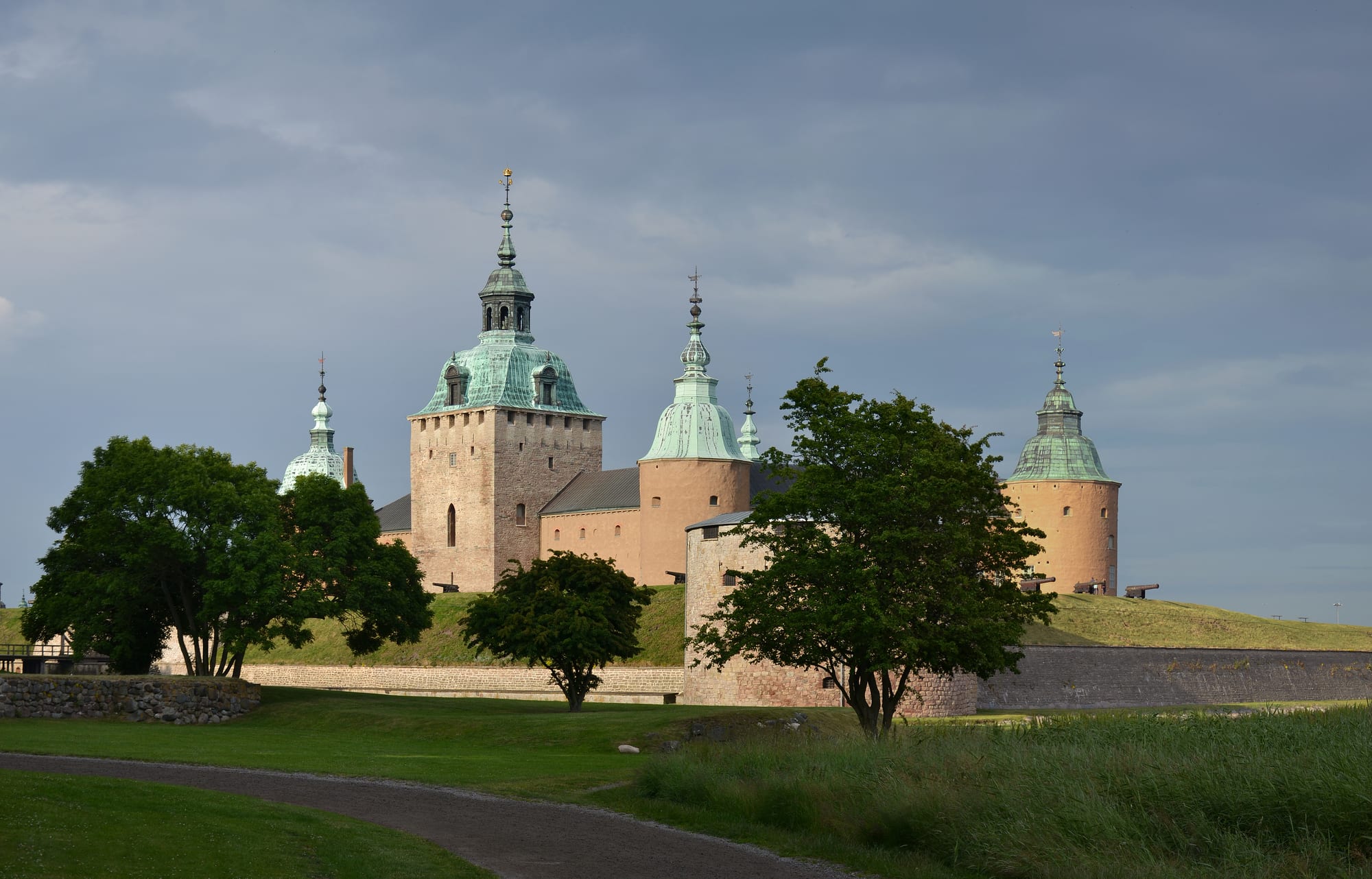
Kalmar Castle's stone towers with green copper domes rising above grassy ramparts and trees under a grey evening sky

Småland, Östergötland & the Baltic Islands, Sweden

Kalmar

Kalmar Castle, the Renaissance palace on the shore of the Kalmar Strait. (Pudelek / Wikimedia Commons · CC BY-SA 4.0)

A Småland port on the Kalmar Strait, facing the island of Öland across the bridge. For four centuries a fortress town on the Danish border — the Kalmar Union was formed at its castle in 1397 — its military importance declined after 1658, it became an industrial city and is now a university and county town around a moated Renaissance castle and a baroque island centre.

Neighbourhoods

  • Kvarnholmen
    • First-time visitors
    • Historic district
    • Shopping

    The island that has been the city centre since the mid-17th century, planned on baroque lines as a fortified town. It holds the two main squares — Stortorget, with the cathedral and town hall, and Larmtorget — the shopping streets, the station a few blocks away and the harbour.

    Open in Maps
  • The castle and the old town
    • Historic sights
    • Parks

    The area around the castle, near the site of the medieval harbour, where the town stood before it moved to Kvarnholmen. The moated castle sits in green ground by the water, a short walk across the bridge from the centre.

    Open in Maps
  • Hansa City
    • Shopping
    • Football

    The retail area by the E22 in the north of the city, with large stores and the Guldfågeln Arena, home of the football club Kalmar FF.

    Open in Maps

Things to do

Famous landmarks

  • Kalmar Castlelandmark

    Begun as a defensive tower around 1180 and known as the Key to the Kingdom, it was turned into a Renaissance palace by the Vasa kings and is described as the best-preserved Renaissance castle in the Nordic countries.

    Open in Maps
  • Kalmar Cathedrallandmark

    Designed by Nicodemus Tessin the Elder, begun in 1660 and finished in 1703, one of the foremost examples of baroque classicism in Sweden.

    Open in Maps
  • Stortorgetlandmark

    The 17th-century main square, redesigned by Caruso St John with Eva Löfdahl as an open stone floor with water gurgling beneath five covered wells; the project won the Siena Prize in 2004.

    Open in Maps

Museums

  • Kalmar County Museummuseum

    The county museum, which runs the excavation of the royal warship Kronan, sunk in 1676 off Öland, and displays many of the more than 30,000 objects raised from the wreck.

    Open in Maps

On the water

  • Canoeing round Kvarnholmenattraction

    Canoes can be hired in the centre to paddle around the island that holds the city centre.

    Open in Maps
  • Öland Bridgelandmark

    The 6-kilometre road bridge across the Kalmar Strait to Öland, once the longest bridge in Europe, with a small wooden footbridge to the island of Svinö copying its shape nearby.

    Open in Maps

Sport

  • Guldfågeln Arenaattraction

    The 12,000-seat home of Kalmar FF, opened in 2011, which also hosted matches of the UEFA Women's Euro 2013.

    Open in Maps

Short trips from the city

  • Borgholm Castlelandmark

    The ruin of a fortress on Öland first built in the 13th century and destroyed by fire in 1806, about an hour from Kalmar by local bus.

    Open in Maps
  • Eketorplandmark

    An Iron Age ring fort in south-eastern Öland, rebuilt in the Middle Ages and reconstructed again in the 20th century.

    Open in Maps
  • Kingdom of Crystalattraction

    The forest district of Glasriket, about 45 minutes by car, where the larger glassworks let visitors watch the glassblowers from a platform and have museums and shops beside them.

    Open in Maps

Eat and drink

Long-standing places and food districts in Kalmar. Hours, ratings and directions come from your maps app, always current.

Kalmar classics

  • Ostkakacafe

    Småland's curd cake, eaten lukewarm with jam or berries and cream or ice cream, also sold ready-baked in grocery stores across Sweden.

    Open in Maps
  • Kroppkakorrestaurant

    Boiled potato dumplings filled with pork and onion, served with melted butter and lingonberry, a dish eaten in both Småland and Öland.

    Open in Maps

Food districts

  • Stortorget and Larmtorgetneighborhood

    The two squares of Kvarnholmen and the streets between them hold most of the city-centre restaurants and cafés, from Swedish cooking to Asian kitchens and takeaway.

    Open in Maps

Experience Kalmar

History

The coast here has been settled since ancient times: Stone Age grave fields have been found, and the oldest evidence of a town dates from the 11th century. Kalmar's city seal, from between 1255 and 1267, is the oldest known in Scandinavia. A round watchtower and a harbour were built on the strait in the 12th century, and at the end of the 13th Magnus Ladulås surrounded the tower with a fortress. Close to the Danish border, with its harbour and trade, Kalmar was one of Sweden's most important towns from the 13th to the 17th century. In 1397 Queen Margaret gathered the leaders of the three kingdoms at the castle, and on 13 July the Kalmar Union was agreed, joining Denmark, Norway and Sweden until 1523.

The border also brought violence. Two massacres are both known as the Kalmar Bloodbath: in 1505 King John had the mayor and council executed, and in 1599 Duke Charles executed the castle's commanders after a siege. Gustav Vasa and his sons turned the fortress into a Renaissance palace from the 1540s. The town became a diocese in 1603, was badly damaged in the Kalmar War of 1611–13, and was besieged 22 times in all without the castle ever being taken. In the mid-17th century the town was rebuilt on the island of Kvarnholmen, where Tessin's cathedral was begun in 1660.

After the Treaty of Roskilde moved the border south in 1658, and Karlskrona became the main naval base, Kalmar's importance declined and the castle fell into disrepair; its restoration ran from 1856 until 1941. Industry arrived in the 19th century, but the engineering works, the shipyard and a Volvo car plant all closed between 1981 and 2005.

Culture & Customs

The castle is the city's emblem, and its history runs through local identity. It was the setting of the union of 1397, and the ship that carried Swedish settlers to found New Sweden in North America in 1638 was named Kalmar Nyckel, the Key of Kalmar, in tribute to the castle known as the key to the kingdom. Restored over nearly a century, it now opens its rooms to visitors and stages a summer programme for children, who play princes and princesses solving puzzles in the castle.

The baroque centre on Kvarnholmen is a piece of 17th-century planning, with the cathedral and town hall facing each other across Stortorget. The square itself became a modern landmark when it was redesigned by the British architects Caruso St John with the artist Eva Löfdahl as a single stone floor with water running beneath it; it was declared a historic monument in 2002 and won several architecture awards after its completion in 2003.

Football is the city's great sporting passion. Kalmar FF plays at the 12,000-seat Guldfågeln Arena, opened in 2011, and the club won promotion to the top division, Allsvenskan, in 2025. The Kronan excavations, carried out by the county museum every year since the wreck was found in 1980, give Kalmar a strong link with maritime archaeology.

Daily Life

About 42,600 people lived in the central town in 2023, and about 72,000 in the municipality. Kalmar is the capital of Kalmar County and the third-largest urban area in Småland. The bridge to Öland makes it the mainland gateway to the island.

The city's economy has moved from heavy industry to services and education. Kalmar Verkstad, which built steam engines and trains, closed in 2005; the shipyard founded in 1679 closed in 1981; and the Volvo car plant that opened in 1974 shut in 1994, part of a loss of around 2,000 industrial jobs. Linnaeus University has one of its two campuses here, including the Kalmar Maritime Academy, and there is a research centre for Telia.

Kalmar has also made a name for cutting fossil fuel use: a wood pulp plant supplies district heating and power, cycle lanes are common, the city has a public biogas pump, and new buildings must meet insulation rules. The centre on Kvarnholmen is small enough to cross on foot, with the station a few blocks from the main square.

Food

Kalmar sits between Småland and Öland, each with its own dishes. From Småland comes ostkaka, a curd cake usually eaten lukewarm with jam, berries or fruit sauce and cream or vanilla ice cream; it is not to be confused with cheesecake, which Swedes call by its English name. From Öland, just across the bridge, and from Småland comes the kroppkaka, a boiled potato dumpling most often filled with pork and onion and served with melted butter, lingonberry jam or cream. The two provinces make them differently: on Öland mostly from raw potato, in Småland mostly from boiled. Ostkaka, too, is known across Sweden, and ready-baked versions are sold in grocery stores, but it is in Småland and Hälsingland that it is most popular.

The centre's restaurants and cafés cluster on Kvarnholmen, around Stortorget, Larmtorget and the streets between them, with Swedish cooking alongside Asian kitchens and takeaways, and coffee shops in old buildings and garden settings. Hansa City, by the E22, is the main out-of-town shopping area.

Planning tools

Budget

Kalmar is among the cheaper towns of southern Sweden, with most sights in the compact centre, and the squares and the waterfront cost nothing to enjoy.

Daily Budget Midrange
USD 150–260 (central hotel, restaurant dinners, castle and museum tickets, a hire car for Öland)
Daily Budget Shoestring
USD 65–100 (hostel or campsite, self-catering, lunch deals, buses and bicycles)

Travel to Kalmar by train if possible: parking in the centre is scarce and usually needs a phone app.

Best Time to Visit

May to September, the season for the castle grounds, the harbour and trips across the bridge to Öland, when the castle runs summer activities for children. Winters are fairly cold, grey and quiet, and guided tours of the castle in English are not offered outside the tourist season.

Suggested Number of Days

The city itself needs a day or two. Three to five days allow for Öland and the glassworks of the Småland forests inland, which are best reached by car.

First Visit
1–2 days
With Surroundings
3–5 days

Transportation

The centre is small enough to walk everywhere, and cycle lanes are common, including the Kalmarsundsleden route along the coast. Driving in the centre is hard work, with many one-way streets and signs whose conditions are written only in Swedish. A local bus crosses the bridge to Borgholm on Öland in about an hour, and Swebus runs coaches to Karlskrona.

Pay-and-display parking machines do not always accept foreign cards; a parking app is the usual alternative.

Airport & Station Connections

Kalmar Airport, about 5 kilometres west of the centre, has direct flights to Stockholm. Kalmar Central station is a few blocks from the main square, with direct trains from Copenhagen, its airport and Malmö, and from Gothenburg; from Stockholm there is a change at Alvesta or Linköping. Long-distance coaches also run from Stockholm.

Walkability

Very good. Kvarnholmen is compact, with the two main squares, the shopping streets and the harbour within a few minutes of each other and of the station, and the castle is a short walk away across the water.

Safety

Sweden is a very safe country for visitors. In Kalmar the practical points are the centre's one-way streets and scarce parking for drivers.

Arrive by train where possible, as parking in the centre is scarce. Check current official travel advice before travelling.

Climate

A climate on the border between oceanic and humid continental. Summers are warm, and Kalmar is among the hottest towns in Sweden, with a record of 35.2°C, though its average summer temperatures are typical for southern Sweden; winters are fairly cold.

Summer
warm, with a record of 35.2°C, though average summer temperatures are typical for southern Sweden
Winter
fairly cold, with temperatures normally hovering around 0°C

Local Customs

Kalmar is proud of the castle and of its part in the history of the Nordic countries, and of its football club. Wine, spirits and strong beer are sold only in the state Systembolaget shops. Cycling is an everyday way to get around.

The cathedral is a working church; keep quiet during services.

Common Payment Methods

The currency is the Swedish krona. Sweden is one of the world's most cashless countries: card payments are very common, as is the Swish phone app (which needs a Swedish bank account), and businesses that do not take cash at all are common too. Contactless phone payments work wherever the reader shows the contactless icon, and a PIN for the card is needed.