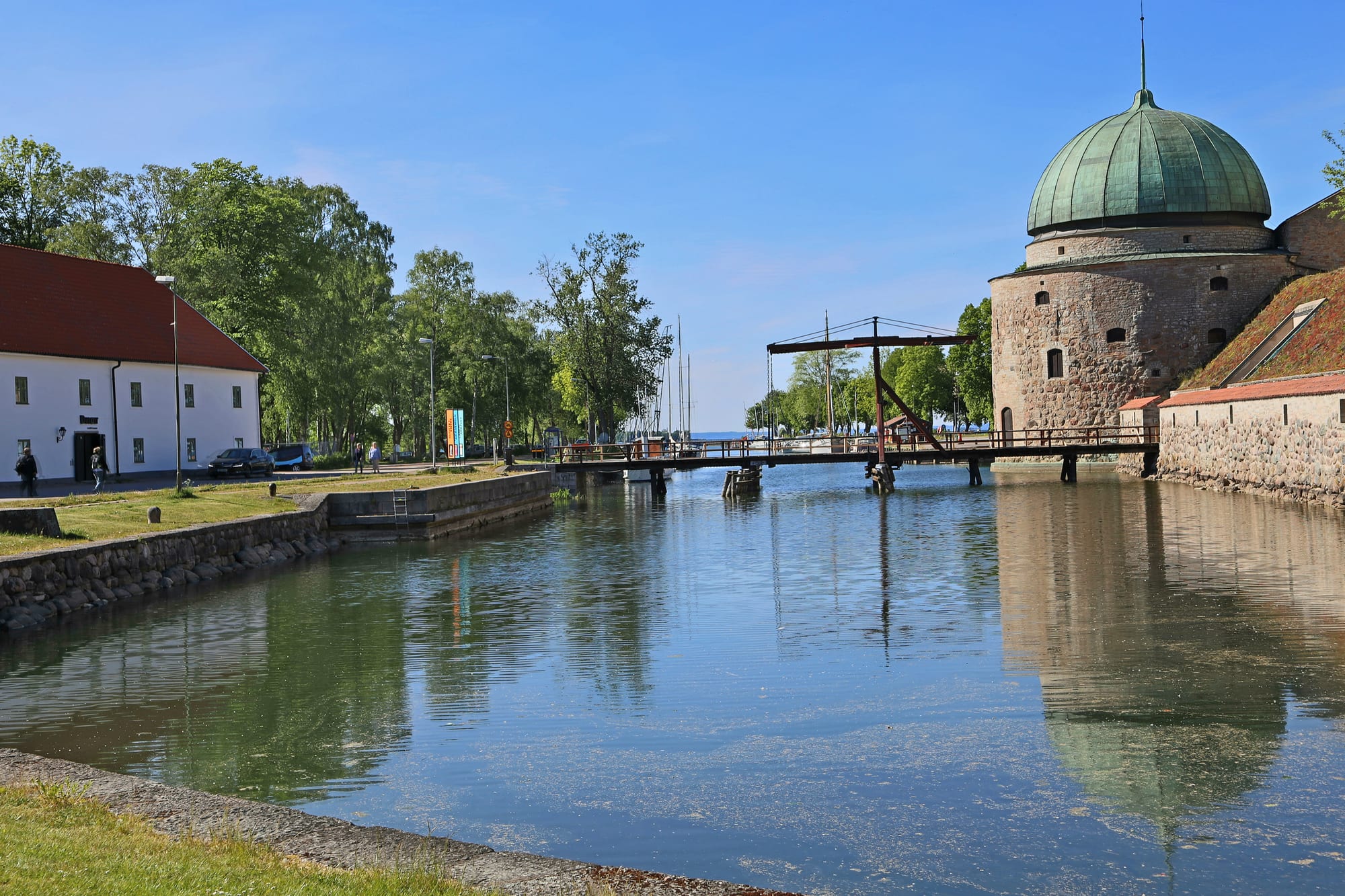
The castle moat at Vadstena with a round stone tower under a green copper dome, a wooden lift bridge and trees on a sunny day

Småland, Östergötland & the Baltic Islands, Sweden

Vadstena

The moat and a domed corner tower of Vadstena Castle. (W. Bulach / Wikimedia Commons · CC BY-SA 4.0)

A small town on the eastern shore of Lake Vättern in Östergötland, where Saint Bridget founded the first abbey of her Bridgettine Order in the 14th century and the Vasa kings later built a moated Renaissance castle. Its abbey church and castle still dominate the skyline, and a well-preserved old town draws day visitors and pilgrims every summer.

Neighbourhoods

  • The old town
    • First-time visitors
    • Historic district
    • Shopping

    The streets around Rådhustorget, with Sweden's oldest surviving town hall from the 15th century and a late-medieval brick merchant's house opposite. Storgatan, the central trading street since the town was founded, still holds the shops, and most buildings date from the 16th to 18th centuries.

    Open in Maps
  • The abbey quarter and the lakeshore
    • History
    • Pilgrimage
    • Lake views

    The abbey church and the old convent buildings stand by Lake Vättern with the former hospital beside them, and the castle is a short walk away. In summer this is where the pilgrims and day visitors gather.

    Open in Maps

Things to do

Abbey, castle and old town

  • Vadstena Abbeylandmark

    The motherhouse of the Bridgettine Order, founded in 1346, whose abbey church, consecrated in 1430, holds Saint Bridget's relics in a red casket, medieval sculptures and other medieval art; the convent buildings house the abbey museum.

    Open in Maps
  • Vadstena Castlelandmark

    Begun by Gustav I in 1545 as a fortress facing Lake Vättern and turned into a Renaissance residence completed in 1620, it holds the provincial archives and a museum of 16th- and 17th-century furniture and portraits.

    Open in Maps
  • Vadstena Town Halllandmark

    The rådhus on Rådhustorget, built in the early 15th century and the oldest surviving town hall in Sweden.

    Open in Maps

Museums

  • Vadstena City Museummuseum

    A volunteer-run museum in a medieval building beside the town hall, telling the everyday history of the town's people from the 15th century onwards.

    Open in Maps
  • Vadstena Hospital Museummuseum

    A museum of the hospital founded in the 16th century to care for poor pilgrims, which later specialised in psychiatric care; the 16th-century Mårten Skinnare's house stands beside it.

    Open in Maps
  • Bobbin Lace Museummuseum

    In the Gottfrid Larsson house, a museum of the bobbin lace that made Vadstena's name and of the pattern makers, lace makers and pedlars behind it.

    Open in Maps
  • Narrow-gauge railway museummuseum

    The museum of the Vadstena–Fågelsta narrow-gauge railway, opened in 1874; a museum society runs tourist trains on summer weekends.

    Open in Maps

Short trips from the town

  • Ombergtrail

    A forested hill rising between Lake Vättern and Lake Tåkern, south of the town, with walking in summer and skiing at Ombergsliden in winter.

    Open in Maps
  • Alvastra Abbeylandmark

    The ruins of a Cistercian monastery founded in 1143 by monks from Clairvaux, at the foot of Omberg.

    Open in Maps
  • Lake Tåkernpark

    A lake considered one of northern Europe's foremost bird lakes, with a visitor centre, Naturum Tåkern, on its southern side.

    Open in Maps
  • Rök runestonelandmark

    The stone beside Rök church carrying the longest known runic inscription, regarded as the beginning of written Swedish literature.

    Open in Maps
  • Motalaattraction

    The town on Lake Vättern regarded as the centre of the Göta Canal, a short drive north.

    Open in Maps

Eat and drink

Long-standing places and food districts in Vadstena. Hours, ratings and directions come from your maps app, always current.

Food on the lake

  • Borghamn harbourneighborhood

    A small village on Lake Vättern south of the town where fish can be bought at the harbour, close to the walks up Omberg.

    Open in Maps
  • Storgatanneighborhood

    The old main street where the town's shops have gathered since the Middle Ages, and the natural place to look for somewhere to eat in the centre.

    Open in Maps

Experience Vadstena

History

Vadstena's history begins with a royal gift. In 1346 King Magnus IV and Queen Blanche left ten farms, including Vadstena, to found an abbey for Bridget, the Swedish noblewoman and visionary who became Saint Bridget. The convent was set up in a 13th-century royal palace beside Lake Vättern. Bridget's daughter Catherine arrived in 1374 with her mother's relics and became abbess; the abbey was blessed in 1384, Bridget was canonised in 1391, and her remains were moved into the abbey church in 1394. As the motherhouse of the Bridgettine Order, Vadstena became the greatest pilgrimage site in Sweden, and the town received its town privileges in 1400.

The Reformation ended that world slowly. The convent survived longer than most, even regaining the right to take novices under John III in 1575, but in 1595 most of the remaining nuns left for a Bridgettine abbey in Danzig, and the last Swedish Bridgettine nun of Vadstena died in 1605. In the same years the Vasa kings were building the castle. Gustav I began it in 1545 as a fortress to guard against attack from the south; his son Duke Magnus, who suffered from mental illness and was the only son not to become king, turned it into a residence, and by its completion in 1620 every Vasa king had contributed.

From the 16th century the town also housed a hospital, first for poor pilgrims and later for psychiatric patients. In 1935 Bridgettine sisters returned to Vadstena, and in 1963 their convent was refounded as a house of the original branch of the order.

Culture & Customs

Saint Bridget still shapes the town. Since 1999 she has been one of the six patron saints of Europe, and the abbey church, now a Lutheran parish church in the Diocese of Linköping, celebrates the daily offices and receives 2,500 to 3,000 pilgrims a day in summer, many arriving on the Saint Birgitta Ways. The modern Bridgettine sisters live close by, and both Lutheran and Catholic pilgrims visit the church.

The town has a long craft tradition. Townspeople earned extra money from bobbin lace, which has been made in Vadstena since the 17th century and gave the town a reputation still celebrated in its lace museum. The sculptor Gottfrid Larsson, whose house now holds that museum, is remembered locally too.

Music is the other strand. Vadstena-Akademien, a music academy founded in 1964 by the singing teacher Ingrid Maria Rappe, is a major commissioner of new Swedish opera, and its productions have been broadcast on Swedish television and radio. Locals pronounce the name of the town "Vasstena".

Daily Life

About 5,800 people lived in Vadstena in 2023. Although Statistics Sweden counts only places with more than 10,000 inhabitants as cities, Vadstena is still called a city for historical reasons, having received its privileges in 1400. In the 1970s it was run for some years as part of Motala Municipality before regaining its own, and today the town is the seat of Vadstena Municipality.

Tourism plays a central part in the local economy, with around 500,000 day visitors a year, most of them in summer. The rest of the year the town is much quieter. The castle remains a working building: since 1899 it has housed the provincial archives, part of the National Archives, whose staff work in its eastern half.

Life follows the seasons, with walking and skiing on Omberg, and regional buses connect the town to the railway stations at Motala, Mjölby and Linköping. The footballer Stina Blackstenius is among the people associated with the town.

Food

Lake Vättern supplies the town's best-known food. The lake is known for its Arctic char, a relict species dating from the end of the ice age, and also holds whitefish and salmon; local fishing serves the districts around it, and visitors may fish with a rod as long as they do not use nets. In the village of Borghamn, on the lakeshore south of town, fish can be bought at the harbour. Many towns around the lake also take their drinking water directly from Vättern.

Everyday eating is Swedish husmanskost, traditional home cooking built on local ingredients such as pork, fish, potatoes, root vegetables, cabbage and berries. Dishes include pea soup, rotmos med fläsk, mashed root vegetables served with pork, herring, most often pickled, and meatballs with brown cream sauce and lingonberry jam. The Östergötland plain that surrounds the town is rich farmland.

Fika, the coffee break with a bun or pastry, is part of every Swedish day, and Swedish bakeries make a wide range of buns, cakes and biscuits to go with it. In summer, when the town fills with day visitors, the centre around Storgatan is the natural place to look for a meal, and two of the old abbey buildings have been converted for a hotel and a restaurant.

Planning tools

Budget

Vadstena is a small town, and most visitors come for the day: the town receives around half a million day visitors a year, mostly in summer. Rooms are limited and fill in high summer, so staying in Motala or Linköping is an alternative. The streets, the lakeshore and the abbey church cost nothing; museum and castle tickets are the main extras.

Daily Budget Midrange
USD 150–260 (guesthouse or small hotel, restaurant meals, castle and museum tickets, a hire car)
Daily Budget Shoestring
USD 65–100 (hostel or campsite nearby, self-catering, regional buses)

Visit in May or September for quieter streets; most day visitors come in summer.

Best Time to Visit

June to August, when the town is at its busiest and the abbey church receives thousands of pilgrims a day. May and September are quieter and good for walking on Omberg and birdwatching at Lake Tåkern. Winter is quiet, with skiing on Omberg when there is snow.

Suggested Number of Days

The town itself is easily seen in a day. Two to three days allow for the hill, the lakes and the runestone to the south, which need a car or bicycle; bus connections to the countryside are thin.

First Visit
1 day
With Surroundings
2–3 days

Transportation

Vadstena is small, and the easiest way to see the sights is on foot. Östgötatrafiken buses link it with the rest of Östergötland; tickets cannot be paid in cash on board. Taxis are on the expensive side. The countryside sights around Omberg are easiest by car or bicycle.

Buy bus tickets before boarding, as cash is not accepted on board.

Airport & Station Connections

There is no railway station: travellers take the train to Motala, Mjölby or Linköping and continue by bus. Vadstena is also on a Swebus Express long-distance route. By road it is about 15 km south of Motala and about 245 km from Stockholm. Linköping Airport is about 40 km to the east.

Walkability

The whole town is walkable: the abbey, the castle, the town hall and Storgatan are all within a few minutes of each other.

Safety

Sweden is a very safe country for visitors. The practical risks around Vadstena are ticks in tall grass in summer, wildlife on country roads at dawn and dusk, and the open lake in strong wind.

Check for ticks after walks on Omberg, watch for elk and deer when driving at dawn and dusk, and take care on the lake in strong wind. Check current official travel advice before travelling.

Climate

A temperate climate; in nearby Motala, Lake Vättern brings slightly cooler summers and milder winters than in inner Östergötland.

Summer
mild to warm — in nearby Motala, July days average about 22°C
Winter
cold — in nearby Motala, February days average around 0°C and nights fall below it, with a daily mean of about -3°C

Local Customs

Tipping is not customary in Sweden; a bill may be rounded up for good service. The abbey church is a working Lutheran church where services are held daily, so visitors keep their voices down and avoid sightseeing during worship. Strong alcohol is sold only by the state-owned Systembolaget, which does not serve anyone under 20.

Dress modestly and keep quiet inside the abbey church, and check service times before visiting.

Common Payment Methods

The currency is the Swedish krona (SEK). Sweden is one of the world's most cashless countries: credit and debit cards are used almost everywhere, as is the Swedish payment app Swish, and businesses that do not take cash at all are common. Local buses do not accept cash.