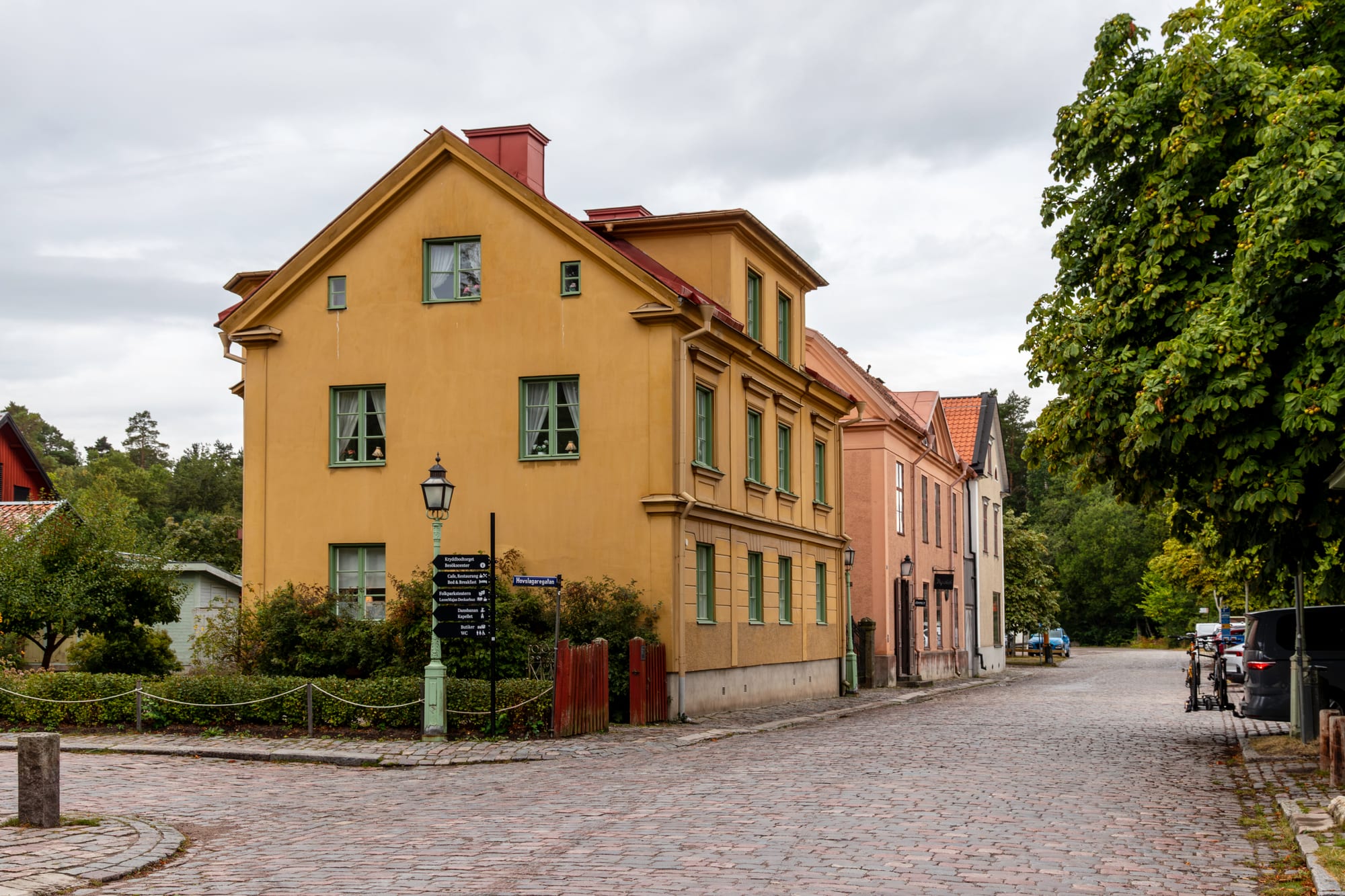
A cobbled street in Gamla Linköping with a yellow two-storey wooden house, signposts and leafy trees under a grey sky

Småland, Östergötland & the Baltic Islands, Sweden

Linköping

A cobbled street of old town houses in the open-air museum of Gamla Linköping. (Bene Riobó / Wikimedia Commons · CC BY-SA 4.0)

The capital of Östergötland County, on the river Stångån on the Östergötland Plain, just south of Lake Roxen. A bishop's seat since the Middle Ages, it grew from a small cathedral town into a city of aircraft, software and students after Saab arrived in 1937, and today a 107-metre cathedral spire still rises over a low-built centre.

Neighbourhoods

  • Innerstaden (the city centre)
    • First-time visitors
    • Historic district
    • Cafés

    The centre runs down Storgatan from the hill crest of the cathedral, the castle and the old school building now used as the city hall to Stora torget, the main square, and on to the Stångebro bridge over the Stångån. Shops, cafés and the station are all within a short walk.

    Open in Maps
  • Valla and Gamla Linköping
    • Museums
    • Parks
    • Families

    West of the centre, the open-air town of Gamla Linköping sits beside the Valla woods and recreation area, with old houses moved here from the centre when it was rebuilt. The university's main Campus Valla lies next door.

    Open in Maps
  • Ryd
    • Students
    • Quiet and residential

    A district built in the style of the 1965–1974 Million Programme, home to the bulk of Linköping University's student body in housing set aside for them, with a manor house that serves as a student pub.

    Open in Maps

Things to do

Famous landmarks

  • Linköping Cathedrallandmark

    One of the largest Gothic cathedrals in Scandinavia, on a site used for a church since the 11th century, with a 107-metre tower rebuilt in the 1880s, carved Gothic sculpture at the west end and an altarpiece by Maarten van Heemskerck.

    Open in Maps
  • Linköping Castlelandmark

    The bishop's residence from the 13th century until the Reformation, standing opposite the cathedral; it is now the residence of the county governor and also holds a museum.

    Open in Maps
  • Folkungabrunnenlandmark

    Carl Milles's fountain on Stora torget, with reliefs from Östergötland's history around the basin and a bronze of the legendary Folke Filbyter on a slipping horse at its centre.

    Open in Maps
  • Stadshusetlandmark

    The city hall on Storgatan, built in 1864 as a secondary school, with a Latin motto about the fear of the Lord as the beginning of learning above its entrance.

    Open in Maps

Museums

  • Gamla Linköpingmuseum

    An open-air museum of town houses saved from demolition in the centre and rebuilt as a small 19th-century town, where residents still live and work in the old buildings.

    Open in Maps
  • Swedish Air Force Museummuseum

    The Flygvapenmuseum at Malmen airbase, where a flying school was founded in 1912, with aircraft from the 1910s to the JAS 39 Gripen and the DC-3 shot down in 1952 and found in 2003.

    Open in Maps
  • Castle and Cathedral Museummuseum

    A museum inside the castle telling the story of Linköping as a bishop's seat since the 12th century.

    Open in Maps
  • Östergötland County Museummuseum

    The museum of the province's history on Raoul Wallenbergs plats, with a large collection of old and contemporary art.

    Open in Maps
  • Konsthallen Passagenmuseum

    A municipal art gallery showing contemporary art, opened in 1998.

    Open in Maps

Parks and the water

  • Trädgårdsföreningenpark

    A large park in the centre of the city, cared for by a society founded in 1859, with ponds along a reopened stream, a lookout tower and a tropical house.

    Open in Maps
  • Valla woods and recreation areapark

    Woods and a recreation area beside Gamla Linköping in the west of the city; Vallaskogen counts as part of the open-air museum.

    Open in Maps
  • Tinnerö oak woodlandpark

    A nature reserve of Östergötland oak landscape in Linköping Municipality, with farmland, wetlands and many well-preserved remains, mainly from the Iron Age.

    Open in Maps
  • Kinda Canal boat tripsattraction

    Boat trips on the Kinda Canal, which follows the Stångån and passes through 19th-century locks to lakes further south.

    Open in Maps

Sport and nights out

  • Saab Arenaattraction

    The arena of the ice hockey club Linköping HC, opened in 2004 and holding 8,500 people for sport and more for concerts.

    Open in Maps

Short trips from the city

  • Berg locks on the Göta Canalattraction

    At Berg, north of the city, the Göta Canal passes through a system of locks, the Bergs slussar, with a bathing spot where the canal meets Lake Roxen.

    Open in Maps
  • Vreta Abbeylandmark

    Founded in the early 12th century as the first nunnery in Sweden, near Lake Roxen in Linköping Municipality.

    Open in Maps
  • Norrköpingattraction

    The neighbouring city nearer the sea, closely linked with Linköping and with an industrial past of its own.

    Open in Maps

Seasonal events

  • Östergötland Music Dayssummer

    A summer music festival held at venues around the county, with Linköping among its sites.

  • Student Orchestra FestivalMay, every other year

    A festival of Swedish student orchestras, hosted by Linköping in alternate years.

Eat and drink

Long-standing places and food districts in Linköping. Hours, ratings and directions come from your maps app, always current.

Cafés and sweets

  • Cafés around Stora torgetneighborhood

    Coffee houses and cafés gather around the main square and the central streets, the natural place for fika.

    Open in Maps
  • Cafe Bergetcafe

    An old-fashioned café on a small hill in the city centre.

    Open in Maps
  • Bosses Glassbarcafe

    A hole-in-the-wall shop selling fresh ice cream, a summer favourite in the centre.

    Open in Maps
  • Cloetta chocolate shop in Gamla Linköpingcafe

    A sweet shop in the open-air museum selling locally produced chocolate and candy.

    Open in Maps

Experience Linköping

History

Linköping may take its name from the Lionga thing, the assembly that medieval law made the most important in Östergötland; the ending "-köping" means a market town. Its importance came from the church. A diocese existed here by about 1082, second only to Skara in the Sweden of the day, and a stone basilica stood on the cathedral site by around 1120. The great Gothic cathedral grew around it over the following centuries, King Valdemar was crowned there in 1251, and a cathedral school can be traced from 1266. Its successor, Katedralskolan, founded in 1627, is the third-oldest gymnasium in Sweden.

The town's most dramatic moment came at the end of the 16th century. In September 1598 Duke Charles defeated his nephew, the Catholic King Sigismund, at the battle of Stångebro, by the town's main bridge. On 20 March 1600, five nobles who had sided with Sigismund or opposed Charles were beheaded on the main square, the Linköping Bloodbath, and a parliament meeting in the town that year effectively made Charles king.

For three centuries afterwards Linköping remained a small cathedral and county town. That changed in 1937, when the Saab aircraft company was formed and the city began a period of rapid growth. Linköping University was established in the 1960s, and the area around the main square was replanned in the same decade, with many old houses destroyed and some moved to Gamla Linköping. In 2022 archaeologists found a rare Viking grave in the city that appears to mark the shift from paganism to Christianity.

Culture & Customs

Linköping's identity rests on three things: the cathedral, the aircraft and the students. The 107-metre tower of the Domkyrkan rises over the low centre, and the cathedral, the castle and the old school buildings on the hill still form the town's ceremonial heart. Saab gave the city the nickname "the flight city", and the Malmen airbase just outside it is home to the air force's flying school. Linköping University, founded in 1969, fills the city with young people, and Sweden's first website was started by students here in 1993.

The cultural calendar includes the Linköping Symphony Orchestra, the Östergötland Music Days in summer, a student orchestra festival in May every other year and the Linköping University Male Voice Choir. NärCon, held twice a year, is the largest gaming and anime convention in Scandinavia, and the theatrical heavy metal band Ghost comes from the city. Gamla Linköping is both a museum and a living neighbourhood, where people in period clothes work in the old buildings.

Sport is followed closely. Linköping HC plays ice hockey at the Saab Arena, Linköpings FC women's football team has won the Swedish Cup, and Linköping Innebandy is the world's largest floorball club. The city also hosted the World Orienteering Championships in 1968 and has long ties to speedway. Norrköping, its neighbour on the plain, lies roughly 40 km to the east.

Daily Life

Around 167,000 people lived in Linköping Municipality as of 2023, and just under 120,000 in the built-up area, Sweden's eighth-largest. The share of residents with a foreign background rose from about 11 per cent in 2000 to 23 per cent in 2019, with the largest groups from Iraq, Somalia, Eritrea, Iran and Bosnia and Herzegovina.

Saab is one of the biggest employers, building the Gripen fighter, and the city has a strong information technology sector, with headquarters of firms such as IFS, Sectra and Cambio Healthcare Systems. The university and its hospital are also based in the city. The military airfield just outside the city has kept buildings low, which gives the centre its small-town feel.

Daily rhythms follow the university year. Students cycle between Ryd, Valla and the centre, and the city has been recognised for its cycling. Shopping is split between the central malls and the large retail area at Tornby to the north. The city set itself the goal of becoming carbon-neutral by 2025, and in 2019 it began testing self-driving buses on a short route around the campus.

Food

Linköping's food is everyday Swedish rather than a cuisine of its own. Husmanskost, traditional Swedish home cooking, is built on local ingredients such as pork, fish, potatoes, root vegetables, cabbage and berries, and includes pea soup, rotmos med fläsk (mashed root vegetables with pork), salmon in many forms and herring, most often pickled. Meatballs come with brown cream sauce and tart lingonberry jam, and lingonberry jam is the classic way to freshen heavy meat dishes.

Lunch is the main meal out for many people. Restaurants across the city offer a set lunch on weekdays, and many also serve a limited Saturday shopping lunch, a cheaper way to try a place than dinner. The city's restaurants also reflect its mixed population, with Thai, Indian and other Asian kitchens around the centre and near the station.

Fika, the coffee break with a pastry, is an institution, and Swedish bakeries make a wide range of buns, cakes and biscuits to go with it. The cafés around Stora torget and in the central streets serve it, as do old-fashioned konditori. In Gamla Linköping a chocolate shop sells locally made chocolate and sweets, and in summer queues form at a small ice-cream bar in the centre.

Planning tools

Budget

Linköping is a mid-sized university city and costs less than Stockholm for rooms and meals. Lunch is the cheapest way to eat out: many restaurants offer a weekday lunch, and some a limited Saturday lunch, for far less than dinner. Most of the centre and the streets of Gamla Linköping can be walked without paying anything.

Daily Budget Midrange
USD 150–260 (city hotel, restaurant dinners, museum tickets, the odd taxi)
Daily Budget Shoestring
USD 65–100 (hostel or budget room, weekday lunches and self-catering, local buses)

Eat the main meal at lunchtime to save money, and use a contactless card on the local buses.

Best Time to Visit

May to September, when the parks, the canal boats and the outdoor cafés are in use and the open-air museum is at its liveliest. Term time fills the city with students; July is quieter as many residents go on holiday. Winter is dark and cold but the cathedral, the museums and the hockey season carry on.

Suggested Number of Days

One to two days covers the centre and the main museums. Three days leaves room for the countryside and the neighbouring city on the plain; a car or bicycle makes the outlying sights easier to reach.

First Visit
1–2 days
With Surroundings
3 days

Transportation

Östgötatrafiken runs the city buses from Resecentrum, the travel centre by the railway station, and also the buses and trains in the rest of the county. Tickets cannot be paid in cash on board, but contactless cards are accepted. Linköping is a cycling city, named Sweden's cycling city of the year in 2002, and most students get around by bike. Taxis are on the expensive side; app-based services also operate.

Buy a ticket at Resecentrum or pay by contactless card on the bus; a single ticket is valid for a limited time and can cover more than one trip.

Airport & Station Connections

Linköping lies on the main railway line between Stockholm and Malmö, and the station is less than ten minutes' walk from the centre; the fastest trains from Stockholm take well under two hours. The E4 motorway passes the city, and long-distance buses run to Stockholm, Gothenburg and Malmö. Linköping City Airport, shared with Saab, has flights to Amsterdam and is about half an hour's walk from the centre.

Walkability

The centre is compact and low-built, and the cathedral, castle, main square and station are all a few minutes apart. Gamla Linköping and the university lie farther west and the Air Force Museum is outside the city at Malmslätt, so a bus or bicycle helps for those. Pavements can be icy in winter.

Safety

Sweden is a very safe country for visitors. The everyday risks are drunken brawls on weekend nights, wildlife on the roads when driving, and ice in winter.

Lock bicycles securely, watch for cyclists when crossing cycle lanes, and check for ticks after walks in the woods in summer. Check current official travel advice before travelling.

Climate

A humid continental climate with maritime influences: clear differences between the seasons, but mild for its latitude. Summers are slightly cooler than in the Mälaren valley to the north.

Summer
pleasant — summer highs average in the low 20s °C
Winter
cold — daytime temperatures commonly hover just above 0°C, falling below it at night

Local Customs

Tipping is not customary in Sweden; a bill may be rounded up for good service. Queueing is very organised. In most homes it is customary to remove shoes. Strong alcohol is sold only by the state-owned Systembolaget, which does not serve anyone under 20, while beer up to 3.5 per cent is sold in supermarkets. The right of public access lets everyone walk and cycle on most land, but not through private gardens.

Carry identification when buying alcohol or going to bars, many of which have an age limit of 20 or more.

Common Payment Methods

The currency is the Swedish krona (SEK). Sweden is one of the world's most cashless countries: credit and debit cards are used almost everywhere, as is the Swedish payment app Swish, and businesses that do not take cash at all are common. Local buses do not accept cash.