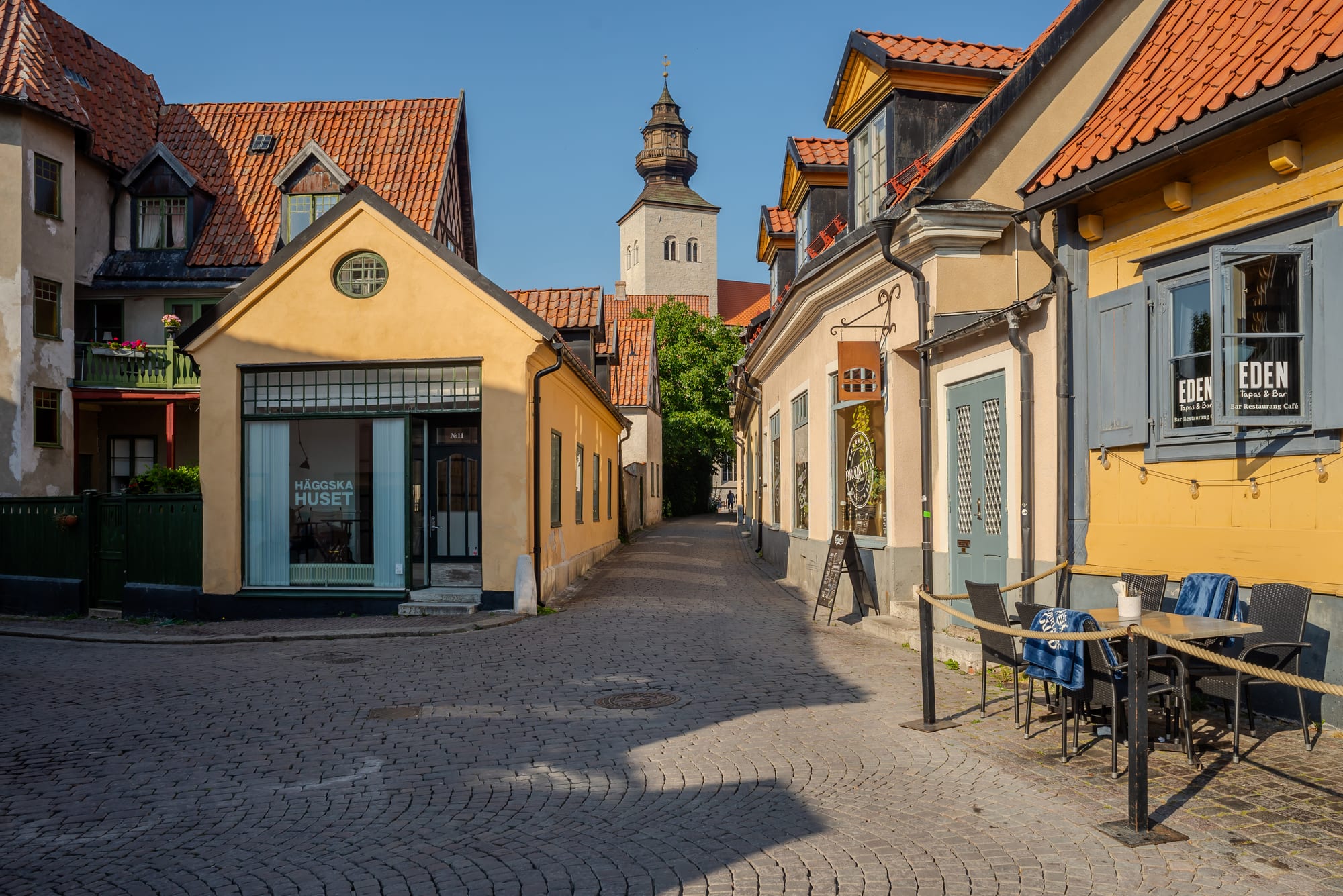
A cobbled lane of yellow and cream houses with red-tiled roofs leading to the white tower of Visby Cathedral under a blue sky

Småland, Östergötland & the Baltic Islands, Sweden

Visby

Södra Kyrkogatan, looking from Stora torget towards Visby Cathedral. (Arild Vågen / Wikimedia Commons · CC BY-SA 4.0)

The only town with historic city status on Gotland, set on limestone slopes above a natural harbour on the island's west coast. A Baltic trading centre by about 900 and later a Hanseatic town, it declined after the 14th century, leaving one of the best-preserved medieval towns in Scandinavia — a walled UNESCO World Heritage Site of church ruins and roses that fills with visitors every summer.

Neighbourhoods

  • Inside the walls
    • First-time visitors
    • Historic district
    • Best for food

    The medieval town, an oblong some two kilometres long and half a kilometre wide, enclosed by the wall on three sides and the sea on the fourth. Long streets run parallel to the old shoreline, crossed by short alleys climbing the slope, with Stora torget, the cathedral and most of the church ruins at its heart.

    Open in Maps
  • Almedalen and the harbour
    • Parks
    • Close to the ferries

    The park that was once the medieval harbour, just outside the wall, with the county library, a conference centre and Campus Gotland beside it. The modern harbour and its ferry terminals lie along the shore to the south.

    Open in Maps
  • Klinten
    • Views
    • Quiet and residential

    The higher eastern part of the old town, once the workers' quarter, a maze of small rose-covered houses with a view over the lower town to the sea.

    Open in Maps
  • Östercentrum
    • Shopping
    • Local life

    The modern pedestrian shopping district just outside the Österport gate, with the usual chain stores, banks, pharmacies and the Systembolaget shop, in the newer part of town that spreads east and inland from the wall.

    Open in Maps
  • The northern shore
    • Beaches
    • Summer

    Beaches line the coast just inside and outside the northern part of the wall — Kallbadhuset, Norderstrand, Snäckgärdsbaden and Gustavsvik — with the Galgberget nature reserve on the cliffs beyond.

    Open in Maps

Things to do

Walls and churches

  • Visby City Walllandmark

    The strongest, most extensive and best-preserved medieval town wall in Scandinavia, built in two stages in the 13th and 14th centuries; about 3.44 kilometres still stands, with 27 large and 9 small towers.

    Open in Maps
  • Visby Cathedrallandmark

    St Mary's, built as the church of the German merchants and consecrated in 1225 and the only one of the town's medieval churches still in use, with a square western tower and two octagonal eastern towers.

    Open in Maps
  • St Nicholas church ruinlandmark

    The roofless ruin of a medieval church on Smedjegatan, whose church and friary were burned by the town's own defenders when Lübeck's forces attacked in 1525.

    Open in Maps
  • St Hans and St Per ruinslandmark

    The remains of two connected churches, whose towers the governor had pulled down in 1533–34 because they threatened the defences of his castle.

    Open in Maps
  • Visborg ruinslandmark

    What is left of the fortress built from 1411 by Erik of Pomerania, ruler of the Kalmar Union, and destroyed in 1679, the year the Treaty of Lund restored Gotland to Sweden.

    Open in Maps

Museums

  • Gotland Museummuseum

    The island's county museum, founded in 1875 by the Friends of Gotland's Antiquity, with its main building, Fornsalen, in Visby.

    Open in Maps

Parks, gardens and viewpoints

  • Almedalenpark

    The park on the site of the medieval harbour, which grew too shallow as the land rose; it is the stage for the speeches of Almedalen Week.

    Open in Maps
  • Botanical Gardenpark

    A garden of trees, flowers and ruins inside the wall, entered through the 'Door of Love', with the ruin of St Olof's church in its grounds.

    Open in Maps
  • Klinten viewpointviewpoint

    The top of the old town's slope, a favourite place to look out over the roofs, ruins and the sea.

    Open in Maps
  • Galgbergettrail

    A nature reserve on the cliffs just north of town, named after the 13th-century gallows that still stand there, and a popular walking area.

    Open in Maps

Short trips from the town

  • Kneippbynattraction

    A summer resort village about three kilometres south of the centre with a water park, an amusement park and the original Villa Villekulla house from the Pippi Longstocking films.

    Open in Maps
  • Lummelunda Caveattraction

    A karst cave north of Visby, explored for almost 4.5 kilometres, one of the longest caves in Sweden and one of Gotland's major attractions.

    Open in Maps

Seasonal events

  • Almedalen Weeklate June or early July

    The most important forum in Swedish politics: party leaders take turns to speak in Almedalen, with seminars and debates across town, most of them open to the public.

  • Medieval WeekAugust

    A week of music, jesters, theatre, a medieval market and jousting, held since 1984, when many visitors dress in medieval clothes.

Eat and drink

Long-standing places and food districts in Visby. Hours, ratings and directions come from your maps app, always current.

Visby classics

  • Saffranspannkakacafe

    Gotland's saffron pancake, a baked dessert of rice pudding, cream, eggs, almonds and saffron, usually served with whipped cream and dewberry jam.

    Open in Maps
  • Medieval feastingrestaurant

    Visby has restaurants that serve medieval cuisine in medieval surroundings, including full feast meals.

    Open in Maps

Food streets

  • Stora torgetneighborhood

    The main square of the old town, where pubs and restaurants set out tables in the sun in summer, some of them open all year.

    Open in Maps
  • Adelsgatanneighborhood

    The main shopping street inside the walls, with shops selling small trinkets and local handicraft.

    Open in Maps

Experience Visby

History

People lived on the site as early as the Stone Age, drawn by fresh water and a natural harbour, and the name comes from Old Norse for a pagan place of sacrifice. By about 900 Visby was a trading centre, and in the 12th and 13th centuries it flourished with the German Hanseatic merchants. St Mary's, their church, was consecrated in 1225, many more churches followed, and around 1300 the wall was raised to its present height. In the first half of the 14th century the town was at the height of its wealth, and the Laws of Wisby, a code of maritime law with influence across the Baltic, probably date from this time.

In 1361 Valdemar IV of Denmark conquered Gotland; 1,800 Gotlanders were killed in battle in front of the walls, and the town was taken without a fight. The Victual Brothers, Baltic pirates, plundered it three times in the 1390s, the Teutonic Knights took the island in 1398, and in 1409 they sold it to Queen Margaret of the Kalmar Union. Erik of Pomerania built the fortress of Visborg and lived there for twelve years, and trade died away. In 1470 the Hanseatic League withdrew Visby's status, and in 1525 Lübeck's forces attacked and set the town on fire.

The Reformation closed almost all of the churches, leaving the cathedral as the only one in use. Gotland passed to Sweden in 1645 by the Treaty of Brömsebro, after some 300 years of Danish rule, and the town stagnated — which is why so many medieval stone houses survived. Russia held the island for a few months in 1808. Trade, the harbour and, later, tourism revived the town in the 19th century, and in 1995 it became a UNESCO World Heritage Site.

Culture & Customs

Visby is called the city of roses and ruins, and its medieval streets have drawn film-makers and writers. The Pippi Longstocking films were shot here, Ingmar Bergman filmed The Touch in the town in 1971, and Hayao Miyazaki named Visby as the main visual inspiration for the town in Kiki's Delivery Service. Mari Jungstedt set nine detective novels on Gotland, with her inspector based at the police headquarters in Visby. The town is also home to the Baltic Centre for Writers and Translators and the Visby International Centre for Composers.

Two weeks define the summer. Almedalen Week turns the old harbour park into the most important forum in Swedish politics, with party leaders speaking in turn and seminars all over town. Medieval Week, held in August since 1984, fills the streets with costumes, jesters, music, a medieval market and jousting, and many visitors dress in medieval clothes. In between, Visby is one of the liveliest party towns in Sweden.

Gotlanders keep their own identity, not least in the island's food and drink. Sport ranges from floorball and football to ice hockey, and the speedway team Bysarna, four times Swedish champions, raced at Galgberget until 2007.

Daily Life

About 26,000 people lived in Visby in 2024, by far the largest town outside the Swedish mainland and the seat of Gotland's municipality and diocese. The newer districts spread east and inland from the wall. It is the only county seat in Sweden that can be reached from the mainland only by sea or air, so the ferries and the airport shape daily life; the ferry service is subsidised by the state.

Tourism is central to the economy, with thousands of visitors every summer, and in 2012 Gotland had over 7,500 registered companies. Campus Gotland, a department of Uppsala University since 2013, stands beside Almedalen, and a static inverter plant near the town serves the first HVDC connection built for a wind farm.

The year has two rhythms. From mid-June to mid-August the town is crowded, many residents move out and let their flats to visitors, and shops and restaurants open daily. For the rest of the year Visby is a quiet county town: many businesses shorten their hours and some open only for the two months of summer.

Food

Visby is where most visitors first meet Gotland's island cooking. Saffranspannkaka, the saffron pancake, is one of the island's provincial dishes: a baked dessert of rice pudding, cream, milk, sugar, eggs and chopped almonds coloured with saffron, eaten tepid or cold, traditionally with whipped cream and dewberry jam. The lamb is the national symbol of Gotland, and a tannery shop in town specialises in lamb products.

Gotlandsdricka, or drikke, is the island's traditional home-brewed ale, smoky, bitter-sweet and flavoured with juniper. Brewing it was traditionally women's work; because its strength varies considerably it is hard to sell commercially, but it survives as a marker of Gotland identity, and a brewing championship is held on the island every autumn.

In town, eating centres on Stora torget and the streets around it, where pubs and restaurants put tables out in summer, and in summer some old-town cafés serve coffee in their backyards. Some restaurants serve medieval food in medieval rooms, and a local tea house, Kränku, sells its own blends across the island.

Planning tools

Budget

Visby is crowded in high summer, and during Medieval Week rooms and ferries are heavily booked. Outside the summer many restaurants and shops shorten their hours or close.

Daily Budget Midrange
USD 160–300 (hotel or rented flat, restaurant dinners, museum entry, the ferry from the mainland)
Daily Budget Shoestring
USD 70–110 (hostel or campsite, self-catering, bakery lunches, bicycle hire)

Book ferries and rooms well ahead for July and August; many residents let their flats to visitors in summer.

Best Time to Visit

Mid-June to mid-August is the high season, when everything is open, the town is one of Sweden's liveliest for nightlife and Almedalen Week and Medieval Week fill the streets. Many sights close at the end of August, and the rest of the year is quiet, with reduced opening days and some places closed altogether.

Suggested Number of Days

The walled town needs two or three days. Four to six days give time for the rest of Gotland, which is best seen by car or bicycle; the ferry crossing adds the better part of a day each way.

First Visit
2–3 days
With Surroundings
4–6 days

Transportation

The town inside the walls is small enough to cover on foot, and in summer cars are not allowed within the walls. Outside them, bicycle paths make cycling easy, and bike hire is widespread in summer. Several bus lines run from Visby to the rest of Gotland, and small sightseeing trains tour the old town with an audio guide.

Check bus timetables before heading out across the island, as services to the countryside are limited.

Airport & Station Connections

Destination Gotland's car ferries sail from Nynäshamn, near Stockholm, and from Oskarshamn in Småland, each taking about three hours, and a weekly ferry runs from Rostock in Germany. Visby Airport, about 5 kilometres north of the town, has daily flights to Stockholm Arlanda. The ferry port lies along the shore just south of the wall.

Walkability

Excellent inside the walls, where everything is within a short walk, though the alleys climb steeply from the harbour up to Klinten and the cobbles are uneven. The beaches on the northern shore and Almedalen are just outside the wall.

Safety

Sweden is a very safe country for visitors. Visby is in general a safe destination; the main risks are road accidents, pickpockets and drunken fights.

Keep food covered at outdoor cafés, where jackdaws grab any unattended food and drink. Check current official travel advice before travelling.

Climate

An oceanic climate, with cooler summers and milder winters than most of mainland Sweden, though still shaped by continental air. Rain is moderate and spread through the year, and Visby is one of the sunniest towns in the Nordic countries, especially in summer.

Summer
cooler than in most of mainland Sweden and one of the sunniest in the Nordic countries; July and August temperatures in Visby tend to be quite similar, and Gotland's record high, 35.2°C, was measured at Buttle in the middle of the island
Winter
milder than in most of mainland Sweden; in Kalmar, on the mainland coast, winter temperatures normally hover around 0°C, and Gotland's yearly mean is around 6.5°C

Local Customs

Gotland has its own identity, and the lamb is the island's symbol. Visby lives two lives, crowded and festive in summer and quiet the rest of the year. Wine, spirits and strong beer are sold only in Systembolaget shops, the town's outside the Österport gate.

Almedalen Week speeches and seminars are largely open to the public, mostly in Swedish.

Common Payment Methods

The currency is the Swedish krona. Sweden is one of the world's most cashless countries: card payments are very common, as is the Swish phone app (which needs a Swedish bank account), and businesses that do not take cash at all are common too. There are only a few ATMs in the old town and port area, with more in Östercentrum.