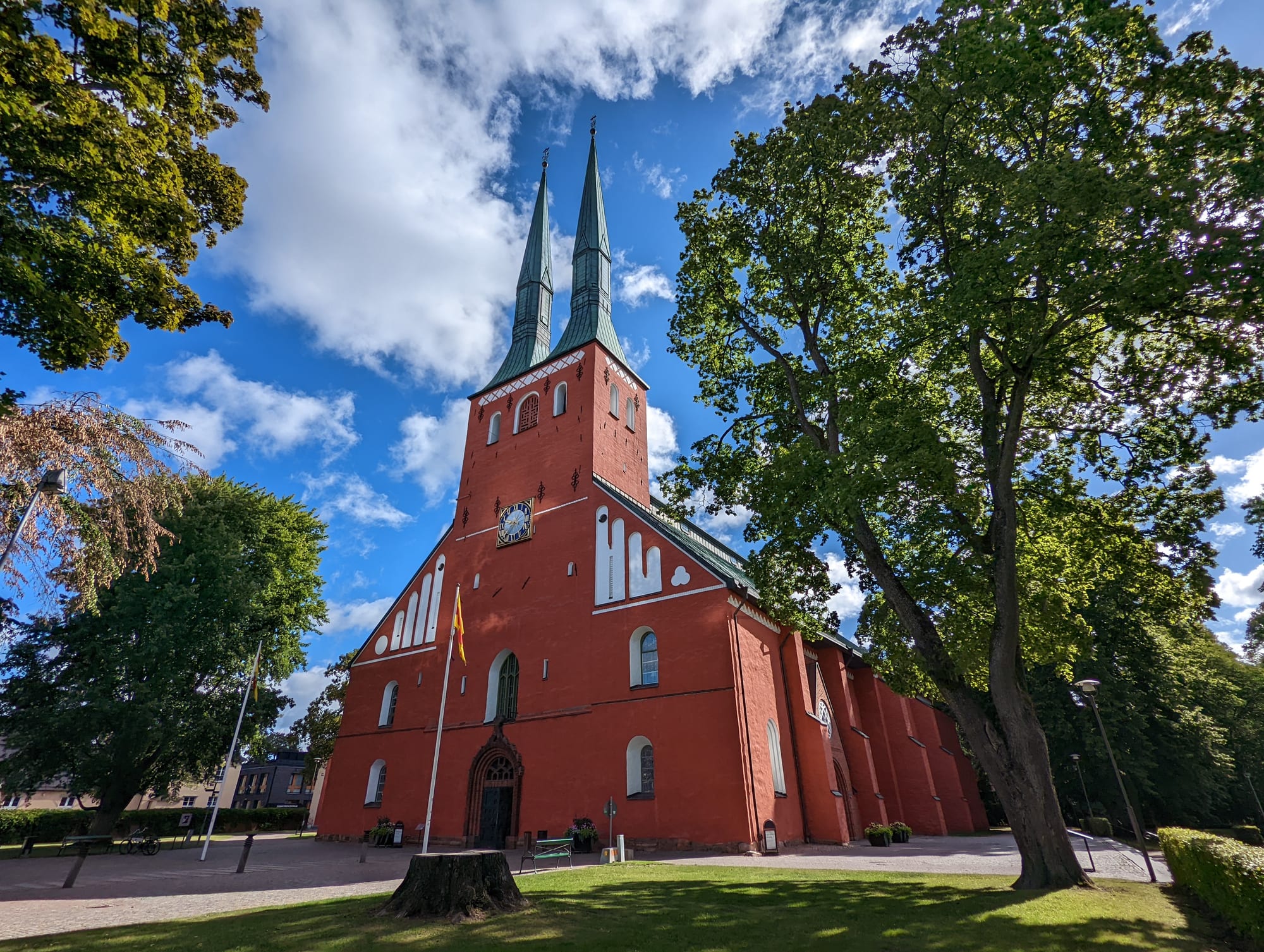
Växjö Cathedral's red-rendered west front with twin green copper spires, framed by tall leafy trees under a blue sky

Småland, Östergötland & the Baltic Islands, Sweden

Växjö

Växjö Cathedral and its twin spires, in the park at the centre of the city. (AleWi / Wikimedia Commons · CC BY-SA 4.0)

The capital of Kronoberg County in the lake country of southern Småland, a bishop's seat since the 12th century that was rebuilt after a great fire in 1843. Today it is a university city that calls itself the greenest in Europe, with a cathedral full of modern glass, the House of Emigrants and the forest glassworks of the Kingdom of Crystal within reach.

Neighbourhoods

  • City centre
    • First-time visitors
    • Shopping
    • Close to public transport

    A compact centre given its street plan after the fire of 1843, with almost all the shops on the main street, Storgatan, and the city buses radiating from Stortorget, the main square. Some older wooden buildings survive among the newer blocks.

    Open in Maps
  • The cathedral, the museum park and Växjö Lake
    • Museums
    • Parks
    • Lake walks

    South of the square, the cathedral stands in its park beside the Museum Park with the House of Emigrants and the Småland Museum, close to the railway station. A path of about 4.5 km circles Växjö Lake just beyond.

    Open in Maps
  • Teleborg and the university
    • Students
    • Quiet and residential
    • Lakes

    The Linnaeus University campus lies 4–5 km south of the centre near Lake Trummen, beside the turreted Teleborg Castle, built in 1900. Much of the city's student life is out here.

    Open in Maps

Things to do

Landmarks

  • Växjö Cathedrallandmark

    A hall church with twin spires on a site with a stone church since the 1160s, much altered and restored in the 1950s, whose works of art are mostly modern and many of them made of glass, including glass from Kosta Boda.

    Open in Maps
  • Teleborg Castlelandmark

    A medieval-looking castle actually built in 1900 as a wedding present from Count Fredrik Bonde to his wife, in the university area by Lake Trummen.

    Open in Maps

Museums

  • House of Emigrantsmuseum

    Opened in 1968 in the Museum Park, home to the Swedish Emigrant Institute, with a museum, a library and archives of letters, diaries and photographs from the 1846–1930 exodus, when 1.3 million Swedes left, mostly for the United States.

    Open in Maps
  • Småland Museum and the Swedish Glass Museummuseum

    The county museum, founded in 1867, whose own building was completed in 1885 and opened as a museum in 1890; glass grew in importance in its work in the 1930s and 1940s, and it holds the Swedish Glass Museum, given modern premises in the 1990s.

    Open in Maps

Lakes and parks

  • Växjö Laketrail

    The small lake beside the station and the cathedral, circled by a walking and cycling path of about 4.5 km.

    Open in Maps
  • Helgasjönpark

    A lake of about 50 square kilometres just north of the city, where the ruin of Kronoberg Castle, once Nils Dacke's base, stands on an island.

    Open in Maps
  • Bergkvaralandmark

    A castle ruin from the 1470s on the shore of Bergkvarasjön west of the centre, in the grounds of a still-inhabited manor, with a garden café in an old workers' building.

    Open in Maps
  • Teaterparkenpark

    A relaxing park in the city, one of its green spaces alongside the park around the cathedral.

    Open in Maps

Sport

  • Vida Arenaattraction

    The 5,750-seat indoor arena opened in 2011, home of the Växjö Lakers ice hockey team.

    Open in Maps
  • Spiris Arenaattraction

    The football stadium of Östers IF, part of a sports district built on the old Värendsvallen site west of the station.

    Open in Maps

Short trips from the city

  • Åsnenpark

    Småland's third-largest lake, about 20 km south of the city, circled by a cycling route of four days or more that passes through Växjö.

    Open in Maps
  • Kosta Boda glassworksattraction

    The glassmaker in Kosta, the village named after it, at the heart of the Kingdom of Crystal, which draws about a million visitors a year; guided tours of the workshop are offered in English.

    Open in Maps
  • Orreforsattraction

    A small village in the Kingdom of Crystal known above all for the glassworks of the same name.

    Open in Maps
  • Råshultlandmark

    The village just north of Älmhult where the botanist Carl Linnaeus, the father of modern taxonomy, was born in 1707.

    Open in Maps

Eat and drink

Long-standing places and food districts in Växjö. Hours, ratings and directions come from your maps app, always current.

Cafés

  • Cafés on Storgatanneighborhood

    The main street holds city-centre cafés, among them a coffee house in an old wooden building; just north-east of Stortorget a konditori is run by the fifth generation of the family that opened it in 1876.

    Open in Maps
  • Bergkvara garden cafécafe

    A café in an old workers' building on the Bergkvara estate, beside the castle ruin, serving local products.

    Open in Maps

Experience Växjö

History

The name is usually explained as väg, "road", and sjö, "lake": the road over the frozen Växjö Lake that farmers took in winter to the marketplace that grew into the town. A wooden church probably stood here in the 11th century, and legend credits Saint Sigfrid, the town's patron saint, with founding it. In the late 1160s Växjö became the seat of its own diocese, split from Linköping and covering the five districts of Värend, and the first stone church, the core of today's cathedral, was built about then. The town received its first charter from Magnus Eriksson in 1342.

Växjö sat in a border land often fought over. During the Dacke War, the great peasant uprising, the town was held by Nils Dacke and his followers from the summer of 1542 until after New Year 1543, and the bishop's castle of Kronoberg on Helgasjön served as his base. Danish and Swedish wars and repeated fires followed; the town burned in 1277, 1516, 1570, 1612, 1658 and several more times, and after the last fire, in 1843, which left 1,140 people homeless, it was given the street plan it still has.

Between 1846 and 1930 about 1.3 million Swedes, a fifth of the population, emigrated, mainly to the United States, a story the Swedish Emigrant Institute, founded in 1965, now tells in the city's House of Emigrants. The university, begun as a department of Lund University in 1967, became Växjö University and merged with Kalmar in 2010 to form Linnaeus University. In 1985 Hans Runesson took the photograph "A Woman Hitting a Neo-Nazi With Her Handbag" in the city.

Culture & Customs

Växjö's identity is green and glassy. In 1996 the city adopted a policy to stop using fossil fuels by 2030, in response to pollution in its lakes; it has called itself "the Greenest City in Europe" since 2007, and in 2018 it became the first Swedish city to receive the European Green Leaf Award. Half its electricity and over 90 per cent of its heating come from trees, and new buildings are made of wood.

The city claims to be the capital of both the "Kingdom of Crystal" and the "Kingdom of Furniture". The cathedral is filled with modern glass art, the Småland Museum holds the Swedish Glass Museum, and glassworks producing both tableware and art pieces surround the city. The House of Emigrants keeps the memory of the great exodus, with letters, diaries and photographs sent home from America; its microfilmed church records serve family historians.

Sport is a big part of local life. The Växjö Lakers play ice hockey at the Vida Arena and Östers IF football at the Spiris Arena, and the city also has clubs in floorball, rugby, basketball, volleyball and orienteering. The heavy metal band Bullet comes from Växjö, and the university gives the city a large student population, including many international students.

Daily Life

As of 2023 the city had about 74,000 inhabitants, out of about 98,000 in the municipality in 2025. It is the administrative, cultural and industrial centre of Kronoberg County and the seat of the Diocese of Växjö.

Linnaeus University, with campuses in Växjö and Kalmar, brings a large student population to the south of the city. Industry includes GE Power and Aerotech Telub, and Volvo Articulated Haulers builds machines at Braås, about 29 km north. Software firms such as Fortnox and Visma are among the best-known service companies, and a science park supports start-ups in forestry, smart-city and circular-economy work.

Daily life is shaped by the lakes, with a 4.5 km path round Växjö Lake, and the city has built cycling and pedestrian routes and traffic-noise measures into its environmental strategy. Shopping is split between Storgatan and two larger shopping areas on the east side of the city. Like other Swedish cities it has districts with social problems; Araby, classified as an especially vulnerable area in 2015, was reclassified as a risk area in 2021.

Food

Småland's food is country cooking. Ostkaka, Swedish curd cake, has roots in Småland, where it has a grainy texture and was originally cooked in a large copper pot with a thin layer of tin; it is made by adding rennet to warm milk and flour, eaten tepid with jam or berries and cream, and served in Småland at Christmas and local gatherings. Kroppkakor, boiled potato dumplings filled with onion and meat and served with melted butter, lingonberry jam or cream, are eaten across south-east Sweden; in Småland they are made mostly from boiled potato with a little raw.

Everyday eating is Swedish husmanskost, traditional home cooking based on pork, fish, potatoes, root vegetables, cabbage and berries, with dishes such as pea soup, herring and meatballs with brown cream sauce and lingonberry jam. Lunch is the main meal out, and some restaurants in the city serve a set lunch on Saturdays as well as weekdays.

Fika, the coffee break with a pastry, is taken seriously. Cafés line Storgatan and the streets near Stortorget, among them a konditori run by the same family since 1876, and the café on the Bergkvara estate serves local produce beside a castle ruin.

Planning tools

Budget

Växjö is a mid-sized county town, and lunch deals, some of them on Saturdays too, are the cheapest way to eat out. The main extra cost is transport to the glassworks, which are not well served by public transport and need a hire car. Walking round the lakes and visiting the cathedral cost nothing.

Daily Budget Midrange
USD 150–260 (city hotel, restaurant dinners, museum tickets, a hire car for the glassworks)
Daily Budget Shoestring
USD 65–100 (hostel or budget room, lunch deals and self-catering, city buses)

Hire a car for a day to see the glassworks; one guided workshop tour takes a little under an hour.

Best Time to Visit

May to September, when walking round the lakes is at its best and the football season, from April to November, is under way. Winter is mild for inland Sweden but wet, cloudy and dark, with ice hockey at the Vida Arena for company.

Suggested Number of Days

The city itself takes one to two days. Three or four allow time for the glassworks, the lakes to the south and the Linnaeus country to the south-west, all of which are far easier with a car.

First Visit
1–2 days
With Surroundings
3–4 days

Transportation

The centre is small enough to walk, with Storgatan as its spine. Twelve city bus lines run by Länstrafiken Kronoberg radiate from Stortorget, most of them also serving the station, and the bus fleet runs on biogas. Cycling is actively promoted. Visiting the glassworks requires a car, as they are poorly served by public transport.

Bus line 4 runs to the airport; a bicycle is the easiest way round the lakes.

Airport & Station Connections

Växjö lies on the Coast-to-Coast railway line, and trains run direct to Copenhagen, Malmö, Kalmar and Gothenburg; for Stockholm the change is at Alvesta. Växjö Småland Airport, about 7 km north-west of the centre, has year-round flights to Stockholm Bromma and Alicante. The nearest major airports are Gothenburg Landvetter, about 206 km away, and Copenhagen, about 275 km.

Walkability

The centre, the cathedral, the museums and the station are all within a few minutes' walk, and the path round Växjö Lake makes an easy stroll. The university and Teleborg are a bus or bicycle ride south; Bergkvara is about 6 km west.

Safety

Sweden is a very safe country for visitors. The Araby district, classified by the police as an especially vulnerable area in 2015, was reclassified as a risk area in the 2021 report.

Watch for elk and deer when driving through the forests at dawn and dusk, and check for ticks after walks in summer. Check current official travel advice before travelling.

Climate

Markedly maritime for an inland town: milder, wetter and cloudier than most of Sweden, with sunshine hours closer to the British Isles than to places further north, relatively mild winters and relatively cool summers.

Summer
warm — in Småland's three main towns, summer days average around 22°C
Winter
cold — in Småland's three main towns, winter days hover around freezing, 0°C

Local Customs

Tipping is not customary in Sweden; a bill may be rounded up for good service. Queueing is very organised. In most homes it is customary to remove shoes. Strong alcohol is sold only by the state-owned Systembolaget, which does not serve anyone under 20. The right of public access lets everyone walk and cycle on most land, but not through private gardens.

Carry identification for bars and Systembolaget, and leave shoes at the door when invited into a home.

Common Payment Methods

The currency is the Swedish krona (SEK). Sweden is one of the world's most cashless countries: credit and debit cards are used almost everywhere, as is the Swedish payment app Swish, and businesses that do not take cash at all are common.