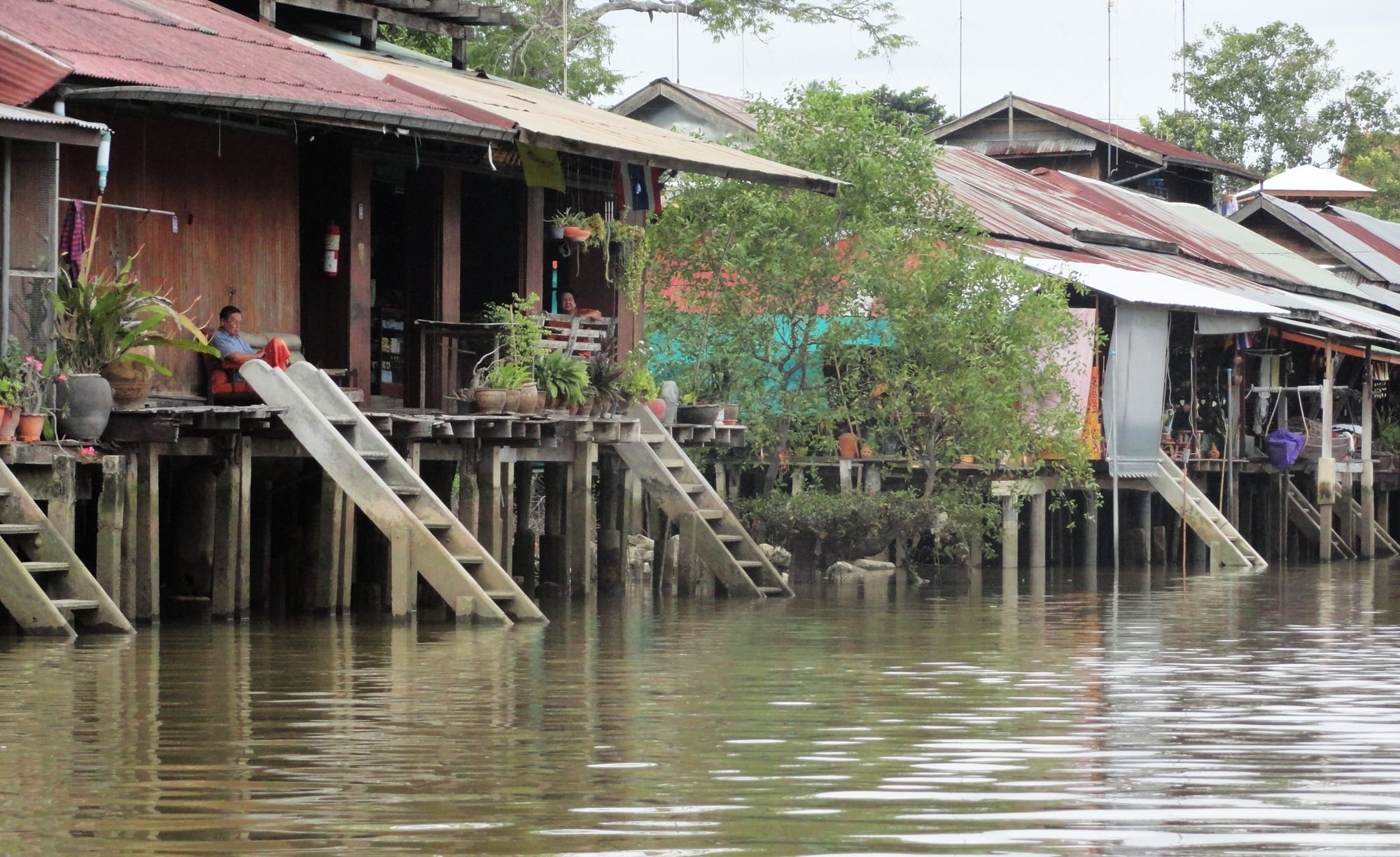
Wooden stilt houses with corrugated roofs and potted plants lining a brown canal in Amphawa, their steps running down to the water

Bangkok & the Central Plains, Thailand

Amphawa

Timber houses on stilts along a canal at Amphawa, Samut Songkhram. (Fabio Achilli / Wikimedia Commons · CC BY 2.0)

A canal town in Samut Songkhram province, south-west of Bangkok, where a branch canal meets the Mae Klong River. Rows of wooden shophouses stand over the water, a floating market fills the canal on weekend afternoons and evenings, and boats run out after dark to watch fireflies in the riverside trees.

Neighbourhoods

  • The canal front
    • First-time visitors
    • Best for food
    • Weekends

    The two banks of Khlong Amphawa, lined with teak shophouses converted into guesthouses, cafés and souvenir shops, linked by footbridges. Almost everything visitors come for happens along this stretch of water, and it is crowded from Friday afternoon to Sunday evening and quiet the rest of the week.

    Open in Maps
  • Around Wat Amphawan
    • Historic district
    • Quiet and residential

    The temple and memorial park at the north end of the canal, on the site associated with the birth of King Rama II. Gardens, traditional Thai houses and a small museum sit among the streets where most of the town's residents actually live.

    Open in Maps
  • The Mae Klong riverside
    • Riverside
    • Boat trips
    • Quiet and residential

    Where the canal meets the broad Mae Klong River, a working waterway of barges and fishing boats. Homestays and resorts stand along the banks among coconut and palm plantations, and the firefly boats set off from here after dark.

    Open in Maps

Things to do

On the canal

  • Amphawa Floating Marketmarket

    A market held on and beside the canal on Friday, Saturday and Sunday afternoons, with cooks grilling seafood from small boats and stalls filling the wooden walkways above.

    Open in Maps
  • Wat Amphawan Chetiyaramlandmark

    The town's principal temple, beside the market canal, traditionally held to stand on the site where King Rama II was born in the 1760s.

    Open in Maps
  • King Rama II Memorial Parkpark

    Gardens and a group of traditional central Thai houses beside the temple, holding the King Rama II Museum, which marks his patronage of Thai art and culture.

    Open in Maps

Temples and markets nearby

  • Wat Bang Kunglandmark

    A small chapel a few kilometres upriver, its ordination hall held up and covered by tree roots, inside the earthworks of an 18th-century camp associated with King Taksin.

    Open in Maps
  • Maeklong Railway Marketmarket

    A fresh market laid out over the rails at Mae Klong, about 6 kilometres away, where awnings and baskets are pulled back several times a day as a train passes through.

    Open in Maps
  • Damnoen Saduak Floating Marketmarket

    The best-known floating market in Thailand, on a 19th-century canal in neighbouring Ratchaburi province, busiest in the early morning.

    Open in Maps
  • Don Hoi Lotbeach

    A wide sandbar at the mouth of the Mae Klong, exposed at low tide, known for razor clams and for the seafood restaurants built out over the mud.

    Open in Maps

Seasonal events

  • Firefly seasonrainy season, roughly May to October

    Fireflies gather in the lamphu trees along the Mae Klong and its canals; boats run out most evenings, and the display is strongest on dark, wet nights.

  • Loy KrathongNovember

    Candle floats are set on the canal and the river on the full moon of the twelfth lunar month, with temple fairs on the banks.

  • Songkranmid-April

    The Thai new year brings water-pouring rituals at the temples and water-throwing along the canal front.

Eat and drink

Long-standing places and food districts in Amphawa. Hours, ratings and directions come from your maps app, always current.

On the water

  • Amphawa Floating Marketmarket

    Charcoal-grilled prawns, squid and shellfish cooked in boats moored against the canal wall, eaten sitting on the steps above, along with noodle stalls and coconut sweets on the walkways.

    Open in Maps
  • Canal-front shophouse caféscafe

    Old timber shophouses converted into coffee and dessert shops looking over the water, serving iced coffee, Thai tea and coconut ice cream.

    Open in Maps

Local specialities

  • Pla thu Mae Klongmarket

    Short mackerel steamed and sold in round bamboo baskets, a product Samut Songkhram is known for across Thailand, eaten with chilli relish and vegetables.

    Open in Maps
  • Don Hoi Lot seafoodrestaurant

    Restaurants on stilts above the estuary mudflats serving razor clams, cockles, crab and river prawns.

    Open in Maps

Experience Amphawa

History

Amphawa grew where a branch canal meets the Mae Klong, on the sea-facing edge of the central plains, as a trading and orchard settlement in the Ayutthaya period. Its canals carried coconut sugar, fruit and salt down to the Gulf and up towards the capital, and rows of wooden shophouses were built facing the water with their backs to the land, because the canal was the road.

The town's place in Thai history comes from the late 18th century. A local family of some standing here produced the woman who became Queen Amarindra, wife of the general who took the throne in 1782 as Rama I; their son, born in Amphawa in 1767, ruled as Rama II from 1809. The temple of Wat Amphawan Chetiyaram is traditionally held to stand on the site of that birth, and the memorial park beside it was created in the 20th century to mark it, with buildings furnished in early Rattanakosin style.

Roads reached the district in the 20th century and trade moved off the water. Shophouses emptied, younger residents left for Bangkok and the canal front decayed. From the early 2000s the community and the provincial authorities restored the timber row, revived a market on the canal and encouraged homestays. What followed was a tourism boom driven almost entirely by Thai visitors from Bangkok, and the arguments that come with it over crowds, prices and how much of the old working town survives behind the shopfronts.

Culture & Customs

Amphawa's identity is built on water and on royal association. The canal network of Samut Songkhram is among the densest in Thailand, and life is arranged around tides that push salt water up the Mae Klong twice a day; orchards of coconut, lychee and pomelo are irrigated by ditches that fill and drain with them. Old houses stand on stilts with steps down to the water and a spirit house in the yard.

The town is strongly Buddhist, with temples along the river holding merit-making ceremonies, ordinations and funerals attended by the whole neighbourhood, and boat-borne processions on festival days. Loy Krathong is a canal occasion here rather than a river-bank one, and the province's temples include several with long histories, among them the root-covered chapel at Wat Bang Kung, linked in local memory to King Taksin's campaigns after the fall of Ayutthaya.

The weekend market has given the place a second culture, one of design shops, cafés and photographs. Thai visitors come for nostalgia — the wooden shophouse, the boat kitchen, the sound of long-tail engines — and the town presents itself accordingly. Residents are used to strangers on their doorsteps and generally welcoming, but it remains a community of a few thousand people whose homes back directly onto the walkway, and quiet after the market closes is expected.

Daily Life

Amphawa town itself holds only a few thousand people, in a district of Samut Songkhram, the smallest province in Thailand. Weekdays are slow: the market stalls are shuttered, school runs and small boats cross the canal, and most work is in coconut sugar production, fruit orchards, fishing and shrimp ponds, salt pans towards the coast, or commuting to Mae Klong and the industrial towns closer to Bangkok.

From Friday afternoon the pattern reverses. Shutters come up, boats moor against the canal wall with charcoal braziers, and several thousand visitors arrive by minivan and car. Homestays and cafés occupy family shophouses, and a good part of household income is made in three days a week. The pressure shows in parking, rubbish and rising property prices along the canal, and in the way some old families have sold or leased their frontages.

The wider environment is a working estuary: mangrove at the river mouth, mudflats at Don Hoi Lot where razor clams are gathered, and fishing boats running into the Gulf. Coastal erosion, salt intrusion into the orchards and changes in water management upstream are live concerns, as is the future of the firefly populations, which depend on the lamphu trees along the banks and on darkness.

Food

Seafood and river food define the table. Grilled prawns, squid and shellfish cooked in boats on the canal are the market's signature, eaten with a sharp seafood dipping sauce of chilli, garlic and lime. The province is known nationally for pla thu, short mackerel steamed and packed into round bamboo baskets at Mae Klong, eaten with nam phrik kapi, a shrimp-paste relish, and raw or blanched vegetables. Hoi lot, razor clams from the sandbar at the river mouth, are stir-fried with chilli paste or garlic.

Coconut runs through everything. Samut Songkhram's coconut palms supply nam tan maphrao, palm sugar boiled down in open pans at small local works and sold in discs, which sweetens curries and desserts across the central plains. Sweets on the canal include khanom krok, coconut-and-rice-flour pancakes cooked in a dimpled pan, kluay ping, grilled bananas in syrup, and coconut ice cream served in the shell with sticky rice and peanuts.

The everyday food is central Thai: noodle soups, fried rice, curries sold by the bag and rice-and-curry shops near the temple. Orchard fruit is sold by the roadside in season — pomelo, lychee, coconut and mango — and drinks are iced coffee, cha yen with condensed milk and fresh coconut water straight from the nut.

Planning tools

Budget

Amphawa is inexpensive, but weekend demand sets the prices: canal-front guesthouses and homestays cost considerably more from Friday to Sunday, when the market runs, and much less midweek. Food is cheap, bought in small portions from boats and stalls, and boat trips are charged per person or per boat.

Daily Budget Midrange
USD 75–160 (riverside resort or canal-front room, restaurant meals, a private boat, a hired car or taxi from Bangkok)
Daily Budget Shoestring
USD 25–45 (homestay or simple guesthouse room, market food, shared minivan, a shared firefly boat)

Book a canal-side room well ahead for a weekend, or come midweek for a much quieter and cheaper town.

Best Time to Visit

The market runs on Friday, Saturday and Sunday, so the choice is between a busy weekend and an almost empty town. November to February is the driest and coolest stretch; the rainy months from May to October are the best for fireflies, which need dark, humid nights.

Suggested Number of Days

One night covers the town comfortably, arriving for the market and the boats after dark. A second night allows the nearby markets, temples and the estuary without rushing. Many people visit as a day trip from Bangkok and miss the fireflies entirely.

First Visit
1 night
With Surroundings
2 nights

Transportation

The town centre is small and covered on foot. Boats are the other form of transport: long-tail craft run market circuits, temple tours and evening firefly trips from piers along the canal and the river. Songthaew pick-ups and motorcycle taxis connect Amphawa with Mae Klong town, and cars are usually parked at the edge of the canal area.

Agree the route and the price with a boatman before boarding, and expect boats to be shared unless one is hired outright.

Airport & Station Connections

Amphawa is south-west of Bangkok, roughly an hour and a half by road when traffic allows. Minivans run from the capital's southern and Victory Monument departure points, and buses reach Mae Klong, about 6 kilometres away, from where songthaews continue. A slow local railway line from Wongwian Yai in Bangkok ends at Mae Klong, with a ferry crossing part way; many visitors come by hired car or on a tour.

Walkability

The canal front is entirely walkable and largely car-free, with footpaths and bridges on both banks, though the wooden walkways are narrow and extremely crowded on market evenings. Outside the centre there are few pavements and the road to Mae Klong is not pleasant on foot.

Safety

Amphawa is a quiet, safe town. The practical risks are on the water and the walkways: low light on the canal front at night, slippery timber decking and steps down to boats, and crowding on market evenings. Boats vary in condition and life jackets are not always provided.

Watch footing on wet walkways and boat steps, keep children close to the canal edge, ask for a life jacket on the evening boats, and check weather before a river trip. Check current official travel advice before travelling.

Climate

Tropical and humid, moderated slightly by the estuary. The pattern is the same as Bangkok's — a hot season, a long rainy season and a short cool season — with mosquitoes near the water in the wet months.

Summer
March to May is hot, often 33–38°C by day; the rainy season from June to October is a little cooler, with heavy afternoon and evening storms
Winter
November to February is drier and milder, roughly 21–33°C, and the most comfortable for walking and boating

Local Customs

This is a small, traditional community where residents live above and behind the shops visitors browse. Shoulders and knees should be covered at the temples, shoes come off before entering a hall, and voices are kept down on the canal after dark, when houses have their windows open. Photographs of people in their homes or boats should be asked for first.

Keep noise low late at night, do not shine torches at the fireflies or the trees they gather in, and take rubbish away from the canal rather than leaving it on the walkways.

Common Payment Methods

The currency is the Thai baht. Small notes and Thai QR payment work best here: boat vendors, stalls and boatmen deal in cash or scanned payment, and only resorts and larger restaurants reliably take cards. There are ATMs in the town centre and more in Mae Klong.