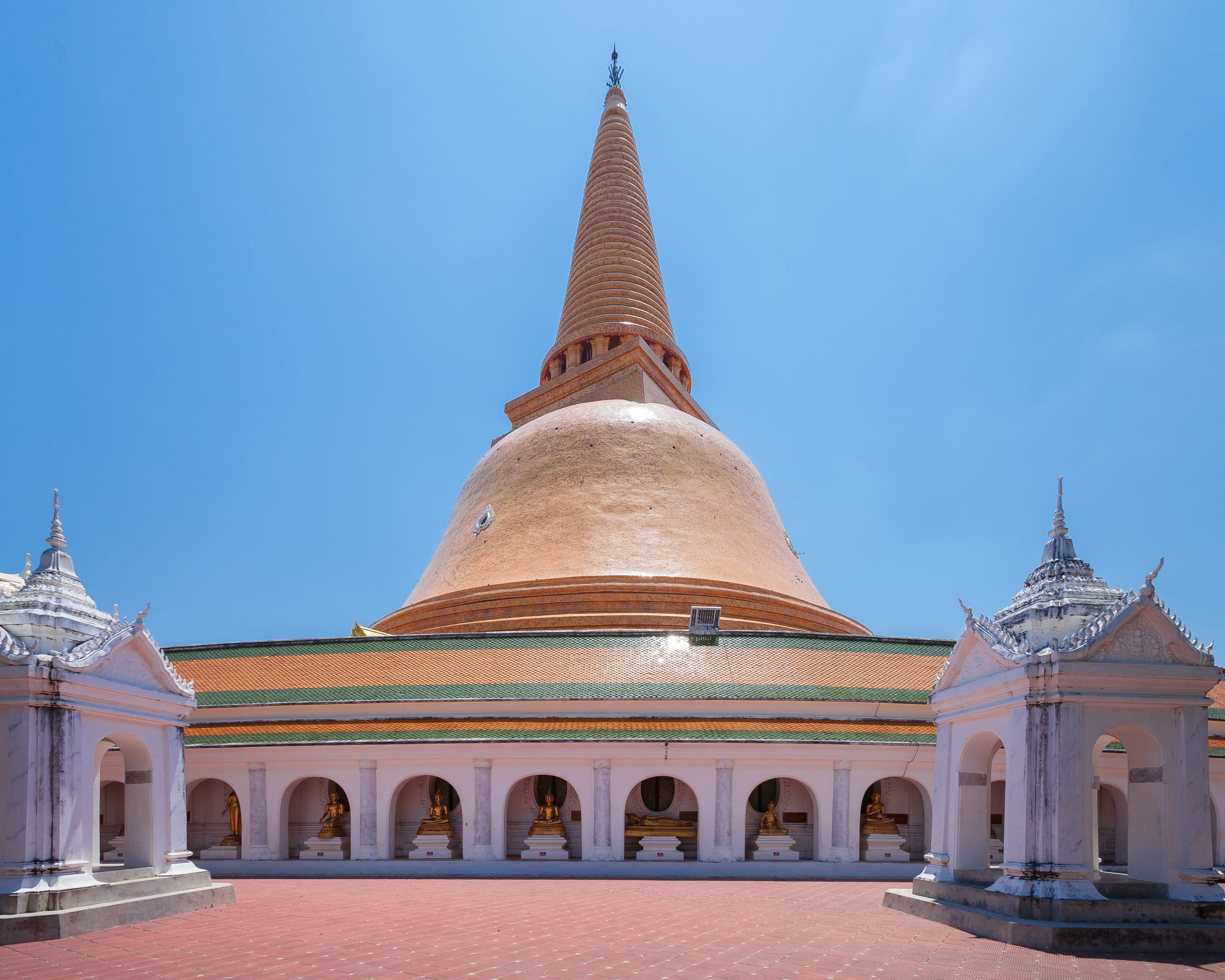
The huge orange-brown bell of Phra Pathommachedi with its tall spire, above a tiled cloister of small gold Buddha images under a clear sky

Bangkok & the Central Plains, Thailand

Nakhon Pathom

Phra Pathommachedi and its surrounding cloister in the centre of Nakhon Pathom. (Supanut Arunoprayote / Wikimedia Commons · CC BY 4.0)

A provincial town about 55 kilometres west of Bangkok, built around Phra Pathommachedi, one of the tallest Buddhist stupas in the world. The site was a centre of the Mon-speaking Dvaravati culture and is linked to the earliest Buddhism in Thailand; the modern town is a university and market place on the road and railway west.

Neighbourhoods

  • Around the chedi
    • First-time visitors
    • Historic district
    • Best for food

    The centre of the town is the stupa and its walled terrace, ringed by a road and by the main market, shophouses, sweet shops and food stalls. Almost everything a visitor wants is within a few hundred metres of the outer wall.

    Open in Maps
  • The station quarter
    • Close to public transport
    • Markets

    The railway station stands a short walk north of the chedi, with the line to Kanchanaburi and the south running through the town. Around it are bus stops, hotels, a fresh market and the stalls that sell khao lam and pomelos to passengers.

    Open in Maps
  • Sanam Chandra
    • Quiet and residential
    • Parks
    • Students

    A green district west of the centre around the palace grounds of King Vajiravudh and the Sanam Chandra campus of Silpakorn University, with lawns, canals, student cafés and cheap eating places.

    Open in Maps

Things to do

In the town

  • Phra Pathommachedilandmark

    A stupa about 120 metres high covered in orange-brown tiles, rebuilt in the 19th century by King Mongkut over a far older monument, and the tallest stupa in Thailand.

    Open in Maps
  • Phra Pathom Chedi National Museummuseum

    A small museum beside the stupa holding Dvaravati sculpture, stone dharma wheels and objects excavated from the ancient town.

    Open in Maps

Palaces and parks

  • Sanam Chandra Palacelandmark

    A group of early 20th-century royal buildings, mixing Thai and European styles, built for King Vajiravudh in gardens crossed by canals west of the chedi.

    Open in Maps
  • Phra Ratchawang Sanam Chandra gardenspark

    The lawns, ponds and canal walks around the palace, shared with Silpakorn University's local campus and used for exercise and picnics.

    Open in Maps

Short trips from the town

  • Wat Rai Khinglandmark

    A riverside temple in Sam Phran, just over 20 kilometres east, built around a revered Buddha image and known for the fish sanctuary in the river below, where visitors buy food to feed the shoals.

    Open in Maps
  • Phutthamonthonpark

    A large Buddhist park created in 1957 at Salaya, with a walking Buddha figure nearly 16 metres tall at its centre, on the road towards Bangkok.

    Open in Maps
  • Don Wai Marketmarket

    A riverside market in Sam Phran, east of the town, behind Wat Don Wai on the Tha Chin River, known for stewed duck, local produce, sweets and river boat trips.

    Open in Maps

Seasonal events

  • Phra Pathommachedi FestivalNovember, around Loy Krathong

    A temple fair on the terraces around the stupa, held from the full moon of the twelfth lunar month, with stalls, performances and crowds from across the province.

  • Loy KrathongNovember

    Candle floats are set on the canals and the Tha Chin River on the full moon of the twelfth lunar month.

  • Songkranmid-April

    The Thai new year brings water-pouring at the temples, processions and water-throwing on the streets around the chedi.

Eat and drink

Long-standing places and food districts in Nakhon Pathom. Hours, ratings and directions come from your maps app, always current.

Nakhon Pathom classics

  • Khao lammarket

    Sticky rice with coconut cream and black beans baked inside a length of bamboo, split open to eat; stalls near the chedi and the station sell it by the bundle.

    Open in Maps
  • Pomelosmarket

    The province is known across Thailand for its som o, large sweet pomelos, sold whole or peeled into segments with chilli-salt.

    Open in Maps
  • Khao mu daeng and khao mu kroprestaurant

    Red-roasted and crisp-fried pork over rice with a sweet gravy, a Chinese-Thai staple of the shophouses around the market.

    Open in Maps

Markets and food streets

  • Nakhon Pathom marketmarket

    The town's main market spreads between the chedi and the railway, selling produce, grilled meats, curries by the bag and Thai sweets from early morning.

    Open in Maps
  • Don Wai Marketmarket

    A riverside market of old wooden shophouses and food stalls along the Tha Chin, known for Chinese stewed duck, fish, fruit and traditional sweets.

    Open in Maps

Experience Nakhon Pathom

History

The area around Nakhon Pathom holds one of the oldest continuously significant Buddhist sites in Thailand. Between roughly the 6th and 11th centuries it was a major centre of the Mon-speaking Dvaravati culture, with a moated town, brick monuments and a distinctive sculpture of stone dharma wheels and standing Buddhas; the name itself is usually read as "first city". Tradition connects the site with the arrival of Buddhist missionaries from the Indian subcontinent in the third century BCE, and the earliest stupa here is far older than the Thai kingdoms.

The Khmer empire later drew the region into its orbit, and the town declined as the coastline shifted and the Chao Phraya delta grew; by the Ayutthaya period the great monument stood ruined and overgrown in open country. In 1831 Prince Mongkut, then still a monk, found the ruin, and after becoming King Rama IV he ordered a vast new bell-shaped chedi to be raised over it. The work took 17 years and was finished in 1870 under his successor, leaving the structure seen today, about 120 metres tall.

A canal, then the railway west, brought the town back to life around the stupa. King Vajiravudh, Rama VI, built Sanam Chandra Palace here between 1907 and 1911 and used it as a base for the Wild Tiger Corps, his volunteer force. In the 20th century Nakhon Pathom became a provincial capital and a university town, with Silpakorn University's Sanam Chandra Palace campus in the grounds since 1965 and Mahidol University's large campus at Salaya towards Bangkok, while Bangkok's suburbs and industry crept steadily westwards.

Culture & Customs

The chedi organises the town in every sense. It is a pilgrimage site as much as a monument: Thai visitors come to make merit, circle the terrace with flowers and incense, and take home miniature replicas, and the November fair around it is the province's biggest annual event. Its silhouette appears on the provincial seal and on the products of local businesses, and local identity is built on being the site of the country's first Buddhist foundation.

The Dvaravati inheritance gives the province an archaeological character unusual in central Thailand: the museums hold stone wheels, terracotta heads and Mon inscriptions, and Silpakorn University, founded to teach fine art and archaeology, maintains that link. The student population of the Sanam Chandra and Salaya campuses also gives the town a younger, cheaper, more informal side than its conservative surface suggests, with cafés and small live-music bars near the universities.

The province has a strong Chinese-Thai presence in trade and in the shophouses around the market, and a long-established rural Lao-descended population in some districts, with local temple fairs and likay folk theatre still performed. Old farming customs persist in the orchards: pomelo growing, sugar cane and coconut gardens are family businesses passed down, and the fruit season shapes the calendar as much as the Buddhist one.

Daily Life

Nakhon Pathom is a small provincial city at the centre of a much larger province that is increasingly an extension of Bangkok's western edge. The town's day starts before dawn at the market and quietens early; government offices, schools, hospitals and the two university campuses provide much of the steady employment.

The provincial economy is agricultural and industrial at once. Orchards and market gardens supply Bangkok with pomelo, coconut, sugar cane, vegetables and flowers, and the pig and poultry industries are large here. Food processing, packaging and light manufacturing plants line the highways, and the commute into Bangkok by road or rail is a daily routine for many residents of the eastern districts, where housing estates have replaced fields.

Life is provincial and family-centred: shophouse businesses run by the same families for generations, evening exercise and markets in the park around the chedi, temple merit-making on Buddhist holy days. Current concerns are the ones of a town being absorbed by a growing capital — land prices, traffic on the highways, water quality in the Tha Chin River, and seasonal air pollution drifting in during the dry months.

Food

Nakhon Pathom's best-known product is fruit: som o, the pomelo, grown in the province's orchards and sold at roadside stalls whole or peeled into pink and white segments to be eaten with a dip of salt, sugar and chilli. Coconut and sugar cane grow alongside it, and the palm sugar of the western plains sweetens much of the local cooking.

The town's signature snack is khao lam: sticky rice, coconut cream, sugar and black beans packed into a length of bamboo and roasted over charcoal until the rice sets, then split open along the tube. Stalls sell it in bundles near the chedi and beside the railway, and it is the standard gift to take home. Other sweets follow the central Thai repertoire — khanom krok, layered khanom chan and egg-yolk confections.

Savoury eating is Chinese-Thai and market-based. Khao mu daeng, red-roasted pork over rice with a sweet gravy and boiled egg, and khao mu krop, crisp pork belly, are served in shophouses around the market; kuay tiao noodle soups and pork satay are everywhere; and the riverside markets to the east, Don Wai in particular, are known for duck braised or roasted with Chinese herbs, eaten with rice or noodles. Freshwater fish from the Tha Chin, grilled in a salt crust, is a weekend family dish.

Planning tools

Budget

Nakhon Pathom is a cheap provincial town with few tourist prices. Hotels are modest and inexpensive, market food costs very little, and the main sights charge small fees or none at all. The largest expense for most visitors is transport to and from Bangkok.

Daily Budget Midrange
USD 75–160 (better hotel, restaurant meals, a hired car or taxi, day trips around the province)
Daily Budget Shoestring
USD 20–40 (simple hotel or guesthouse, market food, trains and songthaews)

The train from Bangkok is much cheaper than a car or tour and drops passengers a short walk from the chedi.

Best Time to Visit

November to February is the driest and mildest time, and the chedi fair falls in November. Pomelos are at their best in the cool season. March to May is very hot on the open terraces around the stupa, and the rains from June to October bring heavy afternoon storms.

Suggested Number of Days

The chedi and the palace grounds can be seen in a few hours, and many people stop on the way to or from Kanchanaburi. Staying a night suits anyone wanting the markets and the temples along the Tha Chin River as well.

First Visit
half a day to 1 day
With Surroundings
1–2 days

Transportation

The centre is small and easily walked, and songthaew pick-ups, motorcycle taxis and tuk-tuks cover the rest of the town and the university campus. Buses and minivans link the province's districts, and trains stop on the line between Bangkok and the south and west.

Agree a price before taking a tuk-tuk or motorcycle taxi; fares here are not metered.

Airport & Station Connections

Nakhon Pathom is about 55 kilometres west of Bangkok, roughly an hour by road outside peak traffic. The station is in the centre of town, about 48 kilometres out along the southern railway from Thon Buri station in Bangkok, and trains towards Kanchanaburi call here as well. Minivans and buses run from the capital's southern terminal, and Suvarnabhumi Airport is about an hour and a half away by road.

Walkability

The chedi, the market and the station form a compact walkable core, with pavements and shade under the shop awnings. Sanam Chandra is about two kilometres west, walkable in cool weather but usually reached by songthaew, and the traffic circling the stupa is constant.

Safety

Nakhon Pathom is a quiet town with little crime affecting visitors. The main hazards are traffic on the ring road around the chedi, heat on the open terraces, and occasional overcharging by drivers. Stray dogs gather around some temple grounds.

Take care crossing the road around the chedi, carry water in hot weather, and fix fares in advance. Check current official travel advice before travelling.

Climate

Tropical and hot all year, on the same pattern as Bangkok but slightly less affected by city heat. Three seasons: hot, rainy and a short cool one.

Summer
March to May is the hottest, commonly 34–39°C at midday; the rainy season from June to October is a little cooler with heavy afternoon storms
Winter
November to February is drier and pleasanter, roughly 20–33°C, with cool mornings

Local Customs

The chedi is one of the most revered Buddhist sites in Thailand and is treated accordingly: shoulders and knees covered, shoes removed before entering the viharn halls, and no climbing on the terraces or turning the feet towards a Buddha image. Visitors circle the stupa clockwise. The town is conservative and quiet in the evening.

Dress modestly at the chedi and at Wat Rai Khing, remove shoes where others do, and ask before photographing monks or people praying.

Common Payment Methods

The currency is the Thai baht. Hotels and larger restaurants take cards, but the market, food stalls, songthaews and tuk-tuks run on cash or Thai QR payment. ATMs are around the chedi, the station and the shopping centres.