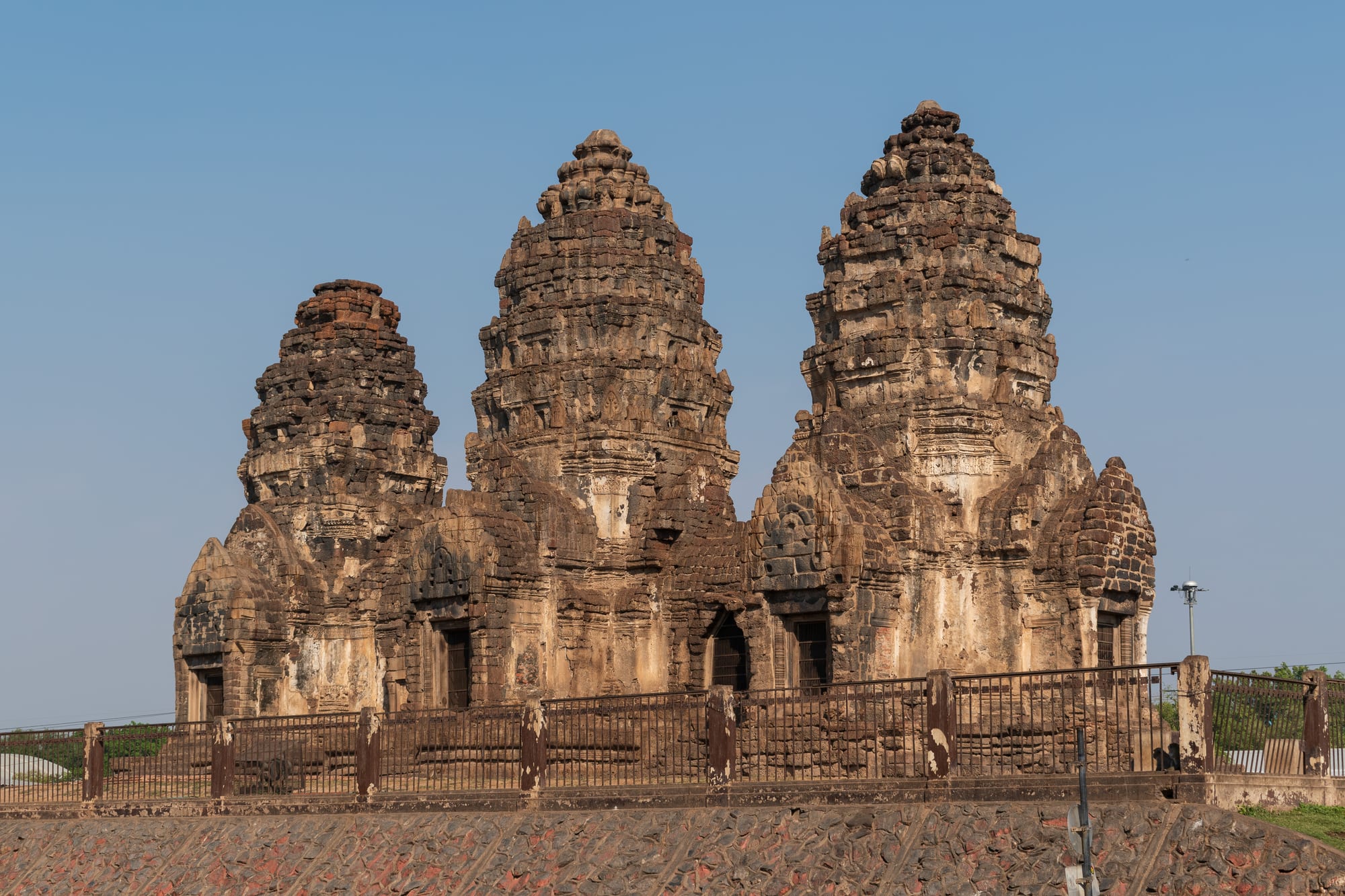
Three weathered laterite Khmer towers of Phra Prang Sam Yot standing side by side above a railing under a clear blue sky

Bangkok & the Central Plains, Thailand

Lopburi

Phra Prang Sam Yot, the three-towered Khmer shrine in the old town of Lopburi. (Dominic Nelson / Wikimedia Commons · CC BY-SA 4.0)

A town on the northern edge of the central plains, about 150 kilometres from Bangkok, whose old quarter holds Khmer laterite towers, a 17th-century royal palace and the ruins of King Narai's second capital. It is also a large army town, and is known worldwide for the macaques that live among its monuments.

Neighbourhoods

  • The old town
    • First-time visitors
    • Historic district
    • Close to transport

    The compact grid between the railway station and the Lopburi River, holding the palace walls, the Khmer towers, the shrine of Phra Kan and rows of shophouses. Almost all the monuments and the cheaper hotels are within a few streets of each other, and this is where the macaques live.

    Open in Maps
  • Around the railway station
    • Close to public transport
    • Markets
    • Best for food

    The station sits at the edge of the ruins, with the fresh market, food stalls and shophouse hotels around it. Ordinary trains from Bangkok and the north stop here, and monkeys are a regular sight on the platforms and the footbridge.

    Open in Maps
  • The new town and army quarter
    • Quiet and residential
    • Shopping

    East and south of the old quarter lie the modern districts: wide roads, shopping centres, hospitals, government offices and the extensive army camps and training grounds that dominate the town's economy and give its streets a distinct uniformed character.

    Open in Maps

Things to do

Khmer-era monuments

  • Phra Prang Sam Yotlandmark

    Three linked laterite towers raised early in the 13th century by the Khmer king Jayavarman VII as a Mahayana Buddhist shrine, rededicated to Theravada Buddhism once Lopburi came under Ayutthaya; the resident macaques have made it the town's emblem.

    Open in Maps
  • Prang Khaeklandmark

    Three small brick towers marooned on a traffic island in the middle of the old town, dating from the 9th or 10th century and counted as the oldest Angkorian temple in Lopburi and central Thailand.

    Open in Maps
  • Wat Phra Si Rattana Mahathatlandmark

    A large ruined temple opposite the railway station, with a tall Khmer-style prang surrounded by chedis and the brick shells of later Ayutthaya-period halls.

    Open in Maps

The royal town

  • Narai Ratcha Niwetlandmark

    King Narai's walled palace of the 1660s, with audience halls, water tanks, elephant stables and warehouses inside; part of it now houses the Somdet Phra Narai National Museum.

    Open in Maps
  • Ban Wichayenlandmark

    The brick ruins of a residence and Christian chapel built in Narai's reign for foreign envoys and associated with Constantine Phaulkon, the Greek chief minister of King Narai.

    Open in Maps
  • Wat Sao Thong Thonglandmark

    A temple beside the palace whose hall has Gothic-arched windows, reflecting the European contacts of Narai's court, with old Buddha images inside.

    Open in Maps

Beyond the old quarter

  • Pa Sak Jolasid Damattraction

    The biggest reservoir in central Thailand, about 50 kilometres south-east, reached from November to January by a weekend excursion train from Bangkok that halts on the viaduct across the water.

    Open in Maps

Seasonal events

  • Monkey Buffet Festivalusually the last Sunday of November

    Tables of fruit and vegetables are laid out for the macaques at Phra Prang Sam Yot, watched by large crowds; in some years the food has been set in blocks of ice.

  • Sunflower seasonthe cool season

    Fields of sunflowers come into bloom on the province's dry uplands, notably around Phatthana Nikhom, with roadside stalls selling seeds and honey.

  • Loy KrathongNovember

    Candle floats are set on the Lopburi River on the full moon of the twelfth lunar month.

Eat and drink

Long-standing places and food districts in Lopburi. Hours, ratings and directions come from your maps app, always current.

Lopburi classics

  • Sunflower-seed sweets and honeymarket

    The province's sunflower crop supplies roasted seeds, brittle and honey, sold at roadside stalls and in the town's markets.

    Open in Maps
  • Kuay tiao and shophouse noodlesrestaurant

    Chinese-Thai noodle shops around the station and the old town serve pork and beef noodle soups, boiled rice soup in the morning and crisp pork over rice.

    Open in Maps

Markets and food streets

  • Lopburi night marketmarket

    Evening stalls near the old town selling grilled meats, curries by the bag, papaya salad and Thai sweets.

    Open in Maps
  • Lopburi fresh marketmarket

    The daily market by the station, with produce from the surrounding farms, river fish, and cooked food from before dawn.

    Open in Maps

Experience Lopburi

History

Lopburi is one of the oldest continuously inhabited towns in Thailand. As Lavo it was a centre of the Mon-speaking Dvaravati culture from about the 6th century, with its own rulers and a Buddhist tradition recorded in inscriptions and in stone dharma wheels found on the site. From the 10th and 11th centuries the Khmer empire drew Lavo into its sphere, and the laterite towers that still stand in the town centre — Phra Prang Sam Yot, Prang Khaek and the prang of Wat Phra Si Rattana Mahathat — date from that period of Angkorian influence, giving the local style the name Lopburi art.

After Ayutthaya was founded in 1351 Lopburi became a northern stronghold of the Siamese kingdom. Its great moment came under King Narai, who ruled from 1656 to 1688 and made the town a second capital, spending much of the year here. He built the walled palace of Phra Narai Ratchaniwet, waterworks fed by clay pipes from the hills, and residences for foreign envoys, and received embassies from Louis XIV of France as well as Persian and Dutch missions. The Greek adventurer Constantine Phaulkon rose to chief minister in this court and was executed in June 1688, in the revolution that broke out as Narai lay dying; the town was largely abandoned by the court afterwards.

King Mongkut restored the palace in the 1850s and used it again as a retreat. From 1937 the government of Field Marshal Plaek Phibunsongkhram built a planned new town a few kilometres east and made Lopburi a major military centre, which it remains: army training schools, artillery and special forces units occupy much of the district. The old quarter kept its ruins, its shophouses and, increasingly, its monkeys.

Culture & Customs

No other Thai town is so defined by animals. Several thousand long-tailed macaques live around Phra Prang Sam Yot and the shrine of Phra Kan, and local belief associates them with the monkey armies of the Ramakien and with the guardian spirit of the shrine, so they are tolerated and fed rather than removed. The annual Monkey Buffet Festival, held around the last Sunday of November, lays out pyramids of fruit for them and draws photographers from around the world, while residents and shopkeepers live with daily raids, barred windows and damaged wiring; in 2024 the government began a mass round-up and sterilisation campaign, and within five months about 1,600 of an estimated 3,000 monkeys had been taken into captivity for neutering.

The other strand of local identity is historical: Lopburi presents itself as the town of King Narai and of the Khmer past. The palace grounds are the setting for historical pageantry in 17th-century costume, and the Somdet Phra Narai National Museum inside them holds Lopburi-style bronzes and Dvaravati sculpture. Local pride in the French embassies and in Phaulkon's story is real, and the episode is taught as an early Thai encounter with European ambition.

The army shapes everyday manners too, with uniformed personnel in the streets, parade grounds, military hospitals and families posted here from across the country. Otherwise the customs are those of the central plains: merit-making at the temples on holy days, alms rounds at dawn, Songkran and Loy Krathong as the main public festivals, and a quiet, early evening.

Daily Life

The town has a population of about 58,000, with more in the surrounding district, and only a part of that in the old town itself, which is a few streets of shophouses, small hotels and offices around the monuments. Most modern life happens in the new town to the east and in the garrison areas, where the shopping centres, hospitals and schools are.

The economy has three legs. The military is the largest employer, with training commands, artillery and special warfare units and their supporting businesses. Agriculture fills the province — sugar cane, cassava, maize, rice and sunflowers on the drier uplands — feeding sugar mills and processing plants. Tourism is small and concentrated on day visitors who arrive by train, see the ruins and the monkeys, and leave again, which is a long-standing local complaint.

Daily routines in the old quarter are arranged around the macaques: shopkeepers fit metal grilles, residents carry sticks or water pistols, and the troops that control different streets are known individually. Elsewhere life is ordinary provincial Thailand, starting early at the market and quiet by nine in the evening. Current concerns include the monkey population itself, which has grown and spread, drought in the farming districts, and the pull of Bangkok on younger residents.

Food

Lopburi eats like the central plains with an upland accent. The market and the shophouses around the station serve kuay tiao noodle soups with pork or beef, khao mu daeng and khao mu krop — red-roasted and crisp pork over rice — boiled rice soup in the morning and rice-and-curry shops at lunch. Freshwater fish from the Lopburi and Pa Sak rivers appear grilled in salt crust or in sour curries, and Isan food from the north-east, with grilled chicken, som tam and sticky rice, is common because so many soldiers and workers come from that region.

The province's own products are agricultural. Sunflowers grown on the dry hills give roasted seeds, seed brittle and sunflower honey, all sold at the roadside in the cool season and taken home as gifts. Sugar cane and cassava fields surround the town, and local sweets rely heavily on palm sugar and coconut; khanom krok and grilled bananas are sold from carts in the evening.

Eating outdoors near the monuments is complicated by the macaques, which take food directly from hands and tables, so the stalls and restaurants of the old town shelter behind screens and grilles, and the night market is set a little away from the ruins. The usual drinks are cha yen, orange tea with condensed milk, oliang, strong iced black coffee, and fresh sugar-cane juice pressed at the market.

Planning tools

Budget

Lopburi is inexpensive even by Thai provincial standards, with modest hotels, cheap market food and small entry fees at the palace and the monuments. There is little in the way of luxury accommodation, and transport within the old town costs almost nothing.

Daily Budget Midrange
USD 75–160 (comfortable hotel, restaurant meals, a hired car or driver, trips out to the dam and the hills)
Daily Budget Shoestring
USD 20–40 (guesthouse or shophouse hotel, market food, trains and songthaews)

Ordinary trains from Bangkok still stop beside the ruins, which makes a car unnecessary for the old town.

Best Time to Visit

November to February is the coolest and driest stretch, with the sunflower fields in bloom and the monkey festival usually on the last Sunday of November. March to May is hot and dusty on this side of the plains, and the rains from June to October are heaviest late in the season.

Suggested Number of Days

The monuments of the old town are close together and take a day at most, which is why many visitors arrive and leave by train on the same afternoon. Staying longer suits anyone wanting the reservoir and the sunflower country in season.

First Visit
1 day
With Surroundings
2 days

Transportation

The old town is small enough to cover on foot, and songthaew pick-ups, motorcycle taxis and tuk-tuks link it with the new town, the bus station and the army districts. Ordinary and commuter trains on the northern line stop in the centre, while rapid and express services use Lopburi 2 (Tha Wung) station on a bypass line outside the town, and buses and minivans run to Bangkok, Ayutthaya, Saraburi and the north-east.

Keep bags closed and hold nothing edible in the hand near the monuments; the macaques are quick and will take food, bottles and sunglasses.

Airport & Station Connections

Lopburi is about 150 kilometres north of Bangkok. Trains on the northern line take roughly two to three hours and pass through Ayutthaya; ordinary and commuter services stop opposite the ruins, while rapid and express trains use Lopburi 2 (Tha Wung) station, opened in December 2025 on a bypass line outside the town. Buses and minivans use the terminal in the new town, a few kilometres from the old quarter, and the drive from Bangkok takes around two and a half hours.

Walkability

The old town is flat, compact and best seen on foot: the station, the palace, the Khmer towers and the shrine are all within a kilometre of each other. Pavements are narrow and shared with parked motorbikes and monkeys, and the new town, several kilometres away, is built for cars.

Safety

Lopburi is a calm provincial town, and the unusual risk here is the macaques. Thousands of them live around the old quarter, in spite of a round-up and sterilisation campaign begun in 2024; they snatch food, bags, phones and glasses, gather on wires and rooftops, and can bite or scratch, which needs medical attention because of the rabies risk. They also fight among themselves in the streets. Traffic and heat are the other concerns.

Carry no visible food or drink near the monuments, do not feed or tease the monkeys, keep bags zipped and held in front, and seek medical advice at once after any bite or scratch. Check current official travel advice before travelling.

Climate

Tropical, hot and drier than the lower plains, with a marked cool season and a dusty hot season. The uplands to the north and east are a little cooler at night.

Summer
March to May is hot and dry, often 35–40°C at midday; the rainy season from June to October is cooler with afternoon storms and heavier rain in September
Winter
November to February is dry and mild, roughly 18–33°C, with noticeably cool mornings

Local Customs

The monuments are religious sites as well as ruins, so shoulders and knees should be covered and shoes removed in halls still in use. Offerings left at the Phra Kan shrine belong to the shrine and the monkeys, not to visitors. Lopburi is a garrison town and military areas are not to be photographed.

Dress modestly at temples, avoid photographing army camps, checkpoints or personnel, and do not hand food to the macaques even where others do.

Common Payment Methods

The currency is the Thai baht. Hotels and larger restaurants accept cards, while markets, stalls, songthaews and site tickets are cash or Thai QR payment. ATMs are near the station and in the new town's shopping centres.