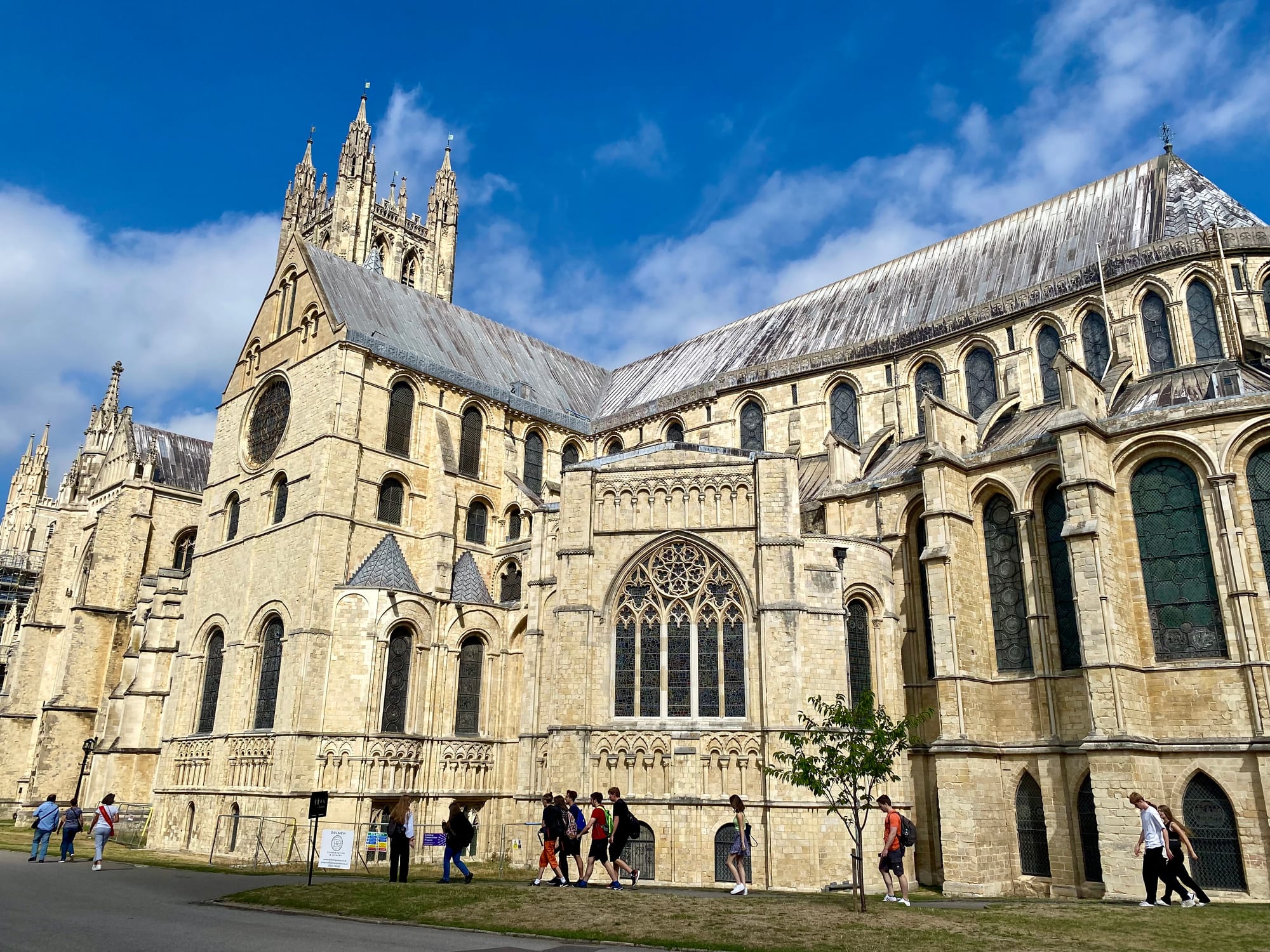
The pale stone Gothic walls, tall windows and pinnacled towers of a great cathedral under a blue summer sky

London & the South East, United Kingdom

Canterbury

Canterbury Cathedral, the seat of the Archbishop of Canterbury, in August 2022. (No Swan So Fine / Wikimedia Commons · CC BY-SA 4.0)

A walled cathedral city on the River Stour in east Kent, about 55 miles east-southeast of London. A Roman town and the Kentish capital where Augustine founded England's senior church in 597, it became one of Europe's great pilgrimage centres after Thomas Becket's murder in 1170. Today it is a UNESCO World Heritage city with three universities and a large student population.

Neighbourhoods

  • The walled city
    • First-time visitors
    • Historic district
    • Shopping

    The medieval centre inside the ring of the city walls, with the cathedral and its precincts, timber-framed 16th- and 17th-century houses and the pedestrianised High Street running straight across from the Westgate. Shops and cafés fill the streets of the Cathedral Quarter.

    Open in Maps
  • Westgate and St Dunstan's
    • Historic district
    • Riverside walks

    The north-west edge of the old city, where the Westgate, the only surviving city gate, stands beside the River Stour. Beside it lie the riverside Westgate Gardens, from which boat trips run, and across the roundabout St Dunstan's Street.

    Open in Maps
  • University hill
    • Students
    • Quiet and residential

    The University of Kent's principal campus, 300 acres of land overlooking the cathedral, founded in 1965 and since a 2026 merger with the University of Greenwich part of the London and South East University Group (LASE). Its Gulbenkian Theatre includes a cinema and café.

    Open in Maps

Things to do

The World Heritage Site

  • Canterbury Cathedrallandmark

    The seat of the Archbishop of Canterbury, whose east end was largely rebuilt in Gothic style after a fire in 1174, and where Thomas Becket was murdered in 1170.

    Open in Maps
  • St Augustine's Abbeylandmark

    The ruins of the abbey founded by Augustine after his arrival in 597 and refounded by Archbishop Dunstan in 978, just outside the city walls.

    Open in Maps
  • St Martin's Churchlandmark

    The oldest existing church in the English-speaking world and the oldest English church building still in use for worship.

    Open in Maps

Walls, museums and historic sights

  • Westgate Towersmuseum

    The medieval gatehouse on the River Stour, the only city gate spared in 1787, Canterbury's prison from the 15th to the 19th century and now home to the West Gate Towers Museum.

    Open in Maps
  • Canterbury Castlelandmark

    The ruins of a Norman castle whose great stone keep was largely built in the reign of Henry I, a five-minute walk from Canterbury East station.

    Open in Maps
  • Canterbury Roman Museummuseum

    A museum built around a Roman pavement found after Second World War bombing, holding finds from Roman Canterbury including the Canterbury Treasure, a late Roman silver hoard.

    Open in Maps
  • The Beaneymuseum

    The city's central museum, library and art gallery, in a Victorian building.

    Open in Maps
  • Dane John Gardenspark

    Gardens built between 1790 and 1803 in the south-east corner of the city walls, on the site of a Roman cemetery and burial mound and incorporating the medieval wall-walk.

    Open in Maps

Theatre and sport

  • Marlowe Theatreattraction

    The city's main theatre, named after the playwright Christopher Marlowe, who was born in Canterbury.

    Open in Maps
  • St Lawrence Groundattraction

    The home ground of Kent County Cricket Club, which hosts many of the county's matches.

    Open in Maps

Short trips from the city

  • Whitstableattraction

    A seaside town 6 miles to the north, famous for oysters gathered from beds offshore from Roman times until the mid-20th century.

    Open in Maps
  • Favershamattraction

    A market town 8 miles to the north-west, home of the Shepherd Neame brewery.

    Open in Maps

Seasonal events

  • Canterbury Festivaltwo weeks in October and November

    The city's arts festival, begun in the 1980s, with more than 200 events in Canterbury and nearby towns, from opera and symphony concerts to world music, jazz and folk.

  • Whitstable Oyster Festivalsummer

    An annual summer festival in nearby Whitstable, now called the Whitstable Rocks Oyster Festival, celebrating the town's links with the oyster industry.

Eat and drink

Long-standing places and food districts in Canterbury. Hours, ratings and directions come from your maps app, always current.

Canterbury classics

  • Old Weavers Restaurantrestaurant

    A restaurant by one of the spurs of the River Stour on St Peter's Street, with a patio, serving traditional English and Italian food; river boat trips leave from beside it.

    Open in Maps
  • The Goods Shedmarket

    A restaurant in a converted engine shed on Station Road West, by Canterbury West station, with an adjoining farmers' market.

    Open in Maps

Food districts

  • The city centreneighborhood

    Low- to mid-range restaurants and cafés in many styles of cuisine across the city centre, including the Cathedral Quarter.

    Open in Maps

Experience Canterbury

History

The Romans captured a British settlement on the Stour in the 1st century AD and named it Durovernum Cantiacorum. Its position on Watling Street, between the Kentish ports of Richborough, Dover and Lympne, gave it strategic importance. After the Romans left Britain in 410 the town was largely abandoned for around a century, until an Anglo-Saxon community grew up inside the walls as Jutes arrived; they called it Cantwareburh, the "stronghold of the Kentish men". In 597 Pope Gregory the Great sent Augustine to convert King Æthelberht of Kent to Christianity, and Augustine made the Roman town the centre of his see, building an abbey and a cathedral and becoming the first Archbishop of Canterbury.

On 29 December 1170 Archbishop Thomas Becket was murdered in the cathedral by knights of King Henry II. Pilgrims from all over Christendom came to his shrine, making Canterbury one of the most notable towns in Europe, and the pilgrimage provided the framework for Geoffrey Chaucer's 14th-century Canterbury Tales. Henry VIII had the shrine demolished in 1538, ending the pilgrimages. From 1575 French-speaking Huguenot refugees settled in the city, and by the 17th century they made up two-fifths of its population; in 1620 the lease of the Mayflower was negotiated at 59 Palace Street.

In 1787 all the city gates except the Westgate were demolished to ease coach traffic, and in 1830 the Canterbury and Whitstable Railway opened as the world's first passenger railway. The most devastating air raid of the Second World War struck on 1 June 1942, in the Baedeker Blitz, destroying many old buildings. The biggest expansion came in the 1960s with the arrival of the University of Kent and Christ Church College.

Culture & Customs

Canterbury Cathedral is the seat of the Archbishop of Canterbury, the senior clergyman of the Church of England and the spiritual leader of the Anglican Communion, and with St Augustine's Abbey and St Martin's Church — the oldest existing church in the English-speaking world — it forms a UNESCO World Heritage Site. The King's School, which traces its origins to Augustine, is described as the oldest extant school in the world.

The playwright Christopher Marlowe was born in the city, and the Marlowe Theatre is named after him; the University of Kent's Gulbenkian Theatre adds a cinema and café, and performances are also staged in the cathedral and at St Augustine's Abbey. The Canterbury Festival, begun in the 1980s, fills two weeks each October and November with opera, symphony concerts, world music, jazz and folk. Chaucer's pilgrims inspired the 1944 film A Canterbury Tale by Michael Powell and Emeric Pressburger.

The city is the home of Kent County Cricket Club, which plays many of its matches at the St Lawrence Ground. Canterbury's newspaper, the Kentish Gazette, claims to be the country's second-oldest surviving newspaper. Canterbury is also a popular destination at Christmas, when festive lights decorate the medieval streets.

Daily Life

The city had a population of 55,087 at the 2021 census, and one of the highest student-to-resident ratios in Britain: some 31,000 students attend three universities and other colleges, the largest being the University of Kent, which merged with the University of Greenwich in 2026 but keeps its name, and Canterbury Christ Church University. In 2014–15 the two universities were worth £909 million to the city's economy and accounted for 16 per cent of all jobs.

The city is the centre of the City of Canterbury local government district, which also takes in the coastal towns of Whitstable and Herne Bay, 6 miles to the north. Its urban area is divided into the wards of Barton, Blean Forest, Northgate, St Stephens, Westgate and Wincheap. The MP for Canterbury, Rosie Duffield, was elected for the Labour Party but now sits as an independent.

A ring road outside the walls takes traffic away from the pedestrianised centre, and park-and-ride buses carry shoppers and workers in from the edge of the city. The rhythm of the year follows the university terms, with crowds of visitors in the summer months.

Food

Canterbury's city centre has a large choice of low- to mid-range restaurants and cafés in many styles of cuisine. The Old Weavers restaurant stands beside one of the spurs of the River Stour in an area sometimes called "Little Italy" and serves traditional English and Italian dishes, while the Goods Shed, a converted engine shed by Canterbury West station, combines a restaurant with a farmers' market selling local produce. The city also has French markets and farmers' markets.

Kent is called the Garden of England for its fruit orchards. Whitstable, 6 miles north, was famous for oysters gathered from beds offshore from Roman times until the mid-20th century, and still celebrates them with an annual summer Oyster Festival. In nearby Faversham, Shepherd Neame, whose official date of foundation is 1698 though brewing on the site dates back to 1573, produces cask ales and filtered beers and has 286 pubs and hotels in South East England, mostly in Kent and London.

Planning tools

Budget

Canterbury's city centre has plenty of low- and mid-range restaurants and cafés. The cathedral is the main paid sight. Rooms are tighter at summer weekends, at Christmas and around university graduation.

Daily Budget Midrange
USD 200–400 (mid-range hotel or guesthouse, restaurant meals, cathedral and museum tickets, a river trip)
Daily Budget Shoestring
USD 85–140 (hostel or budget guesthouse, cafés and pub meals, walking)

Visit from London on the high-speed train to save on a room, or stay overnight to see the cathedral precincts once the day-trippers have gone.

Best Time to Visit

Spring to early autumn is the most pleasant for walking the walls, the river and the gardens, and July and August are the busiest months. The Canterbury Festival fills two weeks in October and November, and at Christmas the lights and medieval streets draw shoppers.

Suggested Number of Days

Many visitors see Canterbury in a day from London, but a night allows time for the museums and the quieter evening city. Three or four days leave room for the Kent coast and the countryside nearby.

First Visit
1–2 days
With Surroundings
3–4 days

Transportation

The walled centre is small and largely pedestrianised, with a ring road outside the walls carrying the traffic. Park-and-ride buses run into the centre from three sites at Wincheap, New Dover Road and Sturry Road. National Cycle Route 1 runs through the city from Dover and Sandwich to Whitstable.

Leave the car at a park-and-ride site; the city centre is pedestrianised and parking is limited.

Airport & Station Connections

Canterbury has two stations, both run by Southeastern, with no direct link between them. High-speed trains from London St Pancras reach Canterbury West in just under an hour; slower trains from London Victoria reach Canterbury East in between 90 minutes and two hours. The nearest major airport is Gatwick, about 66 miles away.

Walkability

Very walkable. The cathedral, the High Street, the Westgate and the museums are a few minutes apart inside the walls, and St Augustine's Abbey and St Martin's Church are a short walk east. Both stations are just outside the walls.

Safety

The UK is generally safe, with the main risks being pickpocketing and phone theft in crowded parts of London and other cities, occasional late-night antisocial behaviour, and drink-related trouble around nightlife. In Canterbury the busiest times are summer days, when the centre is crowded with visitors, and term-time weekend nights.

Watch bags in the crowded High Street in summer and take care on the river. Check current official travel advice before travelling.

Climate

A mild oceanic climate. Canterbury has mild temperatures all year round, with average temperatures ranging between about 1.8°C and 22.8°C.

Summer
mild to warm, with average highs of about 22.8°C
Winter
cool and damp, with average lows of about 1.8°C

Local Customs

Canterbury Cathedral is a working church and the mother church of the Anglican Communion, so services take priority over sightseeing and quiet is expected inside. The city is relaxed and informal, and its large student population keeps it lively in term time.

Respect services and quiet areas in the cathedral and churches, and check the rules before photographing inside. Identification may be asked for when buying alcohol (the legal age is 18).

Common Payment Methods

The currency is the pound sterling. Shops and cash machines widely accept foreign credit and debit cards, and some merchants no longer accept cash. Scottish and Northern Irish banks issue their own notes, while Bank of England notes are accepted throughout the UK.