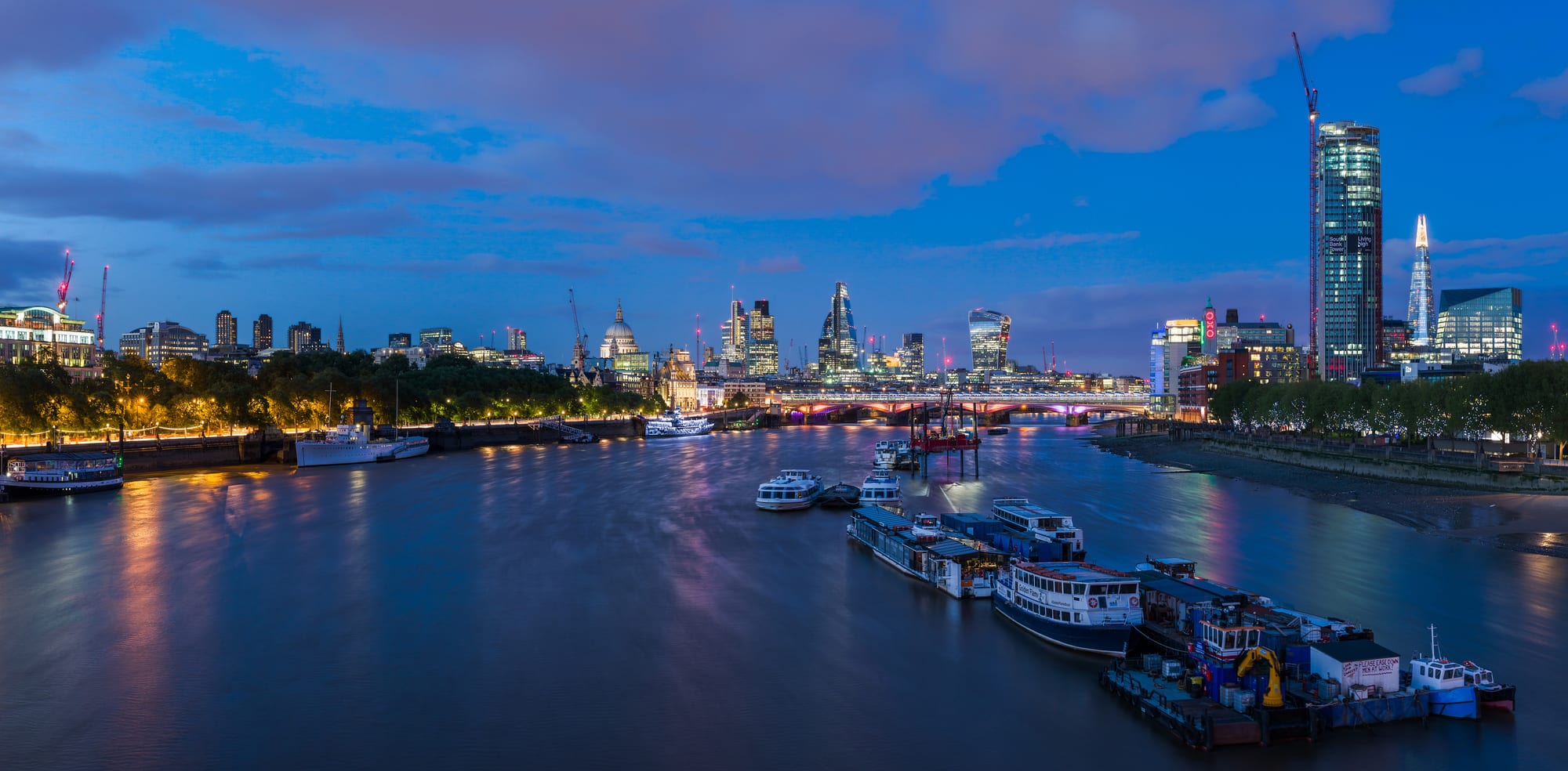
The Thames with moored barges, the dome of St Paul's and the towers of the City of London

London & the South East, United Kingdom

London

The River Thames, St Paul's Cathedral and the skyline of the City of London from Waterloo Bridge. (Diliff / Wikimedia Commons · CC BY-SA 3.0)

The capital of England and the United Kingdom, on the River Thames in the south-east of England. Founded by the Romans as Londinium, it grew into the centre of a global empire and the world's largest city in the 19th century. Today it is a financial centre and one of the world's most diverse cities, known for its royal palaces, free national museums and West End theatres.

Neighbourhoods

  • West End
    • First-time visitors
    • Theatre
    • Shopping

    The main shopping and entertainment district of inner west London, taking in Soho, Covent Garden, Leicester Square and Oxford Street. Most of the city's big theatres are here, along with Chinatown, the National Gallery on Trafalgar Square and a dense mix of restaurants, pubs and shops.

    Open in Maps
  • Westminster
    • First-time visitors
    • Historic district

    The seat of government beside the Thames: the Palace of Westminster, Westminster Abbey, the ministries of Whitehall and, across St James's Park, Buckingham Palace. Busy with visitors by day and quiet once the offices empty in the evening.

    Open in Maps
  • South Bank
    • Arts and culture
    • Riverside walks

    A narrow strip of riverside land on the south bank of the Thames opposite Westminster, home to the London Eye, the Southbank Centre, the Royal Festival Hall, the National Theatre and BFI Southbank. Bankside, with Tate Modern and Shakespeare's Globe, adjoins it to the east.

    Open in Maps
  • The City
    • Historic district
    • Architecture

    London's ancient core, founded by the Romans and still inside its medieval boundaries, now the financial district. Glass towers stand beside Wren churches, St Paul's Cathedral and fragments of the Roman wall; the streets are crowded on weekdays and much quieter at weekends.

    Open in Maps
  • South Kensington
    • Museums
    • Families

    A district in west London that holds the Natural History Museum, the Science Museum, the Victoria and Albert Museum and Imperial College London, built on land bought after the Great Exhibition of 1851 in nearby Hyde Park.

    Open in Maps
  • Shoreditch
    • Nightlife
    • Street art
    • Best for food

    A district in east London whose former industrial buildings have become offices and flats, now known for its pubs, bars, nightclubs, art galleries and restaurants, and for the web technology companies around Old Street, nicknamed 'Silicon Roundabout'.

    Open in Maps
  • Camden Town
    • Markets
    • Live music

    A north London district crossed by the Regent's Canal, known for the street markets around Camden Lock, its music venues and alternative culture, and restaurants of many culinary traditions near the markets.

    Open in Maps
  • Greenwich
    • Historic district
    • Quiet and residential

    A riverside town in south-east London with a maritime history, the Royal Observatory and the prime meridian, the Cutty Sark and Greenwich Park. It feels more like a separate small town than an inner-city district, and is reached by river boat, rail or the Docklands Light Railway; it contains the UNESCO World Heritage Site of Maritime Greenwich.

    Open in Maps

Things to do

Famous landmarks

  • Tower of Londonlandmark

    A castle on the north bank of the Thames whose White Tower was built by William the Conqueror; it has served as a prison, an armoury and a treasury and is the home of the Crown Jewels.

    Open in Maps
  • Tower Bridgelandmark

    The Victorian bascule and suspension bridge beside the Tower, built between 1886 and 1894, whose central bascules can be raised to let shipping pass.

    Open in Maps
  • Westminster Abbeylandmark

    The Gothic abbey church where 40 English and British monarchs have been crowned since 1066, and where 18 monarchs are buried.

    Open in Maps
  • Palace of Westminsterlandmark

    The riverside home of the House of Commons and the House of Lords, rebuilt in Gothic Revival style after a fire in 1834, with the clock tower that holds Big Ben.

    Open in Maps
  • Buckingham Palacelandmark

    The London residence and administrative headquarters of the monarch, scene of the Changing of the Guard and of royal balcony appearances.

    Open in Maps
  • St Paul's Cathedrallandmark

    Christopher Wren's domed cathedral on Ludgate Hill, completed in 1710 to replace the medieval cathedral lost in the Great Fire.

    Open in Maps
  • London Eyeviewpoint

    The giant observation wheel on the South Bank, originally the Millennium Wheel, which opened to the public in 2000.

    Open in Maps

Museums and galleries

  • British Museummuseum

    A museum of human history and culture founded in 1753, holding the Rosetta Stone and the Parthenon sculptures among millions of objects; like all UK national museums it charges no admission except for loan exhibitions.

    Open in Maps
  • National Gallerymuseum

    An art museum on Trafalgar Square founded in 1824, with more than 2,300 paintings from the mid-13th century to 1900; entry to the main collection is free.

    Open in Maps
  • Natural History Museummuseum

    A vast Romanesque-style building in South Kensington holding the national collections of fossils, minerals, plants and animals, known for its dinosaur galleries.

    Open in Maps
  • Victoria and Albert Museummuseum

    The V&A, the world's largest museum of applied arts, decorative arts and design, with a permanent collection of over 2.8 million objects.

    Open in Maps
  • Tate Modernmuseum

    The national gallery of international modern and contemporary art, inside the former Bankside Power Station on the South Bank.

    Open in Maps
  • Shakespeare's Globeattraction

    A reconstruction of the open-air playhouse for which Shakespeare wrote, completed in 1997 on the south bank of the Thames in Southwark, like the original; productions are staged in the summer months.

    Open in Maps

Parks and gardens

  • Hyde Parkpark

    The largest of a chain of royal parks in central London, divided by the Serpentine and the Long Water and merging with Kensington Gardens to the west, with Speakers' Corner in its north-east corner.

    Open in Maps
  • Regent's Parkpark

    A royal park designed by John Nash and James and Decimus Burton, with Queen Mary's Gardens, a boating lake and London Zoo on its northern side.

    Open in Maps
  • Kew Gardenspark

    A botanic garden in south-west London founded in 1759, a World Heritage Site with Victorian glasshouses and some of the largest and most diverse botanical collections in the world.

    Open in Maps
  • Royal Observatory, Greenwichattraction

    The observatory on a hill in Greenwich Park, overlooking the Thames, through which the prime meridian passes and which gave its name to Greenwich Mean Time.

    Open in Maps
  • Hampton Court Palacelandmark

    A Tudor palace on the Thames in south-west London, begun for Cardinal Wolsey in 1514 and given to Henry VIII; William III's rebuilding of the 1690s replaced much of it, and the gardens include the Hampton Court Maze.

    Open in Maps

Markets

  • Borough Marketmarket

    One of London's largest and oldest food markets, by London Bridge, on a site with a market since at least the 12th century.

    Open in Maps
  • Camden Marketmarket

    A number of adjoining markets around Camden Lock in the former Pickfords stables, selling crafts, clothing, books, bric-a-brac and fast food.

    Open in Maps
  • Portobello Road Marketmarket

    The street in Notting Hill that holds Portobello Road Market, known for second-hand clothes and antiques; Saturday is the main day for antiques.

    Open in Maps

Seasonal events

  • The London Parade1 January

    London's year begins with a fireworks display at the London Eye and a parade through the streets of the West End, first held in 1987 and formerly called the New Year's Day Parade.

  • RHS Chelsea Flower ShowMay

    A garden show run by the Royal Horticultural Society in the grounds of the Royal Hospital Chelsea, its home almost every year since 1913.

  • Trooping the ColourJune

    A ceremony on Horse Guards Parade by regiments of the Household Division to mark the sovereign's official birthday, with a royal procession down The Mall and a Royal Air Force flypast.

  • Notting Hill Carnivallate August bank holiday

    A Caribbean carnival held since 1966 in the streets of Notting Hill, attracting around two million people and one of the world's largest street festivals.

  • Lord Mayor's ShowNovember

    A procession through the City of London, on the second Saturday in November, marking the appointment of a new Lord Mayor of the City.

Eat and drink

Long-standing places and food districts in London. Hours, ratings and directions come from your maps app, always current.

London classics

  • M.Manzerestaurant

    A pie and mash shop on Tower Bridge Road in Bermondsey, first opened in 1892 and known for pie and mash with eel; the Manze family still run the M.Manze shops.

    Open in Maps
  • Rulesrestaurant

    A restaurant on Maiden Lane in Covent Garden, founded by Thomas Rule in 1798, which describes itself as London's oldest restaurant.

    Open in Maps

Food districts and markets

  • Borough Marketmarket

    A wholesale and retail market hall at the southern end of London Bridge selling fresh fruit and vegetables, cheese, meat, game, bread and pastry.

    Open in Maps
  • Brick Laneneighborhood

    An East End street known for its Bangladeshi curry houses and for beigels, sold in the area since the middle of the 19th century; Beigel Bake has been here since 1974.

    Open in Maps
  • Chinatownneighborhood

    A few streets around Gerrard Street in the West End lined with Chinese restaurants, bakeries and supermarkets.

    Open in Maps
  • Southallneighborhood

    A west London town home to the largest Punjabi community outside the Indian subcontinent, a major centre of South Asian culture with its main shops along the Broadway.

    Open in Maps

Experience London

History

Scattered Brythonic settlements existed in the area, but the first major settlement was founded by the Romans around AD 47, about four years after their invasion. Londinium was burned in Boudica's revolt around AD 61, rebuilt, and by the year 100 had replaced Colchester as the principal city of Roman Britain, with a population of perhaps 60,000 at its height in the 2nd century. After Roman rule collapsed early in the 5th century the walled city was largely abandoned. William the Conqueror built the White Tower after 1066, and medieval London grew from some 18,000 people in 1100 to nearly 100,000 by 1300 before the Black Death took almost a third of them.

The Tudor and Stuart city grew fast, from about 50,000 people in 1530 to about 225,000 in 1605. The Great Plague of 1665–1666 killed some 100,000 people, a fifth of the population, and in 1666 the Great Fire destroyed much of the wooden city; Christopher Wren's St Paul's Cathedral, completed in 1710, rose in its place. As the Port of London expanded downstream and the City became the leading international financial centre, London became an imperial capital and was the world's largest city from about 1831 to 1925.

The Blitz of the Second World War killed over 30,000 Londoners and destroyed many buildings. The population fell from an estimated 8.6 million in 1939 to around 6.8 million in the 1980s, then rose again with immigration from the Commonwealth and beyond. London hosted the Olympic Games in 1908 and 1948 and became the first city to host three Summer Olympics in 2012. On 7 July 2005 three Underground trains and a bus were bombed in a series of terrorist attacks.

Culture & Customs

London has the most museums, galleries, libraries and cultural venues in the UK, from the British Museum, the National Gallery and Tate Modern to the British Library, and the West End's theatres make it one of the great theatre cities of the world. Opera and ballet are performed at the Royal Opera House, the London Coliseum, Sadler's Wells and the Royal Albert Hall, and the O2 Arena and many mid-sized venues host rock and pop concerts.

It is one of the most diverse cities in the world: a 2005 survey counted more than 300 languages spoken, and in the 2021 census about 40 per cent of residents had been born outside the UK. Immigrants, many from Commonwealth countries such as Jamaica, India, Bangladesh and Pakistan, have shaped whole districts since the 1940s, and their festivals have become part of the city's calendar — the Notting Hill Carnival every late August bank holiday, and the Boishakhi Mela, the largest open-air Asian festival in Europe, for the Bengali New Year. Cockney, the accent of working-class East London, is still heard across the city, though in multicultural areas it is partly giving way to Multicultural London English.

Ceremony is part of the city's rhythm: Trooping the Colour marks the King's Official Birthday each June, and November's Lord Mayor's Show celebrates the appointment of a new Lord Mayor of the City. Sport is followed fiercely, from the FA Cup Final at Wembley and the Wimbledon tennis championships to the London Marathon, and the North London derby between Arsenal and Tottenham Hotspur has been played since 1909.

Daily Life

Greater London had a population of just over 9.8 million in 2025, about 13 per cent of the UK's people, and the wider metropolitan area about 15 million. In the 2021 census about 41 per cent of Londoners described themselves as Christian, around a fifth said they had none and 15 per cent were Muslim, with smaller Hindu, Jewish, Sikh and Buddhist communities. Since 2016 the city's elected mayor has been Sadiq Khan of the Labour Party.

London is Europe's largest city economy and one of the world's major financial centres, with banking and insurance concentrated in the City and at Canary Wharf, alongside government, law, media, the creative industries and technology. Its universities draw an international student population of around 110,000, larger than that of any other city.

For most Londoners the day is shaped by the commute: over 4 million journeys are made every day on the Underground, and around 670,000 people use a bicycle every day. Waterloo is Britain's busiest station, with over 184 million passengers a year, and the east–west Elizabeth line opened in May 2022.

Food

London eats the world, but its own working-class traditions survive. Pie and mash, a Cockney classic that began in the docks, is a minced beef pie, once also an eel pie, served with mashed potato and a parsley sauce known as liquor, with malt vinegar on the side; pie and mash shops have been in London since the 19th century and are still common in the East End and south London. Jellied eels, which date from the 18th century, are chopped eels boiled in a spiced stock that cools and sets into a jelly, and are usually eaten cold.

Beigels, the local spelling of the bagel, have been sold in and around Brick Lane since the middle of the 19th century, when the area's Jewish population was growing; the street is now best known for its Bangladeshi curry houses. Southall in west London is home to the largest Punjabi community outside the Indian subcontinent, and Chinatown, around Gerrard Street in the West End, is lined with Chinese restaurants, bakeries and supermarkets.

Borough Market by London Bridge, with a market on the site since at least the 12th century, is one of the largest and oldest food markets in London, selling fresh fruit and vegetables, artisanal food, cheese, meat, game, bread and pastry. Rules in Covent Garden, founded in 1798, describes itself as London's oldest restaurant.

Planning tools

Budget

London is an expensive city. Accommodation is the largest cost, followed by eating out and theatre tickets. Many of the biggest museums and galleries are free, the parks and riverside walks cost nothing, and paying for public transport by contactless card or Oyster is much cheaper than buying paper tickets.

Daily Budget Midrange
USD 240–470 (mid-range hotel, restaurant meals, a theatre ticket or paid sights, public transport)
Daily Budget Shoestring
USD 95–150 (hostel dorm, market and supermarket food, buses and the Underground by contactless, free museums)

Pay for every journey with the same contactless card or Oyster card so daily capping applies, and stay further out along a Tube or Elizabeth line route to cut the cost of a room.

Best Time to Visit

London works in any season, since most of its sights are indoors. Late spring and early autumn are mild and less crowded; summer has the longest days, open-air theatre and the Notting Hill Carnival, but also the biggest crowds and highest room prices. Winter is grey and damp, with Christmas lights and the New Year fireworks.

Suggested Number of Days

A first visit to London usually takes four or five days, because the city is large and its museums deserve unhurried time. A week or more allows for the outer districts and day trips by train to the towns and countryside of the South East.

First Visit
4–5 days
With Surroundings
7–10 days

Transportation

Transport for London runs the Underground, the Elizabeth line, the London Overground, the Docklands Light Railway, trams and a dense network of red buses, and boat services run along the Thames. Fares are zonal. Visitors can touch in and out with an Oyster card or a contactless bank card on the yellow readers at ticket gates; paper tickets are significantly more expensive. Driving in the centre is slow and expensive.

Touch in and out on the yellow reader on every Tube or rail journey, even where the gates are open, or a penalty fare can be charged.

Airport & Station Connections

Heathrow Airport lies 14 miles west of central London; the non-stop Heathrow Express reaches Paddington in about 15 minutes, and the Elizabeth line and the Piccadilly line also serve the terminals. Gatwick, Stansted, Luton and London City airports serve the city too. Mainline trains arrive at a ring of central termini, and Eurostar trains from the Continent arrive at St Pancras.

Walkability

Central London is good for walking: the West End, Westminster, the South Bank and the City run into each other, and the riverside paths along both banks of the Thames link many of the main sights. The city as a whole is very large, though, and the outer districts need the Tube, a bus or a train.

Safety

The UK is generally safe, with the main risks being pickpocketing and phone theft in crowded parts of London and other cities, occasional late-night antisocial behaviour, and drink-related trouble around nightlife. London has the UK's highest robbery and theft rates, and mobile phones are among the items most commonly stolen, especially in crowded tourist areas and on busy streets.

Keep phones away from the kerb and out of back pockets, watch bags in crowds and on the Underground, and use licensed black cabs or booked minicabs late at night. Check current official travel advice before travelling.

Climate

A temperate oceanic climate in which severe weather and extremes of temperature are uncommon. As a large city London has a considerable urban heat island, which can at times leave the centre 5°C warmer than the suburbs and outskirts. Annual rainfall is relatively low, about 600 mm, but rain falls on about 110 days a year.

Summer
mild to warm — the average July high is 23.5°C, with about 31 days a year above 25°C
Winter
cool with little variation; heavy snow is rare, but snow usually falls at least once each winter, and the lowest temperature recorded in London is −17.4°C, at Northolt on 13 December 1981

Local Customs

Tipping is usual for table service in restaurants unless a service charge has already been added to the bill or the service was notably poor; tipping taxi drivers is not mandatory. London is a city of many faiths, so modest dress is appreciated in churches, mosques, temples and synagogues.

Identification may be asked for when buying alcohol (the legal age is 18). Ask before photographing people, and check the rules before photographing inside churches and museums.

Common Payment Methods

The currency is the pound sterling. Shops and cash machines widely accept foreign credit and debit cards, contactless bank cards can be used on buses and the Underground, and some merchants no longer accept cash. Scottish and Northern Irish banks issue their own notes, while Bank of England notes are accepted throughout the UK.