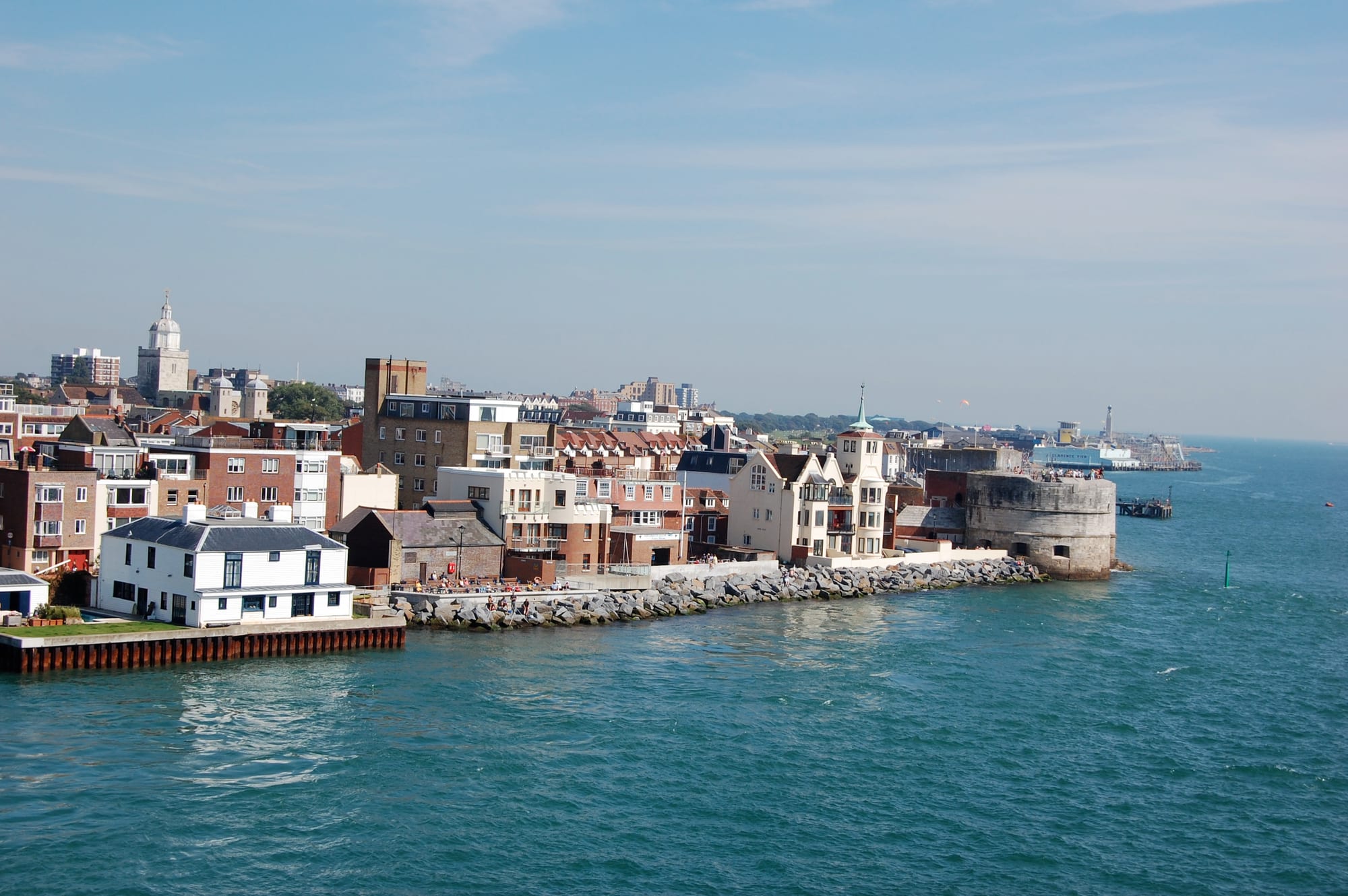
The waterfront of Old Portsmouth seen from the sea, with the stone Round Tower and the houses of Portsmouth Point

London & the South East, United Kingdom

Portsmouth

Old Portsmouth and the Round Tower at the entrance to Portsmouth Harbour. (John Jennings / Wikimedia Commons · CC BY-SA 2.0)

A port city in Hampshire, built almost entirely on Portsea Island facing the Solent and the Isle of Wight. For centuries the home of the Royal Navy, it grew around a dockyard and a ring of forts; today the historic warships, the Spinnaker Tower and the Southsea seafront draw visitors to a dense, working city.

Neighbourhoods

  • Old Portsmouth
    • Historic district
    • Harbour views
    • Quiet and residential

    The original town in the south-west corner of Portsea Island, where the merchant Jean de Gisors founded Portsmouth around 1180. Narrow streets lead past the Anglican cathedral to the Round Tower, the old sea walls, the Camber's fishing boats and harbourside pubs facing Gosport.

    Open in Maps
  • Gunwharf Quays and The Hard
    • First-time visitors
    • Close to public transport
    • Shopping

    The former naval shore establishment HMS Vernon, reopened in 2001 as an outlet shopping centre with restaurants, bars and a cinema under the Spinnaker Tower. Next to it, The Hard has Portsmouth Harbour station, the bus station, the Gosport and Isle of Wight ferries and the gate of the Historic Dockyard.

    Open in Maps
  • Southsea
    • Seaside
    • Best for food
    • Nightlife

    Portsmouth's seaside resort, named after Southsea Castle, with a long shingle seafront, two piers and the open grass of Southsea Common. Inland, Palmerston Road has shops and restaurants, and Albert Road is the main strip of pubs, bars, music venues and Indian restaurants, busy with students.

    Open in Maps
  • City centre and the Guildhall
    • Close to public transport
    • Theatre and music
    • Shopping

    The civic heart around Guildhall Square, home to the Guildhall and the Central Library. Commercial Road is the main shopping street, and Guildhall Walk has the New Theatre Royal and a run of pubs and clubs.

    Open in Maps
  • Fratton and the north of the island
    • Local life
    • Football

    Dense Victorian terraces north of Southsea, home to Fratton Park, where Portsmouth FC play. Further north the city runs up through North End and Hilsea to the old Hilsea Lines fortifications on the island's edge, with Portsdown Hill rising beyond on the mainland.

    Open in Maps

Things to do

The Historic Dockyard

  • Portsmouth Historic Dockyardattraction

    The heritage area inside the working naval base, with historic warships, the National Museum of the Royal Navy and the old dry docks, including one first built in 1698 and still in use.

    Open in Maps
  • HMS Victoryattraction

    Nelson's flagship, floated out in 1765 and in dry dock at Portsmouth since 1922, the world's oldest naval ship still in commission.

    Open in Maps
  • Mary Rose Museummuseum

    The surviving hull of Henry VIII's warship, which sank off Southsea in 1545 and was raised from the Solent in 1982, shown with thousands of objects recovered from the wreck.

    Open in Maps
  • HMS Warriorattraction

    A steam-powered armoured frigate built in 1859–1861, one of the first two armour-plated, iron-hulled warships in the world.

    Open in Maps

Landmarks and the old town

  • Spinnaker Towerviewpoint

    The sail-shaped tower above Gunwharf Quays, one of the tallest accessible structures in the United Kingdom outside London, with viewing decks over the harbour, the Solent and the city.

    Open in Maps
  • Portsmouth Cathedrallandmark

    The Anglican cathedral of St Thomas of Canterbury in Old Portsmouth, which grew from a chapel founded around the time of the town's beginnings.

    Open in Maps
  • Round Towerlandmark

    The fortification at the mouth of the harbour, first built in wood in the 1420s, from which the sea walls of Old Portsmouth run along the shore.

    Open in Maps
  • Charles Dickens' Birthplace Museummuseum

    The red-brick house on Mile End Terrace where the novelist was born, a four-storey Grade I listed building now run as a museum.

    Open in Maps

Southsea seafront

  • Southsea Castlelandmark

    Henry VIII's coastal fort, from which he saw the Mary Rose sink in 1545, now with a small museum.

    Open in Maps
  • The D-Day Storymuseum

    The museum of Operation Overlord, opened in 1984 and reopened under its present name in 2018, home to the 83-metre Overlord Embroidery.

    Open in Maps
  • Southsea Commonpark

    The broad open grassland behind the seafront, used for festivals, fairs and events through the year.

    Open in Maps
  • Clarence Pierattraction

    An amusement park on the Southsea seafront.

    Open in Maps
  • South Parade Pierattraction

    The second of Southsea's piers, at the eastern end of the promenade.

    Open in Maps

Short trips from the city

  • Royal Navy Submarine Museummuseum

    Across the harbour in Gosport, a museum of submarine history beside the former home of the Royal Navy Submarine Service, reached by the short Gosport ferry crossing.

    Open in Maps
  • Portchester Castlelandmark

    A medieval castle built inside the walls of a Roman Saxon Shore fort at the head of Portsmouth Harbour.

    Open in Maps
  • Fort Nelsonmuseum

    One of the Victorian forts on Portsdown Hill above the city, home to the Royal Armouries' collection of artillery.

    Open in Maps
  • Ryde, Isle of Wightattraction

    The Isle of Wight town reached from Southsea by the world's only regular hovercraft service, or by fast ferry from The Hard.

    Open in Maps

Seasonal events

  • D-Day commemorationsearly June

    Yearly remembrance of the D-Day landings, for which Portsmouth Harbour was a main embarkation point, attended by veterans from Allied and Commonwealth nations.

  • Victorious Festivallate August

    A three-day music festival on Southsea Common and the seafront, founded in 2012.

  • Great South RunOctober

    A ten-mile road race through the city and along the seafront, held in Portsmouth since 1991 and one of Europe's most popular races at the distance.

  • Victorian Christmas marketNovember

    A yearly Christmas market held among the warships and buildings of the Historic Dockyard.

Eat and drink

Long-standing places and food districts in Portsmouth. Hours, ratings and directions come from your maps app, always current.

Portsmouth classics

  • Camber Quay fish marketmarket

    The quayside where Portsmouth's small fishing fleet lands its catch, most of it sold at the fish market beside the boats.

    Open in Maps
  • Fish and chips on The Hardneighborhood

    Fish and chip shops facing the harbour by the Historic Dockyard gate and the ferry terminals.

    Open in Maps
  • Old Portsmouth's harbourside pubsneighborhood

    Pubs around Bath Square and the Point, with tables looking straight across the harbour mouth to Gosport and the passing ferries and warships.

    Open in Maps

Food districts

  • Albert Roadneighborhood

    Southsea's main drag of student pubs, wine bars, café-bars and Indian restaurants, with a restaurant every few doors.

    Open in Maps
  • Palmerston Roadneighborhood

    Southsea's main shopping street, with a more expensive run of restaurants and bars near the seafront.

    Open in Maps
  • Gunwharf Quaysneighborhood

    Chain restaurants, bars and waterfront terraces in the converted naval yard beneath the Spinnaker Tower.

    Open in Maps

Experience Portsmouth

History

Portsmouth was founded around 1180 by the Anglo-Norman merchant Jean de Gisors in the south-west corner of Portsea Island, the area now called Old Portsmouth, and received its royal charter in 1194. Its sheltered harbour made it a naval base. Henry VII had a dry dock built here in 1496, the first ever constructed, and a wooden Round Tower guarding the harbour mouth was completed in 1426. Henry VIII built Southsea Castle against a French invasion, and from there he watched his flagship, the Mary Rose, sink in the Battle of the Solent in 1545 with the loss of about 500 lives.

The dockyard grew with the navy. The Great Stone Dock, first built in 1698, is still in use, and the Block Mills, which made pulley blocks for warships, are counted as the world's first mass production line. By the early 19th century Portsmouth was the most heavily fortified city in the world, and after an invasion scare in 1859 a ring of land and sea forts, the Palmerston Forts, was built, among them the forts along Portsdown Hill. The town absorbed Buckland, Fratton and Stamshaw as it spread across the island, and by 1871 its population had passed 100,000. Charles Dickens and Isambard Kingdom Brunel were both born here.

In the Second World War the Luftwaffe bombed the city heavily in the Portsmouth Blitz, killing 930 people, burning out the Guildhall and destroying areas of Landport and Old Portsmouth. In June 1944 the harbour was a main embarkation point for the D-Day landings. After the war the city rebuilt and looked for new work. The naval shore establishment HMS Vernon became the Gunwharf Quays shopping complex in 2001, and the Spinnaker Tower rose beside it.

Culture & Customs

Portsmouth's identity is bound up with the Royal Navy. The nickname Pompey, shared by the naval base, the city and Portsmouth Football Club, is thought to come from the abbreviation for Portsmouth Point in ships' logs. The city has hosted international commemorations for the 50th, 75th and 80th anniversaries of D-Day, and remembrance of the landings each June draws veterans from Allied and Commonwealth nations.

The arts scene is larger than many expect. The Guildhall is one of the biggest venues in South East England, with about 2,500 seats and a concert series by the Bournemouth Symphony Orchestra; the Kings Theatre in Southsea, designed by the Victorian architect Frank Matcham, hosts a variety of performances, the New Theatre Royal specialises in professional drama, and the Wedgewood Rooms host live music. The Victorious Festival on Southsea Seafront drew more than 150,000 people over three days in 2026. In November 2025 the council bid for Portsmouth to become UK City of Culture 2029.

Writers have used the city often. Dickens sent Nicholas Nickleby and Smike to Portsmouth to join a theatrical troupe, H. G. Wells turned Southsea into Port Burdock in The History of Mr Polly, and Jonathan Meades's novel Pompey is set here; the council even renamed a Southsea street The Ocean at the End of the Lane after Neil Gaiman's novel. Football is followed closely, and Portsmouth FC's home is Fratton Park.

Daily Life

About 208,000 people lived in the city at the 2021 census, which makes Portsmouth the most densely populated city in the United Kingdom; it forms part of the wider South Hampshire urban area with Gosport, Fareham, Havant and Southampton. On Portsea Island itself, Victorian terraced houses dominate districts such as Southsea, Fratton and North End, with newer estates and suburbs on the mainland at Cosham, Drayton, Farlington and Paulsgrove.

The naval base remains a major employer, alongside the commercial ferry and cruise port, retail, tourism and the University of Portsmouth, founded as a university in 1992 from the old polytechnic and enrolling about 23,000 students. A small fishing fleet of 20 to 30 boats still works from Camber Quay in Old Portsmouth. Gunwharf Quays and the Historic Dockyard bring visitors through the year, and student life shapes the pubs and venues of Southsea.

Daily rhythms follow the water: ferries leaving for international ports and the Isle of Wight, warships moving in and out of the harbour, and the promenade busy with walkers, runners and cyclists in good weather. Local government has been a live issue: in March 2026 the government announced that the city council would be abolished in 2028 as part of a reorganisation across Hampshire, but the proposals were withdrawn in September 2026.

Food

Fish and chips, battered and fried fish served with chips, is the classic meal of the English seaside, and Portsmouth has its share of chip shops along The Hard and the Southsea seafront. Fish shops became common across the country from the 1860s, and the dish is often considered the national dish of the United Kingdom. Fresh fish has a local source too: most of the catch from the boats at Camber Quay is sold at the quayside market in Old Portsmouth.

Albert Road in Southsea is the city's busiest eating street, lined with Indian restaurants, pubs, wine bars and café-bars known for cheap curries and student pubs. Palmerston Road, closer to the seafront, has a more expensive set of restaurants and bars, while Gunwharf Quays gathers chain restaurants and waterfront terraces beneath the Spinnaker Tower.

Pubs are central to eating and drinking here, as across the country. The old harbourside pubs of Old Portsmouth, around Bath Square and the Point, look across the narrow harbour mouth to Gosport, and several Southsea pubs serve cask ales. Further along the harbour, the marina at Port Solent has its own cluster of restaurants beside a cinema.

Planning tools

Budget

Portsmouth is noticeably cheaper than London or Brighton for rooms and meals. The main costs are the Historic Dockyard's ticketed ships and museums, the Spinnaker Tower and any Isle of Wight crossing; the seafront, Southsea Common, the old town walls and many of the city's smaller museums cost nothing.

Daily Budget Midrange
USD 200–380 (mid-range hotel, restaurant dinners, dockyard and tower tickets, a ferry or hovercraft trip)
Daily Budget Shoestring
USD 80–130 (hostel or budget guesthouse, pub meals and fish and chips, walking and local buses)

The seafront, the Round Tower and the sea walls, Southsea Common and the cathedral can all be seen without a ticket; the dockyard ships are the main paid sight.

Best Time to Visit

May to September, when the seafront, the ferries and the outdoor events are at their best; early June brings the D-Day commemorations and late August the Victorious Festival, when rooms fill. Winters are mild and grey, quieter, and the dockyard's indoor ships and museums still make a good visit.

Suggested Number of Days

One full day covers the dockyard, and a second suits the old town and Southsea. Adding Gosport, the Portsdown Hill forts, Portchester or a crossing to the Isle of Wight makes three or four days.

First Visit
1–2 days
With Surroundings
3–4 days

Transportation

Portsea Island is flat and compact, and most visitors walk or use the local buses between The Hard, the city centre and Southsea. The railway has stations at Portsmouth Harbour, Portsmouth and Southsea, Fratton and Hilsea. A passenger ferry crosses the harbour to Gosport, and car ferries, fast ferries and the hovercraft link the city with the Isle of Wight.

Get off the train at Portsmouth Harbour for the dockyard, Gunwharf Quays and the ferries, and at Portsmouth and Southsea for the city centre and the Guildhall.

Airport & Station Connections

Trains from London Waterloo take about an hour and a half to Portsmouth, and there are direct services to Southampton, Brighton, Bristol and Cardiff. The nearest airport is Southampton Airport, beside the M27 motorway. Portsmouth International Port handles ferries and cruise ships to international destinations.

Walkability

Good. The island is flat, and the Historic Dockyard, Gunwharf Quays and Old Portsmouth sit side by side; from the Round Tower a seafront promenade runs past Southsea Common and Southsea Castle towards the eastern end of the island. Fratton Park and the northern districts are better reached by bus or train.

Safety

The UK is generally safe, with the main risks being pickpocketing and phone theft in crowded parts of London and other cities, occasional late-night antisocial behaviour, and drink-related trouble around nightlife. In Portsmouth the busiest night-time streets are Guildhall Walk and Albert Road, where pavements are narrow and crowds can be rowdy late at weekends.

Keep phones and bags secure in crowded nightlife streets, take care on the shingle and sea walls in rough weather, and check tide and weather before any coastal walk. Check current official travel advice before travelling.

Climate

Mild and maritime, with the sea keeping frosts light and short-lived; snow is quite rare, and temperatures seldom fall below freezing. Summers are warm rather than hot, though the temperature sometimes reaches 30°C.

Summer
warm — July averages a high of about 22°C and a low of about 15°C
Winter
mild and damp — January averages a high of about 10°C and a low of about 5°C

Local Customs

Portsmouth is a navy town: the base, the dockyard and the yearly D-Day remembrance are part of everyday life, and the nickname Pompey belongs to the city, the naval base and the football club alike. Queuing is expected, pub rounds are bought in turn, and football loyalties run deep.

The Historic Dockyard lies inside an active naval base, so follow signs about where visitors may go; dress respectfully during services in the cathedrals and at remembrance events.

Common Payment Methods

The currency is the pound sterling. Most pubs in the UK now take contactless cards, though a few are still cash only, and cash machines are very widely available.