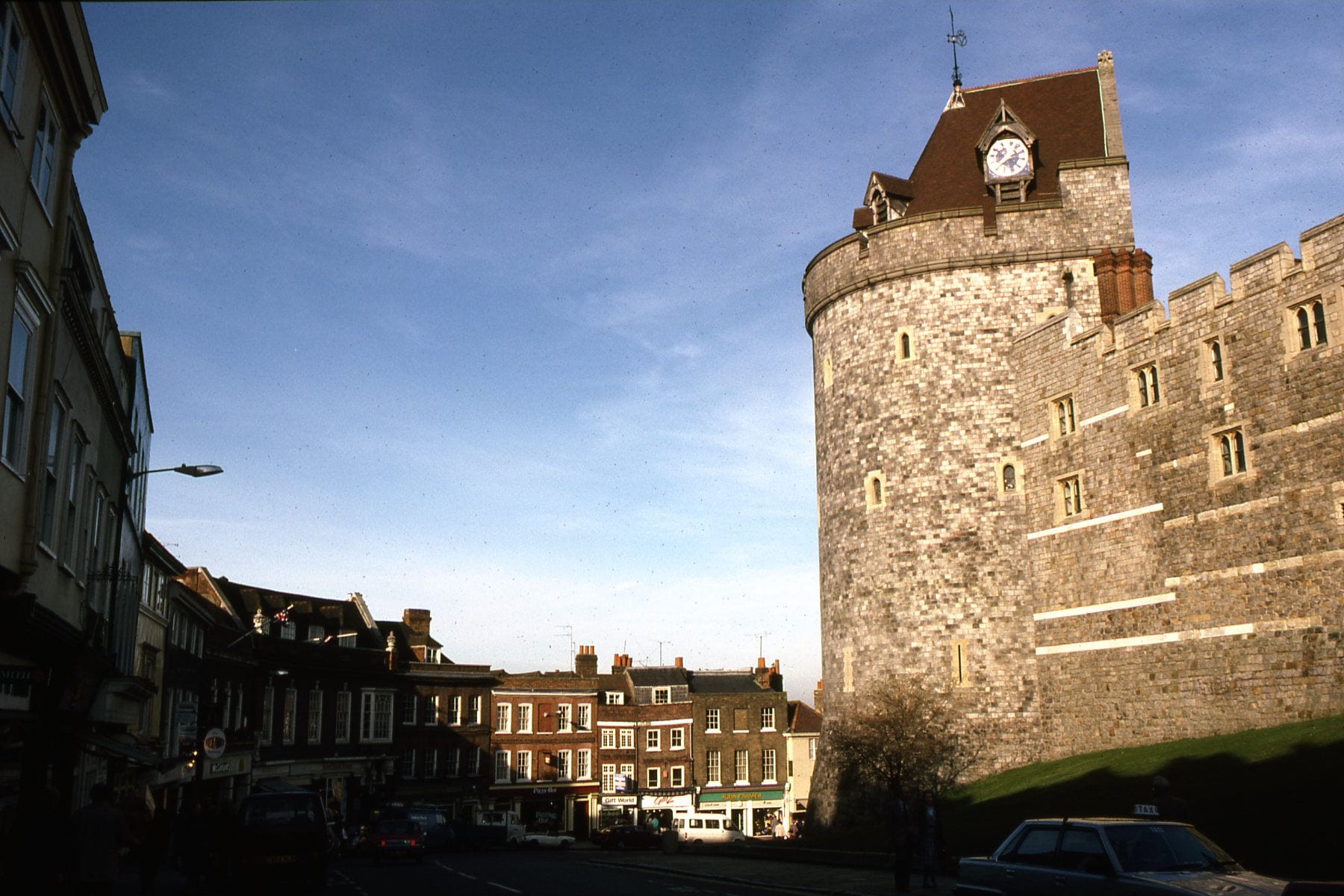
A round stone castle tower with a clock and pointed roof beside battlemented walls, above a street of brick shops

London & the South East, United Kingdom

Windsor

Thames Street in Windsor, below the Curfew Tower and walls of Windsor Castle. (Colin Park / Wikimedia Commons · CC BY-SA 2.0)

A historic town on the south bank of the Thames in Berkshire, about 22 miles west of central London, facing Eton across the river. It grew up below the castle that William the Conqueror founded around 1070, now one of the official residences of the British monarch, and today lives largely from the visitors drawn by the castle, the Great Park and Legoland.

Neighbourhoods

  • The town centre
    • First-time visitors
    • Historic district
    • Shopping

    The streets that wrap around the castle walls: Thames Street, the High Street with its 17th-century town hall, and pedestrianised Peascod Street, the ancient main street, now the shopping street leading up to the castle. Gift shops cluster near the castle, and Windsor Royal Station has shops and restaurants of its own.

    Open in Maps
  • The riverside
    • Riverside walks
    • Families

    The Thames Promenade and Alexandra Gardens below the castle, where river boats leave for trips up and down the Thames and a temporary ice rink appears in winter. Pedestrianised Windsor Bridge crosses to Eton.

    Open in Maps
  • Eton
    • Historic district
    • Quiet

    The smaller historic town across the river, dominated by Eton College, the school founded by Henry VI in 1440. Inns were set up along its High Street once the new college chapel made the village a place of pilgrimage.

    Open in Maps

Things to do

The castle

  • Windsor Castlelandmark

    One of the official residences of the British monarch, begun as a timber motte-and-bailey around 1070 and rebuilt and extended by Edward III and later monarchs.

    Open in Maps
  • St George's Chapellandmark

    The Perpendicular Gothic chapel inside the castle walls, largely redeveloped between 1475 and 1528, the chapel of the Order of the Garter and burial place of Henry VIII, Jane Seymour and Charles I.

    Open in Maps

The town and Eton

  • Windsor Guildhalllandmark

    The town hall on the High Street, about 100 metres from Castle Hill, built in 1680–91 on the site of an earlier market house and commonly called the Guildhall.

    Open in Maps
  • Theatre Royal Windsorattraction

    A medium-sized Victorian theatre on Thames Street staging touring productions, often with well-known British actors.

    Open in Maps
  • Eton Collegelandmark

    The school founded by Henry VI in 1440 across the river, which has educated many of England's politicians, judges and diplomats.

    Open in Maps

Parks and the river

  • Windsor Great Parkpark

    A royal park of about 5,000 acres south of the town, once the castle's hunting ground, reached by the Long Walk avenue from the castle; most of it is open to the public free of charge from dawn to dusk.

    Open in Maps
  • Runnymedepark

    The National Trust water-meadow beside the Thames between Old Windsor and Egham, associated with King John's sealing of Magna Carta in 1215, with memorials on the adjoining hillside.

    Open in Maps

Days out

  • Legoland Windsor Resortattraction

    The only Legoland park in the UK, built on the site of the former Windsor Safari Park on the edge of the town.

    Open in Maps
  • Royal Windsor Racecourseattraction

    A racecourse on an island between the Thames and the Clewer Mill Stream, first raced in 1866, with evening meetings among its fixtures.

    Open in Maps

Seasonal events

  • Royal Windsor Horse ShowMay or June

    A five-day horse show held in Home Park since 1943, the only show in the UK hosting international dressage, show jumping, carriage driving and endurance riding.

Eat and drink

Long-standing places and food districts in Windsor. Hours, ratings and directions come from your maps app, always current.

Food streets

  • Thames Street and the High Streetneighborhood

    Pubs, cafés and restaurants around the castle walls, including a listed building with views across the Thames.

    Open in Maps
  • Eton High Streetneighborhood

    The historic High Street of Eton across the bridge, where inns were set up once the college chapel made the village a place of pilgrimage.

    Open in Maps
  • Windsor Royal Stationneighborhood

    Shops and restaurants inside Windsor & Eton Central railway station.

    Open in Maps

Experience Windsor

History

The first Windsor was Windlesora, mentioned in the Anglo-Saxon Chronicle, a riverside settlement about 3 miles downstream, possibly founded in the late 7th century; today it is the village of Old Windsor. By 1070, recognising the strategic importance of the site, William the Conqueror had a timber motte-and-bailey castle built there. By 1110 meetings of the Great Council had moved to the castle, called New Windsor, and during the 12th century the settlement transferred to a planned new town below it, with a parish church, marketplace and burgage plots, while the castle was gradually rebuilt in stone. Windsor received its first charter confirming its royal borough status in 1277.

Edward III's rebuilding of the castle between 1350 and 1368 was the largest secular building project in medieval England, and it brought wealth to the town even as the Black Death struck elsewhere. St George's Chapel was radically redeveloped between 1475 and 1528, and Henry VI founded Eton College across the river in 1440. In the Civil War the castle became a base for the New Model Army, and Charles I was buried in St George's Chapel without ceremony after his execution in 1649. The present town hall was built in 1680–91, but the town was poor, and its population fell below about 1,500.

Royal visits resumed in 1778, and part of the castle's royal apartments was refurbished for George III in 1804. The substantial redevelopment of the castle that followed, Queen Victoria's residence from 1840 and the arrival of two railways in 1849 — built by rival companies that each wanted to carry the Queen — brought the most dramatic changes in the town's history.

Culture & Customs

Windsor's identity is bound to the monarchy. The castle is one of the monarch's official residences, and St George's Chapel, inside its walls, is the chapel of the Order of the Garter and a royal peculiar, under the direct jurisdiction of the monarch. The chapel holds the tombs of Henry VIII, Jane Seymour and Charles I, and its former Lady Chapel was completed and renamed the Albert Memorial Chapel.

Across the river, Eton is dominated by Eton College, the school that educates many of England's establishment, especially future politicians, judges and diplomats. The Royal Windsor Horse Show, held each year since 1943 in Home Park below the castle, is the only show in the UK hosting international competition in dressage, show jumping, carriage driving and endurance riding, and draws more than 50,000 visitors; it has long been attended by royalty. Racing takes place at the riverside Royal Windsor Racecourse, and the Theatre Royal, a Victorian theatre, stages touring productions.

The town has had many notable residents. Geoffrey Chaucer held the post of Clerk of the Works at the castle in 1391, though there is no record that he visited, and Sir Sydney Camm, designer of the Hawker Hurricane fighter, lived in the town; a replica Hurricane on the Thames Promenade near Alexandra Gardens remembers him.

Daily Life

Windsor is part of the Royal Borough of Windsor and Maidenhead in Berkshire, about 22 miles west of central London, 6 miles south-east of Maidenhead and 16 miles east of Reading. The Thames forms its boundary with Eton to the north, and Old Windsor lies just over 2 miles to the south.

Mainly because of the castle, Windsor is a popular tourist destination, and tourism shapes the town centre, from the gift shops around the castle to the shops and restaurants inside Windsor Royal Station. Legoland Windsor Resort, built on the site of the former Windsor Safari Park, is the only Legoland park in the United Kingdom and, by area, the largest in the world. The town lies under the flight path of Heathrow Airport.

Day-to-day life centres on Peascod Street, the ancient main street, now pedestrianised and lined with shops leading up to the castle. Residents use the two stations for trains to London, and frequent buses run to Heathrow, central London and Legoland. In winter Alexandra Gardens by the river hosts a temporary ice rink, and Windsor Great Park, most of which is open to the public free of charge from dawn to dusk, serves as the town's countryside.

Food

Windsor's food is mostly that of an English market town busy with visitors: pubs, cafés and restaurants around the castle walls and along the river, including a listed building with views across the Thames, alongside Chinese, Moroccan, Indian and Portuguese peri-peri restaurants. Windsor Royal Station, inside Windsor & Eton Central station, holds more shops and restaurants.

Two English dishes carry the names of the two towns. Eton mess is a traditional dessert of strawberries or other berries, meringue and whipped cream; first mentioned in print in 1893, it is commonly believed to come from Eton College and is served at the school's annual cricket match against Harrow School, where it is occasionally served as Harrow mess. Windsor soup, or Brown Windsor soup, is a British soup associated with the Victorian and Edwardian eras; elegant recipes for it appeared among famous 19th-century chefs, but the "Brown Windsor" name, which did not emerge until at least the 1920s, came to mean a cheap brown soup of uncertain ingredients and later became a joke about bad English food.

Planning tools

Budget

Windsor is expensive in summer and at weekends, when day-trippers fill the town and the castle and Legoland are the main costs. The Great Park, the Long Walk and the riverside cost nothing. Staying in London or visiting midweek keeps the bill down.

Daily Budget Midrange
USD 230–450 (mid-range hotel, restaurant meals, castle or Legoland tickets, a river trip)
Daily Budget Shoestring
USD 90–145 (budget guesthouse or a base in London, pub meals and cafés, walking in the Great Park)

Check before visiting that the castle is open, since it is a working royal residence.

Best Time to Visit

Late spring to early autumn for the Great Park, river trips and Legoland, with the Royal Windsor Horse Show in May or June. Summer weekends are the busiest. Winter is quieter, with an ice rink in Alexandra Gardens.

Suggested Number of Days

Windsor is usually visited as a day trip from London. Two or three days allow time for the Great Park, Eton, the river and Legoland as well as the castle.

First Visit
1 day
With Surroundings
2–3 days

Transportation

The town centre and Eton are small enough to walk. Buses link Windsor with Heathrow Airport, central London and Legoland, river boats run up and down the Thames, and a hop-on, hop-off bus serves the castle, the Long Walk and Eton College. A car or bus is needed for the far parts of the Great Park.

Peascod Street and Windsor Bridge are pedestrianised; use the town's car parks or arrive by train.

Airport & Station Connections

Windsor is about 22 miles west of central London and has two stations. Windsor and Eton Riverside has direct South Western Railway trains from London Waterloo; Windsor and Eton Central is the end of a Great Western Railway shuttle from Slough, which connects with trains from London Paddington and Reading. Heathrow Airport is about 8 miles away by the M4, with buses taking around 40 minutes.

Walkability

Very walkable. The castle, the shopping streets, both stations, the riverside and Eton across the bridge are all within a few minutes of each other. The Long Walk leads south from the castle into the Great Park.

Safety

The UK is generally safe, with the main risks being pickpocketing and phone theft in crowded parts of London and other cities, occasional late-night antisocial behaviour, and drink-related trouble around nightlife. Windsor is a busy tourist town, and crowds are heaviest around the castle on summer weekends.

Watch bags in the crowds near the castle, and take care by the river. Check current official travel advice before travelling.

Climate

A temperate climate like that of nearby London, where severe weather and extremes of temperature are uncommon and the average July high is 23.5°C.

Summer
mild to warm — in nearby London the average July high is 23.5°C, with about 31 days a year above 25°C
Winter
cool and damp; in nearby London heavy snow is rare, though snow usually falls at least once each winter, and the lowest temperature recorded in London is −17.4°C, at Northolt in 1981

Local Customs

Windsor Castle is a working royal residence and St George's Chapel a place of worship, so parts may close at short notice and quiet is expected in the chapel. Eton College is a working school.

Check the rules before photographing inside the castle and chapel. Identification may be asked for when buying alcohol (the legal age is 18).

Common Payment Methods

The currency is the pound sterling. Shops and cash machines widely accept foreign credit and debit cards, and some merchants no longer accept cash. Scottish and Northern Irish banks issue their own notes, while Bank of England notes are accepted throughout the UK.