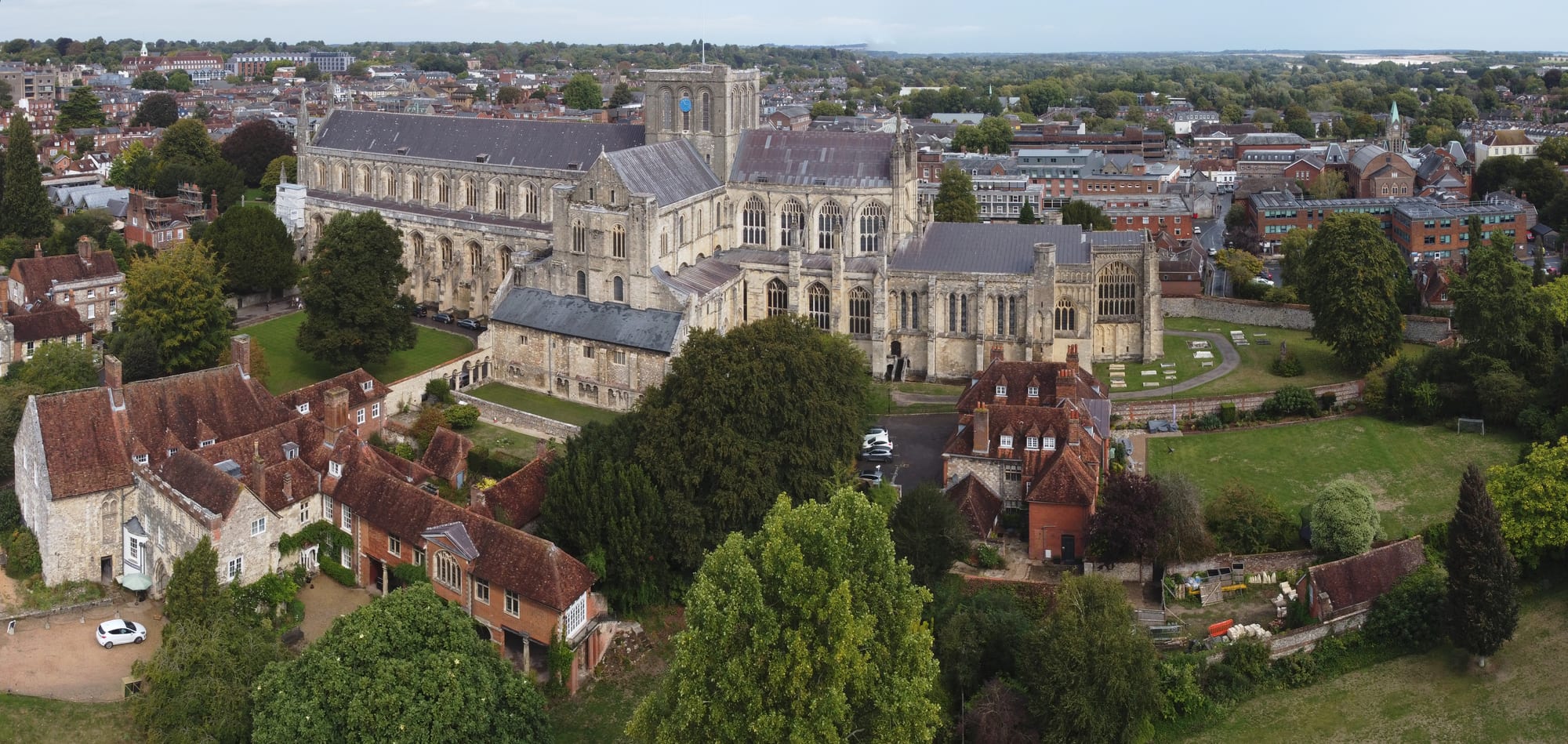
View of Winchester Cathedral's long grey nave and square tower among trees, lawns and brick houses of the Close

London & the South East, United Kingdom

Winchester

Winchester Cathedral and the Close, with the city spreading beyond. (Tim Sheerman-Chase / Wikimedia Commons · CC BY 4.0)

Hampshire's county town, on the River Itchen at the western end of the South Downs. A Roman tribal capital that became one of the chief cities of Alfred the Great's Wessex, it keeps a medieval core around a long Norman and Gothic cathedral, a castle hall with King Arthur's Round Table and water meadows running out into the countryside.

Neighbourhoods

  • High Street and the city centre
    • First-time visitors
    • Shopping
    • Close to public transport

    The medieval spine of the city, running from the Westgate down past the 15th-century Buttercross and the arcaded Pentice to the Broadway and King Alfred's statue. Most shops, cafés and pubs are here, a short walk downhill from the railway station.

    Open in Maps
  • The Cathedral Close
    • Historic district
    • Quiet and residential

    The precinct around the cathedral south of the High Street, where historic buildings survive from the days when the cathedral was also a priory. Lanes lead on to Wolvesey Castle and the College.

    Open in Maps
  • Kingsgate and St Cross
    • Historic district
    • Walking
    • Quiet and residential

    South of the Close, the surviving Kingsgate leads to the streets around Winchester College and out across the water meadows of the Itchen to the Hospital of St Cross, with St Catherine's Hill rising to the east.

    Open in Maps
  • Chesil and the riverside
    • Riverside walks
    • Best for food

    The east end of the city where the High Street crosses the River Itchen by the City Mill. Chesil Street, on the far bank, has old houses and restaurants, and riverside paths run north and south from the bridge.

    Open in Maps

Things to do

Famous landmarks

  • Winchester Cathedrallandmark

    The Norman cathedral begun in 1079, with architecture from the 11th to the 16th centuries, the longest medieval cathedral in the world at 170 metres; Jane Austen is buried here, among Anglo-Saxon kings and bishops.

    Open in Maps
  • The Great Hall and the Round Tablelandmark

    The surviving hall of Winchester Castle, rebuilt between 1222 and 1235, where the Round Table hangs: made in the 13th century and repainted for Henry VIII with the names of King Arthur's knights.

    Open in Maps
  • Wolvesey Castlelandmark

    The ruins of the Norman bishops' palace, begun in 1110 on the site of an earlier Saxon building, beside a stretch of the old city wall.

    Open in Maps
  • Hospital of St Crosslandmark

    Almshouses and a large Norman chapel founded by Henry de Blois in the 1130s, just outside the city across the water meadows.

    Open in Maps
  • Winchester Collegelandmark

    The school founded by William of Wykeham in 1382, which has operated on its present site ever since.

    Open in Maps
  • Statue of Alfred the Greatlandmark

    Hamo Thornycroft's statue of the West Saxon king, completed in 1901, facing the city from the Broadway.

    Open in Maps

City history

  • Westgatemuseum

    One of the two surviving medieval city gates, now a small museum.

    Open in Maps
  • Buttercrosslandmark

    A 15th-century city cross with twelve statues on the High Street, restored by George Gilbert Scott in 1865.

    Open in Maps
  • Winchester City Millattraction

    A working water mill on the River Itchen at the foot of the High Street, one of several mills the river drove in the city.

    Open in Maps

Walks and viewpoints

  • Itchen water meadowstrail

    Riverside paths running south from the city centre through the water meadows towards St Cross and Twyford.

    Open in Maps
  • St Catherine's Hillviewpoint

    A chalk downland hill topped by an Iron Age hillfort on the outskirts of the city, above the water meadows of the Itchen.

    Open in Maps

Short trips from the city

  • Jane Austen's Housemuseum

    The 17th-century house in the village of Chawton, near Alton, where Jane Austen lived and wrote, now a small independent museum.

    Open in Maps
  • Watercress Lineattraction

    A preserved railway running 10 miles from New Alresford to Alton, named after the watercress it once carried to market.

    Open in Maps

Seasonal events

  • Winchester Hat Fairfirst weekend in July

    The UK's longest-running festival of street theatre, comedy and music, which began as a buskers' fair in 1974.

  • Winchester Cathedral Christmas Marketmid-November to just before Christmas

    A Christmas market in the cathedral grounds, held every year.

  • Winchester farmers' marketthrough the year

    One of the larger farmers' markets in the UK, with about 100 stalls.

Eat and drink

Long-standing places and food districts in Winchester. Hours, ratings and directions come from your maps app, always current.

Winchester classics

  • Winchester farmers' marketmarket

    One of the larger farmers' markets in the UK, with about 100 stalls.

    Open in Maps
  • The Chesil Rectoryrestaurant

    A restaurant in a Grade II listed timber building of 1450 just over the river, given to the city by Mary Tudor; it held a Michelin star in the early 2000s.

    Open in Maps

Food districts

  • High Street and the Broadwayneighborhood

    Cafés, pubs and restaurants along the pedestrian High Street and around the Buttercross and the cathedral grounds.

    Open in Maps
  • New Alresfordneighborhood

    The small town near Winchester considered the country's watercress capital, at the western end of the Watercress Line.

    Open in Maps

Experience Winchester

History

Winchester grew from an Iron Age settlement whose Celtic name, Venta, probably meant "tribal town" or "meeting place". After the Roman conquest it became Venta Belgarum, the capital of the Belgae, and by the late second century it had outgrown its rivals Silchester and Chichester. To the Anglo-Saxons it was Wintanceaster. King Cenwalh of Wessex built the church later known as the Old Minster in 648, and in the late ninth century Alfred the Great swept away the Roman street plan and laid out a new grid as a defence against the Vikings. Alfred's widow founded the Nunnaminster, the New Minster rose beside the Old, and historians count Winchester among the chief cities of the West Saxon kingdom.

The Normans began the present cathedral in 1079, built a castle whose Great Hall was rebuilt between 1222 and 1235, and gave the bishops Wolvesey Castle in 1110. Bishop Henry de Blois founded the Hospital of St Cross in the 1130s, and William of Wykeham, bishop in the 14th century, remodelled the cathedral's Norman nave and founded Winchester College in 1382. The Buttercross on the High Street dates from the 15th century.

As London grew, Winchester settled into life as a county and cathedral town. Of its six gates only the Kingsgate and the Westgate survive. Jane Austen died here in 1817 and was buried in the cathedral, and John Keats spent the late summer and autumn of 1819 in the city, writing several of his poems.

Culture & Customs

Winchester's culture centres on its cathedral, whose choir regularly performs at concerts. Many visitors come for Jane Austen's grave, and since the 1980s the crypt has held a life-sized statue of a man by Antony Gormley. Alfred the Great's statue on the Broadway, completed in 1901, honours the king who laid out the city's street grid.

The Hat Fair, first held in 1974 as a buskers' fair, is the UK's longest-running festival of street theatre, comedy and music, filling the streets on the first weekend of July. The Winchester Cathedral Christmas Market runs from mid-November to just before Christmas, and the city hosts one of the country's larger farmers' markets.

Education shapes the city's identity. Winchester College, on the same site since 1382, even has its own form of football, Winchester College football. The University of Winchester began as a diocesan teacher-training college in 1840, and the Winchester School of Art, founded in the 1860s, is now part of the University of Southampton. The city lends its name to Winchester, Virginia, whose apple blossom festival keeps a standing invitation for Winchester's mayor.

Daily Life

At the 2021 census about 48,000 people lived in the built-up area of Winchester, and about 127,000 in the wider City of Winchester district, which takes in towns such as Alresford and Bishop's Waltham; the district grew by more than 9 per cent between 2011 and 2021. As the county town, Winchester holds the head offices of Hampshire County Council, and the city also has the Royal Hampshire County Hospital and the University of Winchester.

The city's history and its fast rail links to London and other cities have made it one of the most expensive and sought-after places to live in the country, a point local estate agents were already making in 2013. Many residents commute, and the centre is busy with shoppers, students and visitors by day and quieter in the evening than larger towns. Suburbs such as Harestock, Olivers Battery, Badger Farm and Kings Barton spread around the old core.

Local politics has its own character: in the 2024 general election the Liberal Democrat Danny Chambers won the seat by a wide margin over the Conservatives. In 2025, with local government across Hampshire being reorganised, the Winchester Town Forum asked for a review of how the unparished city and its edges are governed.

Food

Hampshire's best-known crop is watercress; the county is one of the main areas where it is grown, and New Alresford, near Winchester, is considered the nation's watercress capital, and the preserved Watercress Line takes its name from the plant, once a common cargo on the railway. The plant is now grown in several English counties, most notably Hampshire, Dorset, Wiltshire and Hertfordshire.

Winchester hosts one of the country's larger farmers' markets, with about 100 stalls, a good place to find local produce. The cathedral's Christmas market adds seasonal food and drink stalls from mid-November.

Eating out is concentrated on the High Street and the streets around the cathedral, with cafés, pubs and restaurants in old buildings. Across the river, the Chesil Rectory occupies a Grade II listed building of 1450 that Mary Tudor gave to the city, and it held a Michelin star in the early 2000s. As elsewhere in England, the pub remains the everyday place for a meal and a pint.

Planning tools

Budget

Winchester is one of the more expensive places to live in the country, and rooms in the city centre are limited and priced to match, especially during the Hat Fair and the Christmas market. Eating out costs about the same as elsewhere in the South East, and the cathedral grounds, the High Street, the water meadows and St Catherine's Hill cost nothing.

Daily Budget Midrange
USD 210–400 (mid-range hotel, restaurant dinners, cathedral and museum tickets, a day trip by train or bus)
Daily Budget Shoestring
USD 90–140 (budget guesthouse or room outside the centre, pub meals and market food, walking)

Most sights lie within a short walk of each other, so no transport costs are needed inside the city; staying in Southampton is a cheaper option.

Best Time to Visit

Late spring to early autumn, when the water meadows and the hill walks are at their best; the first weekend of July brings the Hat Fair. From mid-November the cathedral's Christmas market draws big crowds. Winter is grey and quiet but suits the cathedral and the museums.

Suggested Number of Days

The compact centre suits a day or a single night. Two days give an easier pace with time for the riverside walks, and three allow for the villages and heritage railway of east Hampshire as well.

First Visit
1–2 days
With Surroundings
3 days

Transportation

The centre is small enough to walk, and the station is a short walk uphill from the High Street. Buses link the city with its suburbs and the surrounding villages, and the Cathedral Connection bus route runs through the countryside to Salisbury. A car is useful only for the villages; parking in the centre is limited.

Ordnance Survey maps cover the walks around the city; the water meadows can be wet underfoot after rain.

Airport & Station Connections

Winchester station is on the South West Main Line, with South Western Railway trains to London Waterloo, Southampton, Portsmouth and Weymouth. Southampton Airport is close by, near the junction of the M3 and M27 motorways. London Heathrow is about 60 miles away by road, and direct National Express coaches from Heathrow take about an hour.

Walkability

Excellent. The High Street is largely pedestrian, and the cathedral, the Great Hall, the Westgate, the College, Wolvesey and the City Mill are all within a short walk of each other. The station is uphill from the centre, and the water meadow path to St Cross is a flat, easy walk.

Safety

The UK is generally safe, with the main risks being pickpocketing and phone theft in crowded parts of London and other cities, occasional late-night antisocial behaviour, and drink-related trouble around nightlife. Winchester is a small, quiet cathedral city, and the main things to watch are crowds at the Christmas market and busy roads round the edge of the centre.

Keep bags and phones close in the Christmas market crowds and wear sturdy shoes for wet riverside and hill paths. Check current official travel advice before travelling.

Climate

Temperate and maritime, mild and changeable, with rain spread through the year. In Portsmouth, on the coast to the south, frosts are light and snow is quite rare.

Summer
mild to warm — in nearby Portsmouth, July highs average about 22°C
Winter
cool and damp — in nearby Portsmouth, January highs average about 10°C and lows about 5°C

Local Customs

Winchester is a cathedral and school city, and the Close, the College and the cathedral are working places rather than museums: services take place regularly and visitors are expected to keep quiet during them. Queuing is expected, and pub rounds are bought in turn.

Keep quiet and avoid photography during services, and dress respectfully in church; Winchester College is a working school.

Common Payment Methods

The currency is the pound sterling. Most pubs in the UK now take contactless cards, though a few are still cash only, and cash machines are very widely available.