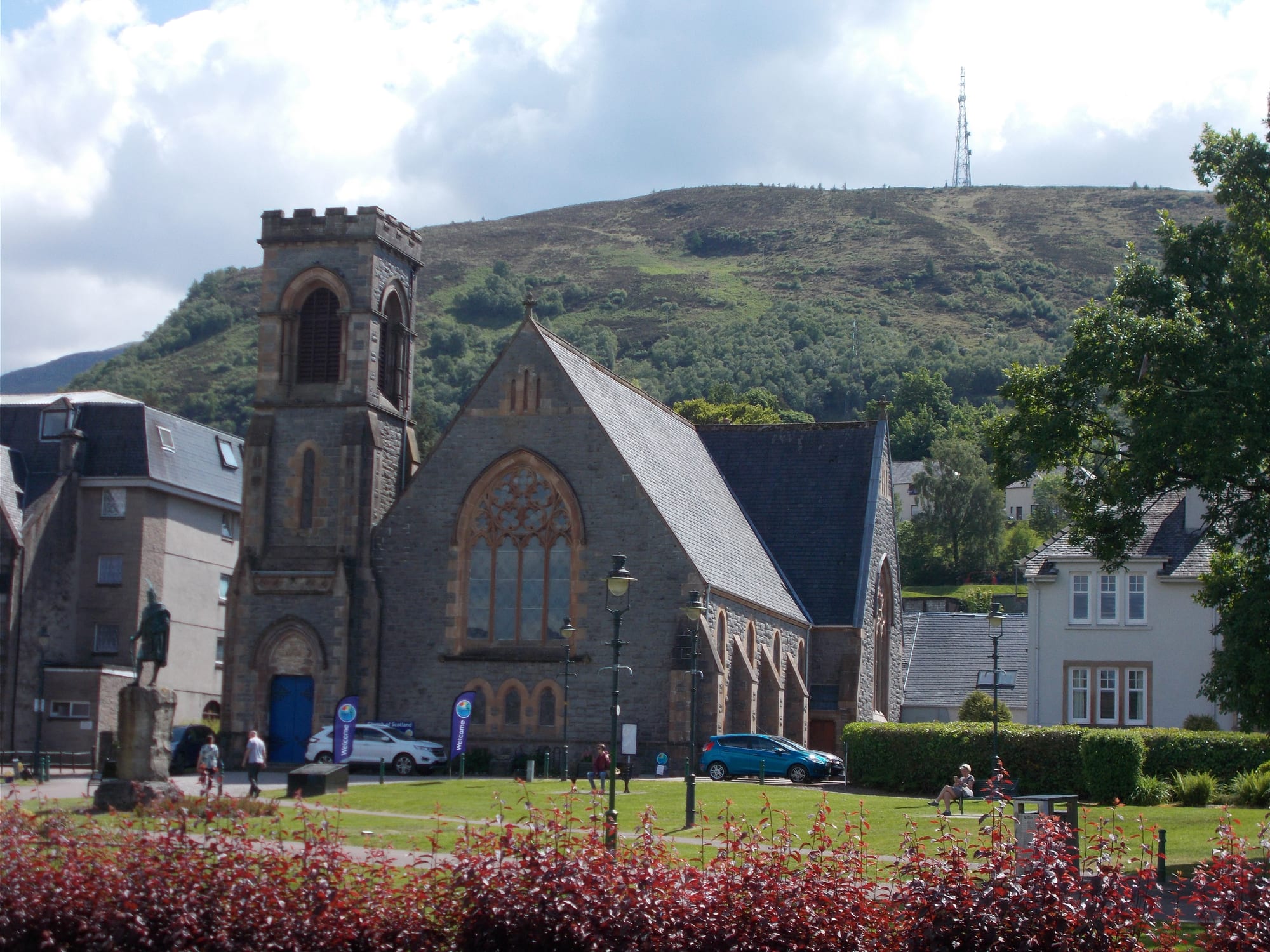
Buildings of Fort William below the slopes of Cow Hill

The Highlands & Islands, United Kingdom

Fort William

Cow Hill rising above Fort William. (Peter S / Wikimedia Commons · CC BY-SA 2.0)

A town on the eastern shore of Loch Linnhe at the southern end of the Great Glen, below Ben Nevis. It grew around a government fort built to control the clans, later lived on hydroelectric power and an aluminium smelter, and is now the Highlands' second-largest settlement and a centre for hillwalking, climbing, mountain biking and the West Highland Line.

Neighbourhoods

  • The High Street and town centre
    • First-time visitors
    • Close to public transport
    • Shops

    The pedestrianised High Street, with small squares opening off it, runs parallel to Loch Linnhe and holds most of the shops, pubs and cheap places to eat. The railway station, bus stands and main supermarket are at its northern end, though the busy A82 cuts the centre off from the shore.

    Open in Maps
  • Inverlochy, Caol, Banavie and Corpach
    • Canal and lochside
    • Quiet and residential

    A second built-up area a couple of miles north, on flatter ground by the mouths of the Lochy and the shore of Loch Eil. The ruined Inverlochy Castle, the whisky distillery at Lochy Bridge, Neptune's Staircase at Banavie and the start of the Caledonian Canal at Corpach are all here, with small railway halts on the line to Mallaig.

    Open in Maps
  • Upper Achintore and the Plantation
    • Quiet and residential
    • Views

    The town's main residential streets, hidden from the High Street and the main road, climb steeply up the hillside above the centre, with views over Loch Linnhe.

    Open in Maps
  • Glen Nevis
    • Walkers
    • Campers
    • Nature

    The glen running up from the edge of town between Ben Nevis and the Mamore ridge, with a visitor centre, a large caravan and camping park and a youth hostel about two miles out, and paths to the Nevis Gorge and Steall Falls at its head.

    Open in Maps

Things to do

In and around the town

  • West Highland Museummuseum

    A museum in a listed building in the town centre that tells the story of the West Highlands and Islands, with collections on the Jacobites, archaeology and wildlife.

    Open in Maps
  • The old fortlandmark

    All that is left of the fort that gave the town its name is a stretch of sea wall near the breakwater, with views over Loch Linnhe.

    Open in Maps
  • Inverlochy Castlelandmark

    A ruined 13th-century castle with round corner towers, the site of two battles, largely unchanged since it was built and now in the care of Historic Environment Scotland.

    Open in Maps
  • Neptune's Staircaseattraction

    Eight locks climbing the Caledonian Canal at Banavie, built by Thomas Telford between 1803 and 1822 — the longest staircase lock in Britain.

    Open in Maps
  • Ben Nevis Distilleryattraction

    A single malt whisky distillery founded in 1825, by Lochy Bridge on the north side of town, which offers tours.

    Open in Maps

Mountains and glens

  • Ben Nevistrail

    The highest mountain in the British Isles at 1,345 metres, climbed from near sea level by the Mountain Track from Glen Nevis — a hard walk in good weather and a technical mountaineering route in winter.

    Open in Maps
  • Glen Nevis and Steall Fallstrail

    A path through the Nevis Gorge at the head of the glen leads to An Steall Bàn, 'the white spout', Scotland's second-highest waterfall with a drop of 120 metres.

    Open in Maps
  • Nevis Range on Aonach Mòrattraction

    The 1,221-metre mountain just north of Ben Nevis, where a gondola runs all year to a mid-station with hill walks and mountain bike courses, and ski runs open in winter.

    Open in Maps

Short trips from the town

  • The Jacobiteattraction

    A steam-hauled tourist train that has run each summer since 1984 on the West Highland Line between Fort William and Mallaig, stopping at Glenfinnan.

    Open in Maps
  • Glenfinnan Viaductlandmark

    The curving railway viaduct built in 1897–1901 at the top of Loch Shiel, about 13 miles west of the town, known from the Harry Potter films.

    Open in Maps
  • Glenfinnan Monumentlandmark

    A tower erected in 1814 at the head of Loch Shiel in honour of the Highlanders who fought in the Jacobite Army during the rising of 1745.

    Open in Maps
  • Glen Coetrail

    A glen of glacial origin cut through volcanic rock to the south, regarded as the home of Scottish mountaineering and scene of the massacre of 1692.

    Open in Maps

Seasonal events

  • Scottish Six Days Trialonce a year

    The oldest motorcycle trials event in the world, held since 1909 with riders covering road and off-road routes around Lochaber each day.

  • UCI Mountain Bike World Cupoften early June

    Fort William has hosted a round of the downhill World Cup on the track beside the Nevis Range gondola most years since 2002.

  • Lochaber LiveSeptember

    A music festival held on the town's shinty grounds.

Eat and drink

Long-standing places and food districts in Fort William. Hours, ratings and directions come from your maps app, always current.

Fort William classics

  • Crannog at Garrison Westrestaurant

    A restaurant on Cameron Square, beside the museum and cinema, known for seafood and classic pub dishes.

    Open in Maps
  • High Street eating placesneighborhood

    A string of cheap and cheerful cafés, takeaways and restaurants along the pedestrianised High Street.

    Open in Maps

Cafés and bars

  • Grog & Gruelrestaurant

    A High Street pub known for its selection of real ales.

    Open in Maps
  • Volunteer Armsrestaurant

    A lively High Street bar with live sport and a dance floor.

    Open in Maps

Experience Fort William

History

Before the town existed, Inverlochy was the main settlement in this corner of Lochaber, the country of Clan Chattan and later Clan Cameron, and two battles were fought there, in 1431 and 1645. The first fort on the present site was a wooden Cromwellian stronghold of 1654, the Garrison of Inverlochy, built to "pacify" Clan Cameron after the Wars of the Three Kingdoms. After the revolution of 1688 William of Orange ordered a new fort to control the clans, and it was named Fort William after him; the settlement beside it was called Maryburgh after his wife, then Gordonsburgh and Duncansburgh, before taking the fort's name, this time after Prince William, Duke of Cumberland. The Gaelic name, An Gearasdan, may come from the English word garrison.

During the Jacobite rising of 1745 the fort was besieged from 20 March to 3 April 1746. The Jacobites had taken the other two forts in the chain along the Great Glen, Fort Augustus and the original Fort George, but failed to take Fort William. Thomas Telford's Caledonian Canal, finished in 1822, linked the west coast at Corpach with Inverness, and the railway arrived in 1894, bringing a tourist boom.

In 1934 the Laggan Dam was completed as part of the Lochaber hydroelectric scheme, which powered an aluminium smelter outside the town; Liberty Steel Group bought the smelter in 2016. In the Second World War the town was home to HMS St Christopher, a Royal Navy training base for coastal forces. The railway station was moved north in 1975, and a council plan for a new waterfront was abandoned in 2010.

Culture & Customs

Mountains define the town's identity. It sits at the northern end of the West Highland Way, the 95-mile route from Milngavie near Glasgow, and at the start of the Great Glen Way to Inverness, and it is a major centre for hillwalking and climbing. The Fort William Mountain Festival celebrates mountain culture each year, and West Highland College, part of the University of the Highlands and Islands, runs a School of Adventure Studies.

Sport is a big part of life. The downhill mountain bike track beside the Nevis Range gondola has hosted a round of the UCI Mountain Bike World Cup most years since 2002, and the town hosted the world championships in 2007. The Scottish Six Days Trial, the world's oldest motorcycle trials event, has been based entirely in the town since 1977. Fort William Shinty Club and Kilmallie Shinty Club keep the Highland game strong, and the town also has a football club playing at Claggan Park, a rugby club, a yacht club founded in 1954 and an eighteen-hole golf course.

About 730 people can speak Scottish Gaelic. The West Highland Museum keeps Jacobite and Highland history at the heart of the town, and the High Street's shops sell tartan, knitwear and whisky to visitors from around the world.

Daily Life

Fort William had about 15,800 people at the 2011 census, making it the second-largest settlement in the Highlands after Inverness. It is the commercial and transport centre of Lochaber, with Lochaber High School serving a wide area of surrounding villages and the Belford Hospital as the main hospital for the district.

The area is a tourism centre, drawing walkers heading for Ben Nevis and drivers visiting the Glenfinnan Viaduct, and summer traffic on the roads has become a problem. Just outside the town stands the large aluminium plant powered by the Lochaber hydroelectric scheme; Sanjeev Gupta's Liberty Steel Group bought it in 2016, and in 2021, during his group's financial troubles, questions surfaced over the ownership of the estate linked to it.

Most people live away from the High Street, in Upper Achintore and the Plantation on the hillside, or in Inverlochy, Claggan, Caol, Banavie and Corpach to the north. Exploratory work on a replacement for the Belford Hospital began in 2023, with the new hospital planned for Blar Mhor near Caol. Daily life follows the seasons: summer brings crowds, the steam train and event weekends, and winter brings skiers when the snow is good.

Food

Fort William eats much as the rest of the Highlands does, with seafood from the west coast, hearty pub meals and plenty of cheap and cheerful cafés for walkers. A restaurant on Cameron Square is known for its seafood.

Scottish classics appear on many menus. Haggis, the national dish, is a savoury pudding of sheep's heart, liver and lungs minced with onion, oatmeal, suet and seasoning, traditionally served with "neeps and tatties", boiled and mashed separately. Cullen skink is a thick soup of smoked haddock, potatoes and onions served widely across Scotland, and cranachan, a dessert of cream, raspberries, oats and whisky, began as a harvest celebration.

Whisky has a home here: Ben Nevis Distillery, by Lochy Bridge on the north side of town, makes a single malt and offers tours, and a brewery at Spean Bridge, about 11 miles north, also offers tours. The High Street pubs serve real ales, and the shops sell bottles of malt to visitors.

Planning tools

Budget

Fort William is a working town as well as a tourist centre, with supermarkets, chain places and cheap cafés alongside the restaurants, so eating can be inexpensive. Rooms are the main cost and fill up in summer and on big event weekends. A campsite and a youth hostel in Glen Nevis keep costs down; the steam train, the gondola and a hire car add the most.

Daily Budget Midrange
USD 200–370 (bed and breakfast, pub and seafood dinners, a gondola ride or the steam train, a hire car)
Daily Budget Shoestring
USD 80–130 (hostel bed or campsite, supermarket food and High Street cafés, buses and trains)

Book rooms early for summer and for the mountain bike and motorcycle trial weekends.

Best Time to Visit

Late spring and early summer bring long days, and the mountain bike World Cup is often held in early June. July and August are warmest and busiest, with the steam train running daily. Autumn is quieter. In winter the ski runs on Aonach Mòr open when the snow allows, but Ben Nevis becomes a serious mountaineering venture.

Suggested Number of Days

Two or three days cover the town and its surroundings at a gentle pace. Allow four to six for hill days and trips further along the coast and glens. Bad weather often closes in on the mountains, so spare days help anyone hoping to climb.

First Visit
2–3 days
With Surroundings
4–6 days

Transportation

The town centre is small enough to cover on foot. Local buses run north to the Nevis Range and Spean Bridge, and up Glen Nevis, with more services in summer. Bikes can be hired on the High Street and are well suited to the glens and the canal towpath. Taxi firms offer tours and airport transfers, and a car is the easiest way to reach sights further out.

The A82 is busy in summer; use the railway or buses where possible, as travellers arriving by train are offered discounts at some local venues.

Airport & Station Connections

Trains on the West Highland Line take about four hours from Glasgow Queen Street and continue to Glenfinnan and Mallaig; the Caledonian Sleeper runs overnight from London Euston most nights. Citylink coaches take about three hours from Glasgow, about two hours from Inverness along the Great Glen and about ninety minutes from Oban. Glasgow Airport, roughly two and a half hours' drive away, has the widest choice of flights.

Walkability

The centre is compact and the High Street is pedestrianised, though the A82 separates the town from the lochside. The suburbs of Inverlochy, Caol and Corpach are a couple of miles north, and Glen Nevis is about two miles from the centre — walkable, but the bus or a bike saves time.

Safety

The UK is generally safe, with the main risks being pickpocketing and phone theft in crowded parts of London and other cities, occasional late-night antisocial behaviour, and drink-related trouble around nightlife. In Fort William the real dangers are on the mountains: Ben Nevis is a long climb from almost sea level, and poor visibility, fast-changing weather and winter snow and ice make it hazardous for the unprepared.

Take a map, compass, food and warm waterproof layers on Ben Nevis, check the mountain forecast, and turn back if the weather worsens. Check current official travel advice before travelling.

Climate

An oceanic climate with moderate, generally cool temperatures and abundant rain, about 2,050 mm a year in the town. Conditions change quickly with height, and the summit of Ben Nevis has a tundra climate, with snow on the mountain for about seven months of the year.

Summer
cool to mild — across Scotland summer days typically average about 18°C and evenings about 11°C, with long days and frequent rain
Winter
mild and wet in the town — across Scotland winter days typically average about 7°C and evenings about 2°C; on the summit of Ben Nevis the winter average is around −5°C

Local Customs

Fort William is proud of its outdoor culture: climbers, walkers finishing the West Highland Way and mountain bikers are part of town life. Shinty is followed closely, with two clubs in the town. About 730 people in the area speak Scottish Gaelic, and the town's Gaelic name is An Gearasdan.

Drinking alcohol on the street is not allowed. Leave gates as found on hill farms and keep dogs on a lead near livestock.

Common Payment Methods

The currency is the pound sterling. Cards and contactless payment are widely accepted. Scottish banks issue their own sterling banknotes, which can be hard to change outside the UK, so leftover cash is best swapped for Bank of England notes before leaving.